March 1921
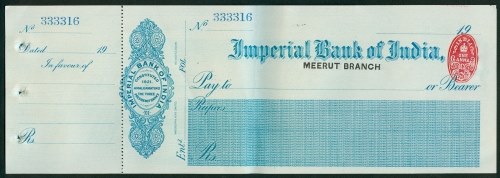
In accordance with a law approved on September 19, 1920, the Imperial Bank of India began operations on January 27 of this year.
This bank represents a consolidation of the presidency banks of Bengal, Bombay, and Madras, which have been doing business in India since the beginning of the nineteenth century.
These banks have acted as fiscal agents of the Government, their business has been rather strictly circumscribed geographically, and they were required to carry large cash reserves and were prohibited from engaging in foreign exchange transactions. To a large extent, the presidency banks have acted as bankers for the exchange banks. Besides the presidency banks, which had about branches, there are in India 45 branches of exchange banks with head offices outside of India, whose business is mainly to finance
foreign trade and to deal in foreign exchange.
In addition, there are about 60 or 70 joint-stock banks with over 150 branches, doing a local business, and subject to a rather high rate of business mortality. All told, therefore, there are about 250 banks and branches in India, situated in about 150 towns, or in about 20 percent of the towns having a population of 10,000 or more.
The initiative in the move toward amalgamation was taken by the presidency banks themselves, which presented to the Government of India a memorandum advocating the establishment of the Imperial Bank. Their main arguments were:
1. That extension of banking facilities in India was greatly needed, as it was ” useless to educate people into a willingness to follow civilized habits as regards keeping their money if there are not at hand banking facilities for them to do so.’
They propose to open, after consolidation, and within five years after its establishment, no less than 100 new branches of the Imperial Bank. (The law as passed includes provision for the establishment of these branches.)
2. It is true that the presidency banks, to a considerable extent, have acted as bankers for local banks, but this consolidation will materially increase their ability to assist the other banks through the rediscount of domestic bills of exchange, known generally as “hundis.”
3. An amalgamation of the three presidency banks, together with the establishment of many new branches, would facilitate the handling of the public debt. So long as Government securities were held by a small number of large investors, transactions in connection with the debt could be conducted satisfactorily by a few large banks, but with the enormous war expansion of the debt and its widespread ownership among the masses of the population who have purchased bonds of the Indian war loans, it has become necessary to afford facilities for cashing coupons, pa}dng off maturing obligations, etc., in a large number of small communities.
4. The amalgamation of the three banks would make it possible to abolish Government reserve treasuries by transferring their business to the Imperial Bank. (The law does abolish the reserve treasuries.)
The new bank has a branch in London, which however, may open accounts for or receive deposits only from persons who are or have been customers of the Imperial Bank or of one of the presidency banks in India. The bank’s sales or purchases of bills payable outside of India are restricted to bills of such banks as the governor-general in council may approve. These provisions are intended to prevent interference of the Imperial Bank with the business of established banks in London.
The Imperial Bank is owned by the shareholders of the three amalgamated presidency banks. Although the bank is to act as fiscal agent of the Government and to carry all the Government balances, the Government will not participate in the bank’s profits for the first three years, largely for the reason that the establishment of new branches, which the bank is obliged to undertake, will involve for the immediate future considerable unprofitable business. Moreover, the bank is to be compensated for its work as fiscal agent in connection with the handling of Government securities and coupons. At the end of three years, the proposed plan is to determine on the basis of actual experience whether and to what extent the Government is entitled to participate in the bank’s profits.
The Government is to be represented on the central board of governors of the Imperial Bank by the controller of the currency or some other officer selected in his place by the governor-general, and by not to exceed six other persons nominated by the governor-general. These members of the board will have the privilege of attending meetings and of participating in deliberations, but not of voting.
Read more below