Government Order dated August 4, 2026: Howrah District Judge, DM Accused of Bypassing Consultation
Did Howrah District Judge Subhash Kumar Kar Violate Section 24 CrPC in Prosecutor Appointment? Is Merit Being Ignored in West Bengal District Prosecutor Appointments?
Howrah, August 16, 2026 – The unprecedented issuance of a Government Order on August 4, 2026, by the Governor of West Bengal, appointing a panel of 40 District Prosecutors for Howrah has triggered widespread consternation across the legal fraternity, marking what many are calling a black day in the history of the Howrah Court.
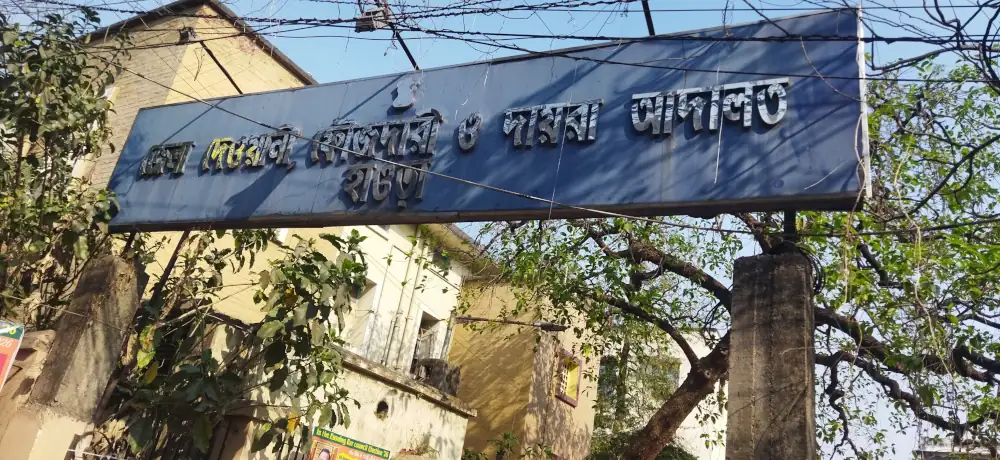
The Howrah District Court, a repository of legal heritage tracing its roots to the ancient Bhurishrestha (Bhurshut) Kingdom, has historically been a beacon of judicial rationality. Its culture, shaped by Bengali scholars, historians, and linguists, fostered a legal environment where merit dictated progression. Historical records, including Chakrabarti’s Judicial Administration in Bengal (1774–1947), note that Howrah’s river systems facilitated early economic activity long before the rise of Satgaon or Kolkata, establishing a foundational need for robust dispute resolution. This legacy, meticulously documented in “Howrah and Howrah Judiciary: Ancient Times to 2024,” has seen the Howrah Bar Association enriched by advocates from diverse political backgrounds since Independence, with the posts of Public Prosecutor and Additional Public Prosecutor traditionally reserved for seasoned criminal practitioners.
However, the current process stands in stark contrast to this tradition. The statutory framework, governed by Section 24 of the Code of Criminal Procedure (now transitioning to the Bharatiya Nagarik Suraksha Samhita), mandates that the District Magistrate shall, in consultation with the Sessions Judge, prepare a panel of fit persons. This requires the District Judge to provide a judicial estimate of the counsel’s quality, professional conduct, and capacity, while the District Magistrate evaluates suitability from an administrative standpoint. Legal precedents, including the landmark Supreme Court judgment in Kumari Shrilekha Vidyarthi v. State of U. P. (1991 AIR 537), establish that even subjective powers are subject to judicial review under Article 14, prohibiting arbitrary or unreasonable exercise of power.
In the instant case, sources confirm that the outgoing Public Prosecutor, Mr. Somnath Banerjee—an experienced and undisputed leader whose tenure saw rigorous prosecution—was not consulted. Furthermore, the District and Sessions Judge, Sri Subhash Kumar Kar, allegedly failed to assess the credibility of the proposed panel or consult the two senior-most judges of the district before forwarding his recommendation to the District Magistrate. Simultaneously, the District Magistrate, Dr. (Ms.) P. Deepap Priya, IAS, is reported to have proceeded without consulting the police establishment or verifying the backgrounds of the empaneled advocates.
The composition of the panel has raised serious questions regarding the statutory requirement of “seven years of practice.” Critics point to the inclusion of Devendra Kumar Ojha (a Notary Public), whose name appears in the Notary List, and Om Prakash Singh, described as a full-time political cadre with questionable academic credentials. Some others listed on the panel are unable to speak or read Bengali. Alok Kr. Mondal vs State of West Bengal (1998) 3 CALLT 146 (HC) by the Calcutta High Court clarifies that “consultation” implies effective discussions and joint preparation by the panel, not merely vague comments or unilateral commands. In the present scenario, it appears the District Magistrate and Sessions Judge failed to convene any meaningful deliberation, nor did they seek input from the President and Secretary of the Howrah Bar Association. Most of the 40 names reportedly possess little to no experience in criminal practice, whether on the prosecution or defense side, and lack training under established criminal chambers in the Howrah jurisdiction or the High Court.
This development contradicts the observations in Harpal Singh Chauhan v. State of U.P. (1993 AIR 2436), where the Supreme Court held that the District Magistrate must prepare a panel based on true consultation, not merely issue commands on the Sessions Judge’s recommendations. The public perception is that the exercise was a politically motivated attempt to pressurize the Governor into issuing the order, sidelining merit to favor party affiliation. This has sparked fears of corruption and compromised justice, particularly in sensitive cases like NDPS and POCSO, which carry huge public ramifications. Ex-Public Prosecutor Aurobinda Nashkar lamented that in his time, authorities meticulously checked practice records, public conduct, and moral standing before appointments, emphasizing that the opposition to bail before the Sessions Judge must be based on public interest, not political diktat.
The concern is realistic in NDPS and POCSO litigation, where prosecutors routinely confront complicated evidentiary questions, statutory presumptions, forensic material, procedural safeguards, victim-related considerations, and applications for bail. A prosecutor opposing bail before a Sessions Court must do so based on law, evidence, and legitimate public interest, not political instruction. The same principle applies to the conduct of a session trial, examination of witnesses, presentation of documentary evidence, and decisions concerning criminal appeals and revisions.
Bharatiya Nagarik Suraksha Sanhita, 2023 (BNSS), which came into force on 1 July 2024, is the statutory framework governing Public Prosecutors is contained principally in Section 18. Section 18(3) provides that, for every district, the State Government shall appoint a Public Prosecutor and may appoint one or more Additional Public Prosecutors. Section 18(4) provides that the District Magistrate shall, in consultation with the Sessions Judge, prepare a panel of names of persons considered fit for appointment. Section 18(7) prescribes not less than seven years’ practice as an advocate as the minimum statutory eligibility requirement.
The distinction between eligibility and suitability is crucial. Seven years of practice is a statutory minimum; it does not necessarily establish that an advocate is the most suitable person to conduct serious criminal prosecutions. The relevant question is whether the authorities responsible for preparation of the panel actually examined the advocate’s criminal-practice record, quality of advocacy, professional conduct, experience in conducting State cases and standing before the criminal courts.
Again, in the above-stated Harpal Singh Chauhan v. State of U.P., AIR 1993 SC 2436, the Supreme Court considered the appointment and renewal of District Government Counsel under Section 24 of the Code of Criminal Procedure and held that the preparation of a prosecution panel required meaningful involvement of the District Magistrate and the Sessions Judge. The Court further recognised that the suitability assessment of the District Magistrate is not immune from judicial review.
Howrah, being an industrial city with a history of District Judges elevated to the High Court, holds a prestige that is now perceived to be under threat. Despite the gravity of the situation, the District BJP President has remained silent, issuing no comment on the controversy. As the state moves toward the new criminal codes, the legal community watches anxiously to see if the institutional integrity of the Howrah Judiciary can withstand what many fear is a descent into arbitrary governance.
Howrah’s legal history has survived changes of Government, political movements and generations of advocates. Its enduring value lies in the proposition that the court belongs neither to a political party nor to an individual office-holder, but to the administration of justice. If the present controversy is resolved according to that principle, the events of August 2026 may become another episode in the continuing history of Howrah’s judiciary. If the statutory safeguards are found to have been bypassed, however, the episode could become a significant test of whether the traditions of professional merit, judicial rationality and institutional independence associated with the Howrah Bar and Court have been adequately preserved.