Editorial: 1st June 2025
An Esoteric Analysis of Transactionalism, Opportunism, and Diplomatic Parasitism in the Trump-Musk Nexus
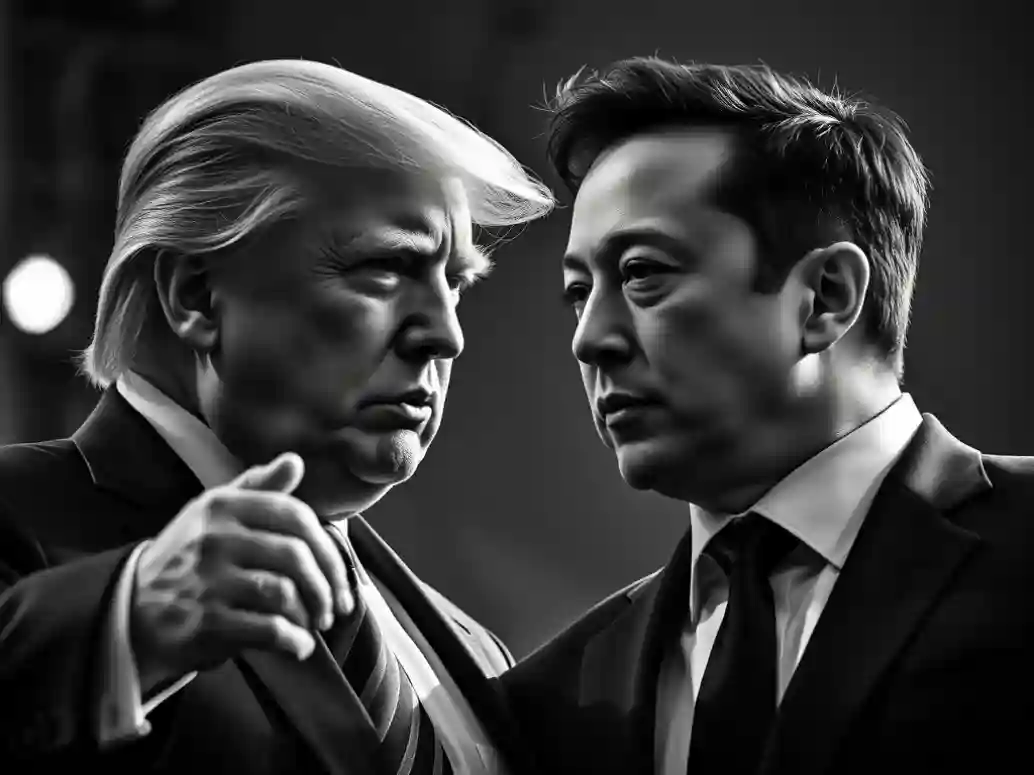
In the febrile theater of American politics, where spectacle often masquerades as substance, the ephemeral dalliance between Donald Trump and Elon Musk manifests as a study in hyper-transactionalism—an alliance forged not in ideological confluence but in mutual expediency. The symbiotic veneer of their affiliation, ostensibly harmonious, belies a more nefarious substratum: the archetypal Machiavellian stratagem of instrumentalizing the individual for ephemeral gain.
Musk, the technocratic impresario, entered the political amphitheater with sanguine expectations. His pecuniary largesse—an eye-watering $250 million and beyond—was not a mere indulgence in electoral philanthropy, but a calculated venture to procure regulatory reprieve and bureaucratic malleability. The formation of the Department of Government Efficiency (DOGE), with Musk as its ephemeral steward, was an emblem of this confluence. Yet the entity, despite its acronymic levity, became the site of bureaucratic ossification and political caprice.
Trump’s encomium for Musk—describing his tenure as “fantastic,” while posturing his facial contusion as a badge of battle—unfurled not genuine esteem but performative gratitude, a strategic simulacrum to mask disposability. Musk, initially lionized, was subsequently trivialized; his precipitous retreat from DOGE, his renunciation of future political endowments, and his circumspect demurral—”I think I’ve done enough”—form a narrative arc familiar in Trumpian orbits: elevation, utility, and then obsolescence.
This behavioral pattern is not anomalous but emblematic. Trump’s political modus operandi thrives on episodic alliances, ad hoc allegiances, and dispensable collaborators. The utility of an individual is coextensive with their electoral or financial efficacy; once that quotient diminishes, so too does their proximity to the locus of power. In Musk’s case, despite being lauded as a technocratic savant and fiscal messiah, the expiration date of relevance arrived with unceremonious haste.
To liken this to mere opportunism would be to understate its ideological vacuity. It is, rather, a cynical exploitation of aspirational idealists—those who, like Musk, envisage reformative intervention, only to find themselves ensnared in a vortex of performative politics and egoistic calculus. The Trumpian archetype does not seek partnership, but pawns; not dialogue, but deference.
Moreover, the insinuation that Trump’s rapport with Indian Prime Minister Narendra Modi functioned as a conduit for harnessing the Hindu vote further accentuates this proclivity for demographic instrumentalization. The “Howdy Modi” and “Namaste Trump” spectacles were not transnational camaraderie, but calculated theatre—an attempt to craft a cosmopolitan conservative alliance palatable to diasporic sensibilities. That over 85% of Hindu voters in swing states reportedly endorsed Trump is not merely serendipity—it is a testament to the efficacy of such curated optics. Despite such saga, at the time of Operation Sindoor Trump sided with Pakistan !
Indeed, Trump’s political algorithm is predicated upon utility: if you furnish him with votes, influence, or capital, your relevance is affirmed—temporarily. Yet once the electoral arithmetic changes, and once obsolescence encroaches, allegiance is dissolved with frigid detachment.
Musk’s descent from kingmaker to footnote exemplifies this frigid transactionalism. Despite his lavish contributions and ideological overlap in technocratic minimalism, he is now a relic of a concluded chapter. His retreat from political entanglements, and the implicit disillusionment therein, signals a sobering realization: in Trump’s calculus, every alliance is provisional, every loyalty contingent.
Thus, the saga does not merely indict Trump’s capriciousness; it illuminates a broader pathology—a political philosophy devoid of continuity, loyalty, or principle. It is a praxis of expedient abandonment masquerading as statesmanship. In such an ecosystem, the only immutable tenet is that permanence is an illusion and allegiance, a commodity.
Tanmoy Bhattacharyya
Read more
- Atomic Supremacy Renaissance and Algorithmic Ascendancy
- US Investment Accelerator: A New Era for Economic Growth
- America First Trade Policy 2025: Inevitable Trade War with China
- Historic Election: Meet Pope Leo XIV, America’s First Pontiff
- Critical Gaps in India’s 2025-26 Budget: What’s Missing?