The Encyclopedia of Dr. Syama Prasad Mookerjee
Symposium on Dr. Shyama Prasad Mukherjee’s Vision for the Indian Union Held at Howrah Bar Association (29 July 2026)
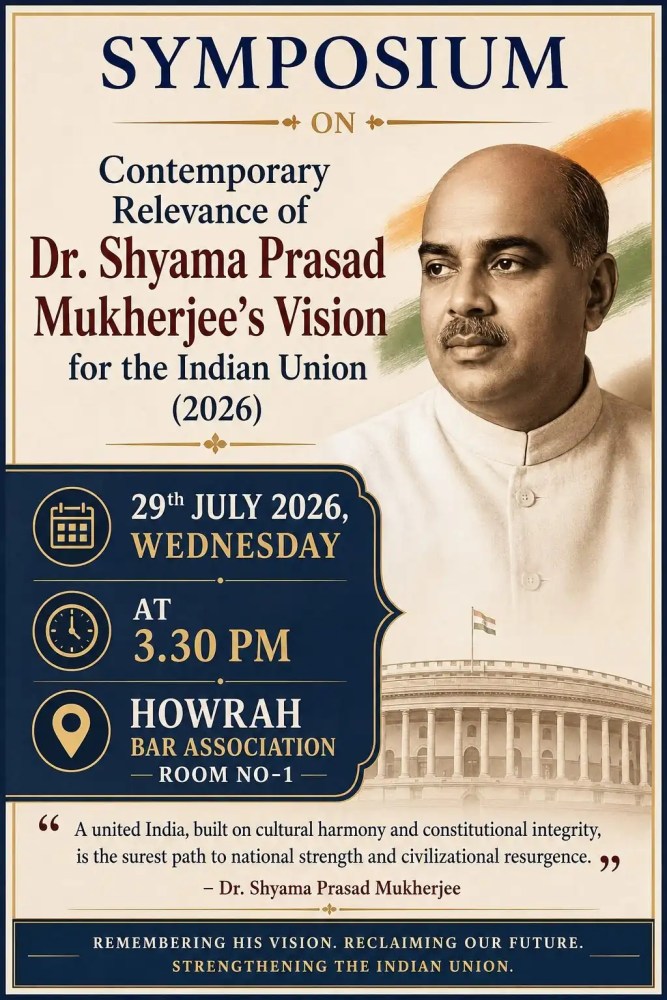
On 29 July 2026, the Symposium on the Contemporary Relevance of Dr. Shyama Prasad Mukherjee’s Vision for the Indian Union was organised in Room No. 1 of The Bar Association, Howrah District Court, Howrah, West Bengal, marking an important intellectual event within the district’s legal fraternity. Commencing at 3.45 p.m. and concluding at approximately 6.00 p.m., the programme assembled advocates, senior members of the Bar, scholars, and guests for a structured examination of the life, political thought, constitutional vision, and national legacy of Dr. Shyama Prasad Mukherjee (1901–1953). The symposium was moderated by Advocate Tanmoy Bhattacharyya, whose opening address welcomed the participants and explained the necessity of revisiting Dr. Mukherjee’s contribution in the context of contemporary India. Although the principal organisational responsibilities were undertaken by Amlan Roy, Kousik Basu, Bappaditya Das, and Saibal Chattopadhyay, the programme became possible through the generous cooperation and institutional support of the Executive Committee of The Bar Association, Howrah, which permitted the use of its conference room for what became the first symposium of its kind within the Howrah District Court campus devoted exclusively to Dr. Shyama Prasad Mukherjee.
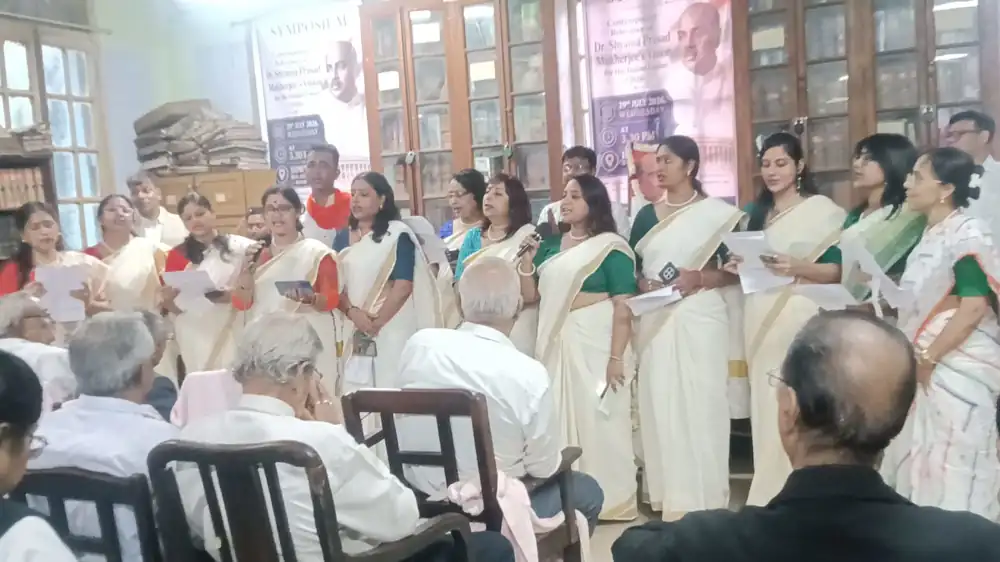
The proceedings began with the ceremonial garlanding of the portrait of Dr. Shyama Prasad Mukherjee by the President and Secretary of the Howrah Bar Association, thereby establishing a solemn atmosphere before the commencement of academic deliberations. The inaugural cultural presentation consisted of the national song “Vande Mataram,” performed by the Howrah Court Youth Choir, led jointly by Smt. Kajal Adak and Achena Roy. The choir was accompanied by Mou Sarkar, Karabi Roy, Paramita Lahiri, Prapti Chatterjee, Moumita Dutta, Manisha Barui, Sudeshna Saha, Ananya Sen, Somdev Maity, Koushik Maity, Rohit Dey, Mithu Bhattacharyya, Dipsikha Bandopadhaya and Tandra Ghatak. During the programme, the choir performed three patriotic songs, of which Vande Mataram remained the central musical expression of the symposium. An additional symbolic feature of the inauguration was the initiative taken by Kajal Adak, who encouraged the participating lady advocates to wear sarees with matching blouses reflecting the colours of the Indian National Flag, thereby creating a visual expression of patriotic sentiment and national unity.
The conceptual foundation of the symposium was introduced by Anindita Santra, who explained the principal theme of the programme and situated Dr. Mukherjee within the larger constitutional, civilisational, and political evolution of independent India. The proceedings were smoothly anchored by Moumita Santra, whose systematic coordination ensured continuity between the cultural presentations, speeches, discussions, and audience interaction. The event witnessed an unusually large attendance from practising advocates of the Howrah District Judiciary, with the conference hall remaining fully occupied throughout the programme. Among the distinguished attendees were Senior Advocate Aurobinda Naskar, who delivered valuable observations concerning lesser-known aspects of Dr. Mukherjee’s life and public service, together with respected senior advocates like Pradeep Adak, Uday Ghosh and Saibal Chattopadhyay, whose presence reflected the significance attached to the event by the senior legal fraternity.
The principal academic presentations were delivered by Alak Bhattacharyya, Amlan Roy, Tanaya Mitra, Santana Bag, Swarup Kumar Sen, and Rajat Chakravarty, each examining different dimensions of Dr. Mukherjee’s life and political philosophy. Alak Bhattacharyya analysed the political significance of Dr. Mukherjee’s career by tracing his participation in late colonial politics, his tenure as Vice-Chancellor of the University of Calcutta, his service in the Constituent Assembly, his role as India’s first Minister for Industry and Supply after independence in 1947, and his later decision to establish an independent nationalist political platform after resigning from the Union Cabinet in 1950. His presentation emphasised the institutional rather than merely partisan dimensions of Dr. Mukherjee’s political contribution.
Santana Bag examined the frequently debated Hindu-Muslim dimension of Dr. Mukherjee’s political life with restraint and analytical balance. Her presentation placed his activities against the historical developments surrounding the Partition of British India in August 1947, the displacement of populations in Bengal and Punjab, communal violence, and the humanitarian concerns that emerged in eastern India following the creation of Pakistan. Rather than reducing his politics to communal categories, the discussion sought to explain the political circumstances that shaped his interventions regarding the protection of displaced populations and constitutional questions arising from Partition.
Amlan Roy presented one of the most extensive analytical papers of the symposium by contextualising Dr. Mukherjee’s public life through ten major historical issues, including constitutional integration, educational reforms, national unity, federal relations, border security, refugee rehabilitation, parliamentary opposition, industrial policy, civilisational identity, and constitutional nationalism. By connecting these themes to developments between 1947 and 1953, the presentation attempted to locate Dr. Mukherjee within the broader process of post-independence nation-building rather than viewing him solely through contemporary political debates.
Advocate Tanaya Mitra surveyed the overall significance of Dr. Mukherjee’s life by highlighting his achievements as a scholar, educationist, barrister, parliamentarian, administrator, and national leader. Particular attention was given to his academic accomplishments, including his distinguished association with the University of Calcutta, and to the intellectual depth that characterised his public interventions. Her presentation argued that Dr. Mukherjee represented a rare synthesis of scholarship and practical politics.
Swarup Kumar Sen addressed several controversial political issues associated with Dr. Mukherjee and attempted to place them within their historical context. His discussion focused upon constitutional debates concerning the relationship between the Union and the States, questions relating to Jammu and Kashmir, and differing interpretations that have emerged within Indian political history. Rather than avoiding controversial questions, the presentation sought to examine competing historical interpretations through constitutional reasoning and political chronology.
Rajat Chakravarty devoted his presentation to documentary evidence concerning the death of Dr. Shyama Prasad Mukherjee on 23 June 1953 following his detention in Jammu and Kashmir. By reading selected historical correspondence and letters connected with the circumstances surrounding his death, he discussed questions that have remained subjects of political and historical debate. His presentation also referred to contemporary criticism directed towards the policies of the Jawaharlal Nehru Government, while recognising that interpretations of responsibility for Dr. Mukherjee’s death continue to be debated within Indian historiography.
Throughout the symposium, several broad themes repeatedly emerged from the individual presentations. A substantial consensus among the speakers regarded Dr. Shyama Prasad Mukherjee as an important patriot whose political career was directed towards the strengthening of the Indian Union during the formative years of the Republic. Considerable attention was devoted to his advocacy regarding the condition of Hindu refugees and minorities affected by the consequences of Partition in eastern India. Another recurring theme concerned his opposition to the special constitutional status formerly accorded to Article 370 and his insistence upon a more integrated constitutional relationship between Jammu and Kashmir and the Union of India. The discussions also emphasised that beyond political controversies, Dr. Mukherjee’s legacy included distinguished contributions to higher education, constitutional development, public administration, and national institution-building. Several speakers described his religious outlook as inclusive, arguing that his conception of Indian civilisation sought national integration rather than sectarian exclusivity.
The symposium also generated broader reflections on the intellectual climate of West Bengal since Independence. Several participants argued that the state had successively experienced prolonged periods of Congress, Left Front, and Trinamool Congress political dominance, each producing different political cultures and historical narratives. Within these discussions, speakers expressed the view that certain prevailing interpretations of secularism, socialism, and Sarva Dharma Samabhava had often overshadowed alternative nationalist perspectives on Partition, refugee experiences, and civilisational identity. These observations represented viewpoints advanced during the symposium and formed part of its wider intellectual debate regarding the historical consequences of Partition, communal relations, constitutional development, and cultural self-understanding. The symposium therefore became a forum for discussing questions of historical memory, constitutional interpretation, and national identity within the legal community of Howrah.
The organisational success of the event depended upon the coordinated efforts of numerous individuals. Kousik Basu played a particularly significant organisational role by supervising hospitality and contributing extensively to the overall management of the programme. Guests were served coffee and freshly prepared samosas, which were specially arranged under his supervision. Bappaditya Das, serving as Floor Manager, ensured efficient seating and accommodation for the large audience, while Siddhartha carefully supervised the service of refreshments so that every guest received personal attention. The orderly management of cultural performances, academic presentations, and audience participation reflected meticulous planning by the organising committee and enthusiastic cooperation from members of the Bar.
From the standpoint of institutional history, the symposium represented a noteworthy milestone in the intellectual activities of the Howrah Bar Association. It demonstrated that a professional legal institution could simultaneously function as a centre for constitutional reflection, historical inquiry, and public education beyond courtroom practice. By bringing together advocates, scholars, senior lawyers, and cultural performers within a common forum, the programme attempted to encourage informed discussion concerning the constitutional legacy of one of modern India’s influential public figures. Whether evaluated as an exercise in historical reassessment, civic education, or legal intellectual culture, the symposium established a precedent for future scholarly programmes within the Howrah District Court. It is therefore likely to remain a memorable episode in the institutional history of the Howrah Bar Association, reflecting an effort by members of the legal fraternity in 2026 to engage critically with questions of national history, constitutional development, civilisational identity, and the continuing relevance of Dr. Shyama Prasad Mukherjee’s vision for the Indian Union.
The Statement on the Theme: Contemporary Relevance of Dr. Shyama Prasad Mukherjee’s Vision for the Indian Union (2026)
Read by Anindita Santra
The Symposium on the Contemporary Relevance of Dr. Shyama Prasad Mukherjee’s Vision for the Indian Union (2026) is conceived as a major intellectual forum dedicated to a critical re-examination of the constitutional, political, economic, educational, and civilisational ideas of Dr. Shyama Prasad Mukherjee (1901–1953) in the context of twenty-first-century India. More than seven decades after his death, many of the questions that shaped his public life—national integration, federalism, constitutional equality, industrial self-reliance, educational excellence, border security, refugee rehabilitation, and cultural identity—continue to occupy the centre of Indian public discourse. The symposium seeks neither to celebrate nor to critique his legacy in isolation, but to examine it through rigorous historical scholarship, constitutional analysis, comparative political thought, and contemporary policy debates.
Dr. Mukherjee occupied a unique position in modern Indian history as an *educationist, **Vice-Chancellor of the University of Calcutta, **member of the Constituent Assembly, **India’s first Minister for Industry and Supply, and *founder of the Bharatiya Jana Sangh. His political philosophy developed at the intersection of constitutional nationalism, democratic opposition, economic modernisation, and cultural consciousness. His advocacy of a politically integrated Union, equal constitutional citizenship, and the strengthening of national institutions became defining features of his public life, particularly in relation to the constitutional status of Jammu and Kashmir, refugee policy after Partition, and the relationship between the Union and the States.
The symposium will investigate how these ideas resonate with the constitutional and political realities of India in 2026. Discussions will explore the evolution of Indian federalism, cooperative and competitive federal governance, constitutional amendments, internal security, demographic changes, border management, and the balance between national unity and regional diversity. Special attention will be given to the historical development of policies concerning the territorial integrity of India and the changing interpretation of constitutional integration in the decades following Independence. These discussions aim to distinguish between historical context and present-day policy challenges while evaluating the enduring relevance of Mukherjee’s constitutional vision.
Another major theme concerns economic nationalism and industrial development. As the country’s first Industry Minister, Dr. Mukherjee argued that political independence required industrial strength, technological capability, and indigenous production. His role in laying the foundations of post-independence industrial institutions, heavy industries, public infrastructure, and manufacturing policy provides an important historical framework for analysing contemporary initiatives relating to manufacturing competitiveness, strategic industries, supply-chain resilience, and technological self-reliance. The symposium will assess how his economic ideas may be interpreted alongside present-day debates concerning industrial policy, innovation ecosystems, entrepreneurship, and national economic security.
Education will constitute another significant area of discussion. As one of the youngest Vice-Chancellors of the University of Calcutta, Dr. Mukherjee viewed universities as institutions responsible not merely for producing skilled professionals but also for cultivating intellectual leadership, civic responsibility, and national character. The symposium will therefore examine the relevance of his educational philosophy in relation to higher education reforms, research universities, knowledge production, language policy, academic freedom, technological education, and the relationship between education and nation-building in contemporary India.
The symposium will also encourage scholarly engagement with Dr. Mukherjee’s contribution to democratic politics. His resignation from the Union Cabinet, the establishment of an organised parliamentary opposition through the Bharatiya Jana Sangh, and his insistence upon constitutional debate as the foundation of democratic governance offer valuable material for understanding the evolution of India’s multi-party parliamentary system. Historians, political scientists, constitutional scholars, economists, jurists, and public intellectuals will be invited to place his political thought within broader traditions of democratic constitutionalism rather than examining it solely through contemporary political lenses.
A distinctive feature of the symposium will be its interdisciplinary methodology. Instead of limiting discussions to political history, it will integrate perspectives from constitutional law, strategic studies, economics, public administration, education, security studies, civilisational studies, political philosophy, and modern Indian intellectual history. Comparative sessions may also examine Mukherjee alongside other nation-builders of independent India, including Jawaharlal Nehru, B. R. Ambedkar, Vallabhbhai Patel, Rajendra Prasad, and Deendayal Upadhyaya, thereby situating his ideas within the larger intellectual evolution of the Indian Republic.
Ultimately, the symposium seeks to transform historical memory into informed academic inquiry. Rather than treating Dr. Shyama Prasad Mukherjee merely as a political figure, it proposes to examine him as a constitutional thinker, institution-builder, educationist, industrial planner, and advocate of national integration whose ideas continue to generate scholarly debate. By bringing together historians, constitutional experts, policymakers, jurists, researchers, and students, the symposium aims to deepen understanding of the evolving relationship between national unity, constitutional governance, democratic pluralism, economic development, and civilisational continuity in the Indian Union. In doing so, it will contribute to a more comprehensive appreciation of one of modern India’s most influential yet continually debated public intellectuals and statesmen, while encouraging evidence-based discussion on the future trajectory of the Indian Republic in the twenty-first century.
Sarvarthapedia Cross-Referenced Conceptual Network
Core Knowledge Node
Symposium on Dr. Shyama Prasad Mukherjee’s Vision for the Indian Union (Howrah Bar Association, 29 July 2026)
Knowledge Domain: Modern Indian Intellectual History • Constitutional Studies • Legal Culture • Political Philosophy • Civilisational Studies • Institutional History
Primary Theme: Contemporary Relevance of Dr. Shyama Prasad Mukherjee’s Vision for the Indian Union
Knowledge Type: Symposium Proceedings • Intellectual History • Constitutional Discourse • Legal Public Education
Core Concept Cluster
Dr. Shyama Prasad Mukherjee
Connected Concepts
- Political Philosophy
- Constitutional Nationalism
- Indian Union
- Nation-Building
- Democratic Opposition
- Bharatiya Jana Sangh
- University of Calcutta
- Education Policy
- Industrial Development
- Partition Studies
- Kashmir Question
- Refugee Rehabilitation
- Constitutional Integration
- Civilisational Nationalism
- Public Administration
See also
- Indian Constitution
- Constituent Assembly of India
- Constitutional Federalism
- National Integration
- Modern Indian Political Thought
- Indian Republican Tradition
Constitutional Studies Cluster
Constitutional Vision
Major Concepts
Equality of Constitutional Citizenship
Links to
- Fundamental Rights
- Constitutional Morality
- Rule of Law
- Citizenship
- Constitutional Governance
Federalism
Links to
- Union-State Relations
- Cooperative Federalism
- Competitive Federalism
- Constitutional Amendments
- Indian Federal Structure
National Integration
Links to
- Territorial Integrity
- Article 370
- Jammu and Kashmir
- Border Security
- Strategic Geography
- Internal Security
Parliamentary Democracy
Links to
- Parliamentary Opposition
- Cabinet Responsibility
- Democratic Accountability
- Constitutional Debate
- Political Institutions
Nation-Building Cluster
Indian Union
Institutional Components
Political Unity
Cross References
- National Identity
- Sovereignty
- Constitutional Integration
- Republic of India
Administrative Unity
Cross References
- Civil Services
- Public Administration
- Governance
- Constitutional Institutions
Cultural Unity
Cross References
- Civilisational Identity
- Indian Civilisation
- National Symbols
- Vande Mataram
- Cultural Nationalism
Education Cluster: Dr. Mukherjee as Educationist
Connected Institutions
- University of Calcutta
- Higher Education
- University Governance
- Academic Leadership
- Research Universities
Associated Concepts
- National Education
- Character Formation
- Civic Responsibility
- Intellectual Leadership
- Knowledge Production
See also
- National Education Policy
- University Autonomy
- Indian Intellectual History
- Academic Institutions
Economic Thought Cluster: Industrial Vision
Major Themes
- Industrial Self-Reliance
- Manufacturing
- Public Sector Development
- Infrastructure
- Technological Capability
Connected Concepts
- Economic Nationalism
- Strategic Industries
- Industrial Policy
- Economic Security
- Supply Chains
Partition Studies Cluster: Partition of India
Historical Nodes
- August 1947
- Bengal Partition
- Punjab Partition
- Refugee Movements
- Population Exchange
Connected Subjects
- Refugee Rehabilitation
- Minority Protection
- Humanitarian Crisis
- Border Formation
- Citizenship Questions
See also
- Independence of India
- Pakistan
- Boundary Commission
- Communal Violence
- Migration Studies
Jammu and Kashmir Cluster
Constitutional Integration
Principal Topics
- Article 370
- Constitutional Status
- Federal Relations
- National Integration
- Territorial Sovereignty
Related Disciplines
- Constitutional Law
- Political Geography
- Security Studies
- Strategic Affairs
Legal Community Cluster: Howrah Bar Association
Institutional History
Connected with
- District Judiciary
- Professional Legal Culture
- Continuing Legal Education
- Public Constitutional Debate
Intellectual Functions
- Legal Scholarship
- Constitutional Reflection
- Historical Inquiry
- Civic Education
- Public Intellectual Forums
Historical Significance
Cross References
- Institutional Memory
- Legal History
- Court Culture
- Professional Associations
Symposium Knowledge Architecture
Cultural Dimension
Inaugural Programme
Connected Concepts
- Vande Mataram
- National Symbols
- Court Choir
- Patriotic Music
- Civic Rituals
Civilisational Studies Cluster
Civilisational Nationalism
Core Themes
- Indian Civilisation
- Cultural Continuity
- Historical Consciousness
- National Identity
- Constitutional Patriotism
Related Topics
- Indic Civilisation
- Political Culture
- National Integration
- Historical Memory
Historiography Cluster: Competing Historical Narratives
Major Schools
- Nationalist Historiography
- Liberal Historiography
- Marxist Historiography
- Constitutional History
- Political Biography
Connected Debates
- Partition Interpretation
- Refugee History
- Secularism
- National Identity
- State Formation
Interdisciplinary Cluster
Constitutional Law
Linked to
- Federalism
- Citizenship
- Judicial Interpretation
- Rule of Law
Political Science
Linked to
- Party System
- Opposition Politics
- Electoral Democracy
- State Formation
History
Linked to
- Independence
- Partition
- Republic of India
- Nation-Building
Education Studies
Linked to
- Universities
- Academic Governance
- National Education
- Research Culture
Strategic Studies
Linked to
- Borders
- Security
- Kashmir
- National Integration
Public Administration
Linked to
- Cabinet Government
- Industrial Policy
- Administrative Institutions
- Governance
Sarvarthapedia Knowledge Web
Parent Articles
- Dr. Shyama Prasad Mukherjee
- Indian Union
- Indian Constitution
- Constitutional Nationalism
- Nation-Building in Independent India
- Bharatiya Jana Sangh
- University of Calcutta
- Partition of India (1947)
- Jammu and Kashmir Constitutional History
- Article 370
- Refugee Rehabilitation in India
- Political Thought in Modern India
- Legal Culture in India
- History of the Howrah Bar Association
- Public Intellectual Forums in India
- Civilisational Nationalism
- Constitutional Federalism
- Democratic Opposition in India
- Indian Industrial Policy
- Higher Education in Independent India
Sister Articles
- Constitutional Dialogues
- Indian Political Philosophy
- Modern Indian Statesmen
- Institutional History of the Indian Bar
- Public Constitutional Education
- Indian Intellectual Traditions
- Historical Memory and Nationhood
- National Integration Studies
- Civilisational Studies of India
Navigation Path
Modern India
→ Republic of India
→ Nation-Building
→ Constitutional Nationalism
→ Indian Union
→ Contemporary Constitutional Discourse
→ Legal Intellectual Culture
→ Civilisational Studies
→ Sarvarthapedia: Modern Indian Political and Constitutional Thought
Read More
- Howrah District: Cultural Heritage and Educational Legacy
- Howrah Law Journal (April 2026)
- Howrah District Environment Plan
- Howrah Bar Association (Civil) Voter List
- Basanta Utsab 2026 at Howrah Court Campus