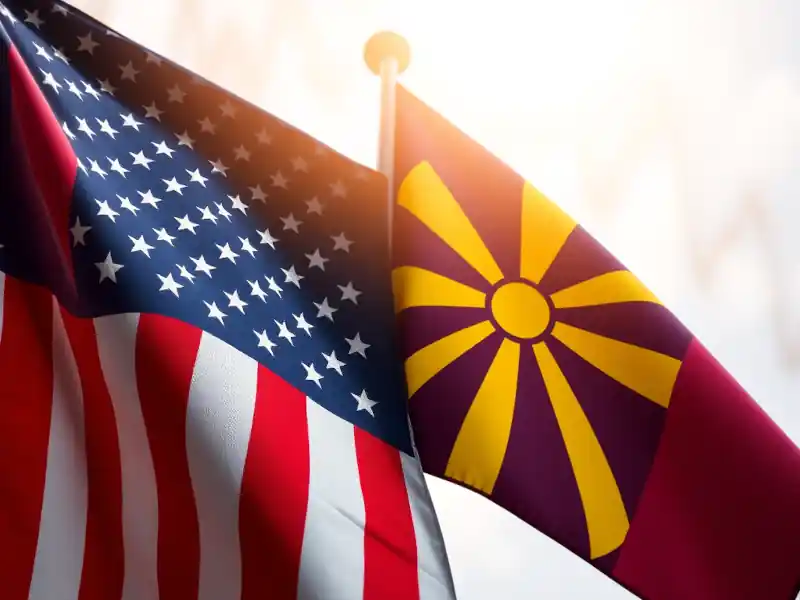
North Macedonia’s 2026 Trade Breakthrough: How Washington Is Expanding Its Balkan Strategy
U.S.–North Macedonia Trade Framework: What the 2026 Agreement Means for Both Economies
February 16th 2026
The relationship between the United States and North Macedonia has evolved over three decades from cautious diplomatic engagement into an increasingly intricate strategic partnership anchored in security cooperation, economic alignment, and transatlantic political affinity. What began as a measured interaction in the late twentieth century—when Washington sought the stabilization of the Western Balkans following Yugoslavia’s fragmentation and Skopje labored to establish its sovereignty—has gradually matured into a multilayered bond shaped by NATO integration, regional energy diversification, and shared commitments to democratic resilience. The journey has not always been linear; it has involved disputes over nomenclature, periodic political crises in Skopje, and shifting global priorities in Washington. Yet both states have consistently found themselves drawn into deeper cooperation by overlapping geopolitical imperatives: preserving peace in Southeastern Europe, resisting malign influence, ensuring energy security, and fostering an open economic order capable of withstanding volatile global forces.
Ties strengthened notably once North Macedonia—after resolving its long-running name dispute with Greece through the Prespa Agreement—entered the North Atlantic Treaty Organization in 2020. The United States had long championed Macedonian accession, viewing the country as a stabilizing hinge between the Adriatic, the Aegean, and the broader Balkan interior. With admission into NATO, bilateral defense cooperation accelerated: joint military exercises multiplied, capacity-building programs expanded, and American officials increasingly emphasized North Macedonia as a dependable node in the alliance’s southeastern architecture. For Skopje, this backing was invaluable. The region remained susceptible to geopolitical penetration from actors employing non-market coercion, strategic disinformation, and infrastructural dependency to erode democratic equilibrium. Washington’s endorsement, together with NATO membership, provided both a security umbrella and a symbolic affirmation of North Macedonia’s Euro-Atlantic trajectory.
Yet diplomacy between Washington and Skopje has never been confined solely to military affairs. It has progressively acquired an economic dimension, particularly as North Macedonia has attempted to reposition itself as a competitive Balkan economy embedded within global value chains. The United States, in parallel, has sought to diversify supply lines, cultivate reliable commercial partners, and encourage policy ecosystems favorable to innovation, fair competition, and the rule of law. Over the years, American vision has converged with Macedonian ambition in sectors such as renewable energy, information technology, agricultural modernization, and industrial manufacturing. U.S. companies—interested in proximity to the European single market, lower operating costs, and a young, tech-capable workforce—have increasingly viewed North Macedonia as a potential platform for both regional and continental expansion.
Against this backdrop of expanding synergy, the two states reached a milestone on February 12, 2026, when the White House released a historic declaration titled:
JOINT STATEMENT ON A FRAMEWORK FOR UNITED STATES–NORTH MACEDONIA AGREEMENT ON RECIPROCAL, FAIR, AND BALANCED TRADE
The White House – February 12, 2026
The United States of America (United States) and the Republic of North Macedonia (North Macedonia) have agreed to a Framework for an Agreement on Reciprocal, Fair, and Balanced Trade (Agreement) to strengthen our bilateral economic relationship, which will provide both countries’ exporters expanded access to each other’s markets. The Agreement will strengthen our trade relationship, support shared strategic interests, promote economic growth, and deepen our transatlantic partnership.
Key terms of the Agreement will include:
• North Macedonia will eliminate customs duties for all U.S. industrial and agricultural goods exported to North Macedonia.
• The United States will maintain at 15 percent the reciprocal tariffs, as set forth in Executive Order 14257 of April 2, 2005, as amended, on originating goods of North Macedonia, and will also identify products from the list set out in Annex III to Executive Order 14346 of September 5, 2025, Potential Tariff Adjustments for Aligned Partners, as amended, to receive a zero percent reciprocal tariff rate. The United States and North Macedonia may consider other tariff modifications following conclusion of the Agreement, taking into account trade balances and other appropriate factors.
• The United States and North Macedonia will work to address U.S. concerns with non-tariff barriers imposed by North Macedonia that affect bilateral trade in priority areas.
• The United States and North Macedonia commit to hold consultations to address and prevent barriers to U.S. agricultural products in the Macedonian market.
• The United States and North Macedonia have committed to strengthen economic and national security cooperation to enhance supply chain resilience and innovation through complementary actions to address non-market policies of other countries, as well as to combat duty evasion and cooperate on investment reviews and export controls. This commitment includes cooperating to ensure that international procurement obligations benefit only those countries that have taken on the same commitments.
• The United States and North Macedonia note their intention to facilitate and enhance commercial ties.
• On energy sector opportunities, the United States and North Macedonia take note of the construction of an important new gas interconnector between North Macedonia and Greece, which will allow North Macedonia to enhance energy security and diversify energy sources, including through purchases of U.S. liquefied natural gas (LNG). North Macedonia will commence purchase of U.S. LNG upon completion of the new gas interconnector.
• North Macedonia commits to adopt and maintain high levels of environmental protections and to effectively enforce its environmental laws.
• The United States and North Macedonia will discuss commitments on intellectual property protection and enforcement, including on geographical indications.
• The United States and North Macedonia will engage to address labor issues.
• The United States and North Macedonia recognize the importance of high-standard commitments on digital trade in order to foster an open and competitive digital economy. North Macedonia has committed not to impose a digital service tax and to support adoption of a permanent moratorium on customs duties on electronic transmissions at the World Trade Organization (WTO).
• The United States and North Macedonia recognize the importance of facilitating trade in services. North Macedonia reaffirms its commitment to the WTO Joint Initiative on Services Domestic Regulation.
The United States and North Macedonia will work to finalize the Agreement, prepare the Agreement for signature, and undertake domestic formalities in advance of the Agreement entering into force.
This landmark framework represented the most expansive bilateral economic initiative between the two nations to date. It was not merely a technical reconfiguration of tariff schedules; it served as a political signal that North Macedonia was being welcomed into the orbit of trusted economic partners capable of aligning regulatory standards, safeguarding supply chains, and resisting distortive trade practices from actors unconstrained by market principles. By abolishing customs duties on all U.S. industrial and agricultural goods, Skopje demonstrated an ambition to attract American exporters, amplify domestic competition, and incentivize technology transfer. Meanwhile, Washington’s willingness to maintain reciprocal tariffs at 15 percent for Macedonian-origin goods, while considering zero-duty rates for products identified in executive order annexes, illustrated a carefully structured openness designed to reward alignment and encourage deeper commercial integration.
The Agreement’s language addressing non-tariff barriers underscored Washington’s long-standing concerns about regulatory opacity and administrative frictions that sometimes constrained bilateral commerce, particularly in agricultural goods and pharmaceuticals. By formalizing consultations to prevent market obstacles for U.S. agricultural producers, the framework took aim at a chronic impediment to trade growth. Concurrently, its robust provisions on investment reviews, duty-evasion countermeasures, and export control coordination demonstrated a shared determination to shelter sensitive sectors from malign economic interference, enhance national security, and nurture a transparent investment climate. These commitments mapped onto a broader U.S. strategy aimed at reinforcing the resilience of global supply chains through diversification into trustworthy economies—an approach accelerated by global disruptions in recent years.
Energy cooperation, highlighted explicitly in the statement, revealed an additional layer of strategic convergence. North Macedonia’s effort to complete a new gas interconnector with Greece would tether the country to regional energy networks supported by Western partners and allow it to procure U.S. LNG, reducing vulnerability to monopolistic suppliers and geopolitical manipulation. For Washington, this infrastructure also symbolized a broader campaign across Southeast Europe to cultivate a diversified, transparent energy architecture aligning with Euro-Atlantic security interests. For Skopje, U.S. LNG provided not only diversification but also leverage: the ability to negotiate supplies competitively, strengthen its regional relevance, and position itself as an energy conduit for its neighbors.
The Agreement’s recognition of strong environmental protections mirrored a rising expectation among transatlantic partners that sustainable governance is now a prerequisite for deeper economic integration. North Macedonia’s pledge to enforce environmental laws signaled a commitment to harmonizing with global ecological norms at a time when environmental governance is closely tied to international investment decisions. Similarly, the emphasis on intellectual property protection and discussions on geographical indications acknowledged the increasing complexity of cross-border commerce in a digital and innovation-driven era.
A standout element of the framework related to digital trade: North Macedonia’s pledge not to impose a digital services tax and its support for a permanent moratorium at the World Trade Organization on customs duties for electronic transmissions illustrated a deliberate alignment with Washington’s vision of an open, competitive, and lightly encumbered digital marketplace. This was no small matter. As global powers debate data sovereignty, digital levies, and algorithmic governance, North Macedonia’s stance placed it firmly within a coalition of states advocating unhindered digital commerce and transparent regulatory frameworks. Its reaffirmation of commitments under the WTO Joint Initiative on Services Domestic Regulation likewise emphasized that Skopje intends to streamline its services sector through predictable, efficient, and nondiscriminatory administrative procedures—an essential prerequisite for attracting American investment in finance, consulting, cloud services, and telecommunications.
The political symbolism of the trade framework should not be understated. It represented a narrative pivot: North Macedonia, once perceived as a small peripheral state trying to reconcile internal divisions and regional disputes, had now emerged as a purposeful collaborator whose policy decisions resonated beyond its borders. Washington, for its part, treated Skopje not as a passive recipient of assistance but as an active contributor to transatlantic prosperity, supply chain stability, and regional security. The Agreement’s emphasis on mutual consultation, reciprocal tariff considerations, and shared national security concerns illustrated that both countries conceived of their partnership through a framework of balanced expectations and reciprocal obligations.
Beyond economics, bilateral relations continued to expand through diplomatic coordination, educational exchange programs, joint cultural initiatives, and robust defense collaboration. Peacekeeping cooperation remained strong, with North Macedonia contributing to NATO missions and aligning its defense modernization with alliance standards. Moreover, U.S. development assistance and rule-of-law programs continued to fortify Macedonian institutions, promoting judicial independence, anti-corruption frameworks, and inclusive governance practices. These initiatives contributed to a broader American strategy aimed at strengthening democratic resilience in regions susceptible to malign interference.
Cultural and academic ties also flourished. Exchange initiatives expanded English-language training, supported STEM education, and created avenues for Macedonian students and researchers to collaborate with U.S. universities. American cultural diplomacy—ranging from arts showcases to civil society partnerships—deepened societal linkages and ensured that bilateral cooperation was not confined to elite diplomacy but permeated broader public spheres.
In the political arena, Washington consistently encouraged North Macedonia’s European Union accession aspirations, advocating in Brussels for fair and merit-based progress and urging Skopje to stay the course on reforms. The U.S. repeatedly emphasized that North Macedonia’s Euro-Atlantic integration was not merely a regional matter but a cornerstone of continental security, given the country’s bridging position between Central Europe, the Mediterranean basin, and the Western Balkans’ historically contested enclaves.
By 2026, the United States–North Macedonia relationship had transformed into a sophisticated, multidimensional partnership. It occupied a unique geopolitical space: small in scale yet symbolically weighty, rooted in shared democratic values, reinforced by complementary economic interests, and energized by strategic goals that positioned Skopje as a capable contributor to regional stability. The February 12, 2026 framework on reciprocal, fair, and balanced trade marked a pivotal milestone in this trajectory, signaling not only the deepening of commercial ties but also a shared conviction that global prosperity requires predictable rules, transparent governance, equitable market access, and resilient supply chains insulated from distortive practices.
As both countries move to finalize the Agreement and complete the domestic legal processes required for its implementation, the bilateral relationship stands poised for yet another phase of expansion. New opportunities in artificial intelligence, cybersecurity cooperation, agricultural modernization, advanced manufacturing, and green technologies continue to beckon. For North Macedonia, engaging with the United States provides not only access to one of the world’s largest markets but also a strategic anchor ensuring that its economic advancement aligns with the norms of a rules-based international order. For the United States, strengthening ties with North Macedonia reinforces its long-term strategy of consolidating democratic, economically open partners along Europe’s southeastern flank.
In sum, the story of United States–North Macedonia relations is one of steady convergence shaped by shared values, mutual benefit, and a recognition that even states separated by geography can forge profound connections when their strategic visions harmonize. The 2026 trade framework exemplifies this evolution: a testament to how far the partnership has come and a blueprint for how much further it may yet advance as both nations navigate an increasingly complex global landscape.
Read more
- European Commission gave €50 million (MFA) to North Macedonia
- Constitution of the Republic of North Macedonia-1991
- Code of Criminal Procedure of North Macedonia-2005