Jamaat-e-Islami's Surge: The Surprise Winner in Bangladesh's 2026 Election?
Bangladesh Election 2026 Results: BNP Secures Landslide Victory
February 16, 2026
On August 5, 2024, Bangladesh’s political order was upended when Prime Minister Sheikh Hasina abruptly resigned and escaped to India, concluding a 15-year rule. Her fall followed a youth-driven rebellion that had ignited in early July over disputed job quotas before swelling into a nationwide revolt against what many viewed as her increasingly autocratic governance. The state responded with lethal force; a later United Nations report estimated as many as 1,400 deaths during that summer’s turmoil. With her departure, the military stepped into the resulting void and, after consulting student organizers, civic groups, and political actors, assembled an interim authority. On August 8, 2024, Nobel laureate Muhammad Yunus was named Chief Adviser, a move intended to placate protest demands and rebuild public trust.
The ensuing weeks mixed optimism with disorder. The Awami League collapsed almost instantly—its senior figures scattered or went underground, and by 2025 the party was formally banned. Sporadic attacks targeted minorities and former Awami loyalists, while clashes flared between supporters of the Bangladesh Nationalist Party and Jamaat-e-Islami, underscoring the volatility of the moment. The Yunus administration inherited what it called a profound economic, institutional, and democratic breakdown: a heavily politicized police force, a compromised judiciary, and an economy staggering under allegations of systemic corruption.
By mid-November 2024, as the interim administration crossed its first 100 days, Transparency International Bangladesh issued a tempered evaluation. On November 18, 2024, the group credited the government with initiating trials for past abuses, scrapping the repressive Cyber Security Act, and establishing reform committees, yet criticized the absence of a coherent strategy, persistent inflation, weak law-and-order management, and the failure of political parties to reform themselves. Even so, the interim leadership continued broad consultations that spanned more than seven months and culminated in a reform blueprint.
This blueprint—eventually titled the July Charter—was conceived as the structural legacy of the 2024 uprising. Containing more than 80 proposals, it envisioned term limits for prime ministers, a bicameral parliament, expanded presidential authority, a more autonomous judiciary, and greater inclusion of women and youth. It was presented as the basis for a new national compact and slated for a binding referendum synchronized with the next general election. Momentum grew in late 2025: by October, 24 political parties had endorsed the Charter, though some disputes persisted, including over the design of the proposed upper chamber. A defining shift came in December 2025 when Tarique Rahman, age 60, returned to Bangladesh after 17 years of self-exile in London to lead the Bangladesh Nationalist Party into the election. Days later, on December 30, 2025, the death of former prime minister Khaleda Zia entrenched her son Tarique as the party’s uncontested figurehead.
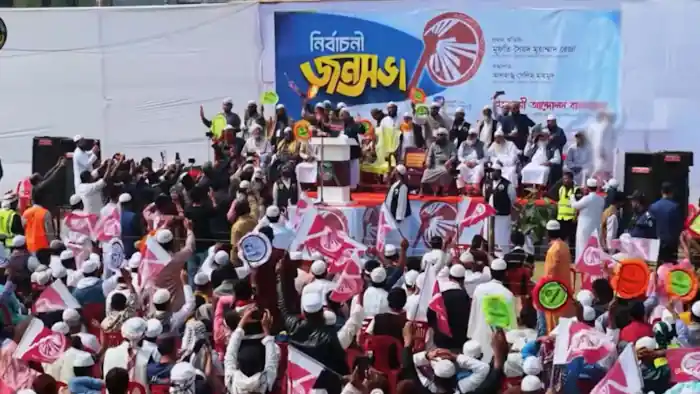
On February 12, 2026, Bangladesh held its pivotal 12th parliamentary election alongside its first nationwide referendum. More than 127.6 million citizens were eligible to vote, and upward of 30,000 security personnel were deployed. The Awami League was barred, leaving the contest to the BNP-led coalition and an 11-party bloc spearheaded by Jamaat-e-Islami, which had allied with the student-founded National Citizen Party. Despite heated rhetoric from some Jamaat leaders and reports of pre-election friction, voting day remained mostly calm aside from at least nine reported deaths. Roughly 60% of voters participated—a dramatic rise from the 41.8% turnout in the opposition-boycotted January 2024 polls.
Results released on February 13, 2026, delivered a commanding verdict. The Bangladesh Nationalist Party and its partners won 212 of 300 directly elected seats, securing a formidable two-thirds majority. The Jamaat-e-Islami-led alliance took 77 seats, its strongest performance to date, with notable gains in border districts adjacent to India—a development viewed warily in New Delhi. The National Citizen Party, despite its revolutionary origins, captured only four to six seats. Meanwhile, the July Charter passed decisively, with more than 48 million votes in favor, obliging the incoming parliament to codify its sweeping constitutional reforms within a fixed window.
The outcome signaled a public appetite for stability under a familiar political actor rather than experimentation with untested protest-born forces or overtly ideological Islamist governance. Tarique Rahman, poised to assume the premiership, dedicated the victory to those who “sacrificed for democracy” and urged unity. The European Union deemed the vote “credible.” India, alongside China and Pakistan, promptly extended congratulations. Outgoing Chief Adviser Muhammad Yunus voiced confidence in the transition. Jamaat’s leader initially questioned the tally but soon conceded and pledged a “vigilant, principled, peaceful” opposition. From exile, Sheikh Hasina dismissed the process as “illegal and unconstitutional.”
By mid-February 2026, Bangladesh stood on the threshold of a reimagined political order. The BNP’s supermajority now carries the burden of steering the July Charter into law—instating term limits, reshaping the judiciary, and stabilizing a fragile economy and debilitated institutions inherited from the past regime. Jamaat-e-Islami’s strong showing ensures that debates over secularism and religious identity will remain charged, while the National Citizen Party’s poor performance casts doubt on the immediate political future of the 2024 protest movement. The months ahead will determine whether a revolution born in the streets and validated at the ballot box can forge the “New Bangladesh” its people demanded.
Read More
- India – Bangladesh Joint Statement during State Visit of Bangladesh PM Sheikh Hasina to India (07/09/2022)
- Political Turmoil in Bangladesh: EAM’s Address to Lok Sabha (06/08/2024)
- Hindu Genocide in Radicalised Islamised Bangladesh
- India condemns the arrest of ISKCON monk Chinmoy Krishna