Positional (Spherical) Astronomy in India
K.K. Chakrabarty’s Essay (2002)
K.K. Chakrabarty: Director, Positional Astronomy Centre, Calcutta.
India is one of the countries in the world where astronomy originated. The Vedic ritual of the Rigveda, around 4000 B.C., observed the stars and at the time of Yajurveda, around 3000 B.C., the identification of bright stars had been completed.
The late Professor Meghnad Saha with his foresight saw the relevance and importance of positional astronomy in India. It was his inspiration that led to the formation of a Nautical Almanac Unit, under the aegis of the India Meteorological Department in Alipore, Calcutta, on December 1, 1955.
Origin
The Planning Committee set up by the Government of India had recommended in 1955 the preparation of an Astronomical Ephemeris and Nautical Almanac for the development of astronomical and astrophysical studies in India. The Calendar Reform Committee formed in 1952 under the Council of Scientific and Industrial Research ( CSIR) of the Government of India with the late Prof. M.N. Saha as chairman, recommended the preparation of the Indian Ephemeris and Nautical Almanac incorporating therein, along with the usual astronomical data, the National Calendar of India (the Saka Calendar) with timings of tithis (dates), nakshatras and yoga calculated with modern astronomical formulae and also with festival dates.
It was decided that the work should be done by a special unit attached to a scientific department of the Government of India. Subsequently the residual work of the Calendar Reform Committee and also the preparation of the Indian Ephemeris and Nautical Almanac was taken up from CSIR by the India Meteorological Department on December 1, 1955. The unit which was functioning as the office of the Calendar Reform Committee at the then Institute of Nuclear Physics, Calcutta, was attached to the Regional Meteorological Centre, Calcutta, as one of its sections named as Nautical Almanac Unit.
The late Prof. Saha was aware of the works of the late N.C. Lahiri in the field of astronomy and Calendar Reform. In 1952 he called Lahiri to help him in the work of the Calendar Reform Committee as its member-secretary. After completion of the Calendar Committee’s work, Lahiri was entrusted with the work of the Nautical Almanac Unit of the India Meteorological Department as its first officer-in-charge. The unit undertook the preparation of The Indian Ephemeris and Nautical Almanac for 1958 which was the first issue published in March, 1957. The Nautical Almanac Unit was initially located in the office premises of the Regional Meteorological Centre at Alipore, Calcutta. The foundation work of the Nautical Almanac Unit was appropriately streamlined by the late N.C. Lahiri. After Lahiri retired from Government service in February 1970, A. Bandyopadhyay took charge of the Nautical Almanac Unit.
The final scheme on the development of the Nautical Almanac Unit under the Fifth Five-Year Plan was approved in 1976 and due to expansion of the unit it was found difficult to accommodate the entire Nautical Almanac Unit in the office premises of the R.M.C. at Alipore and, consequently, a building at New Alipore was hired. On January 1, 1977, the Nautical Almanac Unit with all its staff and officers was shifted to the present location at New Alipore.
The Nautical Almanac Unit was earlier under the administrative control of the then Director, Regional Meteorological Centre, Calcutta. In 1976 a high power Committee was constituted under the Chairmanship of Dr. R. Ramanna to review the organisational structure and functions of the India Meteorological Department. The Ramanna Committee after examination of the working of the Nautical Almanac Unit recommended its independent status and also upgrading of the post of officer-in-charge of the Unit to the level of Director.
These recommendations were finally approved by the Council of Meteorology and Atmospheric Sciences (CMAS) of the Government of India and it was decided that the Nautical Almanac Unit would be completely separated from the administrative control of the Director, Regional Meteorological Centre, Calcutta. It was made an independent centre to be known as the Positional Astronomy Centre (P.A.C.) directly under the control of the Director General of Meteorology, New Delhi. The CMAS also recommended an Advisory Committee consisting of a few experts in this particular field of astronomy to guide the development work of the Centre. The Positional Astronomy Centre was formally inaugurated on April 26, 1980.
Activities
The Centre mainly publishes astronomical books. The Nautical Almanac Unit compiled the first issue of Indian Ephemeris and Nautical Almanac for 1958. From the issue for 1979, the title of this publication was changed to Indian Astronomical Ephemeris. This publication contains advance positions of the sun, moon, planets, stars and details of eclipses and occultation with particular reference to India and its neighbouring countries. It contains a section of Indian National Calendar giving all astronomical data required for the preparation of a Panchang and also for festivals of different communities in India. The Government of India and other State Governments mainly depend upon this publication for declaring holidays.
India is one of the eight countries of the world to prepare and publish such an astronomical ephemeris. The other countries are U.K., U.S.A., Russia, France, Spain, Japan and China. Apart from Japan and China, India is the only country in Asia to publish an Ephemeris of its own. The neighbouring countries depend on this publication for their astronomical data as their requirements are like that of the Indian astronomers and Panchang-makers.
Tables of Sunrise, Sunset and Moonrise, Moonset is another publication of the Centre which is in considerable demand by various Government departments, especially the Army, the Air Force and other public concerns and newspapers.
At the instance of the Ministry of Home Affairs, the Rashtriya Panchang using the Saka era is also being published by this Centre. Its main objective is to unify the divergent practices existing in different parts of the country and to promote a scientific basis for calendric computations. The first issue for the year 1897 SE (1957-58 CE) was published in June 1957. It is issued in 13 languages, namely English, Hindi, Sanskrit, Urdu, Assamese, Bengali, Oriya, Telugu, Tamil, Malayalam, Kannada, Marathi and Gujarati.
The publicity and sale of the Panchang has considerably increased and the people are being gradually convinced about its utility on an all-India basis and its correct calculations of tithi, nakshatra and other items necessary for Panchang-makers of our country. From 1922 SE(2000-2001CE) one more edition, i.e. Punjabi in Gurumukhi script is being introduced.

The Sūrya-siddhānta (III.37-39 in the texts of 51 verses) explains the method to obtain time from
the observed shadow. The method is just opposite to the above procedure.
Positional Astronomy Centre Kolkata
The Planning Committee set up by the Government of India recommended in 1945 the preparation of an Astronomical Ephemeris and Nautical Almanac for the development of astronomical and astrophysical studies in India. Moreover, although the Govt. of India used the Gregorian calendar for official use, divergent practices prevailed for observing festivals at various states of the country. As nearly 30 different Panchangas were in use during the post-independence period of the country, a need was felt by the then Prime Minister Late Pt. Jawahar Lal Nehru to develop a unified National Calendar based on the most accurate modern astronomical data for the interest of national integrity.
Keeping these in view a Calendar Reform Committee was formed in 1952 under the Council of Scientific and Industrial Research of the Government of India with Late Prof. Meghnad Saha, F.R.S, as Chairman and eminent persons as members with Late N.C.Lahiri as member secretary. The committee recommended preparation of the Indian Ephemeris and Nautical Almanac incorporating therein along with the usual astronomical data calculated with most modern astronomical formulae, the National Calendar of India (using Saka Era) with timings of tithis, nakshatras, yoga etc, and also festival dates.
The committee also recommended the preparation of the Rashtriya Panchang with solar calendar system for civil purposes and luni-solar calendar system for religious purposes. It was decided that the work should be done by a special unit attached to a scientific department of the Government of India. Thus the residual work of the Calendar Reform Committee and also the preparation of the Indian Ephemeris and Nautical Almanac along with Rashtriya Panchang were taken up by the India Meteorological Department from the Council of Scientific and Industrial Research on 1st December 1955. The unit, which was functioning as the office of the Calendar Reform Committee at the then Institute of Nuclear Physics, Calcutta, was brought under the control of the Regional Meteorological Centre, Calcutta as one of its sections named ‘Nautical Almanac Unit’.
After completion of the Calendar Reform Committee’s work, Late N.C.Lahiri was entrusted with the work of the Nautical Almanac Unit of the India Meteorological Department as its first Officer-in-Charge. The unit undertook the preparation of ‘The Indian Ephemeris and Nautical Almanac’ for 1958, which was the first issue published in March 1957. Simultaneously the first issue of Rashtriya Panchang was started from the 1879 Saka Era (1957- 58 C.E). The Nautical Almanac Unit was initially located in the office premises of the Regional Meteorological Centre at Alipore, Calcutta.
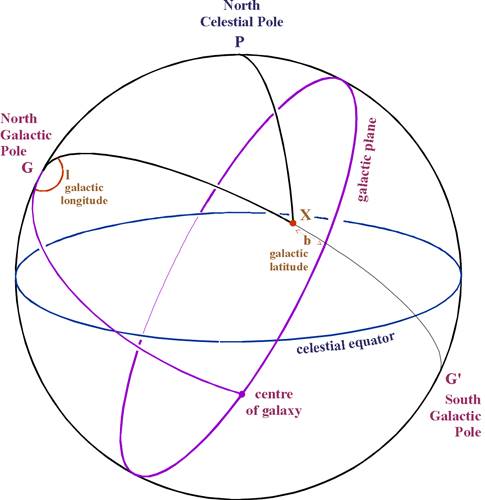
Image: Galactic coordinates
The Nautical Almanac Unit was so long under the administrative control of the then Director, Regional Meteorological Centre, Calcutta. In the year 1976 a high power Committee was constituted under the Chairmanship of Dr. R. Ramanna to review the organisational structure and functions of the India Meteorological Department. The Ramanna Committee, after examination of the working of the Nautical Almanac Unit, recommended its independent status and upgradation of the post of Officer-in-Charge of the Unit to the level of Director. These recommendations were finally approved by the Council of Meteorology and Atmospheric Sciences ( CMAS ) of the Govt. of India and it was decided that the Nautical Almanac Unit would be completely separated from the administrative control of the Director, Regional Meteorological Centre, Calcutta and was made an independent centre with the name as “Positional Astronomy Centre” ( P.A.C.) directly under the control of the Director General of Meteorology, New Delhi. The CMAS also recommended an Advisory Committee consisting of a few experts in this particular field of astronomy to give guidance for the development work of the Centre. The implementation of this decision has been made with effect from the 1st December 1979 and the formal inauguration of the Positional Astronomy Centre took place on the 26th April 1980.
Sample Daily Astronomical Information
Date: 14 February 2024, 25 Magha, 1945 Saka Era, Wednesday
Tithi: (Magha Sukla) Panchami h. 12-10 Nakshatra: Revati h. 10-43 Yoga: Subha h. 19-59 Karana: Balava h. 12-10 then Kaulava h. 23-07 Moon: in Mina, enters Mesha h. 10-43 Age of Moon: 4.1 Declination of Sun: S 13° 16′ Sidereal Time (noon): h. 21-49-21s Equation of time: -14m 10s
Date: 13 February 2024, 24 Magha, 1945 Saka Era, Tuesday
Tithi: (Magha Sukla) Chaturthi h. 14-43 Nakshatra: Uttara Bhadrapada h. 12-36 Yoga: Sadhya h. 23-05 Karana: Vishti h. 14-43 then Bava h. 25-22 Moon: in Mina Age of Moon: 3.1 Declination of Sun: S 13° 36′ Sidereal Time (noon): h. 21-45-26s Equation of time: -14m 11s
The following specific data are computed and supplied by the office of Positional Astronomy:
- Lunar phenomena for prediction of tides for Survey of India.
- Solar data for orienting large civil construction projects, for laying electric transmission lines, and for large public meetings.
- Position of the Sun for aligning antennas and radars for railways, communication, Air Force, and for atmospheric observations during expeditions (Antarctica).
- Pole star data for aligning radio transmitters for AIR. Times for rising, setting of the Sun & Moon and Moon’s phases for defence, judiciary, crime detection agencies and scientific researchers.
- Local circumstances of eclipses for a large number of researchers/amateur astronomers.
- Advance intimation on dates of festivals for Govt. holiday declaration, tourist promotion abroad and for use of Panchang Makers.
Contact
Positional Astronomy Centre
Block-AQ, Plot-8, Sector-V,
Salt Lake, Mahish Bathan,
Kolkata-700091
Phone: (033) 2367 1200/1201/1202
Fax: (033) 2367 1203
Refer:
Ôhashi, Yukio (2009): “The Mathematical and Observational Astronomy in Traditional India”, in
J.V. Narlikar (ed.): Science in India (History of Science, Philosophy and Culture in Indian
Civilization, Volume XIII, Part 8), New Delhi, Viva Books, pp.1 – 88.
Ôhashi, Yukio (2011a): “On Vedāṅga astronomy: The Earliest Systematic Indian Astronomy”, in
Nakamura, Orchiston, Sôma and Strom (eds.): Mapping the Oriental Sky. Proceedings of the Seventh
International Conference on Oriental Astronomy, Tokyo, National Astronomical Observatory of
Japan,pp. 164 – 170.
- Surya-Siddhanta
- Siddhānta-sārva-bhauma (1646 CE)
- Guḍhartha-prakaiaka (Bapu Deva Shastri)
Read more
- Lilavati (लीलावती): Know the Mathematical Treatise of Bhaskara
- बौधायन शुल्ब सूत्रम् – Sulva Sutram of Baudhayana
- Surya Siddhantha of Mayasura
Note:
The Indian National Calendar or Saka Sambat Calendar(Luni-solar) was adopted in 1957 CE.
It started on March 22(1st Chaitra) on the birthday of King Shalivahana of the Shatavahana Dynasty on 78th CE by the Sakadvipi (शाकद्वीप) Brahmins. Therefore deducting 78 from the Common era would generate the present Sakabda. Indian official Gazette mentions the date.