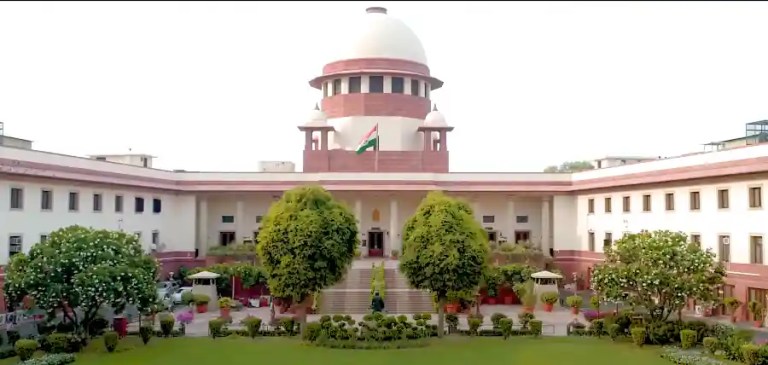
Supreme Court Of India
Whether, a criminal proceeding can be initiated and the accused therein held guilty with natural consequences thereof to follow, in connection with a transaction, in respect of which a decree by a competent Court of civil jurisdictionJurisdiction Authority by which courts receive and decide cases. Limited Jurisdiction: the authority over only particular types of cases, or cases under a prescribed amount in controversy, or seeking only certain types of relief, the District Court is a court of limited jurisdiction. Original Jurisdiction:ย Jurisdiction of the first court to hear a case., already stands passed.
SUPREME COURT OF INDIAArticle 124 of the Constitution of India Constitution of India > 124. Supreme Court (1) There shall be a Supreme Court of India consisting of a Chief Justice of India and, until Parliament by law prescribes a larger number, of not more than seven other Judges. (2) Every Judge of the Supreme Court shall be appointed by the President by warrant under his hand and seal and shall hold office until he attains the age of sixty-five years: Provided that-- (a) a Judge may, by writing under his hand addressed to the President, resign his office (b) a Judge may be removed from his office in the manner provided in clause (4). (2A) The age of a Judge of the Supreme Court shall be determined by such authority and in such manner as Parliament may by law provide. (3) A person shall not be qualified for appointment as a Judge of the Supreme Court unless he is a citizen of India and-- (a) has been for at least five years a Judge of a High Court or of two or more such Courts in succession; or (b) has been for at least ten years an advocate of a High Court or of two or more such courts in succession; or (c) is, in the opinion of the President, a distinguished jurist. (4) A Judge of the Supreme Court shall not be removed from his office except by an order of the President passed after an address by each House of Parliament supported by a majority of the total membership of that House and by a majority of not less than two-third of the members of the House present and voting has been presented to the President in the same session for such removal on the ground of proved misbehavior or incapacity. (5) Parliament may by law regulate the procedure for the presentation of an address and for the investigation and proof of the misbehavior or incapacity of a Judge under clause (4): (6) Every person appointed to be a Judge of the Supreme Court shall, before he enters upon his office, make and subscribe before the President, or some person appointed in that behalf by him, an oath or affirmation according to the form set out for the purpose in the Third Schedule. (7) No person who has held office as a Judge of the Supreme Court shall plead or act in any court or before any authority within the territory of India.
Prem Raj v. Poonamma Menon & Anr.
(Criminal AppealCriminal Appeal Shankar Kerba Jadhav and others vs. The State of Maharashtra (AIR 1971 SC 840): "An appeal is a creature of a statute and the powers and jurisdiction of the appellate Court must be circumscribed by the words of the statute. At the same time a Court of appeal is a "Court of error" and its normal function is to correct the decision appealed from and its jurisdiction should be co-extensive with that of the trial Court. It cannot and ought not to do something which the trial Court was not competent to do. There does not seem to be any fetter to its power to do what the trial Court could do." No. 1858 of 2024)
02 April 2024
[Sanjay Karol and Aravind Kumar, JJ.]
[2024] 4 S.C.R. 29 :ย 2024 INSC 260
DATE: 02 April 2024
ACTS: Negotiable Instruments Act, 1881 โ s.138
JudgmentJudgment The statement given by the Judge on the grounds of a decree or order - CPC 2(9). It contains a concise statement of the case, points for determination, the decision thereon, and the reasons for such decision - Order 20 Rule 4(2).ย Section 354 of CrPC requires that every judgment shall contain points for determination, the decision thereon and the reasons for the decision. Indian Supreme Court Decisions > Law declared by Supreme Court to be binding on all courts (Art 141 Indian Constitution) Civil and judicial authorities to act in aid of the Supreme Court (Art 144) Supreme Court Network On Judiciary โ Portal > Denning: โJudges do not speak, as do actors, to please. They do not speak, as do advocates, to persuade. They do not speak, as do historians, to recount the past. They speak to give Judgment. And in their judgments, you will find passages, which are worthy to rank with the greatest literatureโฆ.โ Law Points on Judgment Writing > The judge must write to provide an easy-to-understand analysis of the issues of law and fact which arise for decision. Judgments are primarily meant for those whose cases are decided by judges (State Bank of India and Another Vs Ajay Kumar Sood SC 2022)
Sanjay Karol, J.
Leave granted.
2. Appellant herein challenges judgment and order dated 23rd January, 2018 passed in Crl.R.P. No.1111 of 20111, whereby the High CourtHigh Court High Court Judges in England and Wales handle complex and tough cases, sitting in London and traveling to court centers around the country. They preside over serious criminal and important civil cases, and support the Lord and Lady Justices in hearing appeals. High Court Judges are commonly referred to as โMr/Mrs/Ms Justice surnameโ and are given the prefix โThe Honourableโ. They are assigned to the Kingโs Bench Division, the Family Division, or the Chancery Division. The Kingโs Bench Division focuses on civil wrongs and judicial review, the Family Division deals with family law, and the Chancery Division handles various cases including company law and probate. Judges are appointed through a rigorous process overseen by the Judicial Appointments Commission. of Kerala allowed, only in part, his Revision PetitionPetition ฮฑฮฝฮฑฯฮฟฯฮฌ > ฯฮฑฯฮฑฮบฮฑฮปฯ (Prayer) against the judgment and order of the learned Additional Sessions Judge, Thrissur,2 dated 11th January, 2011, in Criminal Appeal No.673 of 2007, which, in turn, upheld his conviction, as handed down by the learned Judicial First Class Magistrate3 vide order dated 14th August, 2007 in CC No.51 of 2003, under Section 138 of the Negotiable Instruments Act, 1881.4
3. The sole issue that we are required to consider is, whether, a criminal proceeding can be initiated and the accused therein held guilty with natural consequences thereof to follow, in connection with a transaction, in respect of which a decree by a competent Court of civil jurisdiction, already stands passed.
4. The facts necessary to put into perspective the issue in the present appeal are:-
4.1 The Appellant borrowed Rs.2,00,000/- from the Complainant, K.P.B Menon โSreyes,โ with the promise that he would repay it on demandDemand In economics, the amount of a good or service that consumers are willing to buy at a particular price..
4.2On receipt of such demand, he issued a cheque dated 30th June, 2002 for the said amount from the South IndianIndia Hind/ hend >hindia. Bharat Varsha (Jambudvipa used in Mahavamsha) is the name of this land mass. The people of this land are Sanatan Dharmin and they always defeated invaders. Indra (10000 yrs) was the oldest deified King of this land. Manu's jurisprudence enlitened this land. Vedas have been the civilizational literature of this land. Guiding principles of this land are : เคธเคคเฅเคฏเค เคตเคฆ เฅค เคงเคฐเฅเคฎเค เคเคฐ เฅค เคธเฅเคตเคพเคงเฅเคฏเคพเคฏเคพเคจเฅเคฎเคพ เคชเฅเคฐเคฎเคฆเค เฅค The place also been called Hindusthan in Pesia. The word Hendu is mentioned in Avesta. Read more Bank, encashment thereof was to be through Canara Bank, Irinjalakuda Branch, to which the cheque was sent through the post with a covering letter dated 24th September, 2002.
4.3 It was dishonoured due to insufficient fundsFund The term refers to assets of every kind, whether corporeal or incorporeal, tangible or intangible, movable or immovable, however acquired, and legal documents or instruments in any form, including electronic or digital, evidencing title to, or interest in, such assets. and โpayments stopped by drawerโ. The Complainant came to know of such dishonour and issued a notice of demand dated 22nd December, 2002. AccountingAccounting It is the process of recording, summarizing, analyzing, and reporting financial transactions of a business or individual. Types of Accounts > Assets- Things you own (cash, property) Liabilities- Things you owe (loans, bills) Equity- Ownerโs stake in the business Revenue- Money you earn (sales, services) Expenses- Costs to run the business for no action on the part of the appellant, the complaint, the subject matterMatter Normal matter is made of molecules, which are themselves made of atoms. Inside the atoms, electrons are spinning around the nucleus. The nucleus is made of protons and neutrons. Inside the protons and neutrons, exist indivisible quarks, like the electrons. All matter around us is made of elementary particles. ( building blocks of matter > quarks and leptons). All stable matter in the universe is made from particles that belong to the first-generation. Fundamental forces result from the exchange of force-carrier particles, which belong to a broader group called โbosonsโ. The strong force is carried by the โgluonโ, electromagnetic force is carried by the โphoton.โ of the instant proceedings, came to be filed.
5. Equally, though, the appellant (accused) had filed Original Suit No.1338 of 2002. The five parties impleaded as defendants were, (i) K.P. Bhaskara Menon; (ii) K.P. Vipinendra Kumar5; (iii) Praveen Menon; (iv) The Manager South Indian Bank Limited Kathikudam, Via Koratty, Trichur; and (v) N.T. Raghunandanan. The prayers made therein were to, (a) declare cheque No.386543 of the South Indian Bank Limited, Kathikudam, as a security cheque; (b) issue mandatory injunction directing the 1st defendant to return the said cheque; and (c) issue a permanent prohibitory injunction restraining defendants 1 to 4 named hereinabove from taking any steps to encash the said cheque.
5.1 The Additional DistrictDistrict India has 800 districts under 29 federal states and 8 union territories. Adilabad Agar-Malwa Agra Ahilyanagar Ahmedabad Aizawl Ajmer Akola Alappuzha Aligarh Alipurduar Alirajpur Alluri Sitharama Raju Almora Alwar Ambala Ambedkar Nagar Amethi Amravati Amreli Amritsar Amroha Anakapalli Anand Ananthapuramu Anantnag Anjaw Annamayya Anugul Anuppur Araria Ariyalur Arvalli Arwal Ashoknagar Auraiya Aurangabad Ayodhya Azamgarh Bagalkote Bageshwar Baghpat Bahraich Bajali Baksa Balaghat Balangir Baleshwar Ballari Ballia Balod Balodabazar-Bhatapara Balotra Balrampur Balrampur-Ramanujganj Banas Kantha Banda Bandipora Banka Bankura Banswara Bapatla Bara Banki Baramulla Baran Bareilly Bargarh Barmer Barnala Barpeta Barwani Bastar Basti Bathinda Beawar Beed Begusarai Belagavi Bemetara Bengaluru Rural Bengaluru Urban Betul Bhadohi Bhadradri Kothagudem Bhadrak Bhagalpur Bhandara Bharatpur Bharuch Bhavnagar Bhilwara Bhind Bhiwani Bhojpur Bhopal Bichom Bidar Bijapur Bijnor Bikaner Bilaspur Bilaspur Birbhum Bishnupur Biswanath Bokaro Bongaigaon Botad Boudh Budaun Budgam Bulandshahr Buldhana Bundi Burhanpur Buxar Cachar Central Chamarajanagar Chamba Chamoli Champawat Champhai Chandauli Chandel Chandigarh Chandrapur Changlang Charaideo Charkhi Dadri Chatra Chengalpattu Chennai Chhatarpur Chhatrapati Sambhajinagar Chhindwara Chhotaudepur Chikkaballapura Chikkamagaluru Chirang Chitradurga Chitrakoot Chittoor Chittorgarh Chumoukedima Churachandpur Churu Coimbatore Cooch Behar Cuddalore Cuttack Dadra And Nagar Haveli Dahod Dakshin Bastar Dantewada Dakshin Dinajpur Dakshina Kannada Dhenkanal Dholpur Dhubri Dhule Dibang Valley Dibrugarh Didwana-Kuchaman Dima Hasao Dimapur Dindigul Dindori Diu Doda Dr. B.R. Ambedkar Konaseema Dumka Dungarpur Durg East East Garo Hills East Godavari East Jaintia Hills East Kameng East Khasi Hills East Siang East Singhbum Eastern West Khasi Hills Eluru Ernakulam Erode Etah Etawah Faridabad Faridkot Farrukhabad Fatehabad Fatehgarh Sahib Fatehpur Fazilka Ferozepur Firozabad Gadag Gadchiroli Gajapati Ganderbal Gandhinagar Ganganagar Gangtok Ganjam Garhwa Gariyaband Gaurela-Pendra-Marwahi Gautam Buddha Nagar Gaya Ghaziabad Ghazipur Gir Somnath Giridih Goalpara Godda Golaghat Gomati Gonda Gondia Gopalganj Gorakhpur Gumla Guna Guntur Gurdaspur Gurugram Gwalior Gyalshing Hailakandi Hamirpur Hamirpur Hanumakonda Hanumangarh Hapur Harda Hardoi Haridwar Hassan Hathras Haveri Hazaribagh Hingoli Hisar Hnahthial Hojai Hooghly Hoshiarpur Howrah Hyderabad Idukki Imphal East Imphal West Indore Jabalpur Jagatsinghapur Jagitial Jaipur Jaisalmer Jajapur Jalandhar Jalaun Jalgaon Jalna Jalore Jalpaiguri Jammu Jamnagar Jamtara Jamui Jangoan Janjgir-Champa Jashpur Jaunpur Jayashankar Bhupalapally Jehanabad Jhabua Jhajjar Jhalawar Jhansi Jhargram Jharsuguda Jhunjhunu Jind Jiribam Jodhpur Jogulamba Gadwal Jorhat Junagadh Kabeerdham Kachchh Kaimur (Bhabua) Kaithal Kakching Kakinada Kalaburagi Kalahandi Kalimpong Kallakurichi Kamareddy Kamjong Kamle Kamrup Kamrup Metro Kancheepuram Kandhamal Kangpokpi Kangra Kannauj Kanniyakumari Kannur Kanpur Dehat Kanpur Nagar Kapurthala Karaikal Karauli Karbi Anglong Kargil Karimganj Karimnagar Karnal Karur Kasaragod Kasganj Kathua Daman Damoh Dangs Darbhanga Darjeeling Darrang Datia Dausa Davanagere Deeg Dehradun Deogarh Deoghar Deoria Devbhumi Dwarka Dewas Dhalai Dhamtari Dhanbad Dhar Dharashiv Dharmapuri Dharwad Dhemaji Katihar Katni Kaushambi Kendrapara Kendujhar Keyi Panyor Khagaria Khairagarh-Chhuikhadan-Gandai Khairthal-Tijara Khammam Khandwa (East Nimar) Khargone (West Nimar) Khawzawl Kheda Kheri Khordha Khowai Khunti Kinnaur Kiphire Kishanganj Kishtwar Kodagu Koderma Kohima Kokrajhar Kolar Kolasib Kolhapur Kolkata Kollam Kondagaon Koppal Koraput Korba Korea Kota Kotputli-Behror Kottayam Kozhikode Kra Daadi Krishna Krishnagiri Kulgam Kullu Kumuram Bheem Asifabad Kupwara Kurnool Kurukshetra Kurung Kumey Kushinagar Lahaul And Spiti Lakhimpur Lakhisarai Lakshadweep District Lalitpur Latehar Latur Lawngtlai Leh Ladakh Leparada Lohardaga Lohit Longding Longleng Lower Dibang Valley Lower Siang Lower Subansiri Lucknow Ludhiana Lunglei MAUGANJ Madhepura Madhubani Madurai Mahabubabad Mahabubnagar Mahasamund Mahendragarh Mahesana Mahisagar Mahoba Mahrajganj Maihar Mainpuri Majuli Malappuram Malda Malerkotla Malkangiri Mamit Mancherial Mandi Mandla Mandsaur Mandya Munger Murshidabad Muzaffarnagar Muzaffarpur Mysuru Nabarangpur Nadia Nagaon Nagapattinam Nagarkurnool Nagaur Nagpur Nainital Nalanda Nalbari Nalgonda Namakkal Namchi Namsai Nanded Nandurbar Nandyal Narayanpet Narayanpur Manendragarh-Chirmiri-Bharatpur(M C B) Mangan Mansa Marigaon Mathura Mau Mayiladuthurai Mayurbhanj Medak Medchal Malkajgiri Meerut Meluri Mirzapur Moga Mohla-Manpur-Ambagarh Chouki Mokokchung Mon Moradabad Morbi Morena Mulugu Mumbai Mumbai Suburban Mungeli Narmada Narmadapuram Narsimhapur Nashik Navsari Nawada Nayagarh Neemuch New Delhi Nicobars Nirmal Niuland Niwari Nizamabad Noklak Noney North North 24 Parganas North And Middle Andaman North East North Garo Hills North Goa North Tripura North West Ntr Nuapada Nuh Pakke Kessang Pakur Pakyong Palakkad Palamu Palghar Pali Palnadu Palwal Panch Mahals Panchkula Pandhurna Panipat Panna Papum Pare Parbhani Parvathipuram Manyam Paschim Bardhaman Paschim Medinipur Pashchim Champaran Patan Pathanamthitta Pathankot Patiala Patna Pauri Garhwal Peddapalli Perambalur Peren Phalodi Phek Pherzawl Pilibhit Pithoragarh Poonch Porbandar Prakasam Pratapgarh Pratapgarh Prayagraj Puducherry Pudukkottai Pulwama Pune Purba Bardhaman Ranipet Ratlam Ratnagiri Rayagada Reasi Rewa Rewari Ri Bhoi Rohtak Rohtas Rudraprayag Rupnagar S.A.S Nagar Sabar Kantha Sagar Saharanpur Saharsa Sahebganj Saitual Sakti Salem Salumbar Samastipur Samba Purba Medinipur Purbi Champaran Puri Purnia Purulia Rae Bareli Raichur Raigad Raigarh Raipur Raisen Rajanna Sircilla Rajgarh Rajkot Rajnandgaon Rajouri Rajsamand Ramanagara Ramanathapuram Ramban Ramgarh Rampur Ranchi Ranga Reddy Sambalpur Sambhal Sangareddy Sangli Sangrur Sant Kabir Nagar Saraikela Kharsawan Saran Sarangarh-Bilaigarh Satara Satna Sawai Madhopur Sehore Senapati Seoni Sepahijala Serchhip Shahdara Shahdol Shahid Bhagat Singh Nagar Shahjahanpur Shajapur Shamator Shamli Sheikhpura Sheohar Sheopur Shi Yomi Shimla Shivamogga Shivpuri Shopian Shrawasti Siaha Siang Siddharthnagar Siddipet Sidhi Sikar Simdega Sindhudurg Singrauli Sirmaur Sirohi Sirsa Sitamarhi Sitapur Sivaganga Sivasagar Siwan Solan Solapur Sonbhadra Sonepur Sonipat Sonitpur Soreng South South 24 Parganas South Andamans South East South Garo Hills South Goa South Salmara Mancachar South Tripura South West South West Garo Hills South West Khasi Hills Sri Muktsar Sahib Sri Potti Sriramulu Nellore Sri Sathya Sai Srikakulam Srinagar Sukma Sultanpur Sundargarh Supaul Surajpur Surat Surendranagar Surguja Suryapet Tamenglong Tamulpur Tapi Tarn Taran Tawang Tehri Garhwal Tengnoupal Tenkasi Thane Thanjavur The Nilgiris Theni Thiruvallur Thiruvananthapuram Thiruvarur Thoothukkudi Thoubal Thrissur Tikamgarh Tinsukia Tirap Tiruchirappalli Tirunelveli Tirupathur Tirupati Tiruppur Tiruvannamalai Tonk Tseminyu Tuensang Tumakuru Udaipur Udalguri Udham Singh Nagar Udhampur Udupi Ujjain Ukhrul Warangal Wardha Washim Wayanad West West Garo Hills West Godavari West Jaintia Hills West Kameng West Karbi Anglong West Khasi Hills West Siang West Singhbhum West Tripura Wokha Y.S.R. Yadadri Bhuvanagiri Yadgir Yamunanagar Yavatmal Zunheboto Umaria Una Unakoti Unnao Upper Siang Upper Subansiri Uttar Bastar Kanker Uttar Dinajpur Uttara Kannada Uttarkashi Vadodara Vaishali Valsad Varanasi Vellore Vidisha Vijayanagara Vijayapura Vikarabad Viluppuram Virudhunagar Visakhapatnam Vizianagaram Wanaparthy Munsif, Irinjalakuda, decreed the Suit on 11th April, 2003 in favour of the plaintiff (accused). The Suit in respect of defendant No.4, namely the Manager, South Indian Bank, was dismissed and the Suit was wholly decreed against the remaining defendants.
5.2 Defendant No.1 filed an appeal before the Additional Subordinate Judge, Irinjalakuda in C.M.A.No.6/2006. In its judgment dated 30th January, 2007, the Court observed that โThe lower court correctly analysed the facts and arrived at the right conclusion. I find no reason to interfere the order of the lower court. Hence I dismissed this appeal.โ
6. Therefore, it appears from the record that the very same cheque was in issue before the Civil Court and also the Court seized of the Section 138 N.I. Act complaint.
The conclusions drawn by the Courts below, subject matter of the instant lis, are as under:
6.1 The Trial CourtTrial court Court of original Jurisdiction > the court which examines the evidences for the first time. convicted the appellant herein to undergo simple imprisonment for one year as well as pay compensation of Rs.2 lakhs in default whereof, he was to undergo further simple imprisonment for six months. The determination of the issues, i.e., whether the decree passed by the Munsif Court would be binding on it, is of note. It was observed that a Court exercising jurisdiction on the criminal side is not subordinate to the Civil Court. Further, it was held โThat order was an ex-parte order as far as criminal complaint is concerned the order of injunction issued cannot be granted and the hands of the criminal court cannot be fettered by the civil courtโ.
6.2 The First Appellate Court framed primarily one point for consideration โ whether the cheque was issued against a legally enforceable debt, thereby attracting the offence under Section 138 of the N.I. Act. This point was held against the appellant and therefore, the conviction handed down by the Court below, accordingly confirmed.
7. The High Court, in revision, observed that no perversity could be indicated in the concurrent findings of the Trial Court and First Appellate Court. The same was dismissed.
8. We find the manner in which this matter has travelled up to this Court to be quite concerning. We fail to understand as to how a civil as well as criminal course could be adopted by the parties involved, in respect of the very same issue and transaction, in these peculiar facts and circumstances.
9. In advancing his submissions, Mr. K. Parameshwar, learned counsel appearing for the appellant, placed reliance on certain authorities of this Court. In M/s. Karam Chand Ganga Prasad & Anr. vs. Union of IndiaIndia Hind/ hend >hindia. Bharat Varsha (Jambudvipa used in Mahavamsha) is the name of this land mass. The people of this land are Sanatan Dharmin and they always defeated invaders. Indra (10000 yrs) was the oldest deified King of this land. Manu's jurisprudence enlitened this land. Vedas have been the civilizational literature of this land. Guiding principles of this land are : เคธเคคเฅเคฏเค เคตเคฆ เฅค เคงเคฐเฅเคฎเค เคเคฐ เฅค เคธเฅเคตเคพเคงเฅเคฏเคพเคฏเคพเคจเฅเคฎเคพ เคชเฅเคฐเคฎเคฆเค เฅค The place also been called Hindusthan in Pesia. The word Hendu is mentioned in Avesta. Read more & Ors.6, this Court observed that:
โโฆโฆ.It is a well-established principle of lawLaw ฮฝฯฮผฮฟฯ:ย Positive command of sovereign or divine. One can be ruled either by a Statute, a Statue, or a Statement. Legislation is the rule-making process by a political or religious organisation. Physics governs natural law. Logical thinking is a sign of a healthy brain function. Dharma is eternal for Sanatanis. Judiciary > Show me the face, and I will show you the law. Some people know how to bend the law rather than break it. Law Practice. Read a scholarly article that the decisions of the civil courts are binding on the criminal courts. The converse is not true.โ
In K.G. Premshanker vs. Inspector of Police & Anr7., a Bench of three learned Judges observed that, following the M.S. Sheriff vs. State of Madras8, no straight-jacket formula could be laid down and conflicting decisions of civil and criminal Courts would not be a relevant consideration except for the limited purpose of sentence or damagesDamages Damages (often termed โuser damageโ) are readily awarded at common law for the invasion of rights to tangible moveable or immovable property (by detinue, conversion or trespass). Damages are also available on a similar basis for patent infringement and breaches of other intellectual property rights of a proprietary character..
10.We notice that this Court in VishnuVishnu He is celebrated as an ancient and supreme deity who upholds cosmic order (แนta) and creation. He is known as Trivikrama, having measured the universe in three strides: covering the earth, the sky, and reaching the ultimate realm of liberation, called the parama padam. He never incarnated himself as an Avatara. Read More Dutt Sharma vs. Daya Sapra (Smt.)9, had observed as under:
โ26. It is, however, significant to notice a decision of this Court in Karam Chand Ganga Prasad v. Union of India (1970) 3 SCCSCC Supreme Court Cases 694, wherein it was categorically held that the decisions of the civil court will be binding on the criminal courts but the converse is not true, was overruled thereinโฆโ
This Court in Satish Chander Ahuja vs. Sneha Ahuja10 considered a numerous precedents, including Premshanker (supra) and Vishnu Dutt Sharma (supra), to opine that there is no embargo for a civil court to consider the evidenceEvidence All the means by which a matter of fact, the truth of which is submitted for investigation, is established or disproved. Bharatiya Sakshya (Second) Adhiniyam 2023 led in the criminal proceedings.
The issue has been laid to rest by a ConstitutionConstitution The Constitution encompasses the global system of rules governing constitutional authority. Simply reading selected provisions of the written text may be misleading. Understanding the underlying principles, such as federalism, democracy, constitutionalism, the rule of law, and respect for minorities, is crucial. Democratic institutions must allow for ongoing discussion and evolution, reflected in the right of participants to initiate constitutional change. This right entails a reciprocal duty to engage in discussions. Democracy involves more than majority rule, existing within the context of other constitutional values. Therefore, a profound understanding of these principles informs our appreciation of constitutional rights and obligations. Read more Bench of this Court in Iqbal Singh Marwah vs. Meenakshi Marwah11 :
โ32. Coming to the last contention that an effort should be made to avoid conflict of findings between the civil and criminal courts, it is necessary to point out that the standard of proofProof Mathematical proof, Direct proof, Proof by contraposition, Proof by contradiction, Proof by construction, Proof by exhaustion, Closed chain inference, Probabilistic proof, Combinatorial proof, Nonconstructive proof, Computer-assisted proofs. required in the two proceedings are entirely different. Civil cases are decided on the basis of preponderance of evidence, while in a criminal case, the entire burden lies on the prosecution, and proof beyond reasonable doubt has to be given. There is neither any statutory provision nor any legal principle that the findings recorded in one proceeding may be treated as final or binding in the other, as both the cases have to be decided on the basis of the evidence adduced therein. While examining a similar contention in an appeal against an order directing filing of a complaint under Section 476 of the old Code, the following observations made by a Constitution Bench in M.S. Sheriff v. State of Madras [1954 SCRSupreme Court Reports It is the official Reporter of the reportable decisions delivered by the Supreme Court of India. It is published under the authority of the Supreme Court of India by the Controller of Publications, Government of India. 1144 : AIRAIR All India Reporter 1954 SC 397: 1954 Cri LJ 1019] give a complete answer to the problem posed: (AIR p. 399, paras 15-16)
โ15. As between the civil and the criminal proceedings, we are of the opinionOpinion A judge's written explanation of a decision of the court. In an appeal, multiple opinions may be written. The courtโs ruling comes from a majority of judges and forms the majority opinion. A dissenting opinion disagrees with the majority because of the reasoning and/or the principles of law on which the decision is based. A concurring opinion agrees with the end result of the court but offers further comment possibly because they disagree with how the court reached its conclusion. that the criminal matters should be given precedence. There is some difference of opinion in the High CourtsHigh Court High Court Judges in England and Wales handle complex and tough cases, sitting in London and traveling to court centers around the country. They preside over serious criminal and important civil cases, and support the Lord and Lady Justices in hearing appeals. High Court Judges are commonly referred to as โMr/Mrs/Ms Justice surnameโ and are given the prefix โThe Honourableโ. They are assigned to the Kingโs Bench Division, the Family Division, or the Chancery Division. The Kingโs Bench Division focuses on civil wrongs and judicial review, the Family Division deals with family law, and the Chancery Division handles various cases including company law and probate. Judges are appointed through a rigorous process overseen by the Judicial Appointments Commission. of India on this point. No hard-and-fast rule can be laid down but we do not consider that the possibility of conflicting decisions in the civil and criminal courts is a relevant consideration. The law envisages such an eventuality when it expressly refrains from making the decision of one court binding on the other, or even relevant, except for certain limited purposes, such as sentence or damages. The only relevant consideration here is the likelihood of embarrassment.
- Another factor which weighs with us is that a civil suit often drags on for years and it is undesirable that a criminal prosecution should wait till everybody concerned has forgotten all about the crimeCrime A positive or negative act in violation of penal law; an offense against the state classified either as a felony or misdemeanor.. The public interests demand that criminal justiceJustice ฮดฮนฮบฮฑฮนฮฟฯฯฮฝฮท > judicature ( ฮดฮนฮบฮฑฮนฮฟฯฯฮฝฮท) > judge (ฮดฮนฮบฮฑฯฯฮฎฯ / ฮบฯฮนฯฮฎฯ). The whole purpose of Plato`s Republic is to search for Justice. The purpose of Justice is to establish a perfect State. The State of happiness (ฮตฯ ฯฯ ฯฮฏฮฑ) should be swift and sure; that the guilty should be punished while the events are still fresh in the public mindMind We know nothing about its origin, growth, or demise. Where it lives, can it live without a brain? Possibly, the mind is the soul and spirit. See Consciousness and that the innocent should be absolved as early as is consistent with a fair and impartial trial. Another reason is that it is undesirable to let things slide till memories have grown too dim to trustTrust It originated and was reduced to practice under the jurisdiction of courts by the civil law, was expanded and developed in the courts of chancery, and has been employed in nearly every field of human activity. The fundamental nature of a trust is the division of title, with the trustee being the holder of legal title and the beneficiary that of equitable title. By definition, the creation of a trust must involve a conveyance of property. > Trust Deed โซ Having trust/faith/confidence in something.
This, however, is not a hard-and-fast rule. Special considerations obtaining in any particular case might make some other course more expedient and just. For example, the civil case or the other criminal proceeding may be so near its end as to make it inexpedient to stay it in order to give precedence to a prosecution ordered under Section 476. But in this case we are of the view that the civil suits should be stayed till the criminal proceedings have finished.โ
(Emphasis Supplied)
11.The position as per Premshanker (supra) is that sentence and damages would be excluded from the conflict of decisions in civil and criminal jurisdictions of the Courts. Therefore, in the present case, considering that the Court in criminal jurisdiction has imposed both sentence and damages, the ratio of the above-referred decision dictates that the Court in criminal jurisdiction would be bound by the civil Court having declared the cheque, the subject matter of dispute, to be only for the purposes of security.
12. In that view of the matter, the criminal proceedings resulting from the cheque being returned unrealised due to the closure of the account would be unsustainable in law and, therefore, are to be quashed and set aside. Resultantly, the damages as imposed by the Courts below must be returned to the appellant herein forthwithForthwith In Rao Mahmood Ahmad Khan v. Ranbir Singh ,ย has held that the word โforthwithโ is synonymous with the word immediately, which means with all reasonable quickness.ย When a statute requires something to be doneย โforthwithโย orย โimmediatelyโย or evenย โinstantlyโ, it should probably be understood as allowing a reasonable time for doing it. The interpretation of the word โforthwithโ would depend upon the terrain in which it travels and would take its colour depending upon the prevailing circumstances which can be variable. (Shento Varghese v. Julfikar Husen & Ors [2024] 6 S.C.R. 409). Anwar Ahmad v. State of UPย [1976] 1 SCR 779ย : AIR (1976) SC 680;ย Nevada Properties (P) Ltd. v. State of Maharashtra & Anr.ย [2019] 15 SCR 223ย : (2019) 20 SCC 119;ย State of Maharashtra v. Tapas D. Neogyย [1999] Supp. 2 SCR 609ย : 1999 INSC 417;ย Ravinder Kumar & Anr. v. State of Punjabย [2001] Supp. 2 SCR 463ย : (2001) 7 SCC 690;ย Bhajan Singh and Ors. v. State of Haryanaย [2011] 7 SCR 1ย : 2011 INSC 422;ย HN Rishbud v. State of Delhiย [1955] 1 SCR 1150ย : (1954) 2 SCC 934;ย Sk. Salim v. State of West Bengalย [1975] 3 SCR 394ย : (1975) 1 SCC 653;ย China Apparao and Others v. State of Andhra Pradeshย [2002] Supp. 3 SCR 175ย : (2002) 8 SCC 440;ย Navalshankar Ishwarlal Dave v. State of Gujaratย [1993] 3 SCR 676ย : 1993 Supp. 3 SCC 754;ย Rao Mahmood Ahmad Khan v. Ranbir Singhย [1995] 2 SCR 230ย : (1995) Supp. 4 SCC 275;ย Bidya Deb Barma v. District Magistrateย [1969] 1 SCR 562 : (1968) SCC OnLine SC 82.ย .
13. The appeal is allowed in the aforesaid terms. Hence, the judgment and order passed by Additional Sessions Judge, Thrissur, in Criminal Appeal 673 of 2007, which upheld the conviction, as handed down by the learned Judicial First Class Magistrate in CC No. 51 of 2003, which came to affirmed by the High Court of Kerela in Crl.R.P.No.1111 of 2011 is quashed and set aside. Pending application(s), if any, shall stand disposed of.
Result of the case: Appeal allowed.
1 โImpugned Judgmentโ
2 โLower Appellate Courtโ
3 โTrial Courtโ
4 โN.I. Actโ
5 2nd defendant
6 (1970) 3 SCC 694
7 [2002] Supp. 2 SCR 350 : (2002) 8 SCC 87
8 [1954] 1 SCR 1144 : AIR 1954 SC 397
9 [2009] 7 SCR 977 : (2009) 13 SCC 729
10 [2020] 12 SCR 189 : (2021) 1 SCC 414
11 [2005] 2 SCR 708 : (2005) 4 SCC 370
Case Law Cited
Iqbal Singh Marwah v. Meenakshi Marwah [2005] 2 SCR 708 : (2005) 4 SCC 370 โ followed. K.G. Premshanker v. Inspector of Police & Anr. [2002] Supp. 2 SCR 350 : (2002) 8 SCC 87 โ relied onRelied on Relied to make the decision (ratio decidendi) and not only referred to push an issue.. Karam Chand Ganga Prasad & Anr. v. Union of India & Ors. (1970) 3 SCC 694; M.S. Sheriff v. State of Madras [1954] 1 SCR 1144 : AIR 1954 SC 397; Vishnu Dutt Sharma v. Daya Sapra (Smt.) [2009] 7 SCR 977 : (2009) 13 SCC 729; Satish Chander Ahuja v. Sneha Ahuja [2020] 12 SCR 189 : (2021) 1 SCC 414 โ referred to.