
United Kingdom
1. Executive Summary
This is a Budget that shows the British people that the hard work is paying off. The substantial upgrade to the health of the public finances that the Office for Budget Responsibility (OBR) has made underscores the strength of the government’s fiscal management and the economic recovery since 2010. This has created a stronger and fairer economy – helping people into work and cutting taxes for families and businesses, while also reducing the deficit and getting debt falling. Unemployment is at its lowest rate since the 1970s and wage growth is at its strongest in 10 years. The strength of the jobs market in the last 8 years means that over 3 million more people are in work, and unemployment is lower in all regions and nations of the UK than in 2010.
The government’s balanced approach to the public finances and the hard work of the British people mean that this Budget shows the government meeting its fiscal rules three years early. The deficit has fallen to its lowest level since 2001 and debt has started its first sustained fall in a generation. The Budget builds on these strong foundations.
As the UK prepares to leave the EU, the government is taking further steps to ensure a positive future by investing in public services, supporting businesses, and boosting living standards across the country. The Budget supports this by:
- setting out a new path for public spending ahead of the Spending Review in 2019, with day-to-day departmental spending now growing in real terms for the first time since 2010
- funding the NHS for its new five-year settlement until 2023-24, announced by the government in June to celebrate the NHS’s 70th birthday; and providing local councils with additional funding for social care to help older people with care needs and help children to live safely at home
- delivering the government’s commitment to increase the Personal Allowance to £12,500 in 2019-20, a year earlier than planned, so that people can keep more of what they earn
- boosting the National Living Wage and increasing the Universal Credit (UC) Work Allowances by £1,000, to ensure that work pays and help families with the cost of living
- investing £1 billion in defence across 2018-19 and 2019-20, and £160 million in counter-terrorism police in 2019-20, so that they are well equipped to keep citizens and communities safe
- increasing the National Productivity Investment Fund (NPIF) from £31 billion to £37 billion, and delivering the largest ever strategic roads investment package worth £28.8 billion from 2020-25
- backing business with further incentives to invest in the short and long term, with a temporary increase in the Annual Investment Allowance to £1 million and the introduction of a new allowance for investments in non-residential structures and buildings
- ensuring that large, established, digital services companies pay their fair share by introducing a 2% tax on the revenues of search engines, social media platforms and online marketplaces, reflecting the value they derive from UK users
- preparing for exiting the EU by providing an additional £500 million to government departments, bringing the government’s investment in EU exit preparations to over £4 billion since 2016
1.1 Economic context
The UK economy has solid foundations and has grown every year since 2010. Employment is at a near record high and real wages are rising. The unemployment rate stands at 4.0%, the lowest rate since 1975. The UK continues to be one of the most competitive economies in the world and remains an attractive destination for inward investment.
The OBR expects the UK economy to continue to grow in every year of the forecast, and has revised up its forecast for cumulative growth compared to Spring Statement 2018. The OBR also expects employment to be higher in every year of the forecast than at Spring Statement.
Productivity growth has picked up since Spring Statement and is rising at its fastest rate since 2016, but remains below its average prior to the financial crisis. The government has already taken significant steps to boost productivity in the longer term, and this Budget goes further, providing increased investment in housing, transport, digital infrastructure, and research and development (R&D).
1.2 Outlook for the public finances
The government has made substantial progress in improving the health of the public finances since 2010, which have now reached an historic turning point. The deficit has been reduced by four‑fifths and debt has begun its first sustained fall in a generation.
The underlying fiscal outlook shows significant improvement compared to Spring Statement 2018. The OBR confirms the government has met its fiscal rules three years early, with the structural deficit below 2% and debt falling in every year of the forecast. Nevertheless, debt is still too high, leaving the public finances vulnerable to economic shocks and incurring significant debt interest costs. Continuing to reduce borrowing and debt is important to enhance the UK’s economic resilience and reduce the burden on future generations.
The government’s balanced approach to fiscal policy means it is able to fund the NHS for the long term, increase overall spending and investment in other public services, cut taxes for millions of households, while reducing borrowing compared to Spring Statement 2018 and ensuring debt is falling in every year of the forecast.
1.3 Building a new economy
In this parliament, levels of public investment will be at their highest consistently sustained levels in 40 years. The Budget puts more money into the NPIF, by extending it for a year to 2023-24 and increasing it to £37 billion. The Budget also announces the largest ever roads investment package, along with an additional £770 million to improve transport infrastructure in cities, and the next steps in the rollout of full fibre broadband nationwide.
Building more homes in the right places is critical to unlocking productivity growth and making houses more affordable. At Autumn Budget 2017 the government announced a comprehensive package of new policies and this Budget sets out further steps to deliver this ambition.
The Budget demonstrates the government’s commitment to building an economy that boosts the prosperity and real wages of people throughout the UK. It sets the clear ambition of creating highly paid and highly skilled jobs, announcing further details on the National Retraining Scheme and action to increase the uptake of apprenticeships. To build on the UK’s position as a world leader in innovation and new technologies, the Budget also announces £1.6 billion in science and innovation including investment in Artificial Intelligence (AI), quantum computing, future manufacturing, and nuclear fusion.
The government is backing business and entrepreneurship by increasing access to finance for private sector investment and helping people who want to start and grow businesses. This includes action to unlock pension fund investment in growing firms and policies to raise business productivity. The Budget is also boosting exports by extending UK Export Finance’s direct lending scheme by £2 billion in 2020-21 and 2021-22.
1.4 A fair and sustainable tax system
The government’s objective is for a fair and sustainable tax system, one which reflects the changing ways people work and businesses operate, ensuring everyone continues to pay their fair share of tax and allowing people to keep more of what they earn. The Budget delivers the government’s commitment to increase the Personal Allowance to £12,500 and higher rate threshold to £50,000 in April 2019, a year earlier than planned, cutting taxes for 32 million people. Fuel duty and duty rates for beer, cider and spirits will be frozen.
The Budget also delivers a more competitive tax regime for businesses. This includes supporting high streets as they adapt to people’s changing shopping habits, by cutting business rates by a third for up to 90% of all retail properties and incentivising business investment with a new structures and buildings allowance and a temporary increase to the Annual Investment Allowance (AIA).
This further support can only be provided because the tax system is fair and people and businesses pay the tax they owe. So the Budget introduces a new digital services tax on large businesses who benefit from those who use them, extends reforms to the taxation of off-payroll working to the private sector, and continues to take action to prevent avoidance and evasion.
As part of its wider strategy on tackling single-use plastic waste, the government will introduce a world-leading new tax on plastic packaging. Subject to consultation, this will mean packaging that does not contain enough recycled content will be taxed.
1.5 Public services and living standards
The Budget takes further steps to improve the services people care most about by setting out a path for future spending which implies day-to-day departmental spending growing at an average of 1.2% per year in real terms from 2019-20. This includes funding for a new multi-year budget for the NHS until 2023-24, following the Prime Minister’s June 2018 statement that the NHS budget would increase by £20.5 billion a year in real terms by 2023-34. Budgets for mental health services will grow as a share of the overall NHS budget over the next 5 years. Ahead of confirming allocations at the Spending Review, the Budget will also provide increased funding in current budgets for adult and children’s social care, schools, defence and police.
The government remains committed to supporting the most vulnerable people in our society. This means making sure that the welfare system is simple and sustainable in the long term, and that work always pays. The measures in this Budget build on the continued roll-out of UC, offering greater protection for people moving from legacy benefits and increasing the UC Work Allowances by £1,000 from April 2019. This means that 2.4 million households will keep an extra £630 of their income each year.
The government wants to see higher wages for those in work. To drive wage growth for those on the lowest pay, the National Living Wage will increase to £8.21 in April 2019. Next year, the government will announce a remit for the Low Pay Commission for the years beyond 2020. The government’s aspiration is to end low pay. In the coming months, it will consult on the remit, and as it sets policy it will take account of the potential impact on employment and economic growth. To help families with the cost of living, this Budget also supports consumers to achieve better value for money and helps households manage unexpected costs by increasing access to fair and affordable credit.
1.6 Budget decisions
A summary of the fiscal impact of the Budget policy decisions is set out in Table 1. Chapter 2 provides further information on the fiscal impact of the Budget.
Table 1: Budget 2018 policy decisions (£ million) (1)
| 2018-19 | 2019-20 | 2020-21 | 2021-22 | 2022-23 | 2023-24 | |
|---|---|---|---|---|---|---|
| Total spending policy decisions | -2,035 | -10,905 | -13,370 | -17,880 | -23,650 | -30,520 |
| Total tax policy decisions | -270 | -4,180 | -1,025 | 280 | 125 | -40 |
| Total policy decisions (2) | -2,305 | -15,085 | -14,395 | -17,600 | -23,520 | -30,560 |
| 1 Costings reflect the OBR‘s latest economic and fiscal determinants |
| 2 Totals may not sum due to rounding |
1.7 Government spending and revenue
Chart 1 shows public spending by main function. Total Managed Expenditure (TME) is expected to be around £842 billion in 2019-2020.
Chart 1: Public sector spending 2019-20
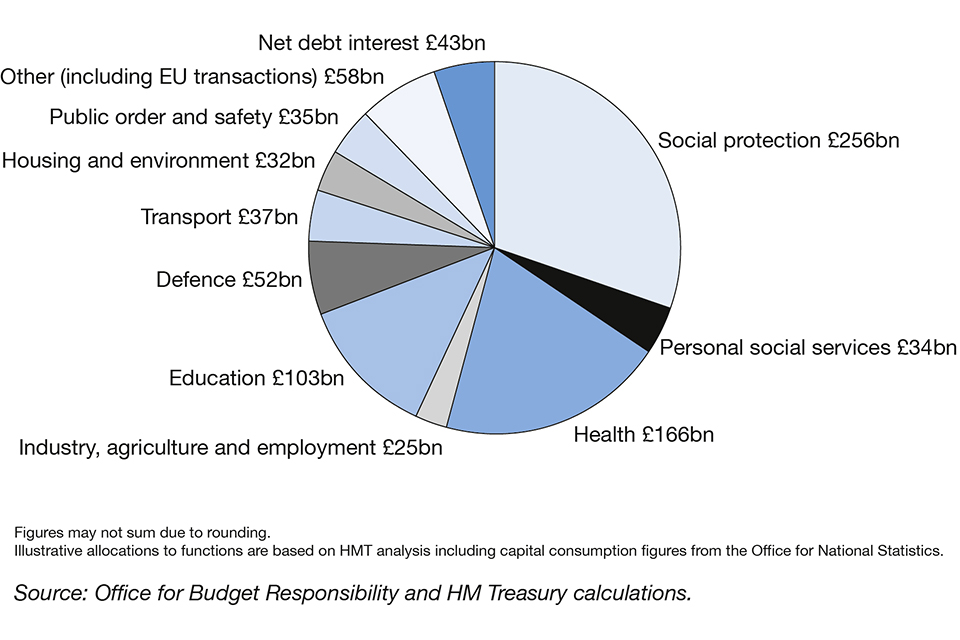
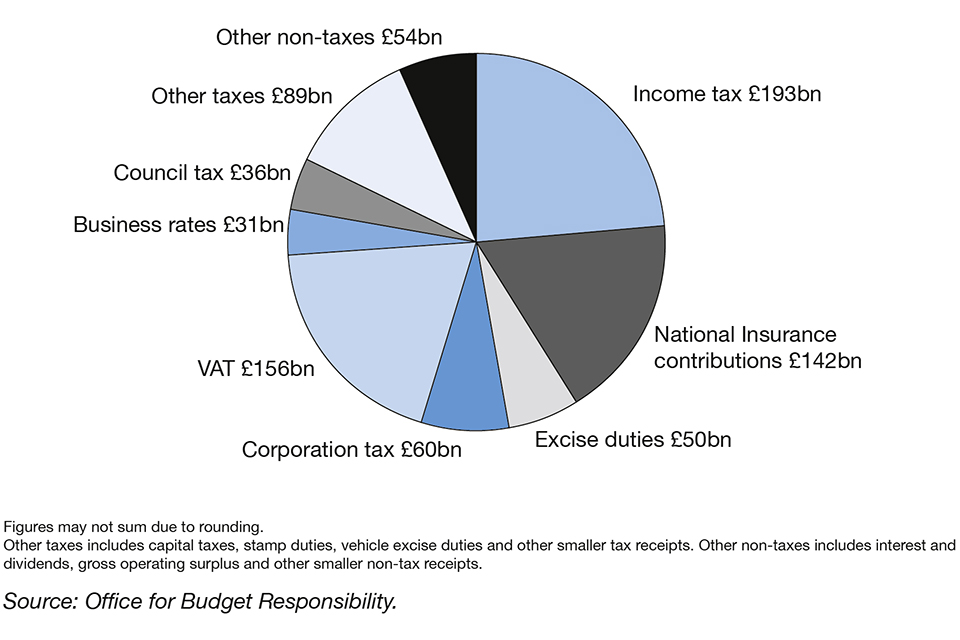
Chart 2 shows the different sources of government revenue. Public sector current receipts are expected to be about £810 billion in 2019-2020.
Chart 2: Public sector current receipts 2019-20
2. Economy and public finances
2.1 Economic context
The UK economy has solid foundations and a strong record to build on. It has grown every year since 2010.1 Employment has risen over the last year, breaking records repeatedly. Since 2010, there are 3.3 million more people in work, and 80% of the rise in employment has been driven by people moving into full-time work. Pay growth (excluding bonuses) is at its joint strongest since 2008 and real wages have risen, as inflation has fallen from its 2017 peak. The unemployment rate has fallen further and at 4.0% is the lowest rate since 1975. The UK continues to be one of the top ten countries in the world for the competitiveness of its economy and remains an attractive destination for inward investment.
In the long term, higher productivity remains the only path to sustainable growth and rising living standards. The government has already taken significant steps to improve productivity with public investment set to average 2.2% of Gross Domestic Product (GDP) over the next five years – levels not consistently sustained in 40 years – supported by the establishment of the NPIF.2 Productivity growth has picked up, and in the year to Q2 2018 grew at its fastest rate since late 2016, but remains below its average prior to the financial crisis. The Budget goes further to build a successful, innovative and prosperous economy, including by increasing the NPIF to £37 billion for areas critical to productivity: housing, transport, digital infrastructure, and R&D.
The OBR expects the UK economy to continue to grow in every year of the forecast, and has revised up its forecast for cumulative growth compared with Spring Statement 2018. The OBR has revised up its estimate of the potential output of the UK economy slightly compared with Spring Statement 2018, due to updated judgements on two of its components – revising up its expectations for labour market activity rates and revising down its assessment of the equilibrium rate of unemployment from 4.6% to 4.0% at the end of the forecast. The OBR’s forecast for trend average hours has also been revised down slightly, which partly offsets this effect. Compared with Spring Statement 2018, the level of employment is expected to be higher in every year of the forecast.
The OBR has not attempted to predict the precise outcome of negotiations with the EU. Instead, it has made broad-brush assumptions, which have not changed since Autumn Statement 2016. However, the OBR has included a transition period in its forecast of exports and imports for the first time. This postpones the point at which EU exit affects imports and exports to 2021.
2.2 Global economy
Global growth remained solid in the first half of 2018, with G20 GDP growth of 1.0% in Q2 2018, up from 0.9% in the previous two quarters. Momentum in the US economy remains strong, but growth in the euro area has moderated, and developments in emerging economies have been mixed. The OBR forecasts that global growth will be 3.7% in 2018 and in 2019, 0.2 percentage points lower in both years than at Spring Statement 2018. Downside risks have risen, as trade tensions have increased and financial conditions have tightened in emerging economies.
2.3 UK economy
The Office for National Statistics (ONS) estimates that the UK economy grew by 1.7% in real terms in 2017. Growth slowed at the start of 2018 to 0.1% in Q1 2018, but increased to 0.4% in Q2 2018. Q1 2018 was weaker than the OBR expected in its Spring Statement 2018 forecast, but Q2 2018 was in line with its expectations.
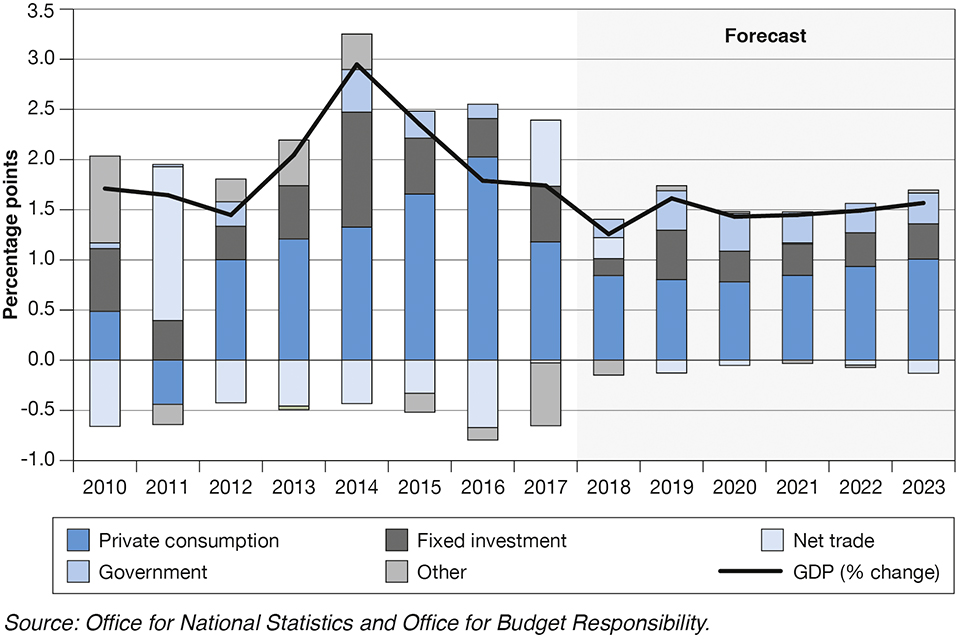
The OBR forecasts that GDP will grow by 0.5% in Q3 2018 and 0.4% in Q4 2018, and expects annual GDP growth of 1.3% in 2018 and 1.6% in 2019. GDP growth dips slightly to 1.4% in 2020 and 2021, and then increases to 1.6% by 2023 (Chart 1.1).
Chart 1.1 UK GDP – Contributions to annual GDP growth
Household consumption growth was 1.8% in 2017. In the first six months of 2018 household consumption grew by 0.8%, up slightly on the second half of 2017. The OBR’s forecast for consumption growth has been revised up in the near term, due to a stronger forecast for employment growth. Consumption growth is expected to dip slightly from 1.3% in 2018 to 1.2% in 2019 and 2020, before rising gradually to 1.5% in 2023.
Business investment grew by 1.8% in 2017, but has subsequently fallen by 0.5% in Q1 2018 and by 0.7% in Q2 2018. The OBR expects business investment to grow by 0.5% in 2018, before rising by 2.3% in 2019. Thereafter, business investment is forecast to grow by around 2.1% a year.
In 2017, export and import volumes grew by 5.7% and 3.2% respectively. Since export growth exceeded that of imports, net trade contributed positively to GDP growth, adding 0.7 percentage points in 2017. In the first half of 2018, both export and import volumes have declined, though imports have declined by less. As a result, net trade has made a negative contribution to quarterly GDP growth over this period. The OBR has revised down its forecast for the contribution of net trade to GDP growth in the near term, although it still expects net trade to make a positive contribution to GDP growth in 2018 of 0.2 percentage points. The OBR then expects net trade to subtract 0.1 percentage points from GDP growth in 2019 and 2020. Net trade makes no contribution to GDP growth in 2021 and 2022, and then subtracts 0.1 percentage points from GDP growth in 2023.
2.4 Prices
Consumer Prices Index (CPI) inflation stood at 2.4% in September, a decrease from August’s figure of 2.7%, and below its recent peak of 3.1% in November 2017. CPIinflation fell at the start of 2018; was steady from April to June at 2.4%; but increased in July and August, in part due to developments in global energy prices. The ONS’s headline measure of inflation, the Consumer Prices Index including owner occupiers’ housing costs (CPIH) inflation, was 2.2% in September, a slight decrease from 2.4% in August.3 The OBR forecasts CPI inflation to be 2.6% in 2018 and it is then expected to be around 2.0% for the rest of the forecast period.
Box 1.A: The government’s use of inflation indices
The government and the private sector make wide use of measures of inflation. The government uses measures of inflation to uprate some taxes and benefits; to determine changes in rail fares, reflecting industry costs; to uprate the rate of interest on student loans; when setting the inflation target for the Bank of England; and as the reference rate for government bonds linked to inflation. In the private sector, inflation is used in some wage agreements; to uprate certain pension payments, particularly defined benefit pensions; and in financial markets. However, there is not a single measure of inflation and the quality of different measures varies.
The ONS, regulated by the UK Statistics Authority (UKSA), produces a range of inflation statistics. The most widely used are CPI and the Retail Prices Index (RPI). Despite measuring the same concept, they use different methodologies and produce different estimates of the rate of inflation. In 2013, as a result of flaws in the way it is measured, RPI lost its status as a National Statistic.(a) In 2015, the Johnson Review recommended that government and regulators should work towards ending the use of RPI as soon as practicable.(b)
Since 2010, the government has been reducing its use of RPI. The indexation of direct taxes, benefits, public sector pensions and the State Pension have all moved from RPIto CPI. More recently, the government changed the indexation of business rates to CPIfrom April 2018, and NS&I has announced it will change the indexation of maturing Index-linked Savings Certificates to CPI from May 2019.
Given the extensive use of RPI across the public and private sectors, moves away from RPI are complex and potentially costly. For instance, switching the remaining uses of RPI to CPI for indirect taxes would come with substantial costs for the Exchequer. At the same time, the prices statistics landscape has evolved. Therefore, it has at times been unclear which measure of inflation it would be appropriate to use. In 2013, the ONS started publishing CPIH. After extensive statistical development, CPIH became the ONS’s main measure of inflation in March 2017 and gained National Statistic status from the UKSA in July that year.(c)
The government’s objective is that CPIH will become its headline measure over time and that it will reduce the use of RPI when and where practicable. CPIH is conceptually the best measure of inflation, but is relatively new and work is ongoing to understand its properties compared to CPI and RPI. As previously stated, while all index-linked debt is currently indexed to RPI, the government keeps issuance of potential new debt instruments under review.(d) Further moves away from RPI are complex and more work is required to understand the costs and benefits of any changes, including through consultation with stakeholders. Any changes will require an orderly transition, likely over an extended period of time. Until then, the government will not introduce new uses of RPI.
a ‘Assessment of the Compliance with the Code of Practice for Official Statistics’, UKSA, 2013.
b ‘UK Consumer Price Statistics: A Review’, Paul Johnson, UKSA, 2015.
c ‘Letter from Ed Humpherson, Director General for Regulation, UKSA, to John Pullinger, National Statistician’, UKSA, 2017.
d ‘Managing fiscal risks: government response to the 2017 Fiscal risks report’, HM Treasury, 2018.
2.5 Productivity, labour markets and earnings
UK labour productivity (measured as output per hour) has picked up recently and grew by 0.8% in 2017. Productivity was subdued at the start of 2018, falling in the first quarter, but rose in Q2 2018, due to higher output and a slight fall in hours worked. Quarterly movements can be volatile and on a more stable quarter-on-year basis, productivity grew by 1.4% in the year to Q2 2018 – its fastest quarter-on-year growth rate since Q4 2016, but remaining below its average prior to the financial crisis of 2.2%.
The OBR forecasts productivity growth of 0.8% in 2018 and 2019.4 Over the medium term, productivity growth is expected to increase to 0.9% in 2020, and then to 1.2% in 2023.
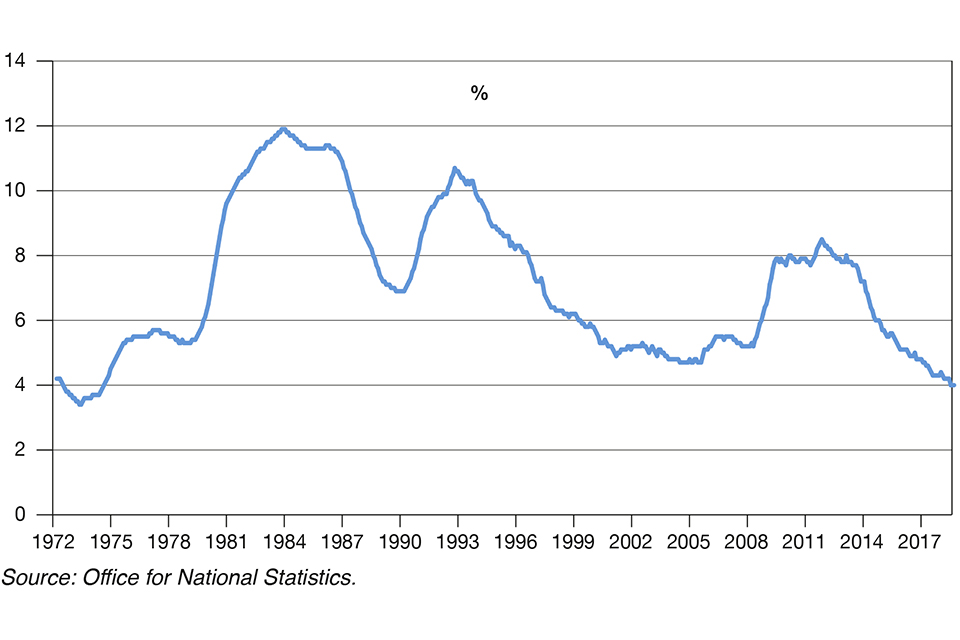
Employment levels have continued to increase in 2018, reaching a new record high in the three months to May 2018, and have remained around this level since. Employment was 32.4 million in the three months to August 2018, close to its highest ever level. The unemployment rate has fallen further and now stands at 4.0%, the lowest rate since 1975 (Chart 1.2).
Chart 1.2 Unemployment rate (16+)
The OBR has revised up its assumption for the trend labour market participation rate and revised down its estimate of the equilibrium rate of unemployment, both of which raise the level of potential output. The OBR’s forecast of average hours has been revised down, which partly offsets this effect. The OBR’s expectation of trend productivity growth remains broadly unchanged. Taken together, potential output is higher across the forecast. With higher potential output, the OBR expects a higher level of employment in every year of the forecast, reaching 33.2 million by 2023. The OBRhas revised down the actual unemployment rate in every year of the forecast, which is expected to be 4.0% in 2018 and to remain at this rate or lower until the end of the forecast period.
Total nominal wage growth (including bonuses) and regular nominal wage growth (excluding bonuses) were 2.7% and 3.1% in the three months to August 2018 respectively. Over the same period, real total pay growth increased slightly to 0.2% and real regular pay growth rose to 0.5%; the sixth consecutive month in which it has been positive. The OBR forecasts average earnings to grow by 2.6% in 2018 and 2.5% in 2019, before rising to 2.8% in 2020.5 Average earnings growth is then forecast to increase further to 3.2% in 2023.
The ONS estimates that real household disposable income (RHDI) per head, the main measure of living standards, is 4.0% higher in Q2 2018 than at the start of 2010. In 2016-17, income inequality was lower than it was in 2010, and close to its lowest point since 1986. The OBR expects RHDI per head to increase 3.2% by the end of 2023.6
Table 1.1: Summary of the OBR’s central economic forecast (percentage change on year earlier, unless otherwise stated) (1)
| Forecast | |||||||
|---|---|---|---|---|---|---|---|
| 2017 | 2018 | 2019 | 2020 | 2021 | 2022 | 2023 | |
| GDP growth | 1.7 | 1.3 | 1.6 | 1.4 | 1.4 | 1.5 | 1.6 |
| GDP growth per capita | 1.1 | 0.6 | 1.0 | 0.9 | 0.9 | 1.0 | 1.1 |
| Main components of GDP | |||||||
| Household consumption (2) | 1.8 | 1.3 | 1.2 | 1.2 | 1.3 | 1.4 | 1.5 |
| General government consumption | -0.1 | 1.0 | 2.1 | 2.0 | 1.7 | 1.6 | 1.6 |
| Fixed investment | 3.3 | 1.0 | 2.9 | 1.8 | 1.8 | 1.9 | 2.0 |
| Business | 1.8 | 0.5 | 2.3 | 2.1 | 2.1 | 2.1 | 2.2 |
| General government | 1.7 | -0.2 | 5.7 | 3.3 | 1.8 | 0.9 | 1.4 |
| Private dwellings (3) | 8.1 | 7.0 | 3.0 | -0.1 | 0.8 | 2.3 | 1.9 |
| Change in inventories (4) | -0.5 | -0.2 | 0.1 | 0.0 | 0.0 | 0.0 | 0.0 |
| Net trade (4) | 0.7 | 0.2 | -0.1 | -0.1 | 0.0 | 0.0 | -0.1 |
| CPI inflation | 2.7 | 2.6 | 2.0 | 2.0 | 2.1 | 2.1 | 2.0 |
| Employment (millions) | 32.1 | 32.4 | 32.7 | 32.9 | 33.0 | 33.1 | 33.2 |
| LFS unemployment (% rate) (5) | 4.4 | 4.0 | 3.7 | 3.8 | 3.9 | 3.9 | 4.0 |
| Productivity per hour | 0.8 | 0.8 | 0.8 | 0.9 | 1.0 | 1.1 | 1.2 |
| 1 All figures in this table are rounded to the nearest decimal place. This is not intended to convey a degree of unwarranted accuracy. Components may not sum to total due to rounding and the statisitical discrepancy. |
| 2 Includes households and non-profit institutions serving households. |
| 3 Includes transfer costs of non-produced assets. |
| 4 Contribution to GDP growth, percentage points. |
| 5 Labour Force Survey. |
| Source: Office for National Statistics and Office for Budget Responsibility. |
2.6 Current account
The current account balance consists of the trade balance, the primary income balance, which is mainly net investment income, and finally, other transfers. In 2017, the current account balance narrowed to a deficit of 3.7% of GDP from 5.2% in 2016. The main reason for the narrowing in the current account deficit was the largest annual improvement in the primary income balance since records began in 1946; this narrowed to a deficit of 1.6% of GDP in 2017 from 2.5% of GDP. In Q2 2018, the current account deficit widened to 3.9% of GDP from 3.0% of GDP in Q1 2018. The OBR expects the current account deficit to narrow to 3.5% in 2018 and to widen to 3.8% in 2019. The current account deficit then narrows to 3.2% in 2023.
2.7 Monetary policy
The Monetary Policy Committee (MPC) of the Bank of England has full operational independence to set monetary policy. The MPC sets monetary policy to meet the 2% inflation target, and in a way that helps to sustain growth and employment. It is therefore a critical element of the UK’s macroeconomic framework.
Low and stable inflation supports living standards and provides certainty for households and businesses. This helps households and businesses make efficient decisions about saving, investment and spending. At its meeting concluding on 12 September, the MPC voted to maintain its policy rate at 0.75%, having increased it from 0.5% in August.7
The Chancellor is responsible for setting the MPC’s remit. In the Budget, the Chancellor reaffirms the symmetric inflation target of 2% for the 12-month increase in the CPI measure of inflation, which applies at all times.8 The government also confirms that the Asset Purchase Facility (APF) will remain in place for the financial years 2018-19 and 2019‑20.
2.8 Public finances
The government has taken a balanced approach to the public finances since 2016, focusing on getting debt falling, while supporting public services, investing in the economy and keeping taxes low. This followed the necessary actions since 2010 to restore the public finances to health, and the deficit has been reduced by four-fifths from a post-war high of 9.9% of GDP in 2009-10 to 1.9% in 2017-18.9 The public finances have now reached a turning point. The government has met its near-term fiscal rules and debt has begun its first sustained fall in a generation.
The need for fiscal discipline continues as, despite the improvement, debt currently remains too high at over 80% of GDP or around £65,000 per household.10 Spending on debt interest, if it were a ministry, would be the third-largest government department after health and education.11 Continuing to reduce borrowing and debt is important to enhancing the UK’s economic resilience, improving fiscal sustainability, and lessening the debt interest burden on future generations.
The fiscal rules approved by Parliament in January 2017 commit the government to reducing the cyclically-adjusted deficit to below 2% of GDP by 2020-21 and having debt as a share of GDP falling in 2020-21.12 These rules will guide the UK towards a balanced budget by the middle of the next decade. The OBR forecasts that the government has met both its near‑term fiscal targets in 2017-18, three years early, and will meet them in the target year.
The Budget continues the government’s balanced approach to fiscal policy; continuing to reduce debt, while also supporting vital public services, keeping taxes low and investing in Britain’s future. Before measures announced in the Budget, the OBR’s forecast shows a significant improvement to the underlying fiscal outlook since Spring Statement 2018. This improvement has allowed the government, in the Budget, to fund the five‑year NHS settlement, increase day-to-day spending on public services in real terms, cut taxes for millions of households, whilst reducing borrowing and keeping debt falling in every year of the forecast. Borrowing and debt are now forecast to be lower in every year than at Spring Statement, and headroom against the fiscal mandate has been maintained at £15.4 billion in the target year.
2.9 The fiscal outlook
The public finances have performed significantly better than forecast in March 2018. Compared with the Spring Statement 2018 forecast, public sector net borrowing (PSNB) was £5.4 billion lower at 1.9% of GDP in 2017-18 due mainly to lower spending than forecast.13 Strong and broad‑based receipts growth in the first half of 2018-19 has helped reduce forecast borrowing by £11.6 billion compared with Spring Statement to 1.2% of GDP this year. Public sector net debt (PSND) has now peaked as a share of GDPat 85.2% in 2016-17 and falls to 83.7% this year, 1.8% of GDP below the Spring Statement forecast.14
This stronger starting fiscal position coupled with higher forecast levels of employment has improved the fiscal outlook in every year of the forecast. Compared with Spring Statement, the main changes to the forecast are due to a combination of the following factors:
- underlying receipts are higher in every year of the forecast. Excluding a broadly fiscally neutral change in the treatment of Value Added Tax (VAT) refunds by the ONS, receipts are higher by £7.4 billion in 2018-19 and £14.1 billion by 2022-23.15This primarily reflects strong outturn data since April 2018 and higher levels of employment across the forecast compared to Spring Statement 2018.
- underlying spending is forecast to be £4.5 billion lower in 2018-19 and £4.1 billion lower in 2022-23, excluding ONS’ treatment of VAT refunds. The lower spending is due to downward revisions to the forecasts for welfare spending (due to lower unemployment), debt interest and tax litigation compared to Spring Statement.
- classification and other changes reduce borrowing by £0.8 billion in 2018-19 and £1.2 billion in 2022-23, predominantly because of the reclassification of Welsh and Scottish Housing Associations and the improvement to the recording of fines and penalties for the late payment of taxes.16
- measures taken by the government in the Budget, and described in Chapter 2, increase borrowing by £1.1 billion in 2018-19 and by £18.8 billion in 2022-23.
Table 1.2: Changes to the OBR’s forecast for public sector net borrowing since March 2018 (£ billion)
| 2018-19 | 2019-20 | 2020-21 | 2021-22 | 2022-23 | |
|---|---|---|---|---|---|
| Spring Statement 2018 | 37.1 | 33.9 | 28.7 | 26.0 | 21.4 |
| Total forecast changes since Spring Statement 2018 (1) | -12.7 | -13.1 | -12.8 | -15.9 | -19.3 |
| of which | |||||
| Receipts forecast | -7.4 | -8.0 | -8.0 | -11.2 | -14.1 |
| Spending forecast | -4.5 | -4.1 | -3.7 | -3.5 | -4.1 |
| Classification and other changes (including net VAT refund change) | -0.8 | -1.1 | -1.1 | -1.2 | -1.2 |
| Total effect of government decisions since Spring Statement 2018 | 1.1 | 10.9 | 10.7 | 13.7 | 18.8 |
| Total changes since Spring Statement 2018 | -11.6 | -2.1 | -2.1 | -2.2 | -0.6 |
| Budget 2018 | 25.5 | 31.8 | 26.7 | 23.8 | 20.8 |
| Figures may not sum due to rounding. |
| 1 Equivalent to lines from Table 1.3 of the OBR (October 2018) ‘Economic and fiscal outlook’; full references available in ‘Autumn Budget 2018 data sources’. |
| Source: Office for Budget Responsibility and HM Treasury calculations. |
Compared with Spring Statement, borrowing is lower in every year of the forecast and falls as a share of GDP from 1.4% in 2019-20 to 0.8% of GDP in 2023-24, its lowest level since 2001-02.17 The ONS’ outturn data show the UK’s Treaty deficit was 2.0% of GDP in 2017‑18,18 below the 3.0% of GDP target agreed in the Stability and Growth Pact.19 The OBR forecasts it will remain below 3.0% of GDP during the forecast period.
Table 1.3: Overview of the OBR’s borrowing forecast as a percentage of GDP
| Outturn | Forecast | ||||||
|---|---|---|---|---|---|---|---|
| 2017-18 | 2018-19 | 2019-20 | 2020-21 | 2021-22 | 2022-23 | 2023-24 | |
| Public sector net borrowing | 1.9 | 1.2 | 1.4 | 1.2 | 1.0 | 0.9 | 0.8 |
| Cyclically-adjusted public sector net borrowing | 1.9 | 1.3 | 1.6 | 1.3 | 1.1 | 0.9 | 0.8 |
| Treaty deficit (1) | 2.0 | 1.3 | 1.5 | 1.3 | 1.3 | 0.9 | 0.7 |
| Memo: Output gap (2) | 0.1 | 0.3 | 0.3 | 0.2 | 0.1 | 0.1 | 0.1 |
| 1 General government net borrowing on a Maastricht basis. |
| 2 Output gap measured as a percentage of potential GDP. |
| Source: Office for National Statistics and Office for Budget Responsibility. |
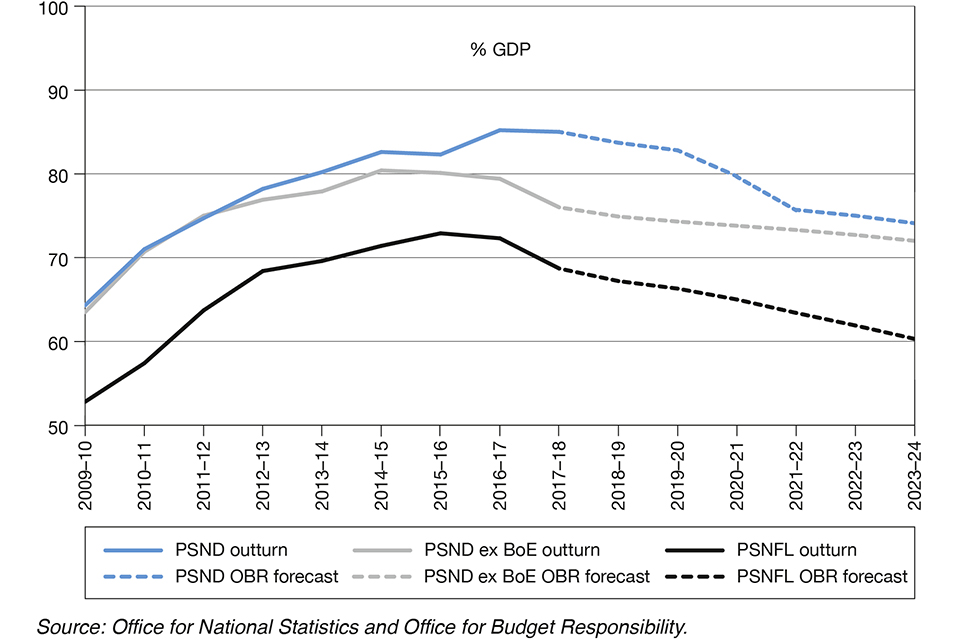
Compared with Spring Statement, debt is also lower in every year of the forecast as a share of GDP. Debt peaked at over 85% of GDP in 2016-17 and is forecast to fall in every year of the forecast, reaching 74.1% of GDP in 2023‑24.20 Public sector net debt excluding the Bank of England (PSND ex BoE) is forecast to decline in every year from 76.0% of GDP last year, to 72.0% of GDP in 2023‑24. Public sector net financial liabilities (PSNFL) is also forecast to continue to fall in every year from 68.7% of GDPlast year to 60.3% of GDP in 2023‑24.
Table 1.4: Overview of the OBR’s debt forecast as a percentage of GDP
| Outturn (3) | Forecast | ||||||
|---|---|---|---|---|---|---|---|
| 2017-18 | 2018-19 | 2019-20 | 2020-21 | 2021-22 | 2022-23 | 2023-24 | |
| Public sector net debt (1) | 85.0 | 83.7 | 82.8 | 79.7 | 75.7 | 75.0 | 74.1 |
| Public sector net debt ex Bank of England (1) | 76.0 | 74.9 | 74.3 | 73.8 | 73.3 | 72.7 | 72.0 |
| Public sector net financial liabilities (1) | 68.7 | 67.2 | 66.3 | 65.0 | 63.4 | 61.9 | 60.3 |
| Treaty debt (2) | 85.6 | 85.0 | 84.1 | 83.2 | 82.7 | 81.8 | 80.8 |
| 1 Debt and liabilities at end of March; GDP centred on end of March. |
| 2 General government gross debt on a Maastricht basis. |
| 3 Nominal Q3 2018 GDP has not yet been published therefore GDP centred on end of March is an estimate. |
| Source: Office for National Statistics and Office for Budget Responsibility. |
Box 1.B: Managing fiscal risks
In July 2017, the OBR published their first biennial ‘Fiscal risks report’ (FRR), providing the UK’s first ever survey of the risks to the public finances.21 It was recognised by the International Monetary Fund (IMF), OECD, and other experts as the most comprehensive report of its kind and the only one produced by an independent body. The report highlighted 57 different risks to the UK’s public finances, relating to the macroeconomy, financial sector, and government revenue, spending and the balance sheet.
In July 2018, in line with its commitments under the Charter for Budget Responsibility, the government published ‘Managing fiscal risks’ (MFR) which provides a detailed account of the actions that the government is taking to address the risks identified by the OBR.22 In doing so, the report provides a mechanism for Parliament and the public to assess the government’s strategies for managing these risks, and hold it to account for their implementation. Its publication reaffirms the UK’s place at the international frontier of fiscal transparency and accountability and supports the government’s long-term fiscal strategy.
MFR highlights the range of policy and management reforms the government has introduced to reduce risks to the fiscal outlook. This includes stronger regulation to reduce the likelihood and cost of financial crises, adapting the tax system to a rapidly changing global economy, ensuring the pension system keeps pace with increasing longevity, tighter controls over the issuance of government loans and guarantees, and actions to reduce the government’s inflation exposure.
Drawing on the fiscal stress test included in the OBR’s FRR, the report also underscores the need to continue to make progress in reducing debt. Governments with high levels of debt are more vulnerable to economic shocks and have less room to mitigate their impact on households and businesses, with consequences for the length and depth of the resulting recessions. Reducing debt also ensures that taxpayers’ money funds vital public services rather than debt interest payments, and avoids burdening the next generation.
2.10 Performance against the fiscal rules
The Charter for Budget Responsibility, approved by Parliament in January 2017, sets out the government’s fiscal rules. The government’s objective for fiscal policy is to return the public finances to balance by the middle of the next decade, with interim targets to reduce the cyclically-adjusted deficit to below 2% of GDP by 2020-21 (the fiscal mandate), and to get debt falling as a share of GDP in 2020-21 (the supplementary debt target).
2.11 The fiscal mandate
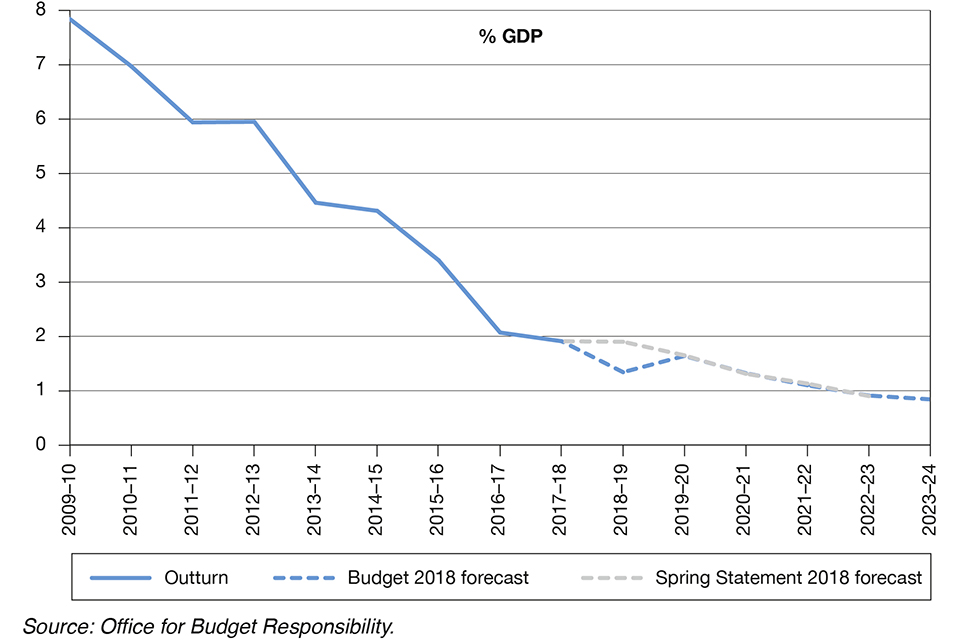
The OBR’s ‘Economic and fiscal outlook’ shows that the government is forecast to have met the 2% cyclically-adjusted deficit rule three years early in 2017-18, with cyclically-adjusted borrowing at 1.3% of GDP in the target year of 2020-21. Compared with the Spring Statement, cyclically-adjusted borrowing is the same or lower in every year of the forecast. The OBR judges that on current policy, the government has a 65% chance of achieving the fiscal mandate in 2020-21. Given uncertainties in the fiscal outlook the government has retained £15.4 billion of headroom in the target year.
Chart 1.3 Cyclically-adjusted public sector net borrowing (CAPSNB)
2.12 The supplementary debt target
The OBR’s forecast also shows that the government has met its supplementary debt target three years early in 2017-18. Debt continues to fall as a share of GDP in every year of the forecast with £73.3 billion of headroom in 2020-21, £4.9 billion more than at Spring Statement.23
Chart 1.4 Public sector debt
2.13 Welfare cap
The government is committed to ensuring the welfare system is put on a sustainable footing. The welfare cap is a key means of managing the government’s total welfare spend. The cap limits the amount that government can spend on certain social security benefits and tax credits. Between 1980 and 2014 spending on working-age welfare trebled in real terms.24 The welfare cap, which was designed to improve Parliamentary accountability of welfare spending, was reset at Autumn Budget 2017, following the OBR’s judgement that the government successfully met the terms of the previous welfare cap set at Autumn Statement 2016.
The cap is based on the OBR’s forecast of the benefits and tax credits within its scope at Autumn Budget 2017, and will apply to welfare spending in 2022-23. To manage unavoidable fluctuations in welfare spending there is a margin rising to 3% above the cap by 2022‑23; the cap will only be breached if spending exceeds the cap plus the margin at the point of assessment.
In the interim years (2018-19 to 2021-22), progress towards the cap will be managed internally, based on monitoring by HM Treasury and the Department for Work and Pensions (DWP) of the OBR’s forecasts of welfare spending. The OBR’s forecast of the level of welfare spending against the cap is set out in its ‘Economic and fiscal outlook’, October 2018.
In accordance with the Charter for Budget Responsibility, the level of the welfare cap and pathway has been adjusted to reflect the fiscally neutral classification changes that occurred because of retaining funding for supported housing in the welfare system and the devolution of Carer’s Allowance to Scotland.
The OBR judges that on current policy, welfare spending within scope is forecast to be within the welfare cap and margin in every year of the forecast. The government is providing additional support for Universal Credit in the Budget, as set out in Chapter 5.
2.14 Public spending
The balanced approach to fiscal policy taken by the government means it has been able to reduce debt and keep taxes low, while investing in the economy and funding the public’s priorities.
Since 2016, this has allowed the government to provide additional support to public services. This includes: the lifting of the public sector pay cap;25 the provision of over £44 billion of new financial support for housing between 2017-18 and 2022-23 announced at Autumn Budget 2017;26 and over £42 billion of core funding for schools this year.27
In June 2018, the government announced a substantial five-year settlement for the NHS in England, under which the NHS England budget would increase by £20.5 billion a year in real terms by 2023-24.28 The Budget confirms the cash allocations announced in June.29 In addition, the government has made provision for NHS pension costs until 2023-24, which will be adjusted in line with the confirmed Superannuation Contributions Adjusted for Past Experience (SCAPE) rate change. Devolved administrations will benefit from Barnett consequentials. Chapter 5 provides further detail of the funding and financial tests the government has put in place to ensure the NHS spends this additional money effectively.
Spending Review 2015 set individual budgets for all departments. Departmental capital totals (CDEL), the money given to departments for investment, are set until 2020-21, as shown in Table 1.5. Departmental resource totals (RDEL), the money given to departments to spend on day-to-day resources and administration, are set until 2019-20, as shown in Table 1.6.
Table 1.5: Departmental Capital Budgets (Capital DEL)
| £ billion | |||
|---|---|---|---|
| 2018-19 | 2019-20 | 2020-21 | |
| Capital DEL | |||
| Defence | 9.4 | 9.8 | 9.6 |
| Single Intelligence Account | 0.6 | 0.7 | 0.7 |
| Home Office | 0.5 | 0.5 | 0.4 |
| Foreign and Commonwealth Office | 0.1 | 0.1 | 0.1 |
| International Development | 2.7 | 3.7 | 3.6 |
| Health (inc. NHS) | 5.9 | 6.7 | 6.8 |
| Work and Pensions | 0.3 | 0.2 | 0.2 |
| Education | 5.6 | 5.1 | 4.5 |
| Business, Energy and Industrial Strategy (1) | 10.3 | 11.5 | 6.3 |
| Transport (2) | 8.5 | 15.8 | 18.4 |
| Exiting the European Union | 0.0 | 0.0 | 0.0 |
| Digital, Culture, Media and Sport | 0.6 | 0.6 | 0.5 |
| MHCLG Housing and Communities | 9.5 | 10.8 | 10.8 |
| MHCLG Local Government | 0.0 | 0.0 | 0.0 |
| Scotland | 3.9 | 4.5 | 4.9 |
| Wales | 2.0 | 2.1 | 2.2 |
| Northern Ireland | 1.6 | 1.5 | 1.5 |
| Justice | 0.6 | 0.4 | 0.1 |
| Law Officers Departments | 0.0 | 0.0 | 0.0 |
| Environment, Food and Rural Affairs | 0.6 | 0.6 | 0.6 |
| HM Revenue and Customs | 0.2 | 0.2 | 0.2 |
| HM Treasury | 0.2 | 0.3 | 0.1 |
| Cabinet Office | 0.0 | 0.0 | 0.0 |
| International Trade | 0.0 | 0.0 | 0.0 |
| Small and Independent Bodies | 0.3 | 0.4 | 0.1 |
| Reserves | 1.2 | 2.2 | 2.0 |
| Adjustment for Budget Exchange (3) | -0.8 | 0.0 | 0.0 |
| Adjustment for R&D RDEL to CDEL switch (4) | 0.0 | 0.0 | 6.5 |
| Total Capital DEL | 63.7 | 77.7 | 80.1 |
| Remove CDEL not in public sector gross investment (5) | -11.3 | -13.4 | -12.1 |
| OBR allowance for shortfall (6) | -2.2 | -2.7 | -2.5 |
| Public Sector Gross Investment in CDEL | 50.2 | 61.6 | 65.5 |
| 1 Full BEIS capital DEL budgets for 2020-21 have not yet been set. See footnote 4. |
| 2 From 2019-20 Transport DEL includes funding for expenditure by Network Rail. This was formerly part of Department for Transport’s Annually Managed Expenditure (AME) budget. |
| 3 Departmental budgets in 2018-19 include amounts carried forward from 2017-18 through Budget Exchange, which will be voted at Main Estimates. These increases will be offset at Supplementary Estimates in future years so are excluded from spending totals. |
| 4 As most departmental RDEL budgets have not been set in 2020-21, the OBR has forecast the size of the resource to capital switch for R&D that will take place in that year. |
| 5 Capital DEL that does not form part of public sector gross investment, including financial transactions in capital DEL. |
| 6 The OBR‘s forecast of underspends in capital DEL budgets. |
Table 1.6: Departmental Resource Budgets (Resource DEL excluding depreciation)
| £ billion | |||
|---|---|---|---|
| 2018-19 | 2019-20 | ||
| Resource DEL excluding depreciation (1) | |||
| Defence | 28.4 | 29.0 | |
| Single Intelligence Account (2) | 2.2 | 2.0 | |
| Home Office | 10.8 | 10.7 | |
| Foreign and Commonwealth Office (3) | 2.2 | 1.2 | |
| International Development (3,4) | 7.7 | 8.2 | |
| Health (inc. NHS) | 123.3 | 129.6 | |
| of which: NHS England | 114.6 | 121.8 | |
| Work and Pensions | 6.0 | 5.4 | |
| Education | 62.5 | 63.5 | |
| Business, Energy and Industrial Strategy | 1.7 | 1.8 | |
| Transport (5) | 2.1 | 2.9 | |
| Exiting the European Union | 0.1 | 0.1 | |
| Digital, Culture, Media and Sport | 1.5 | 1.5 | |
| MHCLG Housing and Communities | 2.6 | 2.3 | |
| MHCLG Local Government | 4.7 | 5.9 | |
| Scotland (6) | 14.7 | 15.7 | |
| Wales (7) | 13.3 | 11.6 | |
| Northern Ireland | 10.3 | 10.3 | |
| Justice | 6.3 | 6.0 | |
| Law Officers Departments | 0.6 | 0.6 | |
| Environment, Food and Rural Affairs | 1.6 | 1.5 | |
| HM Revenue and Customs | 3.4 | 3.2 | |
| HM Treasury | 0.2 | 0.2 | |
| Cabinet Office | 0.4 | 0.3 | |
| International Trade | 0.4 | 0.3 | |
| Small and Independent Bodies | 1.5 | 1.3 | |
| Reserves (8) | 5.2 | 12.3 | |
| Adjustment for Budget Exchange (9) | -0.6 | -0.4 | |
| Total resource DEL excluding depreciation | 313.0 | 327.0 | |
| OBR allowance for shortfall (10) | -2.2 | -1.7 | |
| OBR resource DEL excluding depreciation forecast | 310.8 | 325.4 | |
| 1. Resource DEL excluding depreciation is the Treasury’s primary control total within resource budgets and the basis on which Spending Review settlements were made. |
| 2. The SIA budget in 2018-19 includes transfers from other government departments, which have yet to be reflected in later years. |
| 3. Figures for 2019-20 do not reflect all transfers which will made from DfID to other government departments, as the cross government funds have not been allocated for that year. |
| 4. Figures reflect Budget 2018 adjustments made as a result of revised GNI forecasts, as well as previous adjustments made at Autumn Budget 2017 and Autumn Statement 2016. |
| 5. From 2019-20 Transport DEL includes funding for expenditure by Network Rail. This was formerly part of Department for Transport’s Annually Managed Expenditure (AME) budget. |
| 6. The Scottish Government’s resource DEL block grant has been adjusted from 2016-17 onwards as agreed in the Scottish Government’s Fiscal Framework. The adjustment accounts for the devolution of Stamp Duty Land tax and Landfill Tax in 2016-17; Income tax powers and revenues from Scottish courts in 2017-18; and Carers Allowance in 2018-19. Expenditure by the Scottish Government, funded by the block grant and devolved taxes, is now included within the OBR‘s AME forecasts. |
| 7. The Welsh Government’s resource DEL block grant has been adjusted from 2018-19 onwards as agreed in the Welsh Government’s Fiscal Framework. In 2018-19 an adjustment reflects the devolution of Stamp Duty Land Tax and Landfill Tax and in 2019-20 a further adjustment reflects the devolution of the Welsh Rates of Income Tax. |
| 8. The reserve in 2018-19 reflects allocations made at Main Estimates and Budget 2018. In 2019-20 it includes provision for additional pension costs for departments, as a result of the SCAPE rate change. |
| 9. Departmental budgets in 2018-19 and 2019-20 include amounts carried forward from 2017-18 through Budget Exchange, which will be voted at Main Estimates. These increases will be offset at Supplementary Estimates in future years so are excluded from spending totals. |
| 10. The OBR‘s forecast of underspends in resource DEL budgets. |
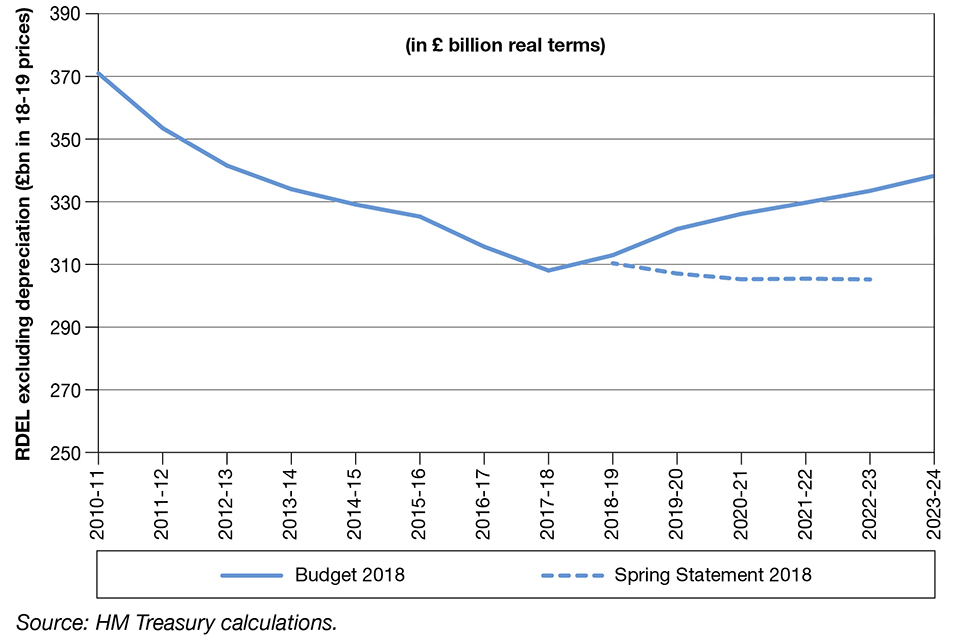
The Budget also sets out the path of day-to-day spending by departments in aggregate for years beyond the current Spending Review period. From 2019-20 to 2023-24, RDEL spending, including the NHS settlement, will grow at an average of 1.2% per year in real terms.30 Chart 1.5 shows how this rate of growth in RDEL compares to the period from 2010. These figures imply aggregate day-to-day spending outside the NHS will rise in line with inflation over this period. Further details are set out in Table 1.7. This does not represent the final envelope for Spending Review 2019, which will be set in due course. The government will use the Spending Review to ensure that funding is directed to its priorities within that overall envelope.
From 2018-19 to 2023-24, capital spending will grow at an average of 3.4% a year in real terms.31 The government will conduct a zero-based review of capital spending at the Spending Review. Ahead of that, the government has rebased the path of capital spending to reflect the latest expected spending plans over the Spending Review 2015 period to 2020-21. After adjusting for expected spend this change has not affected existing departmental capital allocations. As a result of decisions taken by this Chancellor, in this Parliament, public sector net investment (PSNI) will average 2.2% of GDP from 2019-20 to 2023-24 – levels not consistently sustained in 40 years.32
Table 1.7: Aggregate Departmental Resource Budgets (Resource DEL excluding depreciation, in £ billion)
| 2018-19 | 2019-20 | 2020-21 | 2021-22 | 2022-23 | 2023-24 | ||
|---|---|---|---|---|---|---|---|
| Total resource DEL excluding depreciation | 313.0 | 327.0 | 338.4 | 348.7 | 359.5 | 371.6 | |
| NHS England | 114.6 | 121.8 | 128.2 | 134.4 | 141.1 | 149.0 | |
| Departmental resource spending excluding NHS England | 198.4 | 205.3 | 210.3 | 214.3 | 218.5 | 222.6 | |
| OBR allowance for shortfall | -2.2 | -1.7 | -1.7 | -1.7 | -1.7 | -1.7 | |
| OBR resource DEL excluding depreciation forecast | 310.8 | 325.4 | 336.8 | 347.0 | 357.9 | 369.9 | |
| 1. Resource DEL excluding depreciation is the Treasury’s primary control total within resource budgets and the basis on which Spending Review settlements are agreed. |
| 2. The OBR‘s forecast of underspends in resource DEL budgets. |
| 3. In June, this government committed to a new multi-year funding plan for the NHS in England, equating to £20.5 billion more a year in real terms by 2023-24, including £1.25 billion per annum for specific pensions pressures, taking the NHS cash budget from £114.60 billion this year to £149.01 billion in 2023-24. |
Chart 1.5 Total resource DEL excluding depreciation, 2010-11 to 2023-23
2.15 Financial transactions
Some policy measures do not directly affect PSNB in the same way as conventional spending or taxation. These include financial transactions, which affect only the central government net cash requirement (CGNCR) and PSND. Table 1.8 shows the effect of the financial transactions announced since Autumn Budget 2017 on CGNCR. Further information on the student loan sale programme can be found in this chapter at paragraph 1.57.
Details of policy decisions on Help to Buy, UK Export Finance and Start-Up Loans can be found in Chapter 4 and details on reducing debt reclamation from Universal Credit can be found in Chapter 5.
Table 1.8: Financial transactions from 2018-19 to 2023-24 (£ million) (1,2)
| 2018-19 | 2019-20 | 2020-21 | 2021-22 | 2022-23 | 2023-24 | |
|---|---|---|---|---|---|---|
| New Help to Buy Equity Loan Scheme (3) | 0 | 0 | -170 | -4,065 | -4,605 | 0 |
| Tuition Fees: fee cap freeze in September 2019 | 0 | 85 | 175 | 175 | 180 | 190 |
| Extension of the pre-2012 student loan sale programme | 0 | 0 | 0 | 0 | 3,000 | 0 |
| Increase to UK Export Finance Direct Lending Facility | 0 | -120 | -315 | -280 | 150 | -20 |
| Universal Credit: reduce debt deduction rate from 40% to 30% | 0 | -25 | -50 | -55 | -60 | -65 |
| Extension of the Start-Up Loans programme to 2021 | 0 | 0 | -80 | 0 | 0 | 0 |
| Total policy decisions | 0 | -60 | -440 | -4,225 | -1,335 | 105 |
| Note: This table details new financial transactions announced at this Budget |
| 1. Costings reflect the Office for Budget Responsibility’s latest economic and fiscal determinants, and are presented on a UK basis. |
| 2. Negative numbers in the table represent a cost to the Exchequer. |
| 3. £170m in 2020-21 represents additional spending in the current Help to Buy scheme from forestalling. |
2.16 Total managed expenditure
Government spending as a share of GDP has been brought down from 44.7% in 2010‑11 to 38.5% in 2017-18.33 The average annual real growth rate of Total Managed Expenditure (TME), the total amount of money that the government spends through departments, local authorities, other public bodies and social security, will be 1.4% between 2018-19 and 2023-24. Table 1.9 sets out the path for TME, public sector current expenditure (PSCE) and public sector gross investment (PSGI) up to 2023-24.
The Spending Review will confirm the government’s priorities for the years ahead, ensuring the provision of high quality public services while bringing down debt. In conducting this review, the government will build on experience and lessons learnt from previous Spending Reviews. It will aim to ensure that policy issues are considered across departmental boundaries, and that performance and outcomes achieved for the money invested in public services are tracked systematically.
Table 1.9: Total managed expenditure (in £ billion, unless otherwise stated) (1,2)
| 2018-19 | 2019-20 | 2020-21 | 2021-22 | 2022-23 | 2023-24 | |
|---|---|---|---|---|---|---|
| Current expenditure | ||||||
| Resource AME | 397.8 | 403.1 | 412.3 | 426.0 | 441.0 | 456.7 |
| Resource DEL excluding depreciation | 310.8 | 325.4 | 336.8 | 347.0 | 357.9 | 369.9 |
| Ring-fenced depreciation | 23.0 | 23.4 | 24.6 | 25.1 | 25.5 | 26.4 |
| Total public sector current expenditure | 731.5 | 751.9 | 773.6 | 798.1 | 824.4 | 853.1 |
| Capital expenditure | ||||||
| Capital AME | 19.8 | 14.7 | 15.8 | 15.2 | 14.6 | 19.0 |
| Capital DEL | 61.5 | 75.0 | 77.6 | 80.1 | 82.7 | 83.1 |
| Total public sector gross investment | 81.3 | 89.7 | 93.5 | 95.2 | 97.2 | 102.2 |
| Total managed expenditure | 812.8 | 841.6 | 867.1 | 893.4 | 921.7 | 955.3 |
| Total managed expenditure % of GDP | 38.2% | 38.3% | 38.1% | 38.0% | 37.9% | 37.9% |
| 1. Budgeting totals are shown including the Office for Budget Responsibility (OBR) forecast Allowance for Shortfall. Resource DEL excluding ring-fenced depreciation is the Treasury’s primary control within resource budgets and is the basis on which departmental Spending Review settlements are agreed. The OBR publishes Public Sector Current Expenditure (PSCE) in DEL and AME, and PSGI in DEL and AME. A reconciliation is published by the OBR. |
| 2. From 2019-20 Transport DEL includes funding for expenditure by Network Rail. This was formerly part of Department for Transport’s Annually Managed Expenditure (AME) budget. |
| Source: Office for Budget Responsibility and HM Treasury calculations. |
2.17 Preparing for EU exit
The government is seeking a deep and special relationship with the EU, encompassing economic and security cooperation. The government is confident of getting a good deal, but has a responsibility to plan for all scenarios, including the unlikely event no mutually satisfactory agreement can be reached with the EU. The government, led by the Department for Exiting the European Union (DExEU), continues to refine these plans ahead of March 2019 and has published a series of notices so that businesses and citizens are prepared.
To support these preparations, the government has already allocated £2.2 billion to departments and devolved administrations. At Autumn Budget 2017, the government set aside a further £1.5 billion to be allocated for preparations taking place in 2019-20. The budget confirms an additional £500 million of funding from the reserve for 2019-20, meaning the government will have invested over £4 billion in preparing for EU exit since 2016. This funding will help departments manage pressures and contingencies arising from EU exit preparations which fall in the 2019-20 financial year, as well as ensuring that the UK is prepared to seize the opportunities available when we leave the EU.
2.18 The Balance Sheet Review
In addition to its £800 million in revenue and spending, the government also holds £1.9 trillion of assets and £4.3 trillion of liabilities,34 which it has a duty to manage for the benefit of current and future generations. The IMF recently highlighted the benefits of improving the management of public balance sheets which could yield up to 3% of GDP annually – the equivalent of total corporate tax receipts across advanced economies.35 At Autumn Budget 2017, HM Treasury launched its first-ever Balance Sheet Review (BSR) aimed at improving the returns on the government’s assets and reducing the costs of its liabilities.
Chart 1.6 Public Sector Net Financial Liabilities components over time
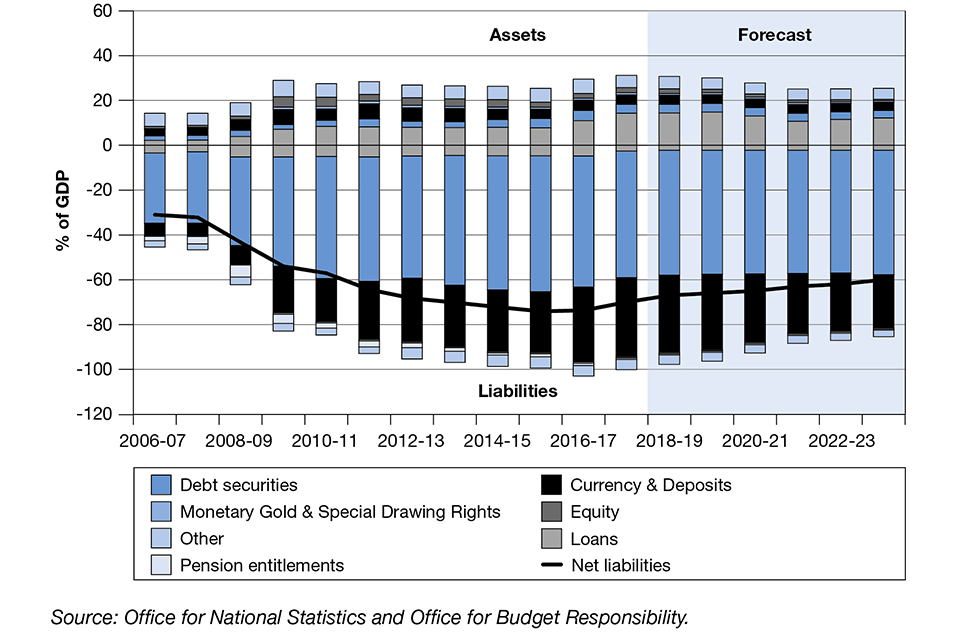
The BSR has already made significant progress and the Budget provides an update on progress in the following areas:
- Balance sheet reporting – Building on the information provided in Whole of Government Accounts, the OBR has today published its first detailed forecast for the government’s financial balance sheet over the next five years (see Chart 1.6). The government has also committed to complying with the IMF’s Government Financial Statistics Manual, which requires regular statistical reporting of the entire balance sheet, starting in spring 2019.36
- Intangible assets – A supplementary document published alongside the Budget sets out how the government is looking to get a better financial, economic and social return on its estimated £150 billion of intellectual property and other intangible assets.37 The importance of intangible assets to the UK’s continued economic success is also reflected in the government’s intention to introduce targeted relief for the cost of intellectual property-rich acquisitions by UK companies, set out in Chapter 3.
- Private Finance II (PF2) – The government has considered the Private Finance Initiative (PFI) and its successor PF2, in light of experience since 2012, and found the model to be inflexible and overly complex. The OBR’s FRR also identified private finance initiatives as a source of significant fiscal risk to government.38 PF2 has not been used since 2016. The Budget announces government will no longer use PF2 for new projects.39 A new centre of best practice in the Department of Health and Social Care (DHSC) will improve the management of existing PFI contracts.
- Reducing inflation exposure – The government is taking action to reduce its inflation exposure by looking to reduce the proportion of index-linked gilt issuance in a measured fashion over the medium term (see Annex A for more detail). NS&I has announced that, in line with successive governments’ reduction in the use of RPI, Index‑linked Savings Certificates entering a new term from 1 May 2019 will receive interest based on CPI rather than RPI.40 (79)
- Property – As part of the Government Estate Strategy 2018, the government is launching its first-ever geo-spatial Digital National Asset Register which will enable better management and commercialisation of its £420 billion of property assets,41and the Whitehall estate will be brought onto a single balance sheet within 5 years.
- Debt owed to the government – The government will improve its recovery of over £20 billion of overdue debt through new performance management measures and continued central support, which has already collected an extra £472 million over the last 3 years.42
- Contingent liabilities – In July 2017, HM Treasury introduced stricter new controls over the issuance of guarantees and other contingent liabilities. The new approvals regime has already been applied to over 60 new contingent liabilities with a total value of £158 billion, with over £1 billion of new liabilities rejected outright and the vast majority approved after significant modification to reduce exposure.43 The BSRis exploring options to improve incentives and secure appropriate compensation for the taxpayer when providing insurance to the private sector.
- Asset sales and loans – HM Treasury will introduce stricter disclosure requirements for asset sales and revised budgetary treatment for financial transactions (e.g. loans) and will publish new guidance on both in December 2018.
In the run-up to Spending Review 2019, the BSR is similarly looking at how to improve the management of departments’ individual balance sheets. For example, the NHS will be generating a £3.3 billion increase in proceeds from selling surplus land and buildings, almost doubling the scale of the investment available to the NHS.44 DHSC will also publish a cross-government strategy for managing the rising cost of the government’s almost £72 billion of clinical negligence liabilities.45 The Ministry of Defence’s (MOD) £32 billion rural and built estate covers 1.8% of the UK land mass.46Through the Defence Estates Optimisation Programme and other activity, the MODaims to reduce the size of its built estate by 30% by 2040. The Department for Transport (DfT) is exploring opportunities for greater commercialisation of transport assets and ways to realise further value from both new developments and existing land.
HM Treasury will publish the final conclusions from the BSR at Spending Review 2019, setting out a strategy for the responsible management of public sector wealth.
2.19 Devolved administrations
The application of the Barnett formula to spending decisions taken by the UK government at the Budget will provide each of the devolved administrations with additional funding to be allocated according to their own priorities. The Scottish and Welsh Governments’ block grants will be further adjusted, as set out in their respective fiscal frameworks.
For the OBR’s forecast, the Scottish Government’s spending has now been reclassified from PSCE in RDEL to PSCE in AME and from PSGI in CDEL to PSGI in AME. This reflects the Scottish Government’s borrowing powers, Reserve facility and the fact that around a third of Scottish Government expenditure is financed by locally raised revenue. This new budgeting treatment only affects the way Scottish Government spending is reported. All previous spending controls, including through the block grant and borrowing and reserve limits, remain unchanged, and the spending power of the Scottish Government is not affected. The Scottish Government block grant remains in the governments measure of RDEL excluding depreciation and CDEL.
2.20 Asset sales
The government remains committed to returning the financial sector assets acquired in 2008 to 2009 to the private sector in a way that achieves value for money for taxpayers:
- Royal Bank of Scotland (RBS) – It remains the government’s objective to return RBSfully to the private sector when it represents value for money to do so and market conditions allow. Over the past year RBS has made significant further progress on resolving its legacy issues. The government now intends to undertake a full disposal of the RBS shareholding by 2023-24, subject to market conditions and achieving value for money. The government will keep all disposal options under review and, as with previous disposal programmes, expects larger disposal values in later years when increased liquidity in the shares should enable higher volumes to be sold.
- UK Asset Resolution (UKAR) – UKAR’s balance sheet has reduced from £115.8 billion in 2010 to £19.8 billion as at 31 March 2018. UKAR has completed two sales of Bradford & Bingley (B&B) mortgages of £11.8 billion and £5.3 billion respectively, which enabled B&B to repay its debt to the Financial Services Compensation Scheme. UKAR has also completed a sale of a £860 million portfolio of equity release mortgages, simplifying the balance sheets of NRAM plc (formerly part of Northern Rock) and B&B. Building on UKAR’s strong track record of successful asset sales, the government now expects to divest the remaining assets from B&B and NRAM plc by March 2020, subject to achieving value for money and market conditions remaining supportive. As has been the case for all previous UKAR sales, buyers will be required to agree to UKAR’s customer treatment protections which include the Financial Conduct Authority’s (FCA) Treating Customers Fairly principles. There will be no changes to the terms and conditions of any of the loans that will be sold, and UKAR will require that the loans must be serviced by an FCA-regulated firm.
The government continues to explore options for the sale of wider corporate and financial assets, where there is no longer a policy reason to retain them and when value for money can be secured for taxpayers. This is an integral part of the government’s plan to improve the public finances:
- Student Loans – In December 2017 the government completed the first in its programme of sales of pre-2012 income-contingent student loans, expected to raise £12 billion by 2021-22. The sale raised £1.7 billion,47 reducing PSND, and was assessed as value for money by the National Audit Office.48 The government will now extend the sales programme by a further year, increasing total proceeds to £15 billion.
- Network Rail – Following a competitive bidding process, Network Rail agreed the sale of its commercial property portfolio on 10 September 2018. The sale generates net receipts of £1.27 billion,49 £170 million above the forecast at Spring Statement.
2.21 Public service pensions
Public service pensions were reformed in 2015 and, as part of those reforms, an agreement was reached to maintain their value. Valuations of public service pensions are ongoing, and provisional results indicate that changes will need to be made from 2019-20 to make pension benefits more generous for public servants, including teachers, police, armed forces and NHS staff.
The Budget confirms a reduction of the discount rate for calculating employer contributions in unfunded public service pension schemes, to 2.4% plus CPI (in line with established methodology to reflect OBR forecasts for long-term GDP growth). The valuations indicate that there will be additional costs to employers in providing public service pensions over the long-term.
The government is supporting departments to ensure that recognition of these costs does not jeopardise the delivery of frontline public services or put undue pressure on public employers. For the NHS, as outlined in the five-year health settlement in England in June 2018, the Treasury has made provision for NHS pension costs until 2023-24. For state schools, the Department of Education are proposing to provide more funding to cover pension costs for the rest of this Spending Review period. To supplement this, the Budget allocates extra DEL to the reserve for 2019-20 to cover an expected £4.7 billion of additional costs. The Spending Review next year will settle the funding for costs beyond 2019-20 arising from the valuations.
2.22 Sovereign Grant
The Sovereign Grant for 2019-20 will be £82.4 million. This grant provides funding in support of Her Majesty’s official duties as Sovereign.
2.23 The Royal Mint
The Royal Mint has a long-established tradition of producing coins in order to commemorate historic moments, including the 2012 Olympics, the UK’s accession to the European Economic Community, and the centenary of the First World War. In line with this tradition, the Royal Mint will produce a coin to commemorate the UK leaving the European Union. This coin will be available in Spring 2019.
2.24 Debt and reserves management
The government’s revised financing plans for 2018-19 are summarised in Annex A.
3. Policy decisions
The following chapters set out all Budget 2018 policy decisions. Unless stated otherwise, the decisions set out are ones which are announced at the Budget.
Table 2.1 shows the cost or yield of all Budget 2018 decisions with a direct effect on PSNB in the years up 2023-24. This includes tax measures, changes to Departmental Expenditure Limits (DEL) and measures affecting annually managed expenditure (AME).
The government is also publishing the methodology underpinning the calculation of the fiscal impact of each policy decision. This is included in the supplementary document ‘Budget 2018: policy costings’ published alongside the Budget.
The supplementary document ‘Overview of Tax Legislation and Rates’ published alongside the Budget, provides a more detailed explanation of tax measures.
Table 2.1: Budget 2018 policy decisions (£ million) (1)
| Head | 2018-19 | 2019-20 | 2020-21 | 2021-22 | 2022-23 | 2023-24 (2) | |
|---|---|---|---|---|---|---|---|
| Spending and public services | |||||||
| 1 National Health Service: five year settlement agreed in June 2018 | Spend | 0 | -7,350 | -11,130 | -16,090 | -21,400 | -27,610 |
| 2 Social Care: 2018-19 and 2019-20 funding | Spend | -285 | -775 | – | – | – | – |
| 3 Children’s Social Care: improvement pilots | Spend | 0 | -45 | -25 | -15 | -15 | 0 |
| 4 Transport: road maintenance | Spend | -500 | 0 | 0 | 0 | 0 | 0 |
| 5 Schools: 2018-19 capital | Spend | -475 | 0 | 0 | 0 | 0 | 0 |
| 6 Justice: 2018-19 prisons, courts, and justice system funding | Spend | -60 | 0 | 0 | 0 | 0 | 0 |
| 7 Defence: 2018-19 and 2019-20 funding | Spend | -200 | -800 | 0 | 0 | 0 | 0 |
| 8 Centre for Public Sector Leadership | Spend | 0 | -10 | -10 | -10 | 0 | 0 |
| 9 Armistice Day Commemorations | Spend | -15 | 0 | 0 | 0 | 0 | 0 |
| Living standards | |||||||
| Tax | |||||||
| 10 Personal Allowance and Higher Rate Threshold: increase to £12,500 and £50,000 for 2019-20 and 2020-21 | Tax | 0 | -2,790 | -1,935 | -1,445 | -1,605 | -1,780 |
| 11 Fuel Duty: freeze for 2019-20 | Tax | 0 | -840 | -855 | -880 | -910 | -935 |
| 12 Alcohol Duties: freeze spirits, beer and cider in 2019 and set rate for high strength cider | Tax | -35 | -165 | -175 | -175 | -180 | -185 |
| Welfare | |||||||
| 13 Universal Credit: £1,000 increase to work allowance | Spend | 0 | -545 | -865 | -1,130 | -1,400 | -1,695 |
| 14 Universal Credit: additional support for transition | Spend | -35 | -90 | -170 | -255 | -240 | -205 |
| 15 Universal Credit: revised implementation schedule | Spend | 0 | -95 | +320 | +845 | +745 | +250 |
| 16 Industrial Injuries Disablement Benefit: include Dupuytren’s contracture | Spend | 0 | 0 | -5 | -5 | -5 | -5 |
| Spending | |||||||
| 17 Low Cost Credit: support | Spend | 0 | -5 | * | 0 | 0 | 0 |
| 18 Pensions Dashboard: further funding | Spend | 0 | -5 | 0 | 0 | 0 | 0 |
| 19 Disabled Facilities Grant: expand | Spend | -65 | 0 | 0 | 0 | 0 | 0 |
| Business and growth | |||||||
| 20 Annual Investment Allowance: temporary increase to £1m for two years from January 2019 | Tax | -215 | -600 | -425 | +140 | +185 | +155 |
| 21 Structures and Buildings Allowance: permanent capital allowance for new structures and buildings | Tax | -55 | -165 | -260 | -365 | -475 | -585 |
| 22 Special Writing Down Allowance: align with depreciation in accounts at 6% rate | Tax | +75 | +250 | +360 | +325 | +315 | +305 |
| 23 Apprenticeships: halve co-investment rate to 5% | Spend | 0 | -25 | -60 | -60 | -70 | -70 |
| 24 Skills: regional pilot of course subsidy for self-employed | Spend | 0 | -5 | -5 | 0 | 0 | 0 |
| 25 Skills: regional pilot of on-the-job training for young people | Spend | 0 | -5 | -5 | 0 | 0 | 0 |
| 26 Skills: digital skills boot camps | Spend | 0 | -5 | 0 | 0 | 0 | 0 |
| 27 Enterprise: expand Knowledge Transfer Partnerships | Spend | 0 | 0 | -5 | -10 | -10 | -10 |
| 28 Enterprise: extension of start-up loans programme | Spend | 0 | 0 | -5 | 0 | 0 | 0 |
| 29 Enterprise: University Enterprise Zones | Spend | -5 | 0 | 0 | 0 | 0 | 0 |
| 30 Trade: Global Britain | Spend | 0 | -5 | 0 | 0 | 0 | 0 |
| 31 Energy: support for UK nuclear fusion | Spend | 0 | -20 | 0 | 0 | 0 | 0 |
| 32 Quantum Technology: research and development | Spend | 0 | -5 | -5 | -15 | -10 | 0 |
| Housing and homeownership | |||||||
| 33 Local Authority Housebuilding: remove borrowing cap | Spend | -95 | -385 | -850 | -855 | -1,235 | -1,235 |
| 34 Development Corporations: competitive fund | Spend | 0 | * | -5 | -5 | 0 | 0 |
| 35 Discounted Homes: capacity funding | Spend | 0 | -5 | -5 | -5 | 0 | 0 |
| 36 Strategic Housing Deals: capacity funding | Spend | 0 | -5 | -5 | 0 | 0 | 0 |
| 37 Stamp Duty Land Tax: extend First Time Buyers relief for shared ownership properties | Tax | * | -5 | * | * | * | -5 |
| Environment | |||||||
| 38 Plastics and Waste: sustainability and innovation | Spend | 0 | -20 | 0 | 0 | 0 | 0 |
| 39 Abandoned Waste Sites: clearance | Spend | 0 | -5 | -5 | 0 | 0 | 0 |
| 40 Urban Tree Planting | Spend | 0 | -5 | -5 | * | * | 0 |
| 41 Air Quality | Spend | -10 | -15 | 0 | 0 | 0 | 0 |
| 42 Industrial Energy Transformation Fund (3) | Spend | 0 | -20 | -60 | -90 | -75 | -70 |
| 43 Capital Allowances: discontinue enhanced allowances for energy and water-efficient equipment | Tax | 0 | +10 | +50 | +100 | +80 | +75 |
| Local growth | |||||||
| 44 Business Rates: one third off for retail premises up to a rateable value of £51,000 in 2019-20 and 2020-21 | Tax | +10 | -490 | -450 | +45 | -15 | 0 |
| 45 Future High Streets Fund: resource | Spend | 0 | -20 | -15 | -15 | -10 | -5 |
| 46 Future High Streets Fund: capital (4) | Spend | 0 | -5 | -75 | -220 | -240 | -195 |
| 47 Business Rates: public lavatories relief from 2020-21 | Tax | 0 | 0 | -5 | -5 | -5 | -5 |
| 48 City and Growth Deals: Tay, Belfast, North Wales, Stirling and Clackmannanshire | Spend | -5 | -40 | -40 | – | – | – |
| 49 Coventry: City of Culture | Spend | 0 | -10 | 0 | 0 | 0 | 0 |
| 50 Northern Powerhouse Rail: development funding | Spend | 0 | -40 | 0 | 0 | 0 | 0 |
| 51 East-West Rail: development funding | Spend | 0 | -20 | – | – | – | – |
| 52 West Midlands Combined Authority: UK Mobility Data Institute | Spend | -20 | 0 | 0 | 0 | 0 | 0 |
| A fair and sustainable tax system | |||||||
| 53 Digital Services Tax | Tax | 0 | +5 | +275 | +370 | +400 | +440 |
| 54 Off-payroll Working: extend reforms to private sector in 2020-21, excluding small businesses | Tax | -5 | -150 | +1,165 | +595 | +635 | +725 |
| 55 Corporation Tax: restrict use of carried forward capital losses from 2020-21 | Tax | 0 | +25 | +110 | +140 | +140 | +125 |
| 56 Capital Gains Tax: extend Entrepreneurs’ Relief minimum qualifying period | Tax | 0 | +5 | +10 | +75 | +80 | +90 |
| 57 Private Residence Relief: reform lettings relief and final period exemption from 2020-21 | Tax | 0 | +15 | +50 | +120 | +135 | +150 |
| 58 VAT Registration Threshold: maintain at £85,000 for a further two years | Tax | 0 | 0 | +60 | +130 | +145 | +150 |
| 59 Employment Allowance: restrict to businesses below a £100,000 employer NICs threshold from 2020-21 | Tax | 0 | 0 | +225 | +260 | +290 | +320 |
| 60 Climate Change Levy: move towards equalised gas and electricity rates | Tax | 0 | 0 | * | * | * | +5 |
| 61 Aggregates Levy: freeze in 2019-20 | Tax | 0 | -10 | -15 | -15 | -15 | -15 |
| 62 Heavy Goods Vehicle VED: freeze in 2019-20 | Tax | 0 | -5 | -5 | -10 | -10 | -10 |
| 63 Tobacco Duty: RPI plus 2ppt on all duties and additional 1ppt for hand rolling tobacco | Tax | 0 | +5 | +5 | +5 | +5 | +5 |
| 64 Carbon Price Support: freeze rate at £18 in 2019-20 and 2020-21 | Tax | 0 | 0 | -15 | -15 | -20 | -20 |
| 65 Alcohol Duty: ban post duty point dilution | Tax | 0 | +65 | -15 | +85 | +85 | +90 |
| 66 Savings: maintain thresholds for adult ISA allowance and starting rate for savings | Tax | 0 | * | +5 | +5 | +5 | +10 |
| 67 Gift Aid: increase small donation limit from £20 to £30 | Spend | 0 | -5 | -5 | -5 | -5 | -5 |
| 68 HMRC: funding for Budget measures | Spend | -5 | 0 | 0 | 0 | 0 | 0 |
| Avoidance, evasion, and unfair outcomes | |||||||
| 69 Withheld Taxes: protecting your taxes in insolvency and tackling abuse | Tax | 0 | +10 | +65 | +150 | +195 | +185 |
| 70 R&D Tax Credits: preventing abuse of the SME payable credit | Spend | 0 | 0 | 0 | +20 | +45 | +45 |
| 71 VAT: ensuring proper adjustments | Tax | +5 | +150 | +200 | +200 | +195 | +190 |
| 72 Offshore: prevent profit fragmentation, extend VAT grouping rules and prevent looping avoidance schemes | Tax | * | +65 | +65 | +75 | +95 | +100 |
| 73 Capital Gains Tax: tackling misuse in Entrepreneurs’ Relief | Tax | 0 | +5 | +10 | +10 | +10 | +15 |
| Previously announced policy decisions | |||||||
| 74 Tuition Fees: freeze fees in September 2019 | Tax | 0 | * | -10 | -20 | -30 | -40 |
| 75 NICs: delay NICs Bill by one year and maintain Class 2 NICs | Tax | -5 | +180 | +395 | +370 | +335 | +310 |
| 76 Childcare Vouchers: extension to the closure for new entrants to October 2018 | Tax | -45 | -55 | -50 | -40 | -25 | -10 |
| 77 Fixed Odds Betting Terminals: £2 stake limit in October 2019 | Tax | 0 | -120 | -245 | -255 | -260 | -270 |
| 78 Remote Gaming Duty: raise to 21% in October 2019 | Tax | 0 | +130 | +255 | +265 | +280 | +295 |
| 79 Index Linked Savings Certificates: reindex at next maturity date from May 2019 | Spend | 0 | +35 | +85 | +150 | +165 | +175 |
| 80 National Retraining Scheme: first phase | Spend | 0 | -10 | -25 | -80 | 0 | 0 |
| 81 Support for Enterprise | Spend | 0 | -35 | – | – | – | – |
| 82 Birmingham: future mobility area | Spend | 0 | -10 | -10 | -10 | 0 | 0 |
| 83 Food Waste: pilot | Spend | 0 | -20 | 0 | 0 | 0 | 0 |
| 84 Mayoral Combined Authorities: extension of borrowing powers | Spend | -45 | -160 | -245 | -205 | -70 | 0 |
| 85 Youth Endowment Fund | Spend | -225 | 0 | 0 | 0 | 0 | 0 |
| 86 Public Service Broadcasting Contestable Fund | Spend | 0 | -15 | -20 | 0 | 0 | 0 |
| Total policy decisions (5) | -2,305 | -15,085 | -14,395 | -17,600 | -23,520 | -30,560 | |
| Total spending policy decisions | -2,035 | -10,905 | -13,370 | -17,880 | -23,650 | -30,520 | |
| Total tax policy decisions | -270 | -4,180 | -1,025 | +280 | +125 | -40 | |
| * Negligible. |
| 1 Costings reflect the OBR‘s latest economic and fiscal determinants. |
| 2 At Spending Review 2015, the government set departmental spending plans for resource DEL (RDEL) for the years up to and including 2019-20, and capital DEL (CDEL) for the years up to and including 2020-21. Where specific commitments have been made beyond those periods, these have been set out on the scorecard. Where a specific commitment has not been made, adjustments have been made to the overall spending assumption beyond the period. |
| 3 In 2019-20, £10m is funded from the Reserve, and is not included in total policy decisions. |
| 4 In 2021-22, 2022-23 and 2023-24, the capital funding for this measure has been allocated from within the National Productivity Investment Fund, and is not included in total policy decisions. |
| 5 Totals may not sum due to rounding. |
4. Tax
4.1 Introduction
The government is committed to keeping taxes low, to allow working families to keep more of what they earn and to provide businesses with an environment in which they can grow and create jobs. The government has already increased the Personal Allowance (PA) and higher rate threshold (HRT), and cut corporation tax to 19% – the lowest in the G2050 – and it will fall further to 17% in 2020.
The government is determined to support working people to keep more of what they earn. The Budget announces that the government will meet its commitment to raise the PA to £12,500 and the HRT to £50,000 from April 2019, one year earlier than planned. These thresholds will remain at the same levels in 2020-21 and then increase by CPI. This means the government has raised the PA by over 90% in less than a decade and in 2019-20 a typical basic rate taxpayer will pay £130 less tax than in 2018-19 and £1,205 less tax than in 2010-11.51 Freezes to fuel duty for the ninth successive year save the average driver a cumulative £1,000 by 2020.52
The Budget introduces measures to reaffirm the UK’s international competitiveness and support local growth. The Budget announces a new structures and buildings allowance and a temporary increase in the Annual Investment Allowance to £1 million, to support business investment. It also takes action to support high streets as they evolve, supporting a crucial part of local economies.
It is important that the tax system works fairly and adapts to changes in the new economy. To reflect the value derived from UK users, the government is introducing a digital services tax, ensuring large multinational businesses make a fair contribution to supporting vital public services. To reflect environmental concerns, the Budget is taking action on single-use plastic waste, including announcing a new tax on plastic packaging which does not contain enough recycled content.
Since 2010 the government has secured and protected over £185 billion of tax that would otherwise have gone unpaid, and introduced over 100 measures to crack down further on avoidance, evasion, aggressive tax planning and unfair outcomes.53 The Budget reaffirms the government’s commitment to ensuring that everyone, businesses and individuals, pay their fair share.
4.2 Personal tax
The government is committed to keeping taxes low to support working people to keep more of what they earn and to encourage individuals to progress. It has made repeated increases to the PA, raising it from £6,475 in 2010-11 to £11,850 in 2018-19.
4.3 Income tax and National Insurance
Personal Allowance and higher rate threshold – The Budget announces that the government will meet its commitment to raise the PA to £12,500 from April 2019, one year earlier than planned. The threshold will remain at the same level in 2020-21 and then increase by CPI. The £650 increase to the PA means that in 2019-20 a typical basic rate taxpayer will pay £130 less tax than in 2018-19 and £1,205 less tax than in 2010-11.54 This will increase the number of tax payers taken out of income tax since 2015-16 to 1.74 million.55 The government will also meet its commitment to increase the HRT to £50,000 from April 2019, one year earlier than planned. The threshold will remain at the same level in 2020-21. This means that there will be nearly one million fewer higher rate taxpayers than in 2015‑16.56 Overall, 32 million individuals will see their tax bill reduced in 2019-20 compared to 2015-16.57 (10)
Off-payroll working in the private sector – To help people comply with the existing rules and bring private sector organisations in line with public-sector bodies and agencies, the government will reform the off-payroll working rules (known as IR35) in the private sector. This follows consultation and the roll-out of reform in the public sector. Responsibility for operating the off-payroll working rules will move from individuals to the organisation, agency or other third party engaging the worker. To give people and businesses time to prepare, this change will not be introduced until April 2020. Small organisations will be exempt, minimising administrative burdens for the vast majority of engagers, and HMRC will provide support and guidance to medium and large organisations ahead of implementation. (54)
Taxation of self-funded work-related training – Following consultation responses indicating that tax relief is unlikely to be effective in addressing the barriers to learning or incentivising training, the government is maintaining the scope of tax relief currently available to employees and the self-employed for work-related training costs. Instead, the government is launching the National Retraining Scheme and skills pilots to help those in work, including the self-employed, develop the skills they need to thrive.
Shared occupancy test for rent-a-room relief – Following consultation on draft legislation, to maintain the simplicity of the system the government will not include legislation for the ‘shared occupancy test’ in Finance Bill 2018-19. The government will retain the existing qualifying test of letting in a main or only residence, and will work with stakeholders to ensure that the rules around the relief are clearly understood.
Employment Allowance reform – To target the Employment Allowance (EA) to support smaller businesses, from April 2020 the government will restrict access to employers with an employer National Insurance contributions (NICs) bill below £100,000 in their previous tax year. The EA provides businesses and charities with up to £3,000 off their employer NICs bill. Over 99% of micro-businesses and 93% of small businesses will still be eligible for the EA.58 (59)
National Insurance Contributions Bill – As previously announced in September, the government will not abolish Class 2 NICs during this Parliament, given the potential impacts on some of the lowest earning in society. There are two remaining measures in the draft NICs Bill published on 5 December 2016: reforms to the NICs treatment of termination payments and income from sporting testimonials. The government still intends to legislate for these reforms, which will take effect from April 2020. (75)
Tax treatment of social security income – The government is legislating to confirm the income tax treatment of nine new and existing social security benefits.59 This includes the five new benefits being introduced in Scotland, which will be treated in accordance with the 2016 agreement between the Scottish government and the UK government on the Scottish Government’s Fiscal Framework.
Short Term Business Visitors (STBVs) – Following a consultation on the tax and administrative treatment of STBVs from overseas branches of UK headquartered companies, the government will widen eligibility for the STBV Pay As You Earn (PAYE) special arrangement and extend its deadlines for reporting and paying tax. This will reduce administrative burdens on UK employers with effect from April 2020.
Trusts consultation – As announced at Autumn Budget 2017, the government will publish a consultation on the taxation of trusts, to make the taxation of trusts simpler, fairer and more transparent.
4.4 Charity taxes
Reducing administrative burdens on charities – From April 2019, the government will introduce a package of measures to reduce administrative burdens on charities. These will:
- increase the upper limit for trading that charities can carry out without incurring a tax liability from £5,000 to £8,000 where turnover is under £20,000, and from £50,000 to £80,000 where turnover exceeds £200,000
- allow charity shops using the Retail Gift Aid Scheme to send letters to donors every three years when their goods raise less than £20 a year, rather than every tax year
- increase the individual donation limit under the Gift Aid Small Donations Scheme to £30, which applies to small collections where it is impractical to obtain a Gift Aid declaration (67)
4.5 Pensions and savings tax
Lifetime allowance for pensions – The lifetime allowance for pension savings will increase in line with CPI for 2019-20, rising to £1,055,000.
Starting rate for savings – The band of savings income that is subject to the 0% starting rate will be kept at its current level of £5,000 for 2019-20. (66)
Individual Savings Account (ISA) annual subscription limits – The adult ISA annual subscription limit for 2019-20 will remain unchanged at £20,000. The annual subscription limit for Junior ISAs for 2019-20 will be uprated in line with CPI to £4,368. (66)
Child Trust Funds – The government will publish a consultation in 2019 on draft regulations for maturing Child Trust Fund accounts. The annual subscription limit for Child Trust Funds for 2019-20 will be uprated in line with CPI to £4,368.
4.6 Business tax
The government is committed to creating a tax system which secures business investment and the location of business activity in the UK. The government has already ensured the UK is a prime location to invest, from cutting the corporation tax rate to 19% and legislating for it to fall to 17% in 2020, to supporting the creative sector through tax reliefs which have helped to make the UK one of the best places to produce film and high-end TV programmes in the world. The Budget builds on the UK’s competitive tax regime by supporting business investment, ensuring that tax paid is fair and responds to the challenges of the new economy. Technology is changing many aspects of the economy – including the vehicles we drive – and the government is considering how the tax system will need to adapt to manage those changes.
4.7 Enterprise tax
Annual Investment Allowance (AIA) – The government will increase the Annual Investment Allowance to £1 million for all qualifying investment in plant and machinery made on or after 1 January 2019 until 31 December 2020, to help stimulate business investment. (20)
Structures and buildings allowance (SBA) – New non-residential structures and buildings will be eligible for a 2% capital allowance where all the contracts for the physical construction works are entered into on or after 29 October 2018. This addresses a significant gap in the UK’s current capital allowances regime, and will improve the international competitiveness of the UK’s tax system. Further information on this measure is available in a supplementary document published alongside the Budget. (21)
Capital allowances special rate reduction (8% to 6%) – From April 2019, the capital allowances special rate for qualifying plant and machinery assets will be reduced from 8% to 6% to more closely match average accounts depreciation. (22)
Entrepreneurs’ Relief: minimum qualifying period – To support longer-term business investments, from 6 April 2019 the minimum period throughout which the qualifying conditions for relief must be met will be extended from 12 months to 24 months. (56)
4.8 Corporate tax
Digital services tax (DST) – From April 2020, the government will introduce a new 2% tax on the revenues of certain digital businesses to ensure that the amount of tax paid in the UK is reflective of the value they derive from their UK users. The tax will:
- apply to revenues generated from the provision of the following business activities: search engines, social media platforms and online marketplaces
- apply to revenues from those activities that are linked to the participation of UK users, subject to a £25 million per annum allowance
- only apply to groups that generate global revenues from in-scope business activities in excess of £500 million per annum
- include a safe harbour provision that exempts loss-makers and reduces the effective rate of tax on businesses with very low profit margins
The government remains committed to G20 and OECD discussions on potential future reforms to the international corporate tax framework, and will only apply the DST until an appropriate long-term solution is in place. The government will consult on the detailed design of the DST and legislate in Finance Bill 2019-20. (53)
Corporate capital loss restriction – To ensure that large companies pay tax when they make significant capital gains, the government will bring the tax treatment of corporate capital losses into line with the treatment of income losses. From 1 April 2020, the government will restrict the proportion of annual capital gains that can be relieved by brought-forward capital losses to 50%. The measure will include an allowance that gives companies unrestricted use of up to £5 million capital or income losses each year, meaning that 99% of companies will be unaffected.60 The government will consult on the detailed design of this change and legislate in Finance Bill 2019-20. The measure will be subject to anti-avoidance rules that are to apply with immediate effect. (55)
Amendments to reform of loss relief rules – With effect from April 2017, the government reformed the rules on how carried-forward corporate losses can be set against taxable profits of a company and its group members. The government will make amendments to the loss relief legislation to ensure that it works as intended and prevents relief for carried-forward losses being claimed in excess of that intended.
Intangible fixed assets regime – In early 2018, the government reviewed how the tax treatment of acquired intangible assets could be made more competitive and administrable. Following a short consultation, the government will seek to introduce targeted relief for the cost of goodwill (the amount paid for a business that exceeds the fair value of its individual assets and liabilities) in the acquisition of businesses with eligible intellectual property from April 2019. With effect from 7 November 2018, the government will also reform the de-grouping charge rules, which apply when a group sells a company that owns intangibles, so that they more closely align with the equivalent rules elsewhere in the tax code.
Hybrid Capital Instruments – Certain corporate debt instruments (known as hybrid capital) have some equity-like features. The government will introduce new rules for the taxation of such instruments, to ensure that they are taxed in line with their economic substance, taking into account new Bank of England requirements for loss absorbency. The new rules will also eliminate mismatches between the tax treatment of instruments used to raise funds externally and those used to lend funds internally within a group. The rules will cover issues by companies in any sector and replace current rules covering regulatory hybrid capital instruments issued by banks and insurers.
Offshore receipts in respect of intangible property (previously Royalties Withholding Tax) – As announced at Autumn Budget 2017, the government is introducing legislation in Finance Bill 2018-19 to tax income from intangible property held in low-tax jurisdictions to the extent that it is referable to UK sales. This measure will come into effect from April 2019. Following consultation, the government is making changes to ensure that the measure is effective, appropriately targeted and robust against abuse. These include:
- collecting the tax by directly taxing offshore entities that realise intangible property income in low-tax jurisdictions, rather than through applying a withholding tax
- broadening the income in scope of the measure to include embedded royalties and income from the indirect exploitation of intangible property in the UK market through unrelated parties
- introducing a de minimis UK sales threshold of £10 million, an exemption for income that is taxed at appropriate levels, and an exemption for income relating to intangible property that is supported by sufficient local substance
- anti-avoidance provisions will apply from 29 October 2018 to counteract arrangements entered into with a main purpose of avoiding a charge under this measure
4.9 Property tax
High streets – High streets and town centres are crucial parts of communities and local economies, but the government recognises the challenges they face from changing consumer behaviour and is taking action to help them to evolve. High street businesses are already benefitting from recent reforms and reductions to business rates announced since Budget 2016 worth more than £12 billion over the next five years.61 In the Budget the government is going further through Our Plan for the High Street. To provide upfront support through the business rates system, the government is cutting bills by one-third for retail properties with a rateable value below £51,000, benefiting up to 90% of retail properties, for 2 years from April 2019, subject to state aid limits.62(44)
In the longer term, to support a sustainable transformation of high streets, the Plan includes a £675 million Future High Streets Fund, planning reform, a High Streets Task Force to support local leadership, and funding to strengthen community assets, including the restoration of historic buildings on high streets.
Business rates public lavatories relief – The government will introduce 100% business rates relief for all public lavatories to help keep these important local amenities open. (47)
Business rates local newspaper discount – The government will continue the £1,500 business rates discount for office space occupied by local newspapers in 2019-20.
Local authorities will be fully compensated for the loss of income as a result of these business rates measures.
Business rates treatment of self-catering and holiday let accommodation – There is concern that some owners of properties that are not genuine businesses may seek to reduce their tax liability by falsely declaring that the property is available for let. To ensure that second properties are subject to the appropriate tax, the government will consult on the criteria under which self-catering and holiday lets become chargeable to business rates rather than council tax.
Stamp Duty Land Tax (SDLT) and first-time buyers relief – The government will extend first-time buyers relief in England and Northern Ireland so that all qualifying shared ownership property purchasers can benefit, whether or not the purchaser elects to pay SDLT on the market value of the property. This change will apply to relevant transactions with an effective date on or after 29 October 2018, and will also be backdated to 22 November 2017 so that those eligible who have not previously claimed first-time buyers relief will be able to amend their return to claim a refund. (37)
Consultation on SDLT charge for non-residents – The government will publish a consultation in January 2019 on a SDLT surcharge of 1% for non-residents buying residential property in England and Northern Ireland.
Capital gains tax – To better target private residence relief at owner occupiers, from April 2020 the government will reform lettings relief so that it only applies in circumstances where the owner of the property is in shared occupancy with the tenant. The final period exemption will also be reduced from 18 months to 9 months. The government will consult on these changes. There will be no changes to the 36 months final period exemption available to disabled people or those in a care home. (57)
4.10 Energy and transport tax
4.11 Transport tax
Fuel duty – Fuel duty will be frozen for a ninth successive year saving the average driver a cumulative £1,000 by April 2020,63 compared with what they would have paid under the pre-2010 fuel duty escalator. (11)
Alternative fuels – Following review, the government will maintain the difference between alternative and main road fuel duty rates until 2032 to support the de-carbonisation of the UK transport sector, subject to review in 2024.
Introduction of the Worldwide harmonised Light vehicles Test Procedure (WLTP) – The government will review the impact of WLTP on Vehicle Excise Duty (VED) and company car tax (CCT) to report in the spring. WLTP aims to provide a closer representation of ‘real-world’ fuel consumption and CO2 emissions.
Vehicle Excise Duty (VED): Uprating – From 1 April 2019 VED rates for cars, vans and motorcycles will increase in line with RPI. To support the haulage sector, the government will freeze the Heavy Goods Vehicle (HGV) VED for 2019-20. (62)
Vehicle Excise Duty (VED): Vans – The government will shortly publish a summary of responses from the consultation on VED reform for vans, published in May 2018. The response will set out proposals to introduce environmental incentives from April 2021. Bands and rates will be set out ahead of Finance Bill 2019-20.
Vehicle Excise Duty (VED): Blood Bikes – To align the tax treatment of the transportation of blood and medical supplies by the national charity Blood Bikes with other emergency vehicles, the government will introduce an exemption for the purpose-built vehicles operated by Blood Bikes from April 2020.
Company vehicles – From 6 April 2019 fuel benefit charges will increase in line with RPIand the van benefit charge will increase in line with CPI.
Air Passenger Duty (APD) – Short-haul APD rates for 2020-21 will not rise, remaining at the same level they have been since 2012, benefitting 80% of passengers.64 Long-haul rates will increase in line with RPI. The rates for long-haul economy will increase by £2, and the rates for those travelling in premium economy, business and first class will increase by £4. Those travelling long-haul by private jets will see the rate increase by £13.
4.12 Energy tax
Carbon price support (CPS) – The price of EU Emissions Trading System (ETS) allowances has risen significantly over recent months, raising the Total Carbon Price (currently made up of the EU ETS price and the CPS rate). The government will freeze the CPS rate at £18/tCO265 for 2020-21. From 2021-22, the government will seek to reduce the CPS rate if the Total Carbon Price remains high. (64)
Carbon pricing following EU exit – The government continues to plan for all scenarios as it prepares for EU exit. In the unlikely event no mutually satisfactory agreement can be reached and the UK departs from the EU ETS in 2019, the government would introduce a Carbon Emissions Tax to help meet the UK’s legally binding carbon reduction commitments under the Climate Change Act. The tax would apply to all stationary installations currently participating in the EU ETS from 1 April 2019. A rate of £16 would apply to each tonne of carbon dioxide emitted over and above an installation’s emissions allowance, which would be based on the installation’s free allowances under the EU ETS. The government is also legislating so it can prepare for a range of long-term carbon pricing options.
Climate change levy (CCL) – The Budget sets the CCL main rates for 2020-21 and 2021-22 and continues with the government’s commitment to rebalance the main rates paid for gas and electricity. The electricity rate will be lowered in 2020-21 and 2021-22. The gas rate will increase in 2020-21 and 2021-22 so it reaches 60% of the electricity main rate by 2021-22. Other fuels, such as coal, will continue to align with the gas rate. The discount for sectors with Climate Change Agreements will change to reflect the change in CCL main rates. (60)
Enhanced Capital Allowances (ECAs) – The government will end ECAs and First Year Tax Credits for technologies on the Energy Technology List and Water Technology List from April 2020. These ECAs add complexity to the tax system and the government believes there are more effective ways to support energy efficiency. The savings will be reinvested in an Industrial Energy Transformation Fund, to support significant energy users to cut their energy bills and transition UK industry to a low carbon future. (43)
Enhanced Capital Allowances (ECAs) for electric vehicle charge points – The government will extend the ECA for companies investing in electric vehicle charge points to 31 March 2023. This will help achieve the government’s ambition for the UK to become a world-leader in the ultra-low emission vehicle market.
4.13 Environmental tax
4.14 Single-use plastics
Following the government’s call for evidence, the government will take action on the problem of single-use plastics waste. This forms part of the government’s wider strategy to address plastics waste, with further detail to be set out in the Resources and Waste Strategy later this year. This will address the current situation where recycling rates of plastic are too low, plastic producers use little recycled plastic and some problematic items are rarely recycled and often end up in the natural environment. The Budget also announces funding for plastics and waste innovation.
Plastic packaging – To reduce the problem of excessive and environmentally harmful plastic packaging, and incentivise manufacturers to use recycled plastic, the government will:
- introduce a tax on the production and import of plastic packaging from April 2022. Subject to consultation, this tax will apply to plastic packaging which does not contain at least 30% recycled plastic, to transform financial incentives for manufacturers to produce more sustainable packaging.
- reform the Packaging Producer Responsibility System, which will aim to increase producer responsibility for the costs of their packaging waste, including plastic. This system will provide an incentive for producers to design packaging that is easier to recycle and penalise the use of difficult to recycle packaging, such as black plastics
To ensure a coherent approach, the government will consult on both of these together in the coming months. Future revenues raised from these measures will enable investment to address single-use plastics, waste and litter to meet the government’s ambitions for resources and waste.
The government recognises the important role incineration currently plays in waste management in the UK, and expects this to continue. However, in the long term the government wants to maximise the amount of waste sent to recycling instead of incineration and landfill. Should wider policies not deliver the government’s waste ambitions in the future, it will consider the introduction of a tax on the incineration of waste, in conjunction with landfill tax, taking account of the possible impacts on local authorities.
Disposable cups – The government recognises the problems caused by disposable cups, which are difficult to recycle and often littered. The government has concluded that a levy on all cups would not at this time be effective in encouraging widespread reuse. Businesses are already taking steps to limit their environmental impact, but the government expects industry to go further and will return to the issue if sufficient progress is not made. In the meantime, the government will look in the Resources and Waste Strategy at the best way to tackle the environmental impact of cups.
Aggregates Levy Rates – The government will freeze Aggregates Levy rates for 2019-20, but intends to return the Levy to index-linking in future. (61)
4.15 Indirect tax
4.16 Alcohol, tobacco and gaming
Alcohol duty rates and bands – Duty rates on beer, most cider and spirits will be frozen. Duty on most wine and higher strength sparkling cider will rise by RPI inflation from 1 February 2019. The government will review the current Small Brewers Relief to ensure it is supporting growth in the sector. (12)
Alcohol structures consultation – As announced at Autumn Budget 2017, the government will introduce a new duty band for still cider and perry from 6.9% to 7.5% alcohol by volume (abv), to target white ciders. This will be legislated for in Finance Bill 2018-19, and a rate of £50.71 per hectolitre will apply from 1 February 2019. (12)
Post duty point dilution – Following a review by HMRC launched at Autumn Budget 2017, and in order to ensure a level playing field with other duty regimes, the government will legislate to ban post duty point dilution from April 2020. (65)
Tobacco duty rates – Duty rates on all tobacco products will increase by two percentage points above RPI inflation until the end of this Parliament. Hand rolling tobacco will increase by an additional one percentage point. These changes will come into effect from 6pm on 29 October 2018. To signal its intent to put an end to the illicit trade in all its forms, the government will act on the recommendations of the recent All Party Parliamentary Group report by supporting the creation of a UK-wide Anti-Illicit Trade Group. This will bring together senior officials, representing each of the four parts of the United Kingdom, to share best practice and develop a national strategy for tackling this criminal activity and the societal ills that it fuels. (63)
Minimum Excise Tax – The Minimum Excise Tax for cigarettes will rise to £293.95 per 1,000 cigarettes. This will take effect from 6pm on 29 October 2018.
Tobacco for heating – As announced at Spring Statement 2018, the government will legislate in Finance Bill 2018-19 for a new duty rate for tobacco for heating. In these products processed tobacco is heated (but not burned like conventional tobacco) to produce, or flavour, vapour. This will be set at the same level as hand rolling tobacco and take effect on 1 July 2019.
Gaming duty accounting periods and bands – As announced in HMRC’s consultation response in July 2018, the government will legislate in Finance Bill 2018-19 to remove the requirement for casinos to pay gaming duty on account and to allow the carry forward of losses between accounting periods. The return period for gaming duty will remain 6 months. The bands to determine payment of gaming duty will be frozen from April 2019, while the changes to gaming duty accounting periods are implemented.
Remote Gaming Duty – As announced in May 2018, in order to ensure funding for public services is maintained following the implementation of a £2 maximum stake on B2 machine games, the rate of Remote Gaming Duty will increase to 21%. Both the reduction in maximum stake and increased duty rate will come into effect in October 2019. (78)
Soft Drinks Industry Levy (SDIL) – The government will legislate in Finance Bill 2018-19 to make the SDIL a common duty with the Isle of Man.
4.17 VAT
VAT registration threshold – Alongside the Budget, the government is publishing a response to the call for evidence on the design of the VAT threshold. The responses to the call for evidence did not provide a clear option for reform. The VAT threshold will therefore be maintained at the current level of £85,000 for a further 2 years until April 2022. The government will look again at the possibility of introducing a smoothing mechanism once the terms of EU exit are clear. (58)
VAT and vouchers – Following consultation, the government will legislate in Finance Bill 2018-19 to implement EU legislation which ensures that the correct amount of VAT is charged on what the customer pays, irrespective of whether payment is with a voucher or other means of payment.
VAT fraud in labour provision in the construction sector – As announced at Autumn Budget 2017, and following consultation, the government will introduce a VAT domestic reverse charge to prevent VAT losses through so-called ‘Missing Trader’ fraud. This occurs when traders collect VAT on their sales but go missing before passing that VATon to HMRC. This will shift responsibility for paying VAT along the supply chain to remove the opportunity for it to be stolen by those traders. The new rules will have effect on and after 1 October 2019 and the government is publishing secondary legislation alongside the Budget to implement this change.
VAT and higher education – The government will amend VAT law to ensure continuity of VAT treatment for English higher education providers under the Higher Education and Research Act by enabling bodies registered with the Office for Students in the Approved (fee cap) category to exempt supplies of education.
Alternative method of VAT collection: ‘split payment’ – To reduce online VAT fraud by third country sellers and improve how VAT is collected on cross-border e-commerce, the government is looking at a split payment model. Following the consultation launched at Spring Statement 2018, the government is publishing a response at the Budget. An Industry Working Group will also be established to address some of the main challenges associated with this policy through close cooperation with stakeholders.
4.18 EU exit
Consequential minor amendments to tax legislation to reflect EU exit – The government is responsible for preparing for all possible outcomes to EU negotiations. This power will allow the government to make small, essential changes to UK tax law to maintain the effect of tax legislation if the UK leaves the EU without a deal. Changes made under this power will maintain current operation of the tax law in essential areas, including changes in line with no deal legislation in other parts of the law.
4.19 Avoidance, evasion & unfair outcomes
The government remains committed to tackling tax avoidance and evasion, aggressive tax planning and non-compliance. Since 2010 the government has secured and protected over £185 billion of tax that would otherwise have gone unpaid, and introduced over 100 measures to crack down further on avoidance, evasion, aggressive tax planning and unfair outcomes.66 These actions have helped the UK achieve the lowest tax gap of the last five years at 5.7% in 2016-17.67 Further steps taken in the Budget target avoidance and evasion, as well as unfair outcomes. These measures reaffirm the government’s commitment to ensuring that everyone, no matter who they are, should pay the right amount of tax at the right time.
Capital gains tax: tackling misuse of Entrepreneurs’ Relief – In addition to the current requirements on share capital and voting rights, from 29 October 2018 shareholders must also be entitled to at least 5% of the distributable profits and net assets of a company to claim the relief. This is to address an identified abuse of the current rules. (73)
Profit fragmentation – As announced at Autumn Budget 2017, the government will legislate in Finance Bill 2018-19 to introduce targeted legislation that aims to prevent UK businesses from avoiding UK tax by arranging for their UK-taxable business profits to accrue to entities resident in territories where significantly lower tax is paid than in the UK. The taxable UK profits will be increased to the actual, commercial level. (72)
Reforming Stamp taxes on shares consideration rules – The government will consult on aligning the consideration rules of Stamp Duty and Stamp Duty Reserve Tax and introducing a general market value rule for transfers between connected persons. Reforming consideration rules will simplify Stamp taxes on shares and prevent contrived arrangements being used to avoid tax. From 29 October 2018, a targeted market value rule will be introduced for listed shares transferred to connected companies to prevent forestalling.
Preventing abuse of R&D tax relief for small and medium-sized enterprises (SMEs) – To help prevent abuse of the payable credit, from 1 April 2020, the amount of payable R&D tax credit that a qualifying loss-making company can receive in any tax year will be restricted to three times the company’s total PAYE and NICs liability for that year. This will ensure the relief is robust against identified abuse, including fraud, following the prevention by HMRC of fraudulent claims worth £300 million.68 The government will consult on this change. (70)
VAT grouping – The government will legislate in Finance Bill 2018-19 to extend the eligibility to join a VAT group to certain non-corporate entities. In addition, revised VATgrouping guidance will be issued to:
- amend the definition of ‘bought in services’ to ensure that such services are subject to UK VAT
- provide clarity to businesses on HMRC’s protection of revenue powers and treatment of UK fixed establishments
These guidance changes will be published in draft and come into effect from 1 April 2019. (72)
VAT Specified Supplies Order – As announced in July 2018, the government will legislate to prevent a version of VAT avoidance (known as ‘looping’) that involves UK insurers setting up associates in non-VAT territories and using these associates to supply their UK customers. This allows them to reclaim VAT on costs that UK based competitors are unable to reclaim. (72)
Unfulfilled supplies – The government will amend rules from 1 March 2019 to bring consistency to the VAT treatment of prepayments. This change will bring all prepayments for goods and services into the scope of VAT where customers have been charged VAT but have failed to collect what they have paid for and have not received a refund. (71)
Regulation 38 – The government will introduce stricter rules for how and when adjustments to VAT should be made following a reduction in price. Secondary legislation will tighten definitions for Regulation 38 and ensure a credit note is issued to customers. This will guarantee businesses are transparent and do not benefit from VATthat is due to the consumer or the Exchequer. (71)
Electronic sales suppression (ESS) – The government will publish a call for evidence later in the year on ESS. ESS refers to the misuse of electronic point of sale functions (i.e. till systems), which is undertaken by a minority of businesses in order to hide or reduce the value of individual transactions and the corresponding tax liabilities.
Protecting your taxes in insolvency – From 6 April 2020, when a business enters insolvency, more of the taxes paid in good faith by its employees and customers, and temporarily held in trust by the business, will go to fund public services rather than being distributed to other creditors. This reform will only apply to taxes collected and held by businesses on behalf of other taxpayers (VAT, PAYE Income Tax, employee NICs, and Construction Industry Scheme deductions). The rules will remain unchanged for taxes owed by businesses themselves, such as Corporation Tax and employer NICs. (69)
Tax abuse and insolvency – Following Royal Assent of Finance Bill 2019-20, directors and other persons involved in tax avoidance, evasion or phoenixism will be jointly and severally liable for company tax liabilities, where there is a risk that the company may deliberately enter insolvency. (69)
Conditionality: hidden economy – Following the consultation ‘Tackling the hidden economy: public sector licensing’ published in December 2017, the government will consider legislating at Finance Bill 2019-20 to introduce a tax registration check linked to licence renewal processes for some public sector licences. Applicants would need to provide proof they are correctly registered for tax in order to be granted licences. This would make it more difficult to operate in the hidden economy, helping to level the playing field for compliant businesses.
International tax enforcement: disclosable arrangements – The government is enacting new legislation to allow the introduction of international disclosure rules about offshore structures that could avoid tax, or could be misused to evade tax.
Offshore tax compliance strategy – The government will publish an updated offshore tax compliance strategy. This will build on the substantial progress the UK has made in tackling offshore tax evasion and non-compliance since the government’s previous strategy was published in 2014.
5. Productivity
5.1 Introduction
The government has made productivity a key priority, because increasing productivity is the only sustainable way to boost economic growth and prosperity, and to deliver better jobs and higher income for people across the country. Businesses can become more productive by, for example, adopting better equipment and techniques, and investing in training their staff. Productive firms pay higher wages, are more competitive, and are more likely to succeed internationally. As Chart 4.1 shows, over the long term, wages rise alongside productivity. When productivity rises, this in turn increases tax receipts and government’s ability to provide public services.
Chart 4.1 National productivity and wages over time
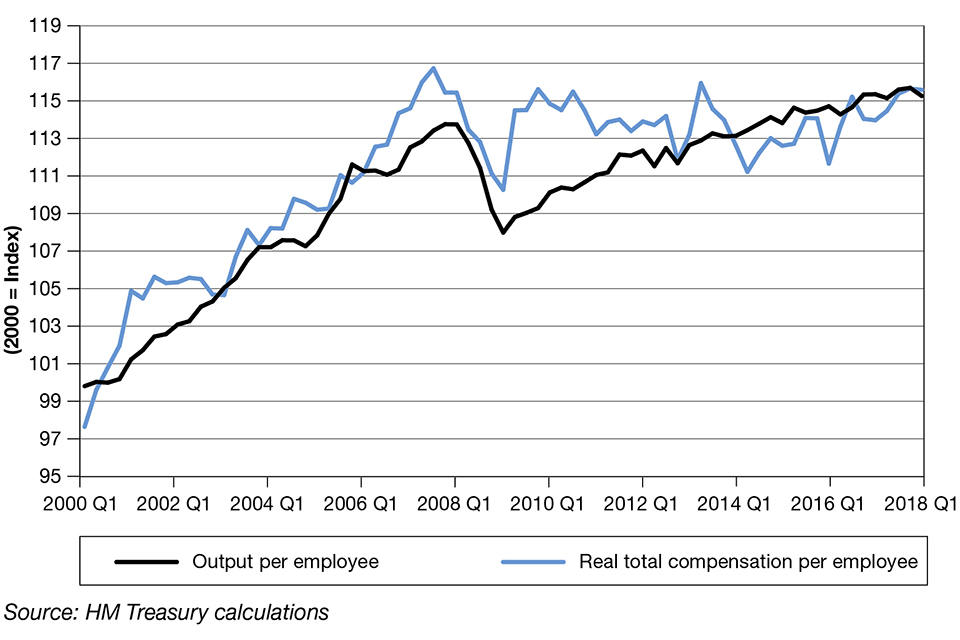
Since the financial crisis, the UK’s productivity growth has been below long-term trends.69 The government has already taken decisive action to address this challenge by significantly boosting capital investment, and public investment is set to average 2.2% of GDP over the next 5 years – levels not consistently sustained in 40 years.70This is supporting investment in the fastest, most reliable broadband connections, the largest roads investment programme in a generation, and the biggest rail investment programme since Victorian times,71 enabling transformative projects such as HS2. The government has also made significant strides to boost growth by cutting business taxes to stimulate investment, and has increased investment in the teaching of science and maths. The government is also acting to ensure businesses and consumers continue to benefit from new technologies, including by asking Jason Furman to lead a review of competition in the digital economy. The government’s modern Industrial Strategy will support this effort.
The cornerstone of the government’s plan to support productivity and boost growth is the National Productivity Investment Fund (NPIF), established in 2016 to provide additional capital investment in areas critical to productivity – housing, transport, digital infrastructure, and R&D (see Table 4.1). At the Budget, the government is going further, extending the NPIF by an extra year to 2023-24, and expanding it to £37 billion. It also announces the biggest ever roads investment package and next steps for the rollout of full fibre broadband nationwide.
Table 4.1: National Productivity Investment Fund (£ million) (1)
| 2017-18 | 2018-19 | 2019-20 | 2020-21 | 2021-22 (2) | 2022-23 (2) | 2023-24 (2) | |
|---|---|---|---|---|---|---|---|
| Housing | |||||||
| Accelerated Construction | 0 | 345 | 170 | 200 | – | – | – |
| Affordable Housing | 495 | 605 | 1,215 | 610 | – | – | – |
| Housing Infrastructure Fund | 0 | 355 | 1,165 | 1,140 | 1,070 | 1,190 | 1,590 |
| Small sites infrastructure and remediation | 0 | 275 | 355 | 120 | – | – | – |
| Land Assembly Fund | 0 | 0 | 220 | 355 | 355 | 355 | – |
| Transport | |||||||
| Roads and local transport | 365 | 360 | 290 | 415 | 90 | 90 | – |
| Next generation vehicles | 75 | 145 | 155 | 115 | – | – | – |
| Digital railway enhancements | 30 | 55 | 165 | 285 | – | – | – |
| Cambridge – Milton Keynes – Oxford Arc | 5 | 135 | 0 | 0 | – | – | – |
| Transforming Cities Fund | 0 | 140 | 355 | 485 | 1,010 | 910 | – |
| Future High Streets Fund | 0 | 0 | 5 | 75 | 220 | 240 | 195 |
| Tyne & Wear Metro | 0 | 0 | 25 | 35 | 265 | – | – |
| Digital Infrastructure | |||||||
| Fibre and 5G investment | 25 | 150 | 275 | 290 | – | – | – |
| Research and Development | |||||||
| Research and Development funding | 425 | 820 | 1,520 | 2,000 | 2,325 | – | – |
| Total | 1,420 | 3,385 | 5,915 | 6,125 | 6,955 | 6,500 | 7,250 |
| 1. Gross costs are presented on a UK basis. |
| 2. Further allocations will be made at future fiscal events. |
| Source: HM Treasury calculations |
The Budget sets out a vision for an economy driven by research and innovation, and announces a further £1.6 billion for R&D funding. The government is providing additional funding to support the Industrial Strategy Grand Challenges and secure the UK’s position as a world leader in new and emerging technologies such as Artificial Intelligence (AI), nuclear fusion, and quantum computing.
The Budget is also backing business and entrepreneurship, taking action to boost private sector investment and support people who want to start and grow businesses. In addition, the government is unlocking billions of pounds worth of pension fund investment in growing firms. The Budget also sets out steps to equip people with the skills they need to take advantage of the highly paid jobs in the new economy, outlining further detail on the National Retraining Scheme and strengthening the role of employers in the apprenticeships system.
As the UK prepares to leave the EU, the Budget is supporting the economy to be even more competitive, global and outward-facing. The government will empower local authorities to drive growth in their areas, including by building more homes in the right places, and is committed to ensuring people in every region and nation of the UK benefit from the proceeds of growth. The Budget announces a Future High Streets Fund that will invest £675 million to support local areas to improve access to high streets and town centres, and an extension to the Transforming Cities Fund, funding significant transport projects in English cities.
5.2 Infrastructure
High-quality infrastructure is essential to supporting jobs and economic growth, and to improving people’s quality of life. The Budget announces the biggest ever strategic roads investment package, and additional steps for the nationwide rollout of digital infrastructure. Overall, by 2021 the government will be investing £9 billion a year more in infrastructure than in 2015.72
5.3 Modernising transport
National Roads Fund – The government is delivering its commitment to hypothecate English Vehicle Excise Duty to roads spending, announcing that the National Roads Fund will be £28.8 billion between 2020-25. The Fund will provide long-term certainty for roads investment, including the new major roads network and large local major roads schemes, such as the North Devon Link Road.
Roads Investment Strategy 2 – The Budget is announcing the draft Roads Investment Strategy 2. This is the largest ever investment in England’s strategic roads and will enable the government to build on the successes of Roads Investment Strategy 1, such as the A1(M) link to Newcastle, and progress transformative projects like the A66 Trans-Pennine, the Oxford‑Cambridge Expressway, and the Lower Thames Crossing. The government expects to spend £25.3 billion on this strategy, funded by the National Roads Fund, between 2020-25.
Local roads – The government will allocate £420 million to local authorities in 2018‑19 to tackle potholes, repair damaged roads, and invest in keeping bridges open and safe. To support projects across England that ease congestion on local routes, the government will also make £150 million of NPIF funding available to local authorities for small improvement projects such as roundabouts. (4)
Transforming Cities Fund extension – As part of the NPIF, the government is extending the Transforming Cities Fund by a year to 2022-23. This will provide an extra £240 million to the six metro mayors for significant transport investment in their areas: £21 million for Cambridgeshire and Peterborough, £69.5 million for Greater Manchester, £38.5 million for Liverpool City Region, £23 million for West of England, £71.5 million for the West Midlands, and £16.5 million for Tees Valley. In addition, a further £440 million will be made available to the city regions shortlisted for competitive funding. Ten city regions are eligible for this funding, and the government will shortly be announcing a further two.
Transforming Cities Fund: Future Mobility Zones – To support the Industrial Strategy Future of Mobility Grand Challenge, £90 million from the NPIF will be allocated to the Transforming Cities Fund to create Future Mobility Zones. This will trial new transport modes, services, and digital payments and ticketing. £20 million of this will be allocated to the West Midlands.
5.4 Digital infrastructure
Full fibre networks – The government set out its strategy to meet the goal of a nationwide full fibre network by 2033 in the Future Telecoms Infrastructure Review published in July 2018.73 Full fibre networks are much faster, more reliable, and cheaper to operate than their copper predecessors. The Budget sets out the next steps to accelerate the rollout of full fibre:
- the Budget allocates £200 million from the NPIF to pilot innovative approaches to deploying full fibre internet in rural locations, starting with primary schools, and with a voucher scheme for homes and businesses nearby. The first wave of this will include the Borderlands, Cornwall, and the Welsh Valleys
- alongside the Budget, the government is publishing consultations to mandate gigabit‑capable connections to new build homes and speed up the delivery of upgraded connections to tenants, making it quicker and easier for communications providers to roll out full fibre networks
- the government is also announcing that Suffolk is the first local area to be awarded £5.9 million of funding from the third wave of the Local Full Fibre Networks challenge fund, enabling next-generation full fibre connections to key public buildings
5.5 Infrastructure strategy
National Infrastructure Strategy – The government will respond in full to the National Infrastructure Commission’s (NIC) ‘National Infrastructure Assessment’74 through a National Infrastructure Strategy that will be published in 2019. Alongside the Budget, the government has published an interim response setting out its investment record and progress in the priority areas identified in the NIC’s report.
NIC study: infrastructure resilience – The government has commissioned a new NIC study, to be published in Spring 2020, on how to improve the resilience of the UK’s infrastructure in light of technological advances and future challenges such as climate change.
Infrastructure finance review – The government will review its existing support for infrastructure finance, to ensure that it continues to meet market needs as the UK leaves the EU.
5.6 New technologies and innovation
Building on the government’s long-term commitment to R&D, and the Industrial Strategy ambition to raise total R&D investment to 2.4% of GDP by 2027, the Budget includes significant additional support for cutting-edge science and technologies that will transform the economy, create highly skilled jobs, and boost living standards across the UK.
Long-term support for research and development – The Budget allocates £1.6 billion to strengthen the UK’s global leadership in science and innovation. This reinforces the UK’s commitment to a strong environment for international scientific collaboration. Since 2016, the government has invested an additional £7 billion in research and development, the largest increase to R&D in 40 years.75
Industrial Strategy Challenge Fund – As part of this investment in R&D, the government will increase the Industrial Strategy Challenge Fund by £1.1 billion, supporting technologies of the future. This includes:
- Up to £121 million for Made Smarter to support the transformation of manufacturing through digitally-enabled technologies, such as the Internet of Things and virtual reality
- Up to £78 million for the Stephenson Challenge, supporting innovation in electric motor technology, making vehicles lighter and more efficient than ever before
Quantum technologies – The government will invest a further £235 million to support the development and commercialisation of quantum technologies, including up to £70 million from the Industrial Strategy Challenge Fund, and £35 million to support a new national quantum computing centre. These technologies will transform capabilities in computing, sensing and communications, bringing promising new approaches to solving global problems such as disease and climate change. This investment is in addition to the government’s recent £80 million extension of the Quantum Technology Hubs and takes overall funding for the second phase of the UK’s world-leading National Quantum Technology Programme to £315 million. (32)
Nuclear fusion – To maintain UK leadership in nuclear fusion and support the government’s Clean Growth Grand Challenge, the Budget announces an additional £20 million in 2019-20 for the UK Atomic Energy Agency to accelerate its ground-breaking work on the development and commercialisation of fusion technologies. (31)
Artificial Intelligence and data-driven innovation – The government has already taken action to ensure the UK is at the forefront of emerging digital technologies, including through the Industrial Strategy Artificial Intelligence (AI) and Data Grand Challenge, and an AI sector deal of up to £950 million. The Budget sets out the following next steps:
- the Office for AI and Government Digital Service (GDS) will review how government can use AI, automation and data in new ways to drive public sector productivity and wider economic benefits. This will feed into the innovation strategy being led by the Cabinet Office
- the Data Science Campus at the ONS and the GDS will conduct an audit of data science capability across the public sector, to make sure the UK public sector can realise the maximum benefits from data
- the government established the UK’s pioneering Centre for Data Ethics and Innovation to ensure that people have confidence in how data and technologies, such as AI, are used. The Budget announces that the Centre has been commissioned to study the use of data in shaping people’s online experiences, and the potential for bias in decisions made using algorithms
Global AI and future talent fellowships – To attract, retain and develop world-leading research talent, the government will invest up to £50 million in new Turing AIFellowships to bring the best global researchers in AI to the UK, and £100 million in an international fellowship scheme.
Catapults – To support entrepreneurs and businesses to access and adopt cutting‑edge technologies, the government is confirming £115 million to extend funding for the Digital Catapult, which has centres in the North East, South East and Northern Ireland, and the Medicines Discovery Catapult in Cheshire. This builds on the £1 billion in long-term funding already committed to the broader network of Catapult centres located across the UK.
Distributed Ledger Technology Field Labs – Distributed ledger technologies (DLT), such as blockchain, could revolutionise how information is recorded, protected, stored and shared, transforming financial markets, supply chains and public services. To test their potential, the Digital Catapult will run a series of DLT Field Labs, working with businesses, investors, and regulators in a range of areas, including in construction and the management of goods in ports.
Cryptoassets Taskforce – The Cryptoassets Taskforce was launched at the International Fintech Conference in March 2018. Following extensive work by HM Treasury, the Financial Conduct Authority (FCA) and the Bank of England, the Cryptoassets Taskforce report will be published alongside the Budget. The report will set out the UK’s approach to cryptoassets and distributed ledger technologies in financial services, including actions that will allow innovators to thrive and the benefits of these new technologies to be realised while at the same time mitigating the risks that arise from cryptoassets. This will ensure the UK maintains its international reputation as a financial services centre with high regulatory standards.
Science and innovation at the heart of government – To stimulate the use of cutting-edge science and innovation in government, the Budget announces a new £50 million per year fund designed to address the most pressing challenges in areas such as public health and cyber security. The fund will focus on joint programmes between government and industry, and will begin in 2021-22.
Supporting innovation across the country – The government will invest an additional £120 million through the Strength in Places Fund. This will support clusters of science and innovation excellence across the UK and enable them to further develop their strengths. This funding extends the existing programme until 2021-22.
5.7 Regulation fit for the future
The UK has a strong regulatory system which protects the interests of consumers and encourages high levels of investment. The government has already asked the NIC to undertake a study examining long-term challenges for utilities regulation. In addition, the Budget is announcing policies to accelerate innovation and collaboration in utilities regulation.
Encouraging innovation in regulated utilities – The government will launch a consultation on how to encourage greater innovation in the utilities sectors.
Increasing the capacity of the UK Regulators Network – Regulated sectors face shared challenges such as adapting to technological change, delivering future infrastructure and protecting vulnerable consumers. The membership body, UK Regulators Network (UKRN), can play a central role in forging a shared response to these challenges. To support this, regulators have pledged additional resources for UKRN to deliver a cross-sector project aimed at improving outcomes for vulnerable consumers. In addition, UKRN will publish a plan in spring 2019 outlining how it will improve collaboration between regulators.
Improving government messaging to regulators – The government will review the process of setting future ‘Strategic Policy Statements’ to Ofgem, Ofcom and Ofwat, to determine how best to set clear strategic direction for regulators, consistent with cross-sectoral government priorities.
5.8 Global Britain
The Budget takes further steps to sustain the UK’s position as an outward-looking and open economy.
Supporting exports – To provide additional fixed rate finance to overseas buyers who choose UK goods and services, UK Export Finance (UKEF) will make a one-off increase to their Direct Lending Facility of up to £2 billion over 2020-21 and 2021-22.
Attracting inward investment – The government will strengthen its investment links with global partners to encourage additional inward investment, including becoming a European Partner to the Institutional Investor Roundtable that brings together leading global investment funds.
Strengthening the overseas network in Europe – To provide enhanced support to UK businesses, the Department for International Trade will expand their network of advisers in Europe. (30)
Enhancing the UK border experience – In 2019, the government will introduce changes at the UK border to enhance the experience for business and leisure travellers to the UK. As part of this, citizens of the United States, Canada, New Zealand, Australia and Japan will, by next summer, be able to use the e-passport gates at UK ports, significantly improving the flow of passengers at busy airports such as Heathrow. Businesses will be able to become customs trusted traders (including ‘Authorised Economic Operator’) in half the time it currently takes, as part of the UK’s aim to be at the cutting edge of global customs administration. HMRC will implement the improvements within 2 years.
Festival of Innovation and Creativity – In October the government committed £120 million to a UK Festival of Innovation and Creativity. The Festival will deliver an exciting programme of events on arts, culture, design and tech across the country, and will help attract new inward investment.
5.9 Enterprise and business support
In order to support the UK’s established and emerging businesses, the Budget takes further action to increase management capability and technology adoption, and improves firms’ access to finance.
Management capability – The Productivity Leadership Group has shown that business‑led approaches to improving productivity work. Building on work with Be the Business and the emerging findings of the Industrial Strategy Business Productivity Review, to support management capability so that businesses can raise their productivity, the government will:
- create a Small Business Leadership Programme, delivered in partnership with business schools and leading businesses across England. 2,000 places will be delivered in 2019-20, with an ambition to train 10,000 people per year by 2025 (81)
- invest up to £25 million to boost business productivity through the Knowledge Transfer Partnerships scheme, placing over 200 additional graduates and academics with relevant skills into firms to translate their research insights into business growth (27)
- invest £20 million in 2019-20 to support local peer-to-peer networks focused on business improvement so that thousands of business leaders can share expertise on leadership, business development and technology adoption (81)
Digital tools for business – The government will work in partnership with large banks, professional services firms and technology companies to support the productivity of their small business customers. The government will also improve the customer experience for businesses accessing online government information and services. (81)
Backing entrepreneurs – To build on the UK’s reputation as one of the best places in the world to start and grow a business, the government will extend the funding of the British Business Bank’s Start-Up Loans Programme to 2021 so it can continue to provide loans and mentoring to entrepreneurs. The British Business Bank, which started operating in 2014, is the government’s UK-wide economic development bank. It makes finance markets for smaller businesses work more effectively, allowing those businesses to prosper, grow and build UK economic activity. (28)
Pension fund investment in patient capital – Autumn Budget 2017 announced an action plan to unlock £20 billion of finance for innovative high-growth firms, and established a taskforce to address the barriers to pensions investment in patient capital. With total assets under management expected to exceed £1 trillion by 2025,76 defined contribution pension schemes have a vital role to play in long-term financing for UK growth and innovation. Following The Pensions Regulator’s updated guidance for pension schemes considering patient capital investment,77 the Budget announces that:
- through the British Business Bank, the government will support pension funds to invest in growing UK businesses. Several of the largest defined contribution pension providers in the UK have committed to work with the British Business Bank to explore options for pooled investment in patient capital, including Aviva, HSBC, L&G, NEST, The People’s Pension, and Tesco Pension Fund
- the FCA will publish a discussion paper by the end of 2018 to explore how effectively the UK’s existing fund regime enables investment in patient capital. This will accompany the ongoing work of HM Treasury’s Asset Management Taskforce to explore the feasibility of a new long-term asset fund
- the Department for Work and Pensions will consult in 2019 on the function of the pensions charge cap to ensure that it does not unduly restrict the use of performance fees within default pension schemes, while maintaining member protections
- the FCA will consult by the end of 2018 on updating the permitted links framework to allow unit-linked pension funds to invest in an appropriate range of patient capital assets
Access to finance and EU exit – The government is committed to supporting the UK’s fast-growing and innovative firms to secure the external finance they need to invest and grow. As the UK leaves the EU, it continues to actively explore options for a future relationship with the European Investment Bank Group (EIBG). However, if no future relationship with the EIBG is in place before the UK leaves the EU on 29 March 2019, the government will provide the British Business Bank with the resources to enable it to make up to £200 million of additional investment in UK venture capital and growth finance in 2019-20.
Intellectual property – The Intellectual Property Office will support more companies to use their intellectual property to access finance, piloting a new offer to help businesses secure high-quality valuations, and will work with banks to improve their awareness of the opportunities and true credit risk associated with such lending.
SME access to dispute resolution and redress – The government welcomes the FCA’s plans to expand access to the Financial Ombudsman Service (FOS) to small and medium-sized enterprises (SMEs) with a turnover of up to £6.5 million, along with its consultation on increasing the FOS award limit to £350,000. As outlined in the FCA’s recent policy statement, the FOS will now take steps to ensure they have the necessary skills and processes in place to handle these new cases. The government also expects the banking industry to set out its response to the recommendations in Simon Walker’s report on alternative dispute resolution for SMEs by the end of November. This includes responding to its recommendations for a voluntary dispute resolution mechanism for SMEs outside the FOS remit, but below £10 million turnover, and to set up a process that can address unresolved historical complaints.
5.10 Skills
The Budget sets out the government’s vision for developing the new skills needed for the UK’s long-term prosperity, in order to build an economy fit for the future.
Apprenticeships – The government will introduce a package of reforms to strengthen the role of employers in the apprenticeship programme, so they can develop the skills they need to succeed. As part of this:
- the government will make up to £450 million available to enable levy paying employers to transfer up to 25% of their funds to pay for apprenticeship training in their supply chains
- the government will provide up to £240 million, to halve the co-investment rate for apprenticeship training to 5% (23)
- the government will also provide up to £5 million to the Institute for Apprenticeships and National Apprenticeship Service in 2019-20, to identify gaps in the training provider market and increase the number of employer-designed apprenticeship standards available to employers. All new apprentices will start on these new, higher-quality courses from September 2020
- the Exchequer Secretary to the Treasury and the Minister for Apprenticeships and Skills will work with a range of employers and providers to consider how they are responding to the apprenticeship levy across different sectors and regions in England, as well as the future strengthened role of apprenticeships in the post-2020 skills landscape
National Retraining Scheme – The government will work with employers to give workers the opportunity to upskill or retrain. The Budget allocates £100 million for the first phase of the National Retraining Scheme (NRS). This will include a new careers guidance service with expert advice to help people identify work opportunities in their area, and state‑of‑the‑art courses combining online learning with traditional classroom teaching to develop key transferable skills. The National Retraining Partnership between the government, the Confederation of British Industry and the Trades Union Congress will focus on job-specific retraining in phase two. (80)
Skills pilots – The government will fund £20 million of skills pilots. This will include:
- a new £3 million pilot to help employers in Greater Manchester and surrounding areas to address local digital skills gaps through short training courses (26)
- a £10 million pilot in Greater Manchester, working with the Federation of Small Businesses, to test what forms of government support are most effective in increasing training levels for the self-employed (24)
- £7 million match funding alongside employers to provide on-the-job training to young people not currently in employment, education or training in Greater Manchester, and to move them into sustainable career paths with employers (25)
T levels – The government will provide £38 million of capital funding to support implementation of the first three T levels in 2020 across 52 providers.
Post-18 education and funding – The government’s review into the post-18 education and funding system in England will ensure that all students are given a genuine choice between high-quality technical, vocational and academic routes in a system accessible to all; students and taxpayers are getting value for money; and employers can access the skilled workforce they need. As part of the review, the government will receive advice from an independent panel, chaired by Philip Augar. The panel will report to ministers at an interim stage before the government concludes the overall review.
Human capital – The government is working with the ONS to better understand how its investment in people helps improve their earning and skills potential. The ONS will consult on how to further measure human capital, and will convene an international meeting of experts in London later this year.
5.11 Housing
The government is determined to fix the broken housing market. Building more homes in the right places is critical to unlocking productivity growth and makes housing more affordable. At Autumn Budget 2017, the government set out a comprehensive package of new policies to raise housing supply by the end of this Parliament to its highest level since 1970, on track to reach 300,000 a year. At this Budget, the government sets out further steps to deliver this ambition.
Delivering housing investment – At Autumn Budget 2017, the government announced over £15 billion of new financial support, bringing total support for housing to at least £44 billion over a five-year period. The Budget announces further progress to implement this commitment, including:
- £291 million from the Housing Infrastructure Fund, funded by the NPIF, to unlock 18,000 new homes in East London through improvements to the Docklands Light Railway
- the British Business Bank will deliver a new scheme providing guarantees to support up to £1 billion of lending to SME housebuilders
- providing £653 million to 2021-22 for strategic partnerships with nine housing associations to deliver over 13,000 homes
- £75 million from the Home Building Fund for St Modwen plc, to fund infrastructure to build over 13,000 new homes
- a new five-year strategic business plan for Homes England, to be published on 30 October 2018
Housing investment for the long term – In September 2018, the government announced £2 billion new funding in the Affordable Homes Programme to give some housing associations long-term funding certainty to 2028-29. The government announces in this Budget that:
- the Housing Revenue Account cap that controls local authority borrowing for house building will be abolished from 29 October 2018 in England, enabling councils to increase house building to around 10,000 homes per year. The Welsh Government is taking immediate steps to lift the cap in Wales (33)
- the Housing Infrastructure Fund, funded by the NPIF, will increase by £500 million to a total £5.5 billion, unlocking up to 650,000 new homes
Accelerating housing delivery – Alongside the Budget, Sir Oliver Letwin has published his independent review of the gap between housing completions and the amount of land allocated or permissioned. The review found no evidence that speculative land banking is part of the business model for major house builders, nor that this is a driver of slow build out rates. The review concluded that greater differentiation in the types and tenures of housing delivered on large sites would increase the market absorption rates of new homes – the binding constraint on build out rates on large sites – and has set out recommendations to achieve this aim. The government will respond to the review in full in February 2019. In order to minimise uncertainty for housebuilders, the government confirms that Help to Buy Equity Loan funding will not be made contingent on large sites with existing outline permission being developed in conformity with any new planning policy on differentiation. The government will honour any funding commitments made to sites with existing outline planning permission, regardless of any new planning policy on differentiation.
Planning reform – The government has already revised the National Planning Policy Framework, implementing 85 of the proposals set out in the Housing White Paper and Autumn Budget 2017, ensuring that more land in the right places is available for housing. The Budget announces that the government has launched a consultation on new permitted development rights to allow upwards extensions above commercial premises and residential properties, including blocks of flats, and to allow commercial buildings to be demolished and replaced with homes.
Land value uplift – The government confirms that it will introduce a simpler system of developer contributions that provides more certainty for developers and local authorities, while enabling local areas to capture a greater share of uplift in land values for infrastructure and affordable housing. The reforms include simplifying the process for setting a higher zonal Community Infrastructure Levy in areas of high land value uplift, and removing all restrictions on Section 106 pooling towards a single piece of infrastructure. The government will also introduce a Strategic Infrastructure Tariff for Combined Authorities and joint planning committees with strategic planning powers.
Strategic housing deals – The government will make £10 million capacity funding available to support ambitious housing deals with authorities in areas of high housing demand to deliver above their Local Housing Need. (36)
Help to Buy Equity Loan – The Help to Buy Equity Loan was introduced in 2013 to support the housing market in challenging conditions. By March 2021, the government expects to have invested around £22 billion in the scheme, supporting up to 360,000 households into homeownership. Conditions in the market have improved since 2013: there is a growing number of high Loan to Value products available to first-time buyers, and housing supply continues to increase. To ensure future support is targeted at those who need most help into homeownership, the Budget announces that from April 2021, a new Help to Buy Equity Loan scheme will run for 2 years before closing in March 2023. The new scheme will be available for first-time buyers only, and for houses with a market value up to new regional property price caps, as set out in Table 4.2. These caps are set at 1.5 times the current forecast regional average first-time buyer price, up to a maximum of £600,000 in London. The government does not intend to introduce a further Help to Buy Equity Loan scheme after March 2023.
Table 4.2: New Help to Buy regional property price caps
| Region | Price cap for properties eligible for Help to Buy Equity Loan scheme from April 2021 to March 2023 |
|---|---|
| North East | £186,100 |
| North West | £224,400 |
| Yorkshire and The Humber | £228,100 |
| East Midlands | £261,900 |
| West Midlands | £255,600 |
| East of England | £407,400 |
| London | £600,000 |
| South East | £437,600 |
| South West | £349,000 |
| Source: HM Treasury analysis |
Shared ownership – To support homeownership further, the government is launching a call for evidence inviting proposals from investors willing to collaborate with government to deliver a new wave of shared ownership homes.
New discounted homes in up to 500 neighbourhoods – The government wants to see parishes and communities provide many more homes for local people to buy, at prices they can afford. The Localism Act allows the people who know their area best to come together to prepare neighbourhood plans and development orders, to ensure they get the right homes, in the right places. The government will provide £8.5 million of resource support so that up to 500 parishes can allocate or permission land for homes sold at a discount. Neighbourhood plans and orders are approved by local referendums, and the government will update planning guidance to ensure that these cannot be unfairly overruled by local planning authorities. The government will also explore how it can empower neighbourhood groups to offer these homes first to people with a direct connection to the local area. (35)
5.12 Clean Growth
The economy of the future will be low carbon and green, and the UK is well positioned to lead this global transition. The Budget sets out how the government is accelerating this shift to a clean economy, building on the Industrial Strategy, Clean Growth Strategy, and 25 Year Environment Plan.
Industrial Energy Transformation Fund – As part of the Industrial Strategy, the government will establish an Industrial Energy Transformation Fund, backed by up to £315 million of investment, to support businesses with high energy use to transition to a low carbon future and to cut their bills through increased energy efficiency. (42)
Improving business energy efficiency – The government will issue a call for evidence on introducing a new Business Energy Efficiency Scheme, focused on smaller businesses. Over time, this scheme will reduce business energy bills and carbon emissions. The call for evidence will seek views on a range of possible delivery options.
Tackling air quality – £20 million additional funding will be allocated to support more local authorities to meet their air quality obligations. (41)
Flood risk management – The Budget allocates £13 million to tackle risks from floods and climate change, through pilot projects to ensure property owners have the best information on protecting their homes, and expanding the flood warning system to an additional 62,000 at‑risk properties.
Plastics and waste innovation funding – The government is providing £20 million to support measures in this Budget to tackle plactics and boost recycling – £10 million more for plastics R&D, and £10 million to pioneer innovative approaches to boosting recycling and reducing litter, such as smart bins. (38)
Supporting abandoned waste site clearance – A government pilot scheme will make available up to £10 million to the Environment Agency to work with partners to clear the worst abandoned waste sites that blight local communities. (39)
Funding for tree planting – Planting trees helps offset carbon emissions and supports wildlife. To provide the long-term certainty needed for investment in woodland, the government will set up a Woodland Carbon Guarantee scheme which will support the planting of around 10 million trees by purchasing up to £50 million of carbon credits for qualifying tree planting. The government will also provide £10 million funding between 2019-20 and 2022-23 for local community street trees and urban trees. (40)
Supporting the UK fishing sector – The government is investing £10 million from UK Research and Innovation to establish an innovation fund to help transform the industry and ensure the UK is a world leader in safe, sustainable and productive fishing. £2 million will also be provided for fishing safety projects across England and to give the devolved administrations the ability to do the same.
Avoiding food waste – Around 250 million meals’ worth of accessible edible food is needlessly wasted every year.78 The government will provide £15 million to charities and others to distribute this surplus food. (83)
5.13 Regional growth
The government’s ambition is for all regions to unlock their potential to boost national productivity and growth. To do this, the government is giving local places the powers and funding they need to invest in local priorities and address local barriers to productivity.
The Budget therefore funds new programmes delivered at the local level to address barriers to productivity and increases funding for existing programmes. These include:
- £770 million to extend the Transforming Cities Fund
- £675 million for a new Future High Streets Fund, which forms part of Our Plan for the High Street
- £420 million for local roads maintenance including potholes (4)
- £200 million to pilot innovative approaches to deploying full fibre internet in rural locations
- £150 million for small road improvement projects
- £120 million for the Strength in Places Fund to support areas of R&D excellence across the UK
- £20 million to support local peer-to-peer networks focused on business improvement
- £10 million to generate proposals for new business-backed Development Corporations and similar delivery bodies (34)
- £5 million to support new University Enterprise Zones (29)
Figure 4.1 Investment across the UK
View the map.
5.14 Investing in UK towns and cities
Future High Streets Fund – As part of Our Plan for the High Street and alongside changes to business rates, the government will launch a new Future High Streets Fund to invest £675 million in England to support local areas to develop and fund plans to make their high streets and town centres fit for the future. This will invest in town centre infrastructure, including to increase access to high streets and support redevelopment and densification around high streets. It will include £55 million for heritage-based regeneration, restoring historic high streets to boost retail and bring properties back into use as homes, offices and cultural venues. The Fund will also establish a new High Streets Taskforce to disseminate best practice among local leaders. (45, 46)
High streets planning – The government will consult on planning measures to support high streets to evolve. As part of this, it will consult on creating a more flexible and responsive ‘change of use’ regime with new Permitted Development Rights that make it easier to establish new mixed‑use business models on the high street. It will also trial a register of empty shops with selected local authorities, and trial a brokerage service to connect community groups to empty shops.
University Enterprise Zones – The government will provide £5 million to support up to 10 local areas to develop proposals for new University Enterprise Zones. They will promote collaboration between universities and businesses, support start-ups and scale-ups, and disseminate management skills. (29)
Development Corporations – The government will consult on the legal framework for Development Corporations. It will also launch a £10 million competitive fund, supported with advice from Sir George Iacobescu, to enable local areas to generate locally-led proposals for new business‑backed Development Corporations and similar delivery bodies. (34)
Local infrastructure rate – Following the announcement at Autumn Budget 2017 that local authorities could bid for access to a local infrastructure rate to support infrastructure projects that are high value for money, five local authorities have been successful in the first round of applications. The Metropolitan Borough of Calderdale, Luton Borough Council, St Helens Council, Transport for London and the West Midlands Combined Authority will be able to borrow a total of £275 million at the new discounted interest rate of gilts +60 basis points.
Dawlish resilience – Following the £15 million of funding committed in November 2016, essential work will begin this November to strengthen the cliffs and protect the seawall at Dawlish. Plans for major improvements for the seawall at Dawlish will be published next summer.
5.15 Midlands Engine
Defence and National Rehabilitation Centre – Working with local partners, the government will continue to support the Midlands Engine with up to £70 million to construct the national element of the Defence and National Rehabilitation Centre, able to provide care for civilians to aid their recovery from debilitating injury and return to the world of work.
UK Mobility Data Institute – The West Midlands Combined Authority will receive up to £20 million, subject to approval of a satisfactory business case, to create the UK Mobility Data Institute, a research centre to collect, process and analyse transport data generated by new mobility technologies. (52)
Coventry, UK City of Culture – The government will invest £8.5 million in Coventry’s plans to showcase the city when it hosts the UK City of Culture in 2021. The funding will support Belgrade Theatre to refurbish the auditorium and establish a new creative talent hub. It will also invest in Coventry’s Cathedral Quarter, including the refurbishment of historic venues, the creation of additional exhibition space and a centre for music education and concerts. (49)
Commonwealth Games Athletes’ Village – In October, the government announced £165 million investment to support the Commonwealth Games Athletes’ Village, which will unlock 5,000 new homes in the area after the Games, creating a long-lasting legacy for Birmingham and the Games.
Midlands Engine Strategy – The government will publish a refreshed Midlands Engine Strategy next year.
5.16 Northern Powerhouse
Northern Powerhouse Rail – Northern Powerhouse Rail will transform the economic geography of the North, connecting cities with faster, more frequent services to boost growth and improve the experiences of passengers across the region. The Budget announces up to a further £37 million to support the development of Northern Powerhouse Rail, building on £300 million already committed to ensure HS2 infrastructure can accommodate future potential Northern Powerhouse Rail and Midlands Engine Rail services. The first business case of the scheme is due at the end of the year. (50)
Tees Valley – The government is supporting local growth in the Tees Valley with plans for a Special Economic Area covering the South Tees Development Corporation (STDC) site and up to £14 million in funding for the STDC, the first Mayoral Development Corporation outside of London. This investment, subject to approval of a satisfactory business case, will enable the STDC to undertake early redevelopment of a part of the site and attract new business and investment. Designation of the site as a Special Economic Area would allow for the local retention of additional business rates growth.
Eden Project North – The government is providing £100,000 to support the development of proposals for an ‘Eden Project North’ centre in Morecambe.
Northern Powerhouse Strategy – The government will publish a refreshed Northern Powerhouse Strategy next year.
5.17 Cambridge – Milton Keynes – Oxford Arc
Responding to the NIC – Alongside the Budget, the government publishes its response to the NIC’s report on the Arc, detailing significant progress and future plans for the Arc.
Housing – The government supports the NIC’s ambition to deliver up to 1 million new homes in the Arc by 2050 to maximise sustainable economic growth. The government recognises that the environmental requirements to underpin sustainable growth need to be considered at a pan-Arc level, and that the Arc is valued for its wildlife and natural places. The Arc is an opportunity to demonstrate the ambitions of the government’s 25 Year Environment Plan.
East West Rail – A new East West Rail company has been established to accelerate the delivery of the central railway section between Cambridge and Bedford. The government is providing a further £20 million to develop a strategic outline business case for the railway. This will explore which routes best support the government’s vision to unlock up to 1 million new homes by 2050. (51)
Cross-Arc collaboration – The government confirms its commitment to work with local partners, and to provide new road and rail links to best achieve its vision for the Arc. The government also announces that:
- working with local partners, the government will publish an ambitious Arc-wide joint vision statement by Spring 2019
- the government will appoint an independent business Chair for the Arc to provide expert advice and act as an advocate and champion to help galvanise local, national and international support for the Arc, particularly from business and industry
- the government will also appoint a Ministerial Champion for the Arc, to provide further focus and facilitate coordination across Whitehall
5.18 London and the South East
Housing Infrastructure Fund – The government will invest £291 million from the Housing Infrastructure Fund to unlock over 18,000 new homes in East London through investment in the Docklands Light Railway.
Westminster Ceremonial Streetscape Project – The government will provide £5 million for the Westminster Ceremonial Streetscape Project to improve security and better manage traffic.
Thames Estuary – Drawing on the Thames Estuary Commission report,79 the government is supporting a study to develop options and consult the local area on a Great Thames Park.
Crossrail 2 – The government is considering the recommendations of the Independent Affordability Review of Crossrail 2, and will consider the case for the project at the Spending Review.
5.19 Scotland, Wales and Northern Ireland
The government is committed to maintaining a strong and prosperous Union to preserve our shared values. In this Budget, the government is taking further steps to improve living standards and productivity across the UK, including targeted support in Scotland, Wales and Northern Ireland. Certain key economic policies are devolved, and the UK government will continue to work closely with the devolved administrations to deliver the maximum benefit for everyone across the UK.
Funding – Spending decisions taken by the UK government in the Budget result in Barnett consequentials for the devolved administrations to deliver their devolved responsibilities:
- the Scottish Government’s budget will increase by over £950 million through to 2020-21 before adjustments for tax devolution
- the Welsh Government’s budget will increase by over £550 million through to 2020-21 before adjustments for tax devolution. This includes over £25 million as a result of a 5% uplift in Barnett consequentials agreed as part of the Welsh Government’s fiscal framework
- the budget for a Northern Ireland Executive will increase by over £320 million through to 2020‑21
The British Business Bank’s UK Network – The government is committed to ensuring that businesses across all regions and nations in the UK can access the finance they need to invest and grow. The British Business Bank is appointing a team to identify and help to reduce geographical imbalances in access to finance for smaller businesses. The team will be based across the UK, including Scotland, Wales and Northern Ireland, with new, dedicated directors overseeing its work.
Supporting the UK’s fishing industry – Over half of the UK’s fishers are based in Scotland, Wales and Northern Ireland.80 The fishing industry across the UK will benefit from the government’s investment of £10 million from UK Research and Innovation to establish an innovation fund. This will help to ensure the UK is a world leader in safe, sustainable and productive fishing. The UK government will also provide additional funding to the devolved administrations to allow them to match the UK government’s increased contribution to fishing safety projects in England.
5.20 Scotland
City and growth deals in Scotland – The government commits £150 million to allow a Tay Cities Deal to be agreed. The government will also begin formal negotiations with local partners and the Scottish Government towards a Moray Growth Deal. The government continues to make good progress towards growth deals for Ayrshire and the Borderlands, and is working with the Scottish Government to achieve this, alongside local partners in England for the Borderlands. (48)
Maintaining the UK’s globally competitive oil and gas fiscal regime – The government is maintaining headline tax rates at their current level. This will help the oil and gas industry continue its recovery from the 2014 oil price crash, protect jobs, and ensure the UK is attractive for new investment, whilst giving the nation a fair return for its natural resources.
Oil and gas taxation: transferable tax history and retention of decommissioning expenditure – As announced at Autumn Budget 2017, the government will introduce a transferable tax history mechanism in Finance Bill 2018-19 for oil and gas companies that will remove tax barriers to new investment in the North Sea. The government will also amend the Petroleum Revenue Tax rules on retained decommissioning costs to simplify the way older fields can be sold to new investors. This will provide further support for an industry that is a vital part of the economies of Scotland and the rest of the UK.
Strengthening the UK’s offshore decommissioning industry – Building on the recent progress made by the oil and gas industry, the government will launch a call for evidence and work together with the Oil and Gas Authority to identify what more should be done to further strengthen Scotland and the UK’s position as a global hub for decommissioning.
5.21 Wales
Growth deals in Wales – The government commits £120 million to allow a North Wales Growth Deal to be agreed, the third deal to be agreed in Wales. The government is also working with local partners and the Welsh Government towards a Mid Wales Growth Deal. (48)
Infrastructure – The government has committed to the removal of tolls on the Severn Crossings from 17 December 2018. In addition, the Department for Transport and the Welsh Government continue to develop proposals for a number of potential rail schemes within Wales.
Welsh Government borrowing powers for the M4 relief road – The government will also support the delivery of a new M4 relief road through a review of the Welsh Government’s capital borrowing powers at the Spending Review, to consider whether the borrowing cap should be increased by up to £300 million to support this vital project.
5.22 Northern Ireland
City Deals in Northern Ireland – The government commits £350 million for a Belfast City Region Deal, and will work with local partners to progress the deal, including establishing robust governance, accountability and transparency arrangements, to ensure this can be spent in the absence of a Northern Ireland Executive. The government will also begin formal negotiations with local partners towards a Derry/Londonderry and Strabane City Region Deal. (48)
Shared and integrated education and shared housing in Northern Ireland – The government will move forward with projects worth £300 million subject to value for money considerations, as part of the government’s commitment in the Fresh Start Agreement to provide up to £500 million to increase the provision of shared and integrated education and shared housing in Northern Ireland.
Belfast regeneration funding – The government will provide £2 million for the recovery and regeneration of Belfast city centre following a fire at the Bank Buildings in August.
VAT and APD – At the Budget the government is publishing its response to the call for evidence on the impact of VAT and APD on tourism in Northern Ireland. There will be no changes to the VAT or APD regimes in Northern Ireland at this time. The government will continue to explore ways to support a successful and growing tourism industry. In particular, establishing a technical working group to consider the practical and legal challenges to changing short-haul APD in Northern Ireland.
6. Supporting public services and people
6.1 Introduction
Since 2016, the government has continued to reduce debt while providing additional support for public services.81 The core schools budget is at a record high this year, standing at more than £42 billion,82 and the government has allocated £5.8 billion between 2015 and 2020 to deliver new school places.83 A further £6.3 billion was invested in the NHS at Autumn Budget 2017 for frontline services and improving buildings and facilities.84
The Budget builds on the government’s strong record of investment in public services and living standards. Since 2010, NHS funding has risen every year and the proportion of children in good or outstanding schools has risen from 66% to 86%.85 The government remains committed to protecting the UK from global threats and keeping people safe, honouring the NATO commitment to spend 2% of GDP on defence, and honouring the UK’s international and legal commitment to spend 0.7% of gross national income on official development assistance.86 Supported by the National Living Wage (NLW), the lowest paid have seen their wages grow by 8% above inflation since April 2015.87
The government’s balanced approach to managing public finances means that the Budget can also provide additional investment in vital public services now, as well as taking action to improve living standards by increasing take-home pay and supporting consumers to make their money go further.
The Budget provides significant new investment into the public services that people care about the most. This includes the following:
- funding for a new multi-year budget for the NHS until 2023-24, following the Prime Minister’s June 2018 statement that the NHS budget would increase by £20.5 billion a year in real terms by 2023-24
- additional funding for social care, to help local councils provide greater support for older people with care needs, and to help more children to live safely at home
- further support for children and young people, including school equipment and maintenance, and help for young people to build strong communities free from violence
- protecting citizens and communities, increasing defence spending to enable our world‑class Armed Forces to face ever-changing threats, including the rise in cyber attacks, and supporting counter-terrorism policing across the country
The government is committed to a welfare system that ensures work always pays, protects the most vulnerable, and is fair to the taxpayer and sustainable for the future. The Budget provides additional support for people transferring onto Universal Credit, and an increase in the Work Allowance that will mean 2.4 million households keep more of their income.
While increasing productivity is the only way to raise living standards in the long term, the Budget goes further to help people now. This includes raising the National Living Wage to £8.21 an hour in April 2019, as well as supporting consumers to make their money go further.88
6.2 The NHS
NHS funding – The NHS is the government’s number one spending priority. In June, the government set out an unprecedented multi-year funding plan, with associated cash budgets, for the NHS in England. At that time this equated to £20.5 billion more a year in real terms by 2023-24, an average real growth rate in the NHS’s budget of 3.4% a year; taking the NHS budget from £114.6 billion in 2018-19 to £147.8 billion89 in 2023-24, with a total UK-wide scorecard cost of £83.6 billion. The NHS agreed to come forward with a new long-term plan this year, to be agreed with the government. The cash settlement that the government promised in June 2018 is fully funded at this Budget. The NHS will deliver its plan by the end of the year, and the government will confirm the final settlement consistent with that plan, and the £20.5 billion real terms increase by 2023-24, by Spending Review 2019. (1)
This settlement will enable the NHS to plan for its future and support it to deliver the world-class care that people want and expect. It is essential that every pound in the NHS is spent wisely. The government has set five financial tests for the NHS to meet in producing the plan, to ensure that it does its part in putting the health service onto a more sustainable footing. The plan must set out how:
- the NHS (including providers) will return to financial balance
- the NHS will achieve cash-releasing productivity growth of at least 1.1% a year (with a final number to be confirmed in the plan), with all savings reinvested in frontline care
- the NHS will reduce the growth in demand for care through better integration and prevention (with a final number to be confirmed in the plan)
- the NHS will reduce variation across the health system, improving providers’ financial and operational performance
- the NHS will make better use of capital investment and its existing assets to drive transformation
As also set out in June 2018, the government will consider proposals from the NHS for a multi-year capital plan to support transformation, and a multi-year funding plan for clinical training places. The government will also ensure that public health services help people live longer healthier lives. Budgets in these areas will be confirmed at Spending Review 2019.
Mental health funding – The government is committed to achieving parity of esteem between mental health and physical health services, ensuring that high quality mental health support is available for those that need it, in appropriate, safe settings. Funding for mental health services will grow as a share of the overall NHS budget over the next 5 years. These services will take pressure off Accident and Emergency (A&E) departments and other public services such as the police, probation and social services. They will also ensure that people with mental illness can return to, and stay in, work, boosting employment and productivity. The NHS will invest up to £250 million a year by 2023-24 into new crisis services, including: 24/7 support via NHS 111; children and young people’s crisis teams in every part of the country; comprehensive mental health support in every major A&E by 2023-24; more mental health specialist ambulances; and more community services such as crisis cafes. The NHS will also prioritise services for children and young people, with schools-based mental health support teams and specialist crisis teams for young people across the country. For adults, the NHS will expand access to the Individual Placement Support programme to help those with severe mental illness find and retain employment, benefitting 55,000 people by 2023-24.
Support for air ambulance trusts – Our air ambulance services work tirelessly 24 hours a day, 365 days a year to get those with life-threatening illnesses and injuries to the expert medical care they need. The government is making available £10 million of capital funding in England to back them in this work.
6.3 Local councils and social care
Local government has a vital role to play in delivering high quality public services for local communities. The government is already taking steps to empower local councils, giving them greater choice in how best to serve their local area – for example, enabling councils to raise more money locally for services. The Budget provides additional funding to help support local authority financial sustainability.
The government has already taken action to help secure a stable system of social care in England. The government has created the Improved Better Care Fund to help support health and social care integration, and introduced the new adult social care precept. At Spring Budget 2017, the government provided an additional £2 billion for councils to spend on adult social care services.
In the longer term, the government is committed to putting social care on fairer and more sustainable footing and will set out proposals for adult social care in the forthcoming green paper.
Additional social care funding – In the short term, the Budget provides an additional £240 million in 2018-19 and £240 million in 2019-20 for adult social care. This will make sure people can leave hospital when they are ready, into a care setting that best meets their needs. This will help the NHS to free up the beds it needs over winter. (2)
The Budget provides a further £410 million in 2019-20 for adults and children’s social care. Where necessary, local councils should use this funding to ensure that adult social care pressures do not create additional demand on the NHS. Local councils can also use it to improve their social care offer for older people, people with disabilities and children. (2)
The Budget provides councils with an additional £55 million in 2018-19 for the Disabled Facilities Grant to provide home aids and adaptations for disabled children and adults on low incomes. (19)
Children’s social care improvement – The Budget provides £84 million over 5 years for up to 20 local authorities, to help more children to stay at home safely with their families. This investment builds on the lessons learned from successful innovation programmes in Hertfordshire, Leeds and North Yorkshire. (3)
6.4 Schools, children and young people
The Budget provides additional support to help children get the care, education and support they need.
School equipment and maintenance uplift – The Budget provides schools across England with £400 million this year to spend on their equipment and facilities. (5)
Maths and physics teacher retention trial – The Budget provides funding for a £10 million regional trial to test how to improve retention of early career maths and physics teachers.
Youth Endowment Fund (YEF) – Building on the Serious Violence Strategy, which was published in April 2018, the Budget provides £200 million for a YEF to help young people avoid a life of violence.90 The YEF will fund activities for 10 to 14 year olds in England and Wales over at least 10 years, specifically working with those most at risk of youth violence to steer them away from becoming serious offenders. (85)
Contestable Fund – The government is providing £35 million for the first wave of the Contestable Fund. This is a competitive fund available to content producers to encourage the provision of new, high quality children’s TV and radio content.
Centre for Public Service Leadership – The government welcomes the recommendations of the Public Service Leadership Taskforce chaired by Sir Gerry Grimstone, published alongside the Budget. The Budget will provide £21 million to establish and run a new Centre for Public Service Leadership as a home for the development of public service leaders. The Centre will support leaders to improve productivity and transform the outcomes of the services they run. (8)
6.5 Defence and security
The government is taking further steps to ensure our Armed Forces and the police can respond to ever-changing threats and continue to protect our national security. The government also remains committed to building modern and decent prison places to replace old, expensive and unsuitable accommodation.
Defence spending – The Budget provides an additional £1 billion for the Ministry of Defence across 2018-19 and 2019-20. Together with the funding announced in March 2018, Defence will have benefitted from an additional £1.8 billion over 2018-19 and 2019-20. This will ensure that our world-class Armed Forces can continue to modernise and meet these threats, including prioritising key capabilities such as offensive cyber, anti-submarine warfare and the nuclear deterrent. (7)
Counter-terrorism police funding – The Budget provides an additional £160 million in 2019-20 for counter-terrorism policing to ensure that forces across the country are well equipped to work closely with our communities and keep citizens safe.
Prisons and the wider justice system – The Budget will fund the construction of HM Prison Glen Parva, and provides £30 million this year to improve security and decency across the prison estate. A further £21.5 million will also be invested in the wider justice system. (6)
6.6 Official Development Assistance
In line with the commitment to spend 0.7% of GNI on Official Development Assistance (ODA) in each calendar year, ODA budgets will be adjusted up by £230 million in 2018-19 and £190 million in 2019-20, to reflect the OBR’s revised forecasts for GNI.
6.7 Welfare
Changes to the welfare system since 2010 have brought welfare spending back under control for the first time in decades. Between 1997 and 2010, costs rose unsustainably – by £84 billion in today’s prices.91 The old welfare system also trapped people out of work, because it did not always pay to work. The old welfare system is being replaced with Universal Credit – a simpler system in which it pays to work, where the most vulnerable in society are protected, and which is fair to the taxpayer.
The government is introducing Universal Credit slowly and carefully, and has made changes where necessary. Ahead of the further expansion of Universal Credit, the Budget announces other changes to ensure the system works for everyone.
Universal Credit Work Allowance increase – The Budget announces that the amount that households with children, and people with disabilities can earn before their Universal Credit award begins to be withdrawn – the Work Allowance – will be increased by £1,000 from April 2019. This means that 2.4 million households will keep an extra £630 of income each year. (13)
Extra help for households moving onto Universal Credit – The government has listened to representations made by stakeholders on Universal Credit, and the Budget announces an extensive package of extra support for claimants as they make the transition to Universal Credit. (14)
Building on the Autumn Budget 2017 announcement that Housing Benefit claimants will receive an additional payment providing a fortnight’s worth of support during their transition to Universal Credit, the government will extend this provision to cover the income-related elements of Jobseeker’s Allowance and Employment and Support Allowance, and Income Support. This will be effective from July 2020, and benefit around 1.1 million claimants. (14)
To support the transition to Universal Credit for all self-employed people, the government is also extending the 12-month grace period (the period before the Minimum Income Floor applies) to all gainfully self-employed people; giving claimants time to grow their businesses to a sustainable level.92 This will be introduced from July 2019 and implemented fully from September 2020. (14)
From October 2019, the government will reduce the maximum rate at which deductions can be made from a Universal Credit award from 40% to 30% of the standard allowance. This will ensure that those on Universal Credit are supported to repay debts in a more sustainable and manageable way. From October 2021, the government will also increase the period over which advances will be recovered, from 12 to 16 months.
Funding for previously announced measures – In addition, the Budget provides funding for the announcements made by the Secretary of State for Work and Pensions in April and June 2018 to support the roll out of Universal Credit. This provided additional protections for welfare claimants, including: enhancements to transitional protection for people moving onto Universal Credit; extending existing support for non-parental carers and adopters in tax credits and Universal Credit; and enhanced protections for those currently receiving the Severe Disability Premium to provide additional support as Universal Credit is implemented. (14)
The government will deliver these changes slowly and carefully. In response to feedback on Universal Credit, the implementation schedule has been updated: it will begin in July 2019, as planned, but will end in December 2023. The scope of the surplus earnings policy in Universal Credit will also be temporarily reduced: it will continue to affect large earnings spikes (above £2,500) until April 2020, when it will revert to affecting earnings spikes of £300. (15)
Housing Benefit – The government continues to ensure that housing benefit is targeted most effectively to support those who need it. This includes:
- Revising the timetable for transferring rent support from Housing Benefit to Pension Credit – The government will delay the transfer of rent support from Housing Benefit to Pension Credit by 3 years, to ensure that this transfer aligns with the full implementation of Universal Credit. (15)
- Retaining funding for supported housing in welfare – As announced in August 2018, the government has decided to retain funding for supported housing within the welfare system, rather than moving to a local funding model.
- Reinstating automatic entitlement to housing support for 18 to 21 year olds – As announced by the Secretary of State for Work and Pensions in March 2018, the government will reinstate automatic entitlement for housing support for 18 to 21 year olds. This group will therefore be entitled to claim support for housing costs under Universal Credit. (14)
Parental bereavement leave and pay – The government will introduce a new statutory entitlement to two weeks’ of leave for employees who suffer the death of a child under 18, or a stillbirth after 24 weeks of pregnancy. Employed parents will also be able to claim pay for this period, subject to meeting eligibility criteria. This entitlement will come into force in April 2020.
Extension to the closure of childcare vouchers to new entrants – The government listened to the concerns of parents and MPs about the transition from childcare vouchers to Tax-Free Childcare and took the decision to keep childcare vouchers open to new entrants for a further 6 months, until October 2018. This allowed more time for Tax-Free Childcare to bed in and for families to understand their entitlement. (76)
Inclusion of Dupuytren’s contracture in Industrial Injuries Disablement Benefit – Dupuytren’s contracture will be added to the existing list of over 70 prescribed diseases for which Industrial Injuries Disablement Benefit is payable, as recommended by the Industrial Injuries Advisory Council. Eligible claimants are expected to gain, on average, over £1,200 per year. (16)
6.8 Living standards
The government is committed to boosting productivity – in the long term it is the best path to sustainable growth and higher living standards. The Budget goes further to build a successful and prosperous economy, raising minimum wages and helping those who are concerned about the costs of living in the short term.
6.9 A better deal for workers
National Living Wage (NLW) and National Minimum Wage (NMW) – Supported by the NLW, the lowest earners (full-time workers at the fifth percentile) have seen their wages grow by 8% above inflation since 2015.93 The government’s objective is for the NLW to reach 60% of median earnings by 2020, subject to sustained economic growth. Following the recommendations of the independent Low Pay Commission (LPC), the government will increase the NLW by 4.9% from £7.83 to £8.21 from April 2019. The LPC estimate that this will benefit around 2.4 million workers. In total, the annual earnings of a full-time minimum wage worker will have increased by over £2,750 since the introduction of the NLW in April 2016. The government will also accept all of the LPC’s recommendations for the other NMW rates to apply from April 2019,94 including:
- increasing the rate for 21 to 24 year olds by 4.3% from £7.38 to £7.70 per hour
- increasing the rate for 18 to 20 year olds by 4.2% from £5.90 to £6.15 per hour
- increasing the rate for 16 to 17 year olds by 3.6% from £4.20 to £4.35 per hour
- increasing the rate for apprentices by 5.4% from £3.70 to £3.90 per hour
The government has an aspiration to end low pay.95 In 2019, the government will set out the LPC’s remit for the years beyond 2020. In the coming months, it will consult with the LPC and others on this new remit, and as it sets policy will take account of the potential impact on employment and economic growth.
Extension of the New Enterprise Allowance (NEA) – The government will continue the NEA from April 2019 onwards. The NEA provides support and mentoring for benefit claimants who are looking to start or develop their business.
6.10 A better deal for consumers
The government wants to support consumers to achieve better value for money. The Budget will help rail passengers get a better deal, protect people from nuisance calls, and reduce red tape so that consumers have more choice about where they spend their money.
26-30 railcard – A new 26-30 railcard will be introduced by the end of 2018, offering a one-third discount (subject to a minimum £12 fare in the morning peak) to around 4.4 million 26 to 30 year olds in England, Scotland and Wales.96
Making it easier to claim compensation – The Budget confirms a more streamlined process for compensating passengers affected by rail delays. A one-click delay repay system will be introduced as a requirement for future rail franchises and will be available to those passengers with advance purchase and season tickets.
Blocking scams and nuisance phone calls – As part of the government’s efforts to tackle nuisance calls, National Trading Standards will receive further funding to extend their project providing telephone call blocking technology to vulnerable people.
Banning pensions cold calling – Cold calling is one of the most common methods used to initiate pension fraud. To help protect people from fraudsters, the government is publishing a response to its consultation alongside the Budget and will shortly be implementing legislation to make pensions cold calling illegal.
Promoting greater choice of wedding venues – England and Wales have outdated laws about how and where couples can marry. The government has asked the Law Commission to propose options for a simpler and fairer system to give modern couples meaningful choice. This will include looking at reducing unnecessary red tape and lowering the cost of wedding venues for couples.
6.11 Support for affordable credit
A strong and vibrant social lending sector is crucial so that everyone has access to valuable financial services, regardless of their circumstances. Following the work of the Financial Inclusion Policy Forum, the Budget announces new policies to help households manage unexpected costs by increasing access to fair and affordable credit, as well as a consultation on a breathing space scheme for people who fall into problem debt.
Affordable Credit Challenge Fund – The government will provide £2 million to launch a challenge fund to promote innovative technological solutions that will harness the power of the UK’s world-leading Fintech industry to support social and community lenders. (17)
Allow Regulated Social Landlords (RSLs) to refer to sources of affordable credit – The government will simplify regulation to make it easier for RSLs to direct tenants to alternatives to high-cost credit.
Dormant assets fund to target access to affordable credit – In August 2018, the government announced that a new independent body would be established to promote financial inclusion. It will be responsible for deploying an initial £55 million of funding from dormant bank accounts, primarily to address the problem of access to affordable credit.
No-interest loans scheme pilot – For some people, even borrowing from social and community lenders can be unaffordable. Therefore, the government, working with leading debt charities and the banking industry, will launch a feasibility study to help to design a pilot for a no-interest loans scheme early next year. (17)
Breathing space for people in debt – Following the Financial Guidance and Claims Act 2018, the Budget announces a consultation on a breathing space scheme for people in problem debt. The scheme will introduce a 60-day period of protection from creditor action to recover debts to help people make plans to pay back their debts in a sustainable way.
Supporting the credit union sector – Credit unions play an important role in facilitating savings and offering affordable borrowing to their members. To help people increase their financial resilience while boosting awareness and membership of these community organisations, the Budget commits to launching a pilot of a new prize-linked saving scheme for credit unions. (17)
6.12 Support for savers
The government wants to make it easier for more people to save at all stages of their lives.
Improving NS&I’s offer to customers – NS&I will allow people other than parents and grandparents to gift Premium Bonds to a child. This, alongside a lower minimum investment of just £25 and the launch of a new app, will make saving with NS&I easier than ever.
Pension Dashboards – The government is taking steps to support the launch of Pensions Dashboards, innovative tools that will for the first time allow an individual to see their pension pots, including their State Pension, in one place. The Budget confirms that the DWP will consult later this year on the detailed design for Pensions Dashboards, and on how an industry-led approach could harness innovation while protecting consumers. DWP will work closely with the pensions industry and financial technology firms. The Budget provides extra funding in 2019-20 to help make this a reality. (18)
Boosting pensions for the self-employed – This winter, DWP will publish a paper setting out the government’s approach to increasing pension participation and savings persistency among the self-employed. This follows the 2017 review of automatic enrolment and will focus on expanding evidence through a programme of targeted interventions and partnerships.
6.13 Supporting communities
The Budget includes support for communities to make the most of their local assets and commemorate the First World War and the Holocaust.
Village halls, Miners’ Welfare facilities and Armed Forces organisations’ facilities – The government will provide up to £8 million to help with the cost of repairs and alterations to village halls, Miners’ Welfare facilities and Armed Forces organisations’ facilities. (9)
First World War commemoration – To mark the centenary of the First World War Armistice and the sacrifices made by so many men and women, the government will commit £10 million to support veterans with mental health needs, and will make available an additional £1 million for First World War battlefield visits for school students.
Holocaust commemoration and education fund – The government will provide a charitable organisation with £1.7 million for educational projects in schools to mark the upcoming 75th anniversary of the liberation of the Bergen-Belsen concentration camps.
7. Annex A: Financing
This annex sets out revisions to the government’s financing plans for 2018-19, which were previously updated on 24 April 2018.97 Further details of the revised financing remit for 2018‑19, including progress against the remit to date, can be found on the website of the UK Debt Management Office (DMO).98 The government’s debt management framework remains as set out in the ‘Debt management report 2018-19’.99
7.1 Debt management objective
The debt management objective, as set out in the ‘Debt management report 2018-19’, is:
“to minimise, over the long term, the costs of meeting the government’s financing needs, taking into account risk, while ensuring that debt management policy is consistent with the aims of monetary policy.”
7.2 Debt management policy
While decisions on debt management policy must be taken with a long-term perspective, specific decisions on funding the government’s gross financing requirement are taken annually. Those decisions are announced in advance of the forthcoming year and can be updated during the year.
7.3 Index-linked gilts
Issuing index-linked gilts has historically brought cost advantages due to strong demand, and has built the UK’s financial resilience through supporting the UK’s long average debt maturity and diversifying the investor base. Tying debt interest payments to inflation also underscored the government’s commitment to price stability in the period prior to central bank independence. However, the UK’s relatively large stock of index-linked debt also increases the sensitivity of the public finances to inflation shocks, as highlighted in the OBR’s 2017 ‘Fiscal risks report’.100 As discussed in its July 2018 response to the OBR’s report,101 the government has been considering the appropriate balance between index-linked and conventional gilts, taking account of the level of structural demand, the diversity of the investor base, and the government’s desired inflation exposure.
Chart A.1 Proportions of index-linked debt in the portfolio under alternative issuance splits
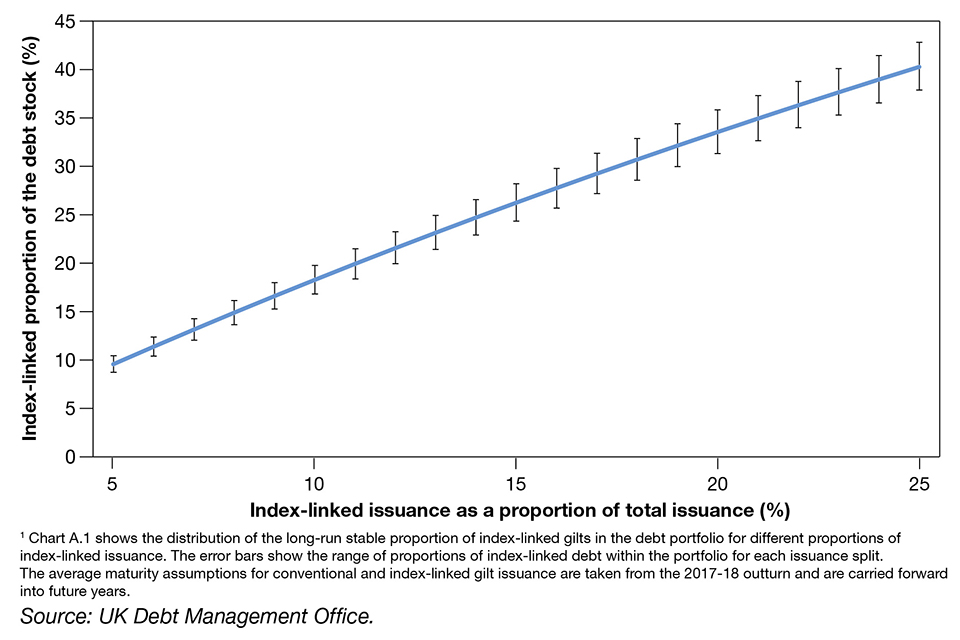
Over the past year, HM Treasury and the DMO have been undertaking work to explore the long-term inflation exposure in the debt portfolio. ‘Managing fiscal risks’ illustrated the future evolution of the stock of index-linked debt under different issuance assumptions.102 More recent analysis, using a newly-developed Vector Auto Regression model and the DMO’s portfolio simulation tools, illustrates the relationship between the share of index-linked gilts in issuance and the variability of index-linked debt in the portfolio (Chart A.1), as well as the volatility in the annual change in borrowing (Chart A.2). At the 95th percentile of the distribution, the variability in the year-on-year changes in annual borrowing rises from £2.0 billion at a 10% index-linked share of the debt stock to £7.6 billion at 40%.103
As part of the government’s responsible approach to fiscal risk management, the revised 2018-19 financing remit retains the planned 1 to 2 percentage point reduction in index-linked gilt issuance compared to that planned at the start of the previous financial year, which was announced in the ‘Debt management report’ 2018-19.104 According to current forecasts, this equates to a £6.7 billion reduction in index-linked gilt issuance this year.105 The government will look to reduce index-linked gilt issuance in a measured fashion as a share of total issuance over the medium term, in line with this planned reduction. Decisions on precise levels of index-linked and conventional gilt issuance will continue to be taken as part of the annual financing remit and in consultation with market participants.
Chart A.2 Variability in changes to PSNB under different proportions of index-linked debt
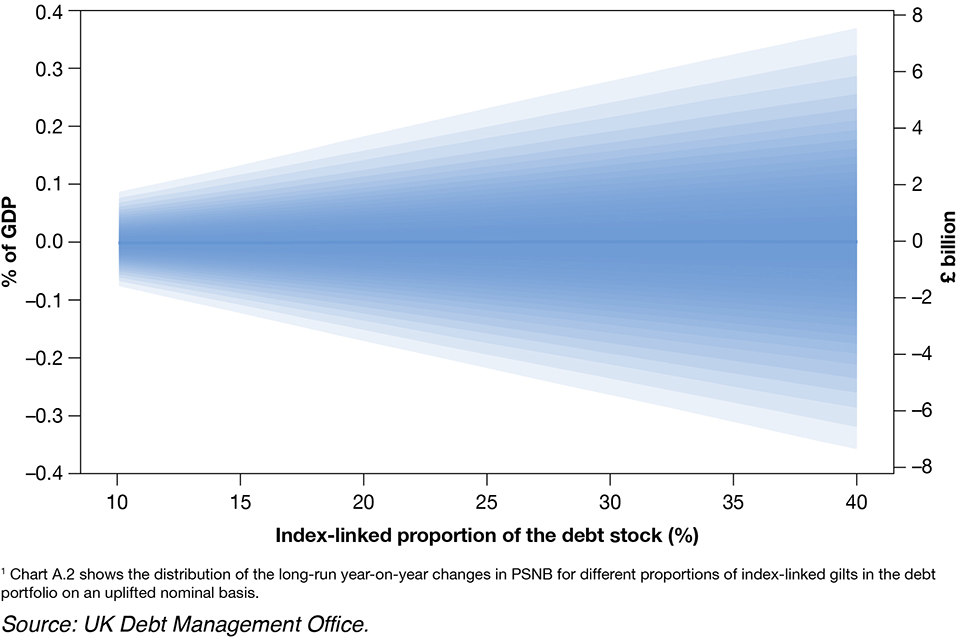
7.4 Financing arithmetic
The financing arithmetic sets out the components of the government’s net financing requirement (NFR) and the contributions from various sources of financing. The updated financing arithmetic for 2018-19 is set out in Table A.1. Table A.2 sets out the financing requirement projections from 2019-20 through to 2023-24.
The OBR’s forecast for the central government net cash requirement (excluding NRAM plc, Bradford and Bingley and Network Rail) (CGNCR (ex NRAM, B&B and NR)) in 2018-19 is £31.2 billion, which represents a downward revision of £9.4 billion from Spring Statement 2018. This is the fiscal aggregate that determines gross debt sales and is derived from the PSNB forecast. The relationship between PSNB and the CGNCR (ex NRAM, B&B and NR) is set out in the OBR’s October 2018 ‘Economic and fiscal outlook’.106 NS&I’s Net Financing target has been revised up by £3.0 billion relative to Spring Statement 2018, from £6.0 billion to £9.0 billion.
These changes will be met by a downward revision of £12.4 billion to the NFR for the DMO in 2018-19. The updated forecast for the 2018-19 NFR of £93.5 billion comprises: CGNCR (ex NRAM, B&B and NR), financing for projected gilt redemptions, planned sterling financing for the Official Reserves and any adjustments carried forward from previous financial years; less the net contribution to financing from NS&I and any other in-year contributions to financing. The downward revision to the DMO’s NFR will be delivered through a decrease in gross gilt issuance this year of £8.5 billion and a £4.0 billion reduction in the stock of Treasury bills for debt management purposes.107
Table A.1: Financing arithmetic in 2018-19 (£ billion) (1)
| Debt management report 2018-19 | April 2018-19 (2) | Autumn Budget 2018-19 | |
|---|---|---|---|
| CGNCR (ex NRAM, B&B and NR) (3) | 40.6 | 40.6 | 31.2 |
| Gilt redemptions | 66.7 | 66.7 | 66.7 |
| Planned financing for the reserves | 6.0 | 6.0 | 6.0 |
| Financing adjustment carried forward from previous financial years | -4.5 | -1.4 | -1.4 |
| Gross financing requirement | 108.9 | 112.0 | 102.5 |
| less: | |||
| NS&I net financing | 6.0 | 6.0 | 9.0 |
| Other financing (4) | 0.0 | 0.0 | 0.0 |
| Net financing requirement (NFR) for the Debt Management Office (DMO) | 102.9 | 106.0 | 93.5 |
| DMO‘s NFR will be financed through: | |||
| Gilt sales, through sales of: | |||
| Short conventional gilts | 24.9 | 25.6 | 24.9 |
| Medium conventional gilts | 20.3 | 21.0 | 20.3 |
| Long conventional gilts | 29.4 | 30.3 | 29.7 |
| Index-linked gilts | 21.7 | 22.4 | 21.1 |
| Unallocated amount of gilts | 6.6 | 6.7 | 1.5 |
| Total gilt sales for debt financing | 102.9 | 106.0 | 97.5 |
| Total net contribution of Treasury bills for debt financing | 0.0 | 0.0 | -4.0 |
| Total financing | 102.9 | 106.0 | 93.5 |
| DMO net cash position | 0.5 | 0.5 | 0.5 |
| 1 Figures may not sum due to rounding. |
| 2 Following the ‘Debt management report 2018-19’ in March 2018, the financing arithmetic was updated in April 2018 to reflect the outturn of the previous financial year’s CGNCR (ex NRAM, B&B and NR), which changes the financing adjustment and gross financing requirement. |
| 3 Central government net cash requirement (excluding NRAM plc, Bradford and Bingley and Network Rail). |
| 4 Prior to publication of the end-year outturn in April each year, this financing item will mainly comprise estimated revenue from coinage. |
| Source: HM Treasury, NS&I, Office for Budget Responsibility and UK Debt Management Office. |
7.5 Gilt issuance
The method, type and maturity of gilt issuance were previously set out at Spring Statement 2018. Total gilt sales in 2018-19 are now forecast to decrease by £8.5 billion to £97.5 billion.
The reduction in gilt sales of £8.5 billion will be implemented by proportionately reducing average auction sizes and reducing the size of the index-linked syndication programme by £700 million. This will also include a decrease in the unallocated portion of the DMO’s financing remit to £1.5 billion. The unallocated portion allows for gilts of any maturity or type to be issued, and by any issuance method, in response to evolving market conditions.
Auctions will remain the government’s primary method of gilt issuance. It is anticipated that £77.1 billion (79.1%) of total issuance will be sold by auction in 2018-19, and £18.9 billion (19.4%) will be sold by syndication. The government may also continue to use gilt tenders to supplement issuance by auction and syndication.
7.6 Treasury bills
Treasury bills for debt management purposes comprised £60.0 billion of the total debt stock at the end of 2017-18.108 It was anticipated at Spring Statement 2018 that net issuance of Treasury bills for debt management purposes would be zero, thereby making no net contribution to debt financing in 2018-19. This will now be changed to a net negative contribution of £4.0 billion from Treasury bills, to help meet the downward revision to the NFR.
7.7 NS&I
At Spring Statement 2018, NS&I was set a Net Financing target of £6.0 billion for 2018‑19, within a range of £3.0 billion to £9.0 billion. The target is being increased by £3.0 billion to £9.0 billion, within a range of £6.0 billion to £12.0 billion. The change to the target reflects higher than expected Net Financing from NS&I being delivered in the first half of 2018‑19 as a result of changing conditions in the savings market.
7.8 Official Reserves
The financing arithmetic provides for £6.0 billion of sterling financing for the Official Reserves in 2018-19.
Table A.2: Illustrative gross financing requirement (£ billion) (1)
| 2019-20 | 2020-21 | 2021-22 | 2022-23 | 2023-24 | |
|---|---|---|---|---|---|
| CGNCR (ex NRAM, B&B and NR) (2) | 27.6 | 49.1 | 43.7 | 43.1 | 32.6 |
| Gilt redemptions | 99.1 | 97.6 | 79.3 | 73.3 | 71.8 |
| Planned financing for the reserves | 6.0 | 0.0 | 0.0 | 0.0 | 0.0 |
| Total illustrative gross financing requirement | 132.7 | 146.7 | 123.0 | 116.5 | 104.4 |
| 1 Figures may not sum due to rounding. |
| 2 Central government net cash requirement (excluding NRAM plc, Bradford and Bingley and Network Rail). |
| Source: HM Treasury, NS&I, Office for Budget Responsibility and UK Debt Management Office. |
8. Annex B: Welfare cap
Table B.1 sets out a full list of expenditure items within the scope of the welfare cap.
Table B.1: Benefits and tax credits in scope of the welfare cap
| In scope | Not in scope |
|---|---|
| Attendance Allowance | Benefits paid from DEL (1) |
| Bereavement benefits | Jobseeker’s Allowance and its passported Housing Benefit |
| Carer’s Allowance (including linked Scottish Government block grant addition) | State Pension (basic and additional) |
| Child Benefit (including Guardian’s Allowance) | Transfers within government (e.g. Over 75s TV licences) |
| Christmas Bonus | Universal Credit payments to claimants subject to full |
| Disability Living Allowance | conditionality and on zero income |
| Employment and Support Allowance | |
| Financial Assistance Scheme | |
| Housing Benefit (except HB passported from JSA) | |
| Incapacity Benefit | |
| Income Support | |
| Industrial injuries benefits | |
| In Work Credit | |
| Maternity Allowance | |
| Pension Credit | |
| Personal Independence Payment | |
| Personal Tax Credits | |
| Return to Work Credit | |
| Severe Disablement Allowance | |
| Social Fund-Cold Weather Payments | |
| Statutory Adoption Pay | |
| Statutory Maternity Pay | |
| Statutory Paternity Pay | |
| Tax Free Childcare | |
| Universal Credit (except payments to jobseekers) | |
| Winter Fuel Payments |
| 1 These payments are subject to firm spending control through the usual DEL process. |
9. Annex C: Office for Budget Responsibility’s ‘Economic and fiscal outlook’
The Office for Budget Responsibility (OBR) has published its October 2018 ‘Economic and fiscal outlook’ alongside Budget 2018. This annex reproduces the OBR’s key forecasts for the economy and public finances. Further detail and explanation can be found in the OBR’s report.
- Details of the sources of all numerical references, including National Statistics, used in this section can be found in ‘Budget 2018 data sources’. ↩
- Excluding the exceptional financial crisis years following 2008-09, the last time there was a higher level of public sector net investment was in 1978-79 to 1980-81. HM Treasury calculations, ‘Public finances databank‘, Office for Budget Responsibility, October 2018; ‘Economic and fiscal outlook’, Office for Budget Responsibility, October 2018. ↩
- CPIH extends CPI to include costs associated with owning, maintaining and living in one’s own home as well as council tax. ↩
- The OBR’s productivity growth forecast is based on non-North Sea Gross Value Added (GVA) per hour, which is different from the ONS’s headline productivity growth measure. ↩
- The OBR uses wages and salaries divided by employees to estimate wage growth, and so this will not exactly correspond to the ONS’s headline Average Weekly Earnings measure. ↩
- The OBR’s measure of RHDI per head differs from the ONS’s by including households and non-profit institutions serving households (NPISH) in the calculations, whereas the ONS measure refers to households only. ↩
- ‘Monetary policy summary and minutes of the Monetary Policy Committee meeting ending on 12 September 2018’, Bank of England, September 2018. ↩
- ‘Monetary policy remit: Budget 2018’, HM Treasury, October 2018. ↩
- ‘Public sector finances: September 2018’, ONS, October 2018. ↩
- ‘Public sector finances: September 2018’, ONS, October 2018; ‘Families and households’, ONS, November 2017 and HM Treasury calculations. ↩
- Details of the sources used for this calculation can be found in ‘Budget 2018 data sources’. ↩
- ‘Charter for Budget Responsibility: autumn 2016 update’, HM Treasury, January 2017. ↩
- ‘Public sector finances: September 2018’, ONS, October 2018; ‘Economic and fiscal outlook: March 2018’, OBR, March 2018. ↩
- ‘Public sector finances: September 2018’, ONS, October 2018; ‘Economic and fiscal outlook: March 2018’, OBR, March 2018. ↩
- The revision comes as a result of HMRC and ONS work to improve data for VATrefunds (that adds to receipts and spending in broadly equal measure). Further information available at ‘Public sector finances: September 2018’, ONS, October 2018. ↩
- ‘Public sector finances: June 2018’, ONS, July 2018; ‘Public sector finances: September 2018’, ONS, October 2018. ↩
- ‘Public finances databank’, OBR, October 2018. ↩
- ‘UK government debt and deficit: June 2018’, ONS, October 2018. ↩
- Treaty deficit is general government net borrowing on a Maastricht basis see ‘Budget 2018 data sources’ for more information. ↩
- ‘Public finances databank’, OBR, October 2018. ↩
- ‘Fiscal risks report 2017’, OBR, July 2017. ↩
- ‘Managing fiscal risks: government response to the 2017 Fiscal risks report’, HM Treasury, July 2018. ↩
- ‘Economic and fiscal outlook: October 2018’, OBR, October 2018 and HM Treasury calculations. Details of the sources used in this calculation can be found in ‘Budget 2018 data sources’. ↩
- ‘Benefits expenditure and caseload tables 2018’, Department for Work and Pensions, March 2018. ↩
- Written Ministerial Statement (HCWS127), Rt Hon Elizabeth Truss MP, 12 September 2017. ↩
- Further information is available at ‘Building the homes the country needs: Autumn Budget 2017 brief’. ↩
- Written Ministerial Statement (HCWS876), Rt Hon Nick Gibb MP, 25 April 2018. ↩
- Further information is available at ‘NHS Funding Settlement’, June 2018 ↩
- Further information is available at ‘Prime Minister sets out 5-year NHS funding plan’, Department of Health and Social Care, HM Treasury and The Rt Hon Jeremy Hunt MP, June 2018 ↩
- Growth rate adjusted for business rates pilot in 2019-20 to ensure consistency between years. ↩
- HM Treasury CDEL excluding Network Rail capital spending, which is switching into DEL from 2019-20. ↩
- Excluding the exceptional financial crisis years following 2008-09, the last time there was a higher level of public sector net investment was in 1978-79 to 1980-81. HM Treasury calculations, ‘Public finances databank’, OBR, October 2018; ‘Economic and fiscal outlook’, OBR, October 2018. ↩
- ‘Public finances databank’, OBR, October 2018. ↩
- ‘Whole of Government Accounts: year ended 31 March 2017’, HM Treasury, June 2018. ↩
- ‘IMF Fiscal Monitor: Managing Public Wealth’, International Monetary Fund, October 2018. ↩
- ‘Looking ahead – developments in public sector finance statistics: 2018’, ONS, July 2018 and ‘Managing fiscal risks: government response to the 2017 Fiscal risks report’, HM Treasury, July 2018. ↩
- ‘SPINTAN database on intangibles in the public sector’, SPINTAN, December 2016. ↩
- ‘Fiscal risks report 2017’, OBR, July 2017. ↩
- Capital spending on public infrastructure is a devolved matter, so this announcement does not affect the use of private finance by devolved administrations. ↩
- This change in indexation applies only to Index-linked Savings Certificates issued by NS&I. It does not apply to index-linked gilts issued by the Debt Management Office. ↩
- ‘Whole of Government Accounts: year ended 31 March 2017’, HM Treasury, June 2018. ↩
- ‘Whole of Government Accounts: year ended 31 March 2017’, HM Treasury, June 2018; ‘Economic and fiscal outlook: October 2018’, OBR, October 2018. ↩
- ‘Managing fiscal risks: government response to the 2017 Fiscal risks report’, HM Treasury, July 2018. ↩
- ‘The Government Response to the Naylor Review’, Department for Health & Social Care, January 2018. ↩
- ‘NHS Annual report and accounts 2017/18’, NHS Resolution, July 2018. ↩
- ‘Whole of Government Accounts: year ended 31 March 2017’, HM Treasury, June 2018; ‘UK Land Holdings 2018’, Ministry of Defence, June 2018. ↩
- ‘Government asset sale: Written statement to Parliament’ (HCWS317), December 2017. ↩
- ‘The sale of student loans’, National Audit Office, (HC1385), July 2018. ↩
- ‘Landmark property asset sale’, Network Rail; ‘Economic and fiscal outlook: October 2018’, OBR, October 2018. ↩
- ‘Corporate tax rates table’, KPMG, October 2018. ↩
- HM Treasury analysis, see ‘Budget 2018 data sources’. ↩
- HM Treasury calculations. ↩
- ‘Annual Report and Accounts 2017-18’, HMRC, July 2018; ‘Tackling tax avoidance, evasion and non-compliance’, HM Treasury, November 2017. ↩
- HM Treasury analysis, see ‘Budget 2018 data sources’. ↩
- HMRC analysis based on Survey of Personal Incomes (SPI) 2015-16 data, and Budget 2018 OBR forecast. ↩
- HMRC analysis based on Survey of Personal Incomes (SPI) 2015-16 data, and Budget 2018 OBR forecast. ↩
- HMRC analysis based on Survey of Personal Incomes (SPI) 2015-16 data, and Budget 2018 OBR forecast. ↩
- HMRC analysis based on Real Time Information 2017-18 administrative data and Budget 2018 OBR forecast. ↩
- These are the: Young Carer Grant, Best Start Grant, Funeral Expense Assistance, Discretionary Housing Payment and Carer’s Allowance Supplement (overseen by the Scottish government); Discretionary Support Scheme (overseen by the Northern Ireland Executive); and, Council Tax Reduction Scheme, Discretionary Housing Payment and the Flexible Support Fund (overseen by the UK government). ↩
- HMRC calculations. ↩
- Ministry of Housing, Communities and Local Government calculations based on analysis of internal Valuation Office Agency ratings list data and published local authority National non-domestic rates data. ↩
- Ministry of Housing, Communities and Local Government calculations based on analysis of internal Valuation Office Agency ratings list data. ↩
- HMT calculations based on OBR RPI forecasts. ↩
- HMT calculations based on ‘Air Passenger Duty Bulletin’, HMRC, March 2018. ↩
- Per tonne of carbon dioxide. ↩
- ‘Annual Report and Accounts 2017-18’, HMRC, July 2018; ‘Tackling tax avoidance, evasion and non-compliance’, HM Treasury, November 2017. ↩
- ‘Measuring tax gaps 2018 edition‘, HMRC, June 2018. ↩
- ‘HMRC arrest three during investigation into suspected £300m corporation tax scam’, HMRC Press Release, June 2016. ↩
- ‘International comparisons of UK productivity’, Office for National Statistics, October 2017. ↩
- Excluding the exceptional financial crisis years following 2008-09, the last time there was a higher level of public sector net investment was in 1978-79 to 1980-81. HM Treasury calculations; ‘Public finances databank’, OBR, October 2018; ‘Economic and fiscal outlook’, OBR, October 2018. ↩
- ‘Action for Roads’, Department for Transport, July 2013; ‘Investing in Britain’s future’, HM Treasury, June 2013. ↩
- HM Treasury analysis; ‘Congestion, Capacity and Carbon’, National Infrastructure Commission, October 2017; ‘National Infrastructure Assessment: Technical Annex’, National Infrastructure Commission, July 2018. ↩
- ‘Future Telecoms Infrastructure Review‘, Department for Digital, Culture, Media & Sport, July 2018. ↩
- ‘National Infrastructure Assessment‘, National Infrastructure Commission, July 2018. ↩
- ‘Gross domestic expenditure on research and development time series’, ONS, 2018; ‘Spending Review 2015’, HM Treasury; ‘Autumn Budget 2017’, HM Treasury; HM Treasury calculations. ↩
- ‘UK Defined Contribution: Looking Beyond the Passive Approach‘, Spence Jonson Market Intelligence, 2016. ↩
- ‘Managing DC benefits: Investment governance’, The Pensions Regulator, October 2018. ↩
- ‘Action to reduce food waste announced’, Department for Environment, Food & Rural Affairs, October 2018. ↩
- ‘2050 Vision’, Thames Estuary 2050 Growth Commission, June 2018. ↩
- ‘UK Sea Fisheries Statistics 2017’ Marine Management Organisation, September 2018. ↩
- ‘Public sector finances: September 2018’, ONS, October 2018. ↩
- ‘Dedicated Schools Grant: 2018 to 2019’, Department for Education, July 2018. ↩
- ‘Basic need allocations’, Department for Education, March 2016. ↩
- ‘Autumn Budget 2017’, HM Treasury, November 2017. ↩
- ‘Spending Review 2010’, HM Treasury, October 2010; ‘Spending Round 2013’, HM Treasury, Junes 2013; ‘Children in good or outstanding schools’, Department for Education, August 2018. ↩
- ‘Defence Expenditure of NATO Countries (2011-2018)’, NATO, July 2018; Official Development Assistance commitment is enshrined in the ‘International Development Official Development Assistance Target) Act 2015’. ↩
- HM Treasury analysis of ONS Annual Survey of Hours and Earnings, 2015 results and 2018 provisional results. ↩
- The Low Pay Commission website. ↩
- In addition, the government has made provision for NHS pension costs until 2023-24, which will be adjusted in line with the confirmed Superannuation Contributions Adjusted for Past Experience (SCAPE) rate change. ↩
- ‘Serious Violence Strategy’, Home Office, April 2018. ↩
- ‘Benefit expenditure and caseload tables 2018’, Department for Work and Pensions, March 2018. ↩
- The Minimum Income Floor is an assumed level of earnings that serves to encourage self-employed people to grow their earnings, mitigates the risk of under-reporting of earnings, and ensures fairness by reducing welfare support for businesses that are not sustainable. ↩
- HM Treasury analysis of ONS Annual Survey of Hours and Earnings, 2015 results and 2018 provisional results. ↩
- The Low Pay Commission website. ↩
- The OECD define relative low pay as two-thirds of median earnings.
- ‘Population Estimates for UK, England and Wales, Scotland and Northern Ireland: Mid-2017’, ONS, June 2018. ↩
- ‘Revision to the DMO’s financing remit 2018-19’, UK Debt Management Office, April 2018. ↩
- ‘UK Debt Management Office’ (website) ↩
- ’Debt management report 2018-19’, HM Treasury, March 2018.
- ‘Fiscal risks report’, Office for Budget Responsibility, July 2017.
- ‘Managing fiscal risks: government response to the 2017 Fiscal risks report’, HM Treasury, July 2018.
- ‘Managing fiscal risks: government response to the 2017 Fiscal risks report’, HM Treasury, July 2018.
- Where the debt stock is measured on an uplifted nominal basis, annual GDP is measured in 2017 prices. This is due to variations in RPI.
- ’Debt management report 2018-19’, HM Treasury, March 2018.
- This is the difference between Table A.1 in Autumn Budget 2017 and Table A.1 in this annex.
- ‘Economic and fiscal outlook’, Office for Budget Responsibility, October 2018.
- Figures may not sum due to rounding.
- ‘Treasury Bill Issuance and Stock’, UK Debt Management Office, October 2018.
Published 29 October 2018
