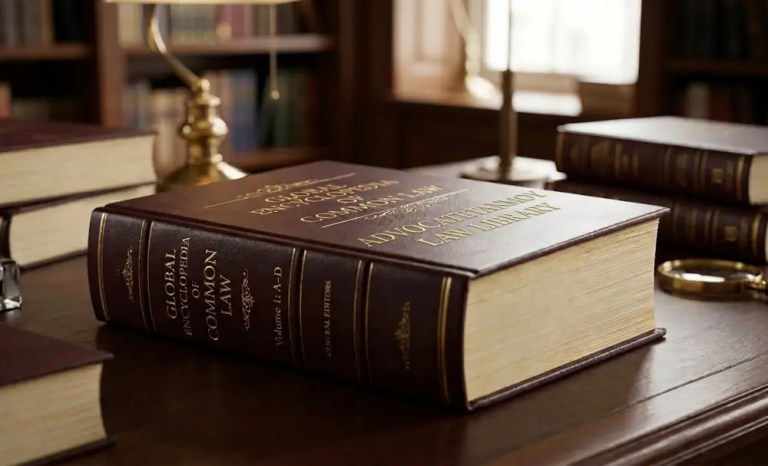
Volume 18 of the Encyclopedia of American Law (180-Volume)
VOLUME 18: FEDERAL RULES OF EVIDENCE II – PRIVILEGES, AUTHENTICATION, BEST EVIDENCE RULE, JUDICIAL NOTICE
Protecting Confidential Communications, Proving What Documents Are, and Taking Notice of Facts
Introduction to Volume 18
Volume 17 covered the core of the Federal Rules of Evidence: relevance, character evidence, hearsay, expert testimony, and the Rule 403 balance. Volume 18 covers the remaining rules that govern the presentation of evidence. These rules answer four questions.
First, when may a witness refuse to answer a question? The privileges protect certain relationships: attorney‑client, spousal, psychotherapist‑patient, clergy‑communicant. A witness who holds a privilege may not be compelled to disclose confidential communications.
Second, how does a party prove that a document is what it claims to be? Authentication is the process of showing that evidence is genuine. A party must produce enough evidence that a reasonable jury could find that the document is authentic. Hearsay does not apply because the statement is not offered for its truth. It is offered to show that the document is what it appears to be.
Third, what happens when a party wants to prove the content of a writing? The best evidence rule requires the original writing, recording, or photograph. The rule applies only when the party is trying to prove the content of the document. If the party is trying to prove that a contract existed, not what the contract said, the original is not required.
Fourth, what facts may the court accept without evidence? Judicial notice allows the court to accept a fact that is not subject to reasonable dispute. The jury must accept the fact in a civil case. In a criminal case, the jury may reject it.
This volume proceeds in four parts. Part One covers the privileges recognized under Rule 501: attorney‑client, spousal, psychotherapist‑patient, clergy‑communicant, and others. Part Two covers authentication and identification under Rule 901 and 902: how to prove that evidence is genuine, and what evidence is self‑authenticating. Part Three covers the best evidence rule under Rules 1001‑1008: when the original is required, when a duplicate is acceptable, and when secondary evidence is permitted. Part Four covers judicial notice under Rule 201: what facts may be noticed, and what procedural protections apply.
PART ONE: PRIVILEGES
Chapter 1: The Structure of Rule 501
Rule 501 does not list privileges. It provides: “The common law—as interpreted by United States courts in the light of reason and experience—governs a claim of privilege unless the Constitution, a federal statute, or a rule prescribed by the Supreme Court provides otherwise.”
The rule is a deliberate choice. The drafters of the Federal Rules of Evidence could not agree on a set of codified privileges. They left the law of privileges to the courts.
The result is that privileges are recognized only when they are “deeply rooted in the common law” or are required by important public policy. The Court has recognized several privileges. It has refused to recognize others.
Rule 501 applies in civil and criminal cases. The federal law of privileges governs federal question cases. In diversity cases, state privilege law governs. Rule 501 provides: “In a civil case, state law governs privilege regarding a claim or defense for which state law supplies the rule of decision.”
A witness who holds a privilege may refuse to answer a question. A party may not compel disclosure of a privileged communication. The privilege may be waived. The privilege is personal to the holder.
Chapter 2: Attorney‑Client Privilege
The attorney‑client privilege is the oldest privilege recognized at common law. It protects confidential communications between a lawyer and a client made for the purpose of seeking legal advice.
Elements. The party asserting the privilege must show:
- The person asserting the privilege is a client or was seeking to become a client.
- The person to whom the communication was made is a lawyer or a lawyer’s representative.
- The communication relates to a fact that the client disclosed to the lawyer for the purpose of obtaining legal advice.
- The communication was made in confidence.
- The privilege has not been waived.
Purpose. The privilege encourages full and frank communication between lawyer and client. A client who fears that his statements will be disclosed may not tell the lawyer everything. The lawyer cannot give sound advice without knowing the facts.
Scope. The privilege protects communications, not underlying facts. A client may be asked about facts, even if the client learned those facts from a lawyer. The privilege does not protect the fact of representation, the fee arrangement, or the identity of the client.
Duration. The privilege survives the client’s death. The lawyer may not disclose confidential communications after the client dies. The privilege belongs to the client. Only the client may waive it. The lawyer may assert it on the client’s behalf.
Crime‑fraud exception. The privilege does not protect communications made to further a crime or fraud. The lawyer must not be made an accomplice. The government must make a prima facie showing that the communication was in furtherance of a crime or fraud. The showing may be based on evidence outside the privileged communication.
Corporate clients. The privilege applies to corporations. Communications between corporate employees and corporate counsel are privileged if they relate to the employee’s duties and are made for the purpose of obtaining legal advice. The privilege belongs to the corporation, not the employee.
Waiver. The client may waive the privilege. Waiver may be express or implied. A client who testifies about a privileged communication waives the privilege for that communication. A client who puts the lawyer’s advice at issue may waive the privilege.
Inadvertent disclosure. A client who inadvertently discloses a privileged communication does not necessarily waive the privilege. Rule 502 governs inadvertent disclosure. The court looks at the reasonableness of the precautions taken, the number of inadvertent disclosures, the extent of the disclosure, and the promptness of efforts to rectify the error.
Chapter 3: Work Product Doctrine
The work product doctrine is not a privilege. It is a protection for materials prepared in anticipation of litigation. Rule 26(b)(3) of the Federal Rules of Civil Procedure codifies the doctrine.
Scope. Work product includes documents and tangible things prepared by or for a party in anticipation of litigation. The party need not be represented by a lawyer. A party’s own investigation may be work product.
Ordinary work product. Witness statements, interview notes, and other fact work product may be discovered if the party seeking discovery shows substantial need and cannot obtain the substantial equivalent without undue hardship. The court must protect against disclosure of mental impressions.
Opinion work product. The lawyer’s mental impressions, conclusions, opinions, and legal theories are not discoverable. Opinion work product is protected absolutely. A lawyer’s notes about witness credibility, trial strategy, and legal analysis may not be compelled.
Purpose. The work product doctrine protects the adversarial process. A lawyer must be able to prepare a case without fear that the opposing party will take the lawyer’s work.
Chapter 4: Spousal Privileges
Two spousal privileges exist.
Spousal immunity (adverse testimony privilege). A witness may not be compelled to testify against the witness’s spouse in a criminal case. The privilege belongs to the witness‑spouse. The witness may choose to testify. The privilege does not belong to the defendant.
The privilege applies only while the marriage is valid. A spouse may not invoke the privilege after divorce. The privilege does not apply in civil cases.
The purpose of spousal immunity is to preserve marital harmony. The government should not force a person to choose between betraying a spouse and going to jail.
Marital communications privilege. A confidential communication made during marriage is privileged. Either spouse may assert the privilege. The privilege survives divorce.
The privilege applies only to communications. It does not apply to acts. A spouse may be compelled to testify that the other spouse was present at a certain place. A spouse may not be compelled to testify about what the other spouse said.
The privilege does not apply to communications made to further a crime or fraud. A spouse may not hide behind the privilege to conceal a conspiracy.
Chapter 5: Psychotherapist‑Patient Privilege
Jaffee v. Redmond (1996) recognized a psychotherapist‑patient privilege. The Court held that confidential communications between a licensed psychotherapist and a patient are privileged.
Scope. The privilege applies to licensed psychiatrists, psychologists, and social workers. The privilege may extend to other mental health professionals. The privilege protects confidential communications made for the purpose of diagnosis or treatment.
Purpose. The privilege encourages patients to seek treatment without fear of disclosure. A patient who fears that his statements will be disclosed may not seek help. The failure to treat mental illness harms the patient and the community.
Exceptions. The privilege does not apply when:
- The patient puts the mental condition at issue. A patient who sues for emotional distress waives the privilege.
- The patient raises a defense of insanity in a criminal case. The government may obtain the defendant’s mental health records.
- There is a threat of future violence. The psychotherapist has a duty to warn potential victims.
Waiver. The patient may waive the privilege. A patient who testifies about privileged communications waives the privilege for those communications.
Chapter 6: Clergy‑Communicant Privilege
The clergy‑communicant privilege protects confidential communications made to a clergy member for spiritual guidance. The privilege is widely recognized at common law.
Scope. The privilege applies to communications made to a priest, minister, rabbi, imam, or other spiritual advisor. The communication must be made for the purpose of seeking spiritual advice. The communication must be made in confidence.
Rationale. The privilege protects religious liberty. A person should be able to confess sins without fear of disclosure. The government should not intrude into the sanctity of the confessional.
Waiver. The privilege belongs to the communicant. Only the communicant may waive it. The clergy member may assert the privilege on behalf of the communicant.
Chapter 7: Physician‑Patient Privilege
The physician‑patient privilege is not recognized in federal common law. Whalen v. Roe (1977) recognized a constitutional right to medical privacy, but the Court has not held that the right gives rise to an evidentiary privilege.
Most states recognize a physician‑patient privilege. In diversity cases, the state privilege applies. In federal question cases, no federal physician‑patient privilege exists.
Chapter 8: Parent‑Child Privilege
The parent‑child privilege is not recognized in federal common law. The Court has not recognized a privilege for communications between parent and child. Most states do not recognize the privilege.
The Court rejected a parent‑child privilege in United States v. Ismail (1985) (First Circuit). The rationales for the privilege (promoting family harmony, protecting child development) are strong. But the tradition of non‑recognition is long.
Chapter 9: Accountant‑Client Privilege
No accountant‑client privilege exists at common law. A client may not refuse to produce records held by an accountant. The accountant may be compelled to testify about the client’s financial affairs.
A limited privilege exists for tax preparation communications. 26 U.S.C. § 7525 provides a privilege for communications between a taxpayer and a federally authorized tax practitioner. The privilege is limited to tax advice. It does not apply in criminal tax matters.
PART TWO: AUTHENTICATION AND IDENTIFICATION
Chapter 10: The Requirement of Authentication – Rule 901
Rule 901 requires the proponent of evidence to produce evidence sufficient to support a finding that the item is what the proponent claims it is. The standard is low. The proponent need not prove authenticity beyond a reasonable doubt. The proponent need only produce enough evidence that a reasonable jury could find the item authentic.
The rule applies to all tangible evidence: documents, photographs, recordings, weapons, clothing, physical objects.
The proponent must produce “evidence sufficient to support a finding” of authenticity. The court’s role is gatekeeping. The court does not decide whether the item is authentic. The court decides only whether the jury could find that it is authentic. If a reasonable jury could find the item authentic, the court admits the evidence and lets the jury decide.
Chapter 11: Methods of Authentication – Rule 901(b)
Rule 901(b) lists examples of authentication methods. The list is not exclusive.
Testimony of a witness with knowledge (901(b)(1)). A witness who saw the event or handled the document may testify that the item is what it is claimed to be.
Nonexpert opinion on handwriting (901(b)(2)). A lay witness who is familiar with the handwriting may state an opinion. The witness must have acquired the familiarity before the litigation.
Comparison by an expert witness or the trier of fact (901(b)(3)). An expert witness may compare handwriting. The jury may compare handwriting samples.
Distinctive characteristics (901(b)(4)). The appearance, contents, substance, internal patterns, or other distinctive characteristics of the item may authenticate it. A letter that refers to facts known only to the defendant may be authenticated by its content.
Voice identification (901(b)(5)). A witness who recognizes the voice may identify it. The witness may have heard the voice at any time, including after the litigation began.
Telephone conversations (901(b)(6)). A telephone call may be authenticated by calling a number that is assigned to the person. The caller must identify the person. The person’s own voice may authenticate.
Public records (901(b)(7)). A document that is a public record may be authenticated by evidence that it is from the public office where it is kept.
Ancient documents (901(b)(8)). A document that is more than 20 years old may be authenticated by its condition and by evidence that it was found in a place where it would likely be kept.
Process or system (901(b)(9)). A process or system (a computer system, a telephone system) may be authenticated by evidence describing the process and showing that it produces an accurate result.
Statute or rule (901(b)(10)). A method provided by statute or rule is sufficient.
Chapter 12: Self‑Authenticating Evidence – Rule 902
Rule 902 lists evidence that is self‑authenticating. The proponent does not need extrinsic evidence of authenticity.
Domestic public documents under seal (902(1)). A document bearing the seal of a federal or state department is self‑authenticating.
Domestic public documents not under seal (902(2)). A document from a public office that is certified by the custodian is self‑authenticating.
Foreign public documents (902(3)). A foreign public document that is certified by an authorized official is self‑authenticating.
Certified copies of public records (902(4)). A certified copy of a public record is self‑authenticating.
Official publications (902(5)). Books and pamphlets purporting to be issued by a public authority are self‑authenticating.
Newspapers and periodicals (902(6)). Printed materials purporting to be newspapers or periodicals are self‑authenticating.
Trade inscriptions (902(7)). An inscription, sign, tag, or label purporting to have been affixed in the course of business and indicating ownership, control, or origin is self‑authenticating.
Acknowledged documents (902(8)). A document that is notarized is self‑authenticating.
Commercial paper (902(9)). Commercial paper, a signature on a bill of exchange, and related documents are self‑authenticating.
Presumptions under a statute (902(10)). Any signature, document, or other matter declared by federal statute to be presumptively genuine is self‑authenticating.
Certified domestic records of a regularly conducted activity (902(11)). A business record that is certified by the custodian is self‑authenticating. The certification must state that the record was made at or near the time, by a person with knowledge, in the regular course of business.
Certified foreign records of a regularly conducted activity (902(12)). A foreign business record that is certified by the custodian is self‑authenticating.
Digital evidence. Self‑authentication does not apply to digital evidence. Emails, text messages, and social media posts must be authenticated by other means. A witness with knowledge may testify that the email came from the defendant. The content of the message may authenticate it.
Chapter 13: Subscribing Witness – Rule 903
Rule 903 provides that a subscribing witness is not necessary to authenticate a writing. The old common law required the attesting witness to testify. Rule 903 abolishes that requirement.
PART THREE: THE BEST EVIDENCE RULE
Chapter 14: The Scope of the Rule – Rules 1001‑1004
The best evidence rule applies only to writings, recordings, and photographs. Rule 1001 defines the terms.
A “writing” includes letters, words, numbers, and their equivalents. A “recording” includes sounds, images, or data stored in electronic form. A “photograph” includes still photographs, x‑ray films, video tapes, and motion pictures.
An “original” is the writing itself, the negative of a photograph, or any print from the negative. For electronic data, a printout or other output readable by sight is an original.
A “duplicate” is a counterpart produced by the same impression as the original (carbon copy) or by mechanical means (photocopy, electronic scan).
The rule applies only when a party seeks to prove the content of a writing. Rule 1002: “An original writing, recording, or photograph is required to prove the content of a writing, recording, or photograph.”
The rule does not apply when a party seeks to prove a fact that exists independently of the writing. A party may prove that a contract was made without producing the contract. The party may call a witness who heard the parties agree.
Chapter 15: Duplicates – Rule 1003
Rule 1003 provides that a duplicate is admissible to the same extent as an original unless:
- There is a genuine question about the authenticity of the original.
- Admitting the duplicate would be unfair.
The rule adopts a pro‑duplicate position. A photocopy is admissible without accounting for the original. The burden is on the opponent to show that the duplicate is not reliable.
Chapter 16: Admissibility of Secondary Evidence – Rule 1004
Rule 1004 lists circumstances in which the original is not required. The proponent may offer secondary evidence (a copy, a witness’s testimony about the content) without producing the original.
Originals lost or destroyed. All originals are lost or destroyed, unless the proponent destroyed them in bad faith. The proponent must show that a diligent search was made.
Original not obtainable. The original cannot be obtained by any available judicial process. The proponent must show that the original is in the possession of a non‑party outside the jurisdiction.
Original in possession of opponent. The original is in the possession of the opponent, and the opponent does not produce it after notice. The proponent must give the opponent notice that the original is required. The opponent must be ordered to produce it.
Collateral document. The writing is not closely related to a controlling issue. The best evidence rule is a rule of exact proof. It does not apply to documents that are not central to the case.
Chapter 17: Summaries – Rule 1006
Rule 1006 permits the proponent to use a summary of voluminous writings, recordings, or photographs. The original materials must be available to the opponent for examination.
The summary may be a chart, graph, or narrative. The summary must be accurate. The opponent may challenge its accuracy. The summary is not a substitute for the original. The original materials remain the evidence.
The rule is often used in complex cases with large volumes of records. An accountant may summarize thousands of pages of financial records. The accountant may present the summary to the jury.
Chapter 18: Testimony or Statement of a Party – Rule 1007
Rule 1007 provides that the proponent may prove the content of a writing by the testimony, deposition, or written statement of the party against whom the evidence is offered. The party does not need to produce the original. The party’s own admission about the content of the writing is enough.
Chapter 19: Function of the Court and Jury – Rule 1008
Rule 1008 allocates issues to the court and jury. The court decides whether a writing is an original, whether a duplicate is admissible, and whether the proponent has satisfied the conditions for secondary evidence. The jury decides the genuineness of the original, the existence of a condition, or the credibility of the secondary evidence.
PART FOUR: JUDICIAL NOTICE
Chapter 20: The Rule – Rule 201
Rule 201 permits the court to take judicial notice of adjudicative facts. An adjudicative fact is a fact about the parties, events, or circumstances of the case.
A judicially noticed fact must be one that is not subject to reasonable dispute. The fact must be:
- Generally known within the court’s territorial jurisdiction.
- Capable of accurate and ready determination from sources whose accuracy cannot reasonably be questioned.
The court may take judicial notice on its own motion. The court must take judicial notice if a party requests it and supplies the necessary information.
Procedural protections. The party must be given notice of the court’s intent to take judicial notice. The party has the right to be heard on the appropriateness of the notice. The party may challenge the noticed fact.
Effect of judicial notice. In a civil case, the court must instruct the jury to accept the noticed fact as conclusive. The jury may not find otherwise.
In a criminal case, the court may not instruct the jury to accept the noticed fact as conclusive. Rule 201(f). The jury must be permitted to find the fact otherwise. The reason is the Sixth Amendment. The defendant has the right to have the jury determine every element of the offense.
Chapter 21: Legislative Facts
Rule 201 does not apply to legislative facts. Legislative facts are general facts about the world that are not specific to the case. The court may take judicial notice of legislative facts without the procedural limitations of Rule 201.
The court may consider legislative facts in making decisions about the constitutionality of a statute, the meaning of a term, or the reasonableness of a standard.
In Muller v. Oregon (1908), the Court took judicial notice of sociological and medical studies about the effect of long working hours on women. The Court did not require the parties to prove those facts through evidence.
Chapter 22: Judicial Notice of Law
A federal court must take judicial notice of federal law. The court must also take judicial notice of state law. 28 U.S.C. § 1738. The court must take judicial notice of the law of foreign countries. Fed. R. Civ. P. 44.1.
The court may consider any source of law. The court is not bound by the parties’ presentation of foreign law. The court may conduct its own research.
APPENDIX 1: GLOSSARY
Adjudicative fact – A fact about the parties, events, or circumstances of the case. Subject to judicial notice under Rule 201.
Authentication – The process of proving that evidence is what the proponent claims it is.
Best evidence rule – The rule requiring the original writing, recording, or photograph to prove the content of the document.
Clergy‑communicant privilege – The privilege that protects confidential communications made to a clergy member for spiritual guidance.
Crime‑fraud exception – The exception to the attorney‑client privilege for communications made to further a crime or fraud.
Duplicate – A counterpart produced by the same impression as the original (carbon copy) or by mechanical means (photocopy, electronic scan).
Judicial notice – The court’s acceptance of a fact that is not reasonably in dispute.
Legislative fact – A general fact about the world that is not specific to the case. Not subject to Rule 201.
Marital communications privilege – The privilege that protects confidential communications made during marriage.
Original – The writing itself, the negative of a photograph, or any print from the negative.
Physician‑patient privilege – Not recognized in federal common law. Recognized in most states. Applies in diversity cases.
Privilege – The right to refuse to disclose confidential communications.
Psychotherapist‑patient privilege – A privilege recognized in Jaffee v. Redmond. Protects confidential communications between a licensed psychotherapist and a patient.
Self‑authenticating evidence – Evidence that is authentic without extrinsic proof. Listed in Rule 902.
Spousal immunity – The privilege that prevents a witness from being compelled to testify against a spouse in a criminal case.
Work product doctrine – The protection for materials prepared in anticipation of litigation. Not a privilege. Codified in Rule 26(b)(3) of the Federal Rules of Civil Procedure.
APPENDIX 2: SELECT BIBLIOGRAPHY
Broun, Kenneth S. McCormick on Evidence. 8th ed. West Academic, 2020.
Cleary, Edward W. “The Federal Rules of Evidence and the Law of Privilege.” American Bar Association Journal 61 (1975): 53.
Faigman, David L., David H. Kaye, and Michael J. Saks. Modern Scientific Evidence: The Law and Science of Expert Testimony. 4th ed. West Academic, 2020.
Fisher, George. Evidence. 4th ed. Foundation Press, 2021.
Graham, Michael H. “The Best Evidence Rule Under the Federal Rules of Evidence.” University of Illinois Law Review 1975 (1975): 421.
Imwinkelried, Edward J. “The Authentication of Digital Evidence Under the Federal Rules of Evidence.” Cardozo Law Review 33 (2012): 1591.
Jaffee, Lynn. “The Psychotherapist‑Patient Privilege: A Critical Analysis of Jaffee v. Redmond.” University of Chicago Law Review 64 (1997): 231.
Lilly, Graham C., Daniel J. Capra, and Stephen A. Saltzburg. Principles of Evidence. 8th ed. West Academic, 2019.
Mueller, Christopher B., and Laird C. Kirkpatrick. Evidence. 6th ed. Wolters Kluwer, 2018.
Park, Roger C., and David P. Leonard. Evidence: A Problems Approach. 3d ed. West Academic, 2018.
Saltzburg, Stephen A., and Daniel J. Capra. Federal Rules of Evidence Manual. 12th ed. LexisNexis, 2020.
Strong, John W., and Kenneth S. Broun. McCormick on Evidence. 8th ed. West Academic, 2020.
Tillers, Peter. “The Federal Rules of Evidence and the Problem of Authentication.” Cardozo Law Review 33 (2012): 1591.
Weissenberger, Glen. Federal Rules of Evidence: Rules, Legislative History, Commentary, and Authority. 8th ed. LexisNexis, 2020.
Volume 18 covers privileges (Rule 501, attorney‑client, work product, spousal, psychotherapist‑patient, clergy‑communicant, physician‑patient, parent‑child, accountant‑client), authentication (Rules 901, 902, 903), the best evidence rule (Rules 1001‑1008), and judicial notice (Rule 201, legislative facts, judicial notice of law).
Next Volume 19:Appellate Procedure