IndiGo meltdown, rupee decline, and weakening institutions reveal a nation strained by regulatory failures, monopolistic power, and political theatrics
The Indigo airline fiasco did not merely inconvenience passengers; it unveiled the unsettling fragility of a state apparatus that has grown so enamoured with its own rhetoric of strength that it no longer notices how easily its edicts can be bent, diluted, or dissolved. A private airline, swollen by years of unchallenged dominance, resisted newly tightened DGCA safety rules meant to protect pilots and passengers. The government responded not with firmness, but with retreat — a retreat so swift and visible that many citizens felt the air pressure drop around them. The episode became an X-ray illuminating a deeper disquiet: either the machinery of governance has become startlingly unprepared, or it has entangled itself so deeply with corporate interests that resistance feels perilous. In either case, the public sentiment echoed through terminals and tea-stalls alike — India deserves better.
This slow-building national irritation finds a perfect economic metaphor in the rupee’s decades-long slide. There was a time when ₹45 bought a dollar; now it requires around ₹90.13. The numbers themselves read like a lament: ₹45.61 in 2005, ₹44.58 in 2010, ₹66.05 in 2015, ₹73.02 in 2020, ₹90.13 in 2025. Against this backdrop, the proclamation “यह नया भारत है — न सर झुकाकर, न सर उठाकर, बल्कि आंख में आंख डालकर बात करता है,” feels almost theatrical. The nation may be speaking boldly, but its currency whispers a far more sobering truth on the global stage.
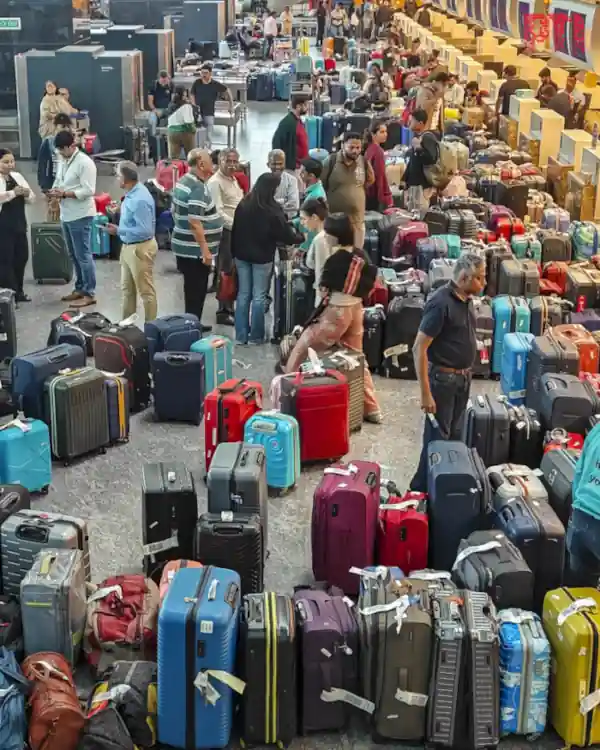
This dissonance sharpened brutally when the Indigo crisis erupted in the middle of Russian President Vladimir Putin’s state visit to Delhi. The timing felt symbolic — as if fate itself wished to illuminate how unprepared the aviation ecosystem had become. The world watched as India’s busiest airline cancelled over a thousand flights, stranding citizens in food courts, on terminal floors, on airport carpets that became involuntary beds. That this meltdown coincided with high diplomatic theatre intensified the sense of institutional brittleness.
Observers point out the troubling inertia within key ministries. The Environment Ministry appears unmoved by the toxic air that coats northern India each winter. Petroleum authorities have been accused by critics of ignoring the fallout of ethanol mixing on engines. The Finance Ministry faces public frustration over the rupee’s continued weakening. And the Aviation Ministry — caught flat-footed during this meltdown — seemed uncertain of whether to enforce rules, negotiate, or merely hope for the storm to pass.
Many citizens mutter a weary refrain: “Why does this keep happening?” The sentiment is that leadership energy flows more into speechwriting, image curation, temple visits, and the perpetual choreography of electoral preparation than into the granular tedium of governance. A section of the population argues that Hindu symbolism is deployed more as an electoral instrument than as a coherent nation-building blueprint. Ram Mandir may stir the Hindu spirit, but does spiritual triumph automatically translate into administrative competence? That question now hangs in the air like Delhi’s November smog.
Just weeks earlier, at the Hindustan Times Leadership Summit 2025, the Prime Minister revisited the term “Hindu rate of growth,” calling it a relic of socialist stagnation and a symptom of colonial-era inferiority complexes. He pointed to growth numbers exceeding 7.8 percent and reforms such as zero tax up to ₹10 lakh as evidence of a new economic dawn. Yet the public mood remains strangely discordant. Citizens hear speeches about 2035 self-confidence, but face 2025 realities — job scarcity, small-business exhaustion, sluggish judicial processes, and an education system that feels increasingly detached from market demands.
Even media houses usually aligned with government messaging have begun airing their discontent — something once unthinkable. The anti-corruption plank that catapulted this government to power now feels clouded by public accusations of favouritism, institutional weakening, and lack of transparency. Journalists, activists, and opposition leaders frequently allege pressure, intimidation, or punitive transfers. Critics argue that dissent is not merely discouraged; it is anaesthetized.
Historical ironies only deepen cynicism. Mulayam Singh Yadav — whose administration oversaw the 1990 Ayodhya firing that killed the Kothari brothers — received a Padma Vibhushan in 2023. Nripendra Misra, a senior bureaucrat from that era, today holds a prominent role in the Ram Mandir Trust. To some Hindus, this juxtaposition feels like betrayal wrapped in ceremony, yet it is largely met with public silence — a silence as perplexing as it is revealing.
Then came the SANCHAR SATHI uproar — critics contending that mandated spyware-like tracking violated individual privacy. Under fierce backlash, the government withdrew the provision. Around the same time, former US President Donald Trump praised India for allegedly halting Russian oil imports — a claim the Indian government did not confirm, leaving citizens puzzled about where geopolitical truth ends and political theatre begins.
Even cultural anxieties simmer. For eight centuries, Hindu narratives were labelled “mythology,” a word critics argue implies “fake belief.” Today, many anchors and commentators still use the term casually, prompting frustration among those who feel modern governance remains indifferent to cultural dignity.
Meanwhile, ordinary Indians remain unmoved by GDP rankings and growth percentages. They want employment, credible banking, fast justice, reliable transport, peaceful neighbourhoods, and education anchored in reality rather than rhetoric. They want the simple dignity of systems that do not collapse at the first sign of stress.
The Indigo fiasco has therefore become a national allegory. DGCA’s decision to cap pilot flying hours at eight — a safety move emulating global norms — left Indigo scrambling due to inadequate staffing. Other airlines adapted, hiring more crew. Indigo did not. The crisis metastasised into over a thousand cancellations. The government ordered refunds, capped fares at ₹18,000, and issued a show-cause notice. But ultimately, the public watched as a private company exerted enough leverage to compel the state to soften its stance.
This is the nightmare of monopoly. When one airline controls half the skies, it stops seeing the state as a regulator and begins seeing it as a negotiator. Telecom travelled the same road — once dominated by competition, now reduced to a duopoly that leaves consumers with little choice and rising costs.
The deeper fear resonates clearly: If the government cannot stand firm against a domestic company dependent on Indian consumers, how will it withstand the geopolitical weight of adversaries like China?
India’s aviation crisis is therefore more than a logistical collapse. It is an existential warning. A government that prides itself on absolute authority appeared suddenly hesitant, almost meek. A nation that dreams of global stature found itself grounded, both literally and metaphorically.
If India is to progress, it must summon not ceremonial strength but regulatory spine — the kind of spine that disciplines monopolies, protects citizens, modernises institutions, and refuses to confuse spectacle with governance. Because governance by slogan is not governance at all. And a nation of 140 crore cannot afford fragility masquerading as grandeur.
What India needs now is not louder rhetoric, but stronger institutions — institutions that do not tremble before corporate leverage, diplomatic choreography, or the relentless seduction of political theatrics.
Until that happens, the Indigo fiasco will remain the perfect symbol of a country forced to confront the uncomfortable truth that its wings, though brightly painted, require more than paint to stay airborne.
December 7, 2025