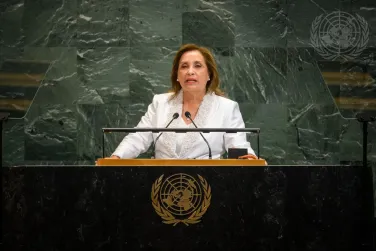
Address by the President of the Republic of Peru
General Debate
80th Session of the United Nations General Assembly
New York – United States of America
Tuesday, September 23, 2025
Original Statement in Spanish
Her Excellency
Dina Ercilia Boluarte Zegarra
President
Madam President of the General Assembly, Annalena Baerbock,
Mr. Secretary-General of the United Nations, António Guterres,
Distinguished Heads of State,
Ladies and Gentlemen,
Peru is the heart and cradle of great ancient civilizations, the last of which—the Inca Empire—left a legacy of greatness. We are also heirs to the Viceroyalty of Peru, which encompassed two-thirds of South America. We are a mestizo nation, the fundamental blend of Hispanic and Andean roots. Proud to be heirs of the two greatest empires of the sixteenth century, Europe’s and America’s, the Peruvian people are today resilient, enterprising, and united—lovers of peace, freedom, and democracy.
Our great writers, Mario Vargas Llosa and José María Arguedas, shared the conviction that Peru is “a country of all bloods.” Our identity creatively expresses that we are the unity of diversity—united under the same red and white Peruvian flag.
In our country, Indigenous peoples and people from around the world live together in peace and unity—a grand synthesis of Peru itself. For forty years, Pope León XIV lived and worked in our land, becoming a naturalized Peruvian out of profound love for our people, for their spirit of solidarity and peace, and for their Catholic and Christian faith.
All studies indicate that we are the most entrepreneurial nation in the world. For this reason, after the COVID-19 pandemic—which, due to a poor government administration, claimed more than two million lives—we have begun to recover, achieving more than seventeen consecutive months of economic growth. We have overcome the recession and inflation caused by political violence and corruption, by a failed coup d’état, and by the flight of over 20 billion dollars between 2021 and 2023. We have restored confidence in both domestic and foreign investment and embraced freedom. We are now a solvent and stable country.
Due to the coup attempt of December 2022—which sought to impose a dictatorship subjugating all branches of government—I was constitutionally obliged to assume the Presidency of the Republic. From that moment on, a narrative emerged in which the coup plotter became the victim, while the president who assumed office constitutionally and lawfully was labeled a “coup leader” and “usurper.” Lies were turned into truth, and truth into lies.
This is one of the defining issues of our time: the construction of false narratives designed to advance anti-democratic political projects. The reflection is clear—ideologies of hatred, through their failed-state projects disguised as powerful states, rely on false narratives to achieve their goals through violence. Once in power, they crush freedoms, suppress the press and democratic opposition, violate human rights, and initiate the control, confiscation, and expropriation of private enterprise—creating a corrupt bureaucracy that destroys the economy, society, and public morality.
The first step in all this is the construction of a narrative built on lies, deceit, and manipulation. Class-hate ideologies are particularly adept at distorting reality and crafting false stories, employing the totalitarian method of repeating a lie ad infinitum—as was done before World War II and as is being done once again. Totalitarianism renews itself, assumes new faces, and remains a grave threat to nations and to the world.
Such cynical narratives are reinforced by foreign interference in the internal affairs of sovereign nations—spreading and supporting falsehoods to destroy democracy and extinguish freedom.
In Peru, we have overcome an intense, organized, and persistent wave of political violence that sought the return of the coup plotter. Since 2024, we have made steady progress in restoring stability and confidence. As a result, Peru’s economy grew by 3.3% that year, and in 2025, growth is surpassing 3.5%, with projections of continued expansion through 2026. The government guarantees three consecutive years of economic growth—leading South America in performance. Inflation is below 2% annually. Our international reserves exceed 88 billion dollars. Our currency remains stable and strong. External debt stands below 32.2% of GDP—one of the lowest ratios in the Americas and the world—and this year’s fiscal deficit will be only 2.2%.
Position Before the United Nations
On October 24, the United Nations was founded after World War II, following the defeat of one of the greatest totalitarian political projects in history—an ideology of hatred that caused the Holocaust, the most horrific genocide humanity has ever known. That dreadful war claimed the lives of 60 million human beings.
Every ideology rooted in hatred—whether class hatred, racial hatred, nationalist hatred, religious or ethnic hatred, or hatred toward women—has caused humanity’s gravest crimes. Ideologies of hatred construct narratives as absolute truths, manipulating both individuals and nations.
The Political Constitution of Peru declares that “the defense of the human person and respect for their dignity are the supreme goals of society and the State.” Accordingly, Peru rejects the two principal narratives of hatred in the world: class hatred and religious hatred—both origins of war and inhuman violence.
Peru endured more than 20 years of messianic, dogmatic, violent, and genocidal terrorism, which cost the lives of more than 70,000 Peruvians. The terrorist despises elections and the people’s right to choose. When participating, it does so only to destroy democracy from within. Yet the narrative that has been imposed is a flagrant lie: the Armed Forces and Police, who defended the lives and freedoms of Peruvians, are accused of human rights violations—turning the defenders of democracy into perpetrators, and terrorists into victims. Thus, the heroes who defended life and liberty are subjected to decades-long trials, while terrorists are compensated and declared victims.
The United Nations was a cornerstone of the twentieth century. But in the twenty-first, we must be even more vigilant. It is our duty to prevent the world from descending into new genocides and new waves of violence. It is unacceptable, in a civilized world, for one nation to invade another under a false pretext—launching wars that primarily target civilians. The massacre of civilians and the capture of hundreds of young people, women, and even children to use as hostages cannot be tolerated.
We live under the threat of international organized crime. In Peru, transnational criminal groups engaged in extortion now employ terrorist methods—such as bomb attacks—to subjugate citizens. These criminal organizations, armed with weapons of war, have created financial networks to launder blood-stained money, transferring vast sums to their countries of origin.
We cannot normalize such violence. To defeat it, the United Nations must recognize these groups as terrorist organizations and promote new national and international legislation to stop their threat to democracy and development.
It is also imperative to act decisively against drug trafficking and illegal mining, which destroy the environment, contaminate rivers, and condemn entire communities to slavery. International crime has enslaved thousands of women—taken violently from their countries, deceived, exploited, and stripped of their freedom.
Ladies and gentlemen,
We live in times that recall the darkest chapters of modern history, and Peru is convinced that the world does not need less United Nations, but more—and better—United Nations. One that meets the challenges of our time, when ideologies of hatred that once devastated humanity now hide behind lies, misinformation, and infiltration of democratic societies.
As a founding member, Peru is committed to an open multilateral system based on international law and the principles of the UN Charter. We regard the United Nations as the cornerstone of the global framework that has brought peace and prosperity—and which must now be renewed to meet new threats.
Each of our nations has a duty to contribute to solutions for the common challenges we face. Peru is working hard to do so. Yet the interconnection of our societies and economies means that only through international cooperation can we resolve the crises confronting us.
If we do not reform the United Nations—our common home—to restore its representativeness and effectiveness, we risk losing one of humanity’s most precious instruments for global stability.
Therefore, Peru supports the Secretary-General’s UN80 Initiative, emphasizing the need to refocus the Organization on its fundamental purposes, bringing it closer to the needs of the world’s peoples while making it more efficient. UN80 must be an opportunity to strengthen multilateralism and ensure that the Organization is better prepared to fulfill its essential objectives.
This reform will only bear full fruit if it is complemented by a transformation in UN governance—one that prevents institutional deadlock in decision-making and ensures the Organization’s effectiveness.
Madam President,
In Peru, my government is committed to fulfilling its obligations—both to its people and to the international community—by confronting organized crime born of the decay of tyrannical regimes. From the first day of my administration, we have worked to restore governance and overcome polarization and violence. In Peru, there is full separation of powers, the rule of law, and respect for freedom and human rights.
My government is the most stable in five years—a period marked by five presidencies. We are combating citizen insecurity and confronting criminal networks that exploit rising gold prices, as well as drug trafficking—with verifiable, positive results. We are strengthening human capital, fighting child malnutrition and anemia, and building schools and hospitals throughout the country as never before. Our priorities are children, women, and Peruvian families.
We are modernizing national infrastructure—ports, airports, highways, bridges—designing an economy better connected to the world. We are also pursuing a firm policy against corruption. Our objective is to guarantee free and impartial elections, defeating the efforts of a violent minority that seeks to undermine them.
Ladies and gentlemen,
The United Nations has always been present throughout Peru’s modern history, especially in our most difficult times. Yet, like much of the world, and despite our efforts, Peru today:
Finds its democratic institutions and the rule of law under attack from political polarization—both cause and consequence of resurgent extremist violence.
Suffers from transnational organized crime and terrorism that cause deaths, attacks, insecurity, and from drug trafficking that erodes the social fabric.
Faces the threat of climate change, which damages our Amazon, melts our glaciers, and endangers our biodiversity.
Seeks inclusive and sustainable growth in a world marked by rivalry among great powers.
But none of these challenges are merely national—they are global. For this reason, we need the United Nations to once again serve as an agora for dialogue and cooperation.
I wish to recall the legacy of Ambassador Javier Pérez de Cuéllar, who led the Organization with remarkable effectiveness even amid the Cold War. Inspired by his example—and given our region’s commitment to the purposes of the Charter—Peru believes the time has come for the next Secretary-General to come from Latin America.
Ladies and gentlemen,
Peru is determined that this General Assembly not be a mere commemoration, but a reaffirmation of our collective commitment to revitalize the United Nations as a tool for global peace, unity, and development.
We must stand firm in defense of truth against narratives that distort, pervert, or openly lie to conceal agendas contrary to the destiny of humanity. It is imperative to strengthen truth against narratives of hatred—the repeated lie that seeks to prevail and only breeds destruction.
Despite all obstacles, truth prevails—and sets us free.
Peace and Unity for Peru and the world.
Thank you very much.