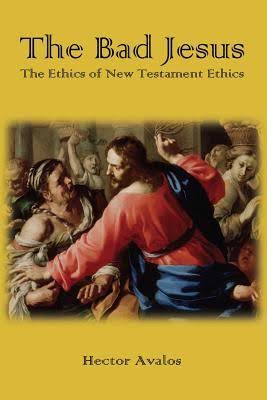
Summary: In “The Bad Jesus: The Ethics of New Testament Ethics,” Hector Avalos, a professor of Religious Studies at Iowa State University, challenges the traditional view of Jesus as morally perfect. He argues that Jesus should be examined through a historical lens rather than revered as a divine figure. Avalos highlights instances in the New Testament where Jesus’ actions and teachings diverge from modern ethical norms, such as violence, treatment of women, imperialism, poverty, and the environment. He contends that Jesus, like other ancient figures, reflected the ethics of his time and culture, which may be viewed as harmful by today’s standards.
The Bad Jesus: The Ethics of New Testament Ethics
Publisher: Sheffield Phoenix Press
Genre: Religion
ISBN: 9781909697799, 9781909697799
Pages: 476
The Bad Jesus, Love, and the Parochialism of New Testament Ethics
Hector Avalos, Professor of Religious Studies, Iowa State University
“Indeed, if one reads almost any treatise on Christian ethics written by academic biblical scholars, one finds something extremely peculiar: Jesus never does anything wrong. This oddity even flies in the face of Jesus’ own reply to the man asking about how to secure eternal life: “And Jesus said to him, “Why do you call me good? No one is good but God alone’” (Mk 10:18). The Gospels record others judging Jesus as immoral: “the Son of man came eating and drinking, and they say, “Behold, a glutton and a drunkard, a friend of tax collectors and sinners!”’(Mt. 11:19)”.
“So how is it that most current academic biblical scholars still do not consider anything that Jesus does as wrong or evil? The answer, of course, is that most biblical scholars, whether in secular academia or in seminaries, still see Jesus as divine, and not as a human being with faults. Their Christology is high enough to exempt Jesus from any evil sentiments or ethical malpractice. The feminist scholar Mary Daly argues, as I do, that, a great deal of Christian doctrine has been docetic, that is, it has not seriously accepted the fact that Jesus was a limited human being”.
Most New Testament scholars are affiliated with religious institutions and are part of what I have called an ecclesial-academic complex that has no counterpart in any other areas of the humanities. For example, most, if not all, scholars of Greek religion are not a part of some Greek religious movement or organization. Despite biases that always exist in the study of the classics, it is fair to say that few have any personal stake in whether Zeus or Tiberius was good or bad because those entities don’t constitute any sort of authority for their actions. That is not the case with Jesus, who is still viewed as the paradigmatic authority for most Christian scholars. Such New Testament ethicists are still studying Jesus through the confessional lenses of Nicea or Chalcedon rather than through a historical approach that we would use with other human beings.
Contents
Introduction
Basic Elements of the Argument
The Unloving Jesus: What’s New Is Old
Loving the Enemy in the Ancient Near East
Love Can Entail Violence
The Golden Rule: Love as Tactical
The Parochialism of New Testament Ethics
The Hateful Jesus: Luke 14.26
Jesus Commands Hate
Expressing Preference
Hate as a Motive for Divorce
The Statistics of Hate and Love
The Semantic Logic of Love and Hate
The Violent Jesus
Matthew 10.34-37: Jesus’ Violent Purpose
Matthew 5.38-42: Don’t Victimize Me, Please
Matthew. 26.48-56: Non-Interference with Planned Violence
John 2.15: Whipping up Pacifism
Acts 9: Jesus Assaults Saul
The Suicidal Jesus: The Violent Atonement
Jesus as a Willing Sacrificial Victim
Mark 10.45: Self-Sacrifice as a Ransom
Sacrifice as Service: Transformation or Denial?
2 Corinthians 5.18: Anselm Unrefuted
René Girard: Sacrificing Apologetics
The Imperialist Jesus: We’re All God’s Slaves
Rethinking ‘Anti-Imperialism’
Selective Anti-Imperialism
The Benign Rhetoric of Imperialism
Christ as Emperor
The Kingdom of God as an Empire
The Anti-Jewish Jesus: Socio-Rhetorical Criticism as Apologetics
Abuse Me, Please: Luke T. Johnson’s Apologetics
When is Anti-Judaism, not Anti-Judaism?
When Did Christian Anti-Judaism Begin?
The Uneconomic Jesus as Enemy of the Poor
Jesus as Radical Egalitarian
The Fragrance of Poverty
Sermon on the Mount of Debts and Merits
The Misogynistic Jesus: Christian Feminism as Male Ancestor Worship
Mark 7//Matthew 15: The Misogynistic Jesus
Mark 10//Matthew 19: Divorcing Equality
The Womanless Twelve Apostles
The Last Supper: Guess Who’s Not Coming to Dinner
The Egalitarian Golden Age under Jesus
The Anti-Disabled Jesus: Less than Fully Human
Disability Studies
John 5 and 9: Redeeming Jesus
The Ethics of Punctuation
Paralyzed by Sin
The Magically Anti-Medical Jesus
Miracles, Not Magic?
The Naturalistic Jesus
Psychosomatic Ethics
The Eco-Hostile Jesus
Mark 5: Animal Rights and Deviled Ham
Luke 22 and Matthew 8: Sacrificing Animal Rights
Matthew 21: Figuratively Speaking
Mark 13: Eschatological Eco-Destruction
The Anti-Biblical Jesus: Missed Interpretations
Mel and Jesus: The Hypocrisy of New Testament Ethics
Mark 2:23-28: Jesus as Biblically Illiterate
Matthew 19: Jesus Adds his Own Twist on Divorce
Isaiah 6:9-10: Integrating Extrabiblical Materials
Conclusion
The Ethics of New Testament Ethics
“New Testament ethics is still affected by a Christian bias that relies on denigrating and diminishing the ethical accomplishments of other Near Eastern cultures to bolster the reputed founder of Christianity. Otherwise, the field of New Testament ethics usually ignores the advances of other Near Eastern cultures in order to render Jesus as an innovator on ethics. In The Bad Jesus, I offer many detailed examples of Jesus’ practices and teachings, as portrayed in the Gospels, that would be antithetical to modern ethical norms on violence, the treatment of women, imperialism, poverty, the environment, and human equality. Far from being a paragon for modern ethics, Jesus was another ancient figure who was a reflection of the ethics of the biblical authors and their cultures. Many of those ethical precepts could be viewed as harmful or negative today if anyone other than Jesus held them”.
Read more:
- Antisemitism and the Foundations of Christianity by Alan Davies
- Anti-Christian Library: Scholarly Critiques and Contextual Discourse