Summary: Acharya Tulsi emphasized the understanding of “dharma” as a practice of self-purification, encompassing right belief, knowledge, and conduct. He advocated for a broader interpretation of “secularism” as being indifferent to sect or creed. He also addressed the discrepancy between being religious in public and leading a different life in private, advocating for a consistent practice of dharma. He proposed a five-point plan for developing religious tolerance and reducing sectarianism. Anuvrat, a movement he advocated for, aimed to integrate dharma into daily life beyond mere bookish knowledge or rituals.
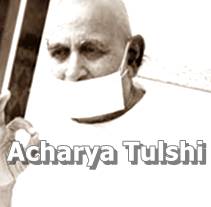
Acharya Tulsi (20 October 1914 – 23 June 1997)
आचार्य तुलसी
Dharma is ultimately a matter of one’s faith
The difficulty is that it is used in more than twenty senses in our practical life. A big volume can be prepared if all the definitions and interpretations of the word ‘dharma’ are collected together. Anyone would be confused by reading such a book, if he does not possess the attitude of many-faceted approach.
Bhagavan Mahavira exhorted us to use many-faceted (anekānt) attitude. It means to look at anything from many points of view. In a one-sided view, there is scope for obstinacy. Its result is: what I say is the only truth. The use of anekānt, on the other hand, gives rise to freedom from obstinacy, i.e., open-mindedness. ‘Both what I say may be true and what you say may also be true.’ This is the line of thought of a person free from obstinacy. If the anekānt is applied to the field of religion, there will not be any conflict.
We must understand clearly the difference between ‘sampradāya’ and ‘dharma’. Sampradāya or creed means the tradition started by a guru. People having faith in a particular ideology which is accepted by a particular school of thought follow its instructions. They consider this school as their dharma. Later on, that school is developed as a creed or a sect.
The simplest meaning of ‘dharma’ is that it is the practice of self-purification. In other words, it is the process through which the soul is purged of its impurities and is made pure. So dharma is also the observance of right belief, right knowledge, and right conduct. In my view, this is the perfect definition of ‘dharma’ and a practice of this will lead to liberation.
India is a secular state. Does this mean our country has to remain, devoid of dharma? Whenever secularism is interpreted this way, I wonder how a country can survive by abandoning dharma. A lot of confusion has been created by the misunderstanding of the word ‘secularism’.
In the Indian Constitution, India is stated to be a secular state, which is translated in Hindi as a state indifferent to dharma. In our democracy, the government cannot be in the hands of a particular sect or creed. This is good. The problem is with the use of the word ‘dharma’. Why not say ‘sampradāya’ or creed?
In 1987 when Prime Minister Rajiv Gandhi came to see me, we discussed about secularism. He agreed that the word had been wrongly translated in the Constitution. I suggested that in place of ‘dharma-nirapeksha,’ we should use ‘Sampradāya-nirapeksha’ or ‘pantha-nirapeksha,’ which means ‘indifferent to sect or creed.’ The Prime Minister agreed with my interpretation and asked for a written note on the subject. I hear that in the new Hindi edition of the Constitution, the word secular is translated as ‘pantha-nirapeksha’.
Sometimes I am asked: ‘Is dharma one or many?’ The answer to it is not so simple. If we identify dharma with religious creed, sect, community, path, tradition, etc., the answer would be that there are many dharmas. But if dharma really denotes the universal and eternal values of life, then the answer would be that there is only one dharma, and it comprises essentially nonviolence and truth; in it are also included faith, knowledge and conduct. Dharma is nothing else but the sanctity of life.
A major problem in the field of religion is that everyone wants to increase the number of followers of his own religion. Increasing the number amounts to politics even in the field of religion. Thus it cannot be a part of pure dharma; it is connected with the creed or the sect.
Some people ask me, ‘Acharyaji, how is it that although Jainism is so good and so great, it has so few followers?’ I tell them, ‘The number of Jains you are talking about is that of people who are Jain only by birth. Because they are born in Jain families, they are considered Jains. How many of them are real Jains? That is, how many of them follow Jainism in their daily life?’ My answer to their question startles them. I then tell them, ‘There are more non-Jains than real Jains among those who are Jain by birth.’ This remark startles them all the more. Then I explain, ‘You see, there are two kinds of Jains: Jains by birth, and Jains by their action. All those who are born in Jain families belong to the former category, while those who really have faith in the tenets of Jainism—tenets such as nonviolence, truth, non-absolutism, etc.—and also practice them, are Jains by action (i.e., the real Jains). They may belong to even a non-Jain family by birth.
If all the religious teachers in the world start thinking along these lines and accept the wider meaning of dharma, then there will be no scope for religious fanaticism. I do not consider sects as useless. Dharma and sect are like soul and body, or fruit and its skin. Both have a role to play. But we should not confuse one with the other. It is sectarianism which gives rise to conflicts.
For the last four decades, I have been propagating a five-point plan for developing religious tolerance and weakening sectarianism. If these points or similar ones are accepted by all sects, a new revolution can take place in the field of religion.
The five-point plan for religious tolerance is as follows:
- A constructive policy should be adopted—only one’s own view should be presented; there should not be any condemnation of other religions.
- Tolerance should be observed towards other ideologies.
- No hatred or contempt towards other sects or their followers should be propagated.
- If a person voluntarily changes his faith, there should not be any improper treatment of him or her, such as social boycotts.
- There should be a joint effort to establish basic values of dharma in the daily lives of people.
The problem today is that the so-called religious people lead a dual life. When they visit any place of worship, they become very religious, but when they return home or go to their workplaces their face is changed. How many masks they wear? In the case of some persons, we may find a world of difference in the quality of their early life and later life. Transformations do take place. But what are we to do with one who is ‘religious’ in the morning and a ‘devil’ the same afternoon? It is disheartening to watch this drama of changing masks. I cannot understand how a person can change so soon as he crosses the threshold of the temple, mosque, church, gurudwara, or monastery. Such hypocrites have done greater harm to religion than even the non-believers.
Anuvrat is a march in the direction of resolving this confusion created by the cult of masks. The aim of the Anuvrat is to link dharma with life by freeing it from the boundaries of bookish knowledge or mere rites and rituals of a creed or sect. Only the dharma which is practiced in our daily life can become effective and fulfilling.
Read more
- Dharmapada Sutra
- चोदनालक्षणोऽर्थो धर्मः-शबरभाष्यम् Chodana Lakshn Artha Dharma
- धर्मसंग्रहः – Dharma-Saṅgraha by Nagarjuna
- ধর্মপ্রচার-রবীন্দ্রনাথ ঠাকুর Dharma Prachar- Rabindranath Thakur