Decree of the President of the People’s Republic of China
No. 26
I hereby promulgate the Basic Law of the Hong Kong Special Administrative Region of the People’s Republic of China, including Annex I, Method for the Selection of the Chief Executive of the Hong Kong Special Administrative Region, Annex II, Method for the Formation of the Legislative Council of the Hong Kong Special Administrative Region and Its Voting Procedures, Annex III, National Laws to be Applied in the Hong Kong Special Administrative Region, and designs of the regional flag and regional emblem of the Hong Kong Special Administrative Region, which was adopted at the Third Session of the Seventh National People’s Congress of the People’s Republic of China on 4 April 1990 and shall be put into effect as of 1 July 1997.
(Signed)
Yang Shangkun
President of
the People’s Republic of China
4 April 1990
Preamble
Hong Kong has been part of the territory of China since ancient times; it was occupied by Britain after the Opium War in 1840. On 19 December 1984, the Chinese and British Governments signed the Joint Declaration on the Question of Hong Kong, affirming that the Government of the People’s Republic of China will resume the exercise of sovereignty over Hong Kong with effect from 1 July 1997, thus fulfilling the long-cherished common aspiration of the Chinese people for the recovery of Hong Kong.
Upholding national unity and territorial integrity, maintaining the prosperity and stability of Hong Kong, and taking account of its history and realities, the People’s Republic of China has decided that upon China’s resumption of the exercise of sovereignty over Hong Kong, a Hong Kong Special Administrative Region will be established in accordance with the provisions of Article 31 of the Constitution of the People’s Republic of China, and that under the principle of “one country, two systems”, the socialist system and policies will not be practised in Hong Kong. The basic policies of the People’s Republic of China regarding Hong Kong have been elaborated by the Chinese Government in the Sino-British Joint Declaration.
In accordance with the Constitution of the People’s Republic of China, the National People’s Congress hereby enacts the Basic Law of the Hong Kong Special Administrative Region of the People’s Republic of China, prescribing the systems to be practised in the Hong Kong Special Administrative Region, in order to ensure the implementation of the basic policies of the People’s Republic of China regarding Hong Kong.
Chapter I – General Principles
Article 1
The Hong Kong Special Administrative Region is an inalienable part of the People’s Republic of China.
Article 2
The National People’s Congress authorizes the Hong Kong Special Administrative Region to exercise a high degree of autonomy and enjoy executive, legislative and independent judicial power, including that of final adjudication, in accordance with the provisions of this Law.
Article 3
The executive authorities and legislature of the Hong Kong Special Administrative Region shall be composed of permanent residents of Hong Kong in accordance with the relevant provisions of this Law.
Article 4
The Hong Kong Special Administrative Region shall safeguard the rights and freedoms of the residents of the Hong Kong Special Administrative Region and of other persons in the Region in accordance with law.
Article 5
The socialist system and policies shall not be practised in the Hong Kong Special Administrative Region, and the previous capitalist system and way of life shall remain unchanged for 50 years.
Article 6
The Hong Kong Special Administrative Region shall protect the right of private ownership of property in accordance with law.
Article 7
The land and natural resources within the Hong Kong Special Administrative Region shall be State property. The Government of the Hong Kong Special Administrative Region shall be responsible for their management, use and development and for their lease or grant to individuals, legal persons or organizations for use or development. The revenues derived therefrom shall be exclusively at the disposal of the government of the Region.
Article 8
The laws previously in force in Hong Kong, that is, the common law, rules of equity, ordinances, subordinate legislation and customary law shall be maintained, except for any that contravene this Law, and subject to any amendment by the legislature of the Hong Kong Special Administrative Region.
Article 9
In addition to the Chinese language, English may also be used as an official language by the executive authorities, legislature and judiciary of the Hong Kong Special Administrative Region.
Article 10
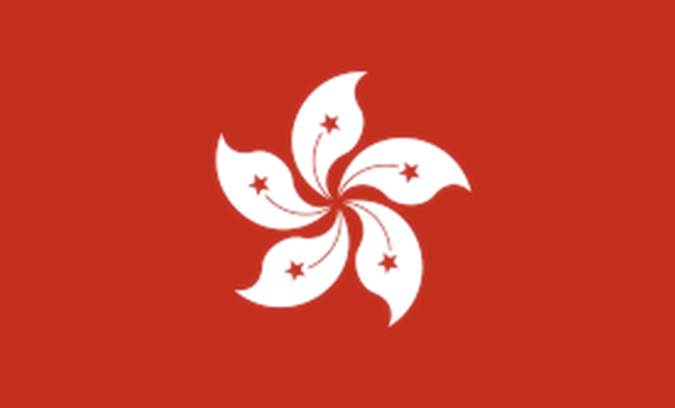
Apart from displaying the national flag and national emblem of the People’s Republic of China, the Hong Kong Special Administrative Region may also use a regional flag and regional emblem.
The regional flag of the Hong Kong Special Administrative Region is a red flag with a bauhinia highlighted by five star-tipped stamens.
The regional emblem of the Hong Kong Special Administrative Region is a bauhinia in the centre highlighted by five star-tipped stamens and encircled by the words “Hong Kong Special Administrative Region of the People’s Republic of China” in Chinese and ” HONG KONG” in English.
Article 11
In accordance with Article 31 of the Constitution of the People’s Republic of China, the systems and policies practised in the Hong Kong Special Administrative Region, including the social and economic systems, the system for safeguarding the fundamental rights and freedoms of its residents, the executive, legislative and judicial systems, and the relevant policies, shall be based on the provisions of this Law.
No law enacted by the legislature of the Hong Kong Special Administrative Region shall contravene this Law.
The Sino-British Joint Declaration on the Question of Hong Kong (The Joint Declaration) was signed between the Chinese and British Governments on 19 December 1984. The Joint Declaration sets out, among other things, the basic policies of the People’s Republic of China (PRC) regarding Hong Kong. Under the principle of “One Country, Two Systems”, the socialist system and policies shall not be practised in the Hong Kong Special Administrative Region (HKSAR) and Hong Kong’s previous capitalist system and life-style shall remain unchanged for 50 years. The Joint Declaration provides that these basic policies shall be stipulated in a Basic Law of the HKSAR.
Relationship Between the Central Authority of China & the Hong Kong SAR
The Central People’s Government (CPG) shall be responsible for the defence and the foreign affairs relating to the HKSAR. (BL Articles 13-14)
The CPG authorizes the HKSAR to conduct relevant external affairs on its own. (BL Article 13)
The HKSARG shall be responsible for the maintenance of public order in the Region. (BL Article 14)
National laws shall not be applied in the HKSAR except for those listed in Annex III to the Basic Law. Laws listed in Annex III shall be confined to those relating to defence and foreign affairs as well as other matters outside the limits of the autonomy of the HKSAR. The laws listed in Annex III shall be applied locally by way of promulgation or legislation by the HKSAR. (BL Article 18)
No department of the CPG and no province, autonomous region, or municipality directly under the Central Government may interfere in the affairs which the HKSAR administers on its own in accordance with the Basic Law. (BL Article 22)
Hong Kong Normalization : US President’s Executive Order -14/07/2020
https://advocatetanmoy.com/2021/01/20/hong-kong-normalization-us-presidents-executive-order-14-07-2020/
The Judiciary
The power of final adjudication of the HKSAR shall be vested in the Court of Final Appeal of the HKSAR, which may as required invite judges from other common law jurisdictions to sit on the Court of Final Appeal. (BL Article 82)
The courts of the HKSAR shall exercise judicial power independently, free from any interference. (BL Article 85)
The principle of trial by jury previously practised in Hong Kong shall be maintained. Anyone who is lawfully arrested shall have the right to a fair trial by the judicial organs without delay and shall be presumed innocent until convicted by the judicial organs. (BL Articles 86-87)
The HKSAR may, through consultations and in accordance with law, maintain juridical relations with the judicial organs of other parts of the PRC, and they may render assistance to each other. With the assistance or authorization of the CPG, the HKSARG may also make appropriate arrangements with foreign states for reciprocal juridical assistance. (BL Articles 95-96)