Date: 12/12/2018
Investigative Agencies are requesting an autopsy -Police under Section 174 Cr PC and Magistrate under Section 176 Cr P C with the following objectives :
Medico-legal issues: Guidelines by Govt of India 
Medico-Legal Postmortem
1. To find out cause of death
2. To find factual, objective, medical information for law enforcement agencies and courts.
3. To allow proper recovery and preservation of evidence
4. To document injuries and disease
5. To determine the manner of death
6. To know the time of death
7. To reconstruct the Crime Scene
8. To provide a correlation of facts and circumstances related to the death
9. To help in the identification of the victim, etc.
Model Postmortem Report [NHRC]
Complete or Incomplete Postmortem Procedure
As of today in India, a full postmortem is carried out in medico-legal cases i.e.
1. Examination of clothing /items over the body.
2. External examination of the body from head to toe front, back, and sides.
3. Internal examination with the opening of all three cavities i. e Head, chest, and abdomen.
There is no practice or provision of incomplete or partial or limited postmortem in medico-legal cases. Partial postmortem is practiced in clinical autopsies( Non-MLC cases)
BODY HANDLING POLICY
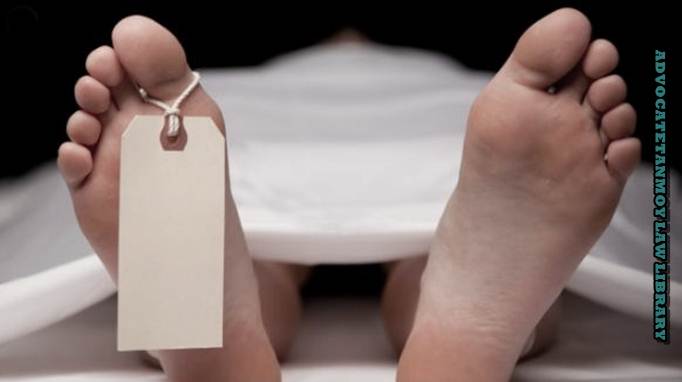
1. All bodies should bear identification tags over the plastic or cloth covering of the dead body; and over the chest, wrist or ankle areas in hospitalized or brought dead persons.
2. The body should be identified by accompanying police personnel and relatives of the deceased.
3. All bodies shall be refrigerated immediately in cold storage ( 40 C) with proper tag and identification number by the morgue attendant/staff.
4. Do not clean the body or clothing after death till postmortem examination is conducted.
5. All clothing of the deceased should remain with the body and their examination should be documented in the postmortem report.
6. Clothing should not be disposed of in any case without permission of Police. All clothing should be handed over to police in cases of murder, suicide, custody, encounter and jail deaths, in sealed packets ( after air drying the clothing if stained with blood or any other stains
MINIMUM TRAINING OF MEDICAL PERSONNEL
1. General Medical Officer -MBBS with three months orientation courses for PHC (Minimum 25 cases independently and 50 under supervision with report writing and digital photography)
2. Senior/Chief Medical Officer/Specialist – MBBS and MD in Forensic Medicine or persons having MBBS with six months to one-year orientation course (100 independent PM and 200 under supervision) for District center
Basic Skills Expected in Medical man handling Forensic Cases
• Professional Skills
• Communication skills
• Workable English language skills
• Description of wounds/lesions
• X-ray interpretation of findings in forensic situations
• Handling, preservation, and transportation of evidence
• Different types of formats used for writing PM findings
• Sketching skills
• Photography skills (digital recording and interpretation)
• Making diagnosis ( Know how to differentiate from other probable diagnoses)
POST-MORTEM EXAMINATIONS Rule ( Delhi High Court)
Evidence in Court of Law –
The examination in the court of law consists of.
1) The examination in chief,
2) The cross-examination,
3) The re-examination.
MEDICO-LEGAL AUTOPSIES
Clinical Autopsy vs Medicolegal Autopsy
- Autopsy Report of President John F. Kennedy
- What should be in a Postmortem Report- Model form
- How to issue Medical Certificate of Death by a Registered Medical Practitioner