KAMPUCHEA IS NOW CAMBODIA
Most Cambodians consider themselves to be Khmers, descendants of the Angkor Empire that extended over much of Southeast Asia and reached its zenith between the 10th and 13th centuries. Attacks by the Thai and Cham (from present-day Vietnam) weakened the empire, ushering in a long period of decline. The king placed the country under French protection in 1863, and it became part of French Indochina in 1887. Following Japanese occupation in World War II, Cambodia gained full independence from France in 1953. In April 1975, after a seven-year struggle, communist Khmer Rouge forces captured Phnom Penh and evacuated all cities and towns. At least 1.5 million Cambodians died from execution, forced hardships, or starvation during the Khmer Rouge regime under POL POT. A December 1978 Vietnamese invasion drove the Khmer Rouge into the countryside, began a 10-year Vietnamese occupation, and touched off 20 years of civil war.
The 1991 Paris Peace Accords mandated democratic elections and a cease-fire, which was not fully respected by the Khmer Rouge. UN-sponsored elections in 1993 helped restore some semblance of normalcy under a coalition government. Factional fighting in 1997 ended the first coalition government, but a second round of national elections in 1998 led to the formation of another coalition government and renewed political stability. The remaining elements of the Khmer Rouge surrendered in early 1999. Some of the surviving Khmer Rouge leaders were tried for crimes against humanity by a hybrid UN-Cambodian tribunal supported by international assistance.
LAND
181,300 km2; 16% cultivated, 74% forested, 10% built-on area, wasteland, and other
Land boundaries: 2,438 km
WATER
Limits of territorial waters (claimed): 12 nm (economic including fishing 200 nm)
Coastline: about 443 km
PEOPLE
Population: 5,882,000 (July 1982), average annual growth rate 1.9%
Nationality: noun—Kampuchean(s); adjective—Kampuchean
Ethnic divisions: 90% Khmer (Kampuchean), 5% Chinese, 5% other minorities
Religion: 95% Theravada Buddhism, 5% various other
Language: Cambodian
GOVERNMENT
Official name: Democratic Kampuchea (supported by resistance forces deployed principally near the western border); People’s Republic of Kampuchea (PRK; pro-Vietnamese, in Phnom Penh)
Type: both are Communist states
Capital: Phnom Penh
Political subdivisions: 19 provinces
Legal system: Judicial Committee chosen by People’s Representative Assembly in Democratic Kampuchea; no information for PRK
National holiday: 17 April for both regimes
Branches: Cabinet, State Presidium, and some form of People’s Representative Assembly in Democratic Kampuchea; Peoples Revolutionary Council, various ministries, and a “National Congress” held in early 1979 and a second time in September 1979 in PRK
Government leaders: Presidium Chairman and Prime Minister KH1EU SAMPHAN; Deputy Prime Ministers IENG SARY and SON SEN; Assembly Standing Committee Chairman NUON CHEA in Democratic Kampuchea; Chairman, Council of State, HENG SAMRIN; Chairman, Council of Ministers, CHAN SI; Minister of National Defense BOU THANG; and Foreign Minister HUN SEN in PRK
Suffrage: universal over age 18
Political parties and leaders: Democratic Kampuchea Khmer Communist Party disbanded December 1981 though chief political figure still former party chairman Pol Pot; in PRK Kampuchean United Front for National Construction and Defense (KUFNCD) and separate Kampuchean Peoples Revolutionary Party
Member of: Colombo Plan, ESCAP, FAO, G-77, GATT (de facto), IAEA, IBRD, ICAO, IDA, ILO, IMCO, IMF, ITU, Mekong Committee (inactive), NAM, UN, UNESCO, UPU, WHO, WMO, WTO for Democratic Kampuchea; none for PRK
ECONOMY
GNP: less than $500 million (1971)
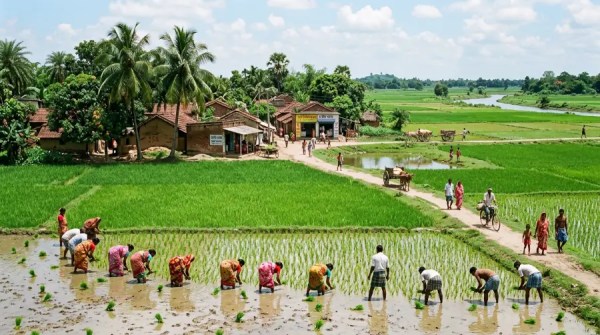
Agriculture: mainly subsistence except for rubber plantations; main crops—rice, rubber, corn; food shortages—rice, meat, vegetables, dairy products, sugar, flour
Major industries: rice milling, fishing, wood and wood products
Shortages: fossil fuels
Electric power: 120,000 kW capacity (1981); 100 million kWh produced (1981), 18 kWh per capita
Exports: probably less than $1 million est. (1978); natural rubber, rice, pepper, wood
Imports: probably less than $20 million (1978); food, fuel, machinery
Trade partners: (1978) exports—China; imports—China, North Korea; (1981) Vietnam and USSR
Aid: economic commitments—US (FY70-80), $690 million; other Western, (1970-79) $135 million; military (FY70-80)—US, $1,260 million; Communist not available
Budget: no budget data available since Communists took over government
Monetary conversion rate (1978): no currency in use
Fiscal year: calendar year
COMMUNICATIONS
Railroads: 612 km meter gauge (1.00 m); government owned
Highways: 13,351 km total; 2,622 km bituminous, 7,105 km crushed stone, gravel, or improved earth; and 3,624 km unimproved earth; some roads in disrepair
Inland waterways: 3,700 km navigable all year to craft drawing 0.6 meters; 282 km navigable to craft drawing 1.8 meters
Ports: 2 major, 5 minor
Airfields: 52 total, 23 usable; 9 with permanent-surface runways; 2 with runways 2,440-3,659 m, 8 with runways 1,220-2,439 m
Telecommunications: service barely adequate for government requirements and virtually nonexistent for general public; international service limited to Vietnam and other adjacent countries; radiobroadcasts limited to 1 station
DEFENSE
Military manpower: males 15-49, 1,571,000; 843,000 fit for military service; 99,000 reach military age (18) annually