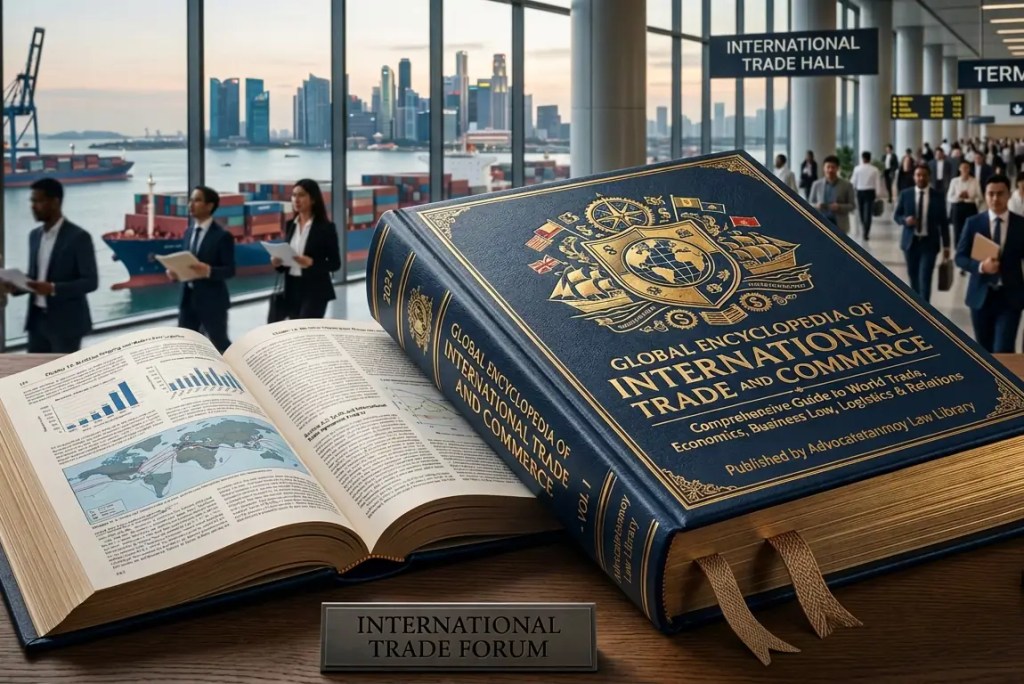
Global Encyclopedia of International Trade and Commerce (GEITAC)
Volume 1 defines the system and its basic mechanisms
Civilizational question: Why do human societies trade, and how does exchange change the structure of civilization?
Sarvarthapedia · Volume 1 · Foundations of Trade and Commerce
Volume 1: Foundations of Trade and Commerce — Concepts, Institutions, Exchange and Civilizational Origins
The first volume of GEITAC establishes the intellectual foundations of the entire fifteen-volume encyclopedia. It would not merely introduce elementary economics. It would explain the nature of exchange, the emergence of markets, the formation of commercial institutions, the relationship between production and consumption, the creation of value, and the transformation of isolated communities into interconnected economic systems.
Its function is foundational: subsequent volumes will examine trade history, economic theory, supply chains, finance, international law, digital commerce, and geopolitical competition. Volume 1 must therefore define the concepts upon which all those subjects depend.
Synopsis of Volume 1 of GEITAC
Part I — The Nature and Meaning of Trade
Chapters 1–10 · Defining the subject
- Trade: Definition, Nature and Scope
- Commerce, Trade and Exchange: Conceptual Distinctions
- International Trade and Domestic Trade
- The Economic Significance of Exchange
- Trade as a Human Institution
- The Relationship Between Production, Distribution and Consumption
- Goods, Services and Economic Exchange
- Voluntary Exchange, Bargaining and Mutual Benefit
- Commercial Activity and Economic Interdependence
- International Trade and the Study of Civilization
Part II — The Origins of Exchange and Commercial Life
Chapters 11–20 · From subsistence to exchange networks
- Human Cooperation and the Origins of Exchange
- Subsistence Economies and Economic Self-Sufficiency
- The Emergence of Surplus Production
- Specialization and the Division of Labour
- Barter and Direct Commodity Exchange
- Reciprocity, Redistribution and Market Exchange
- Household Production and Community Exchange
- Occupational Differentiation and the Emergence of Merchants
- Long-Distance Exchange Before the Formation of States
- Trade as a Mechanism of Social and Economic Transformation
Part III — Value, Utility and the Economics of Exchange
Chapters 21–30 · Why goods and services are exchanged
- The Concept of Economic Value
- Use Value, Exchange Value and Market Value
- Utility, Scarcity and Human Wants
- Subjective Valuation and Individual Preferences
- Demand, Supply and the Conditions of Exchange
- Price Formation and Market Equilibrium
- Opportunity Cost and Commercial Decision-Making
- Marginal Utility and the Logic of Exchange
- Surplus, Gains from Trade and Mutual Advantage
- Value Creation, Value Capture and the Distribution of Gains
Part IV — Resources, Production and Economic Specialization
Chapters 31–40 · The productive foundations of commerce
- Natural Resources and the Geography of Production
- Land, Labour, Capital and Entrepreneurship
- Human Skills, Knowledge and Productive Capacity
- Technology and the Transformation of Production
- Productivity and the Expansion of Exchange
- Economies of Scale and Commercial Expansion
- Division of Labour Within and Between Economies
- Specialization, Comparative Cost and Market Participation
- Industrial Organization and the Supply of Tradable Goods
- Production Networks and the Emergence of Economic Interdependence
Part V — Markets and the Organization of Exchange
Chapters 41–50 · How commercial systems operate
- The Market: Meaning, Structure and Functions
- Local Markets, Regional Markets and World Markets
- Marketplaces, Trading Posts and Commercial Centres
- Market Participants: Buyers, Sellers and Intermediaries
- Wholesale Trade and Retail Distribution
- Spot Markets, Forward Markets and Futures Markets
- Auction Markets, Negotiated Markets and Posted Prices
- Competition, Market Power and Commercial Concentration
- Market Information, Price Discovery and Transparency
- Market Failure, Externalities and Institutional Correction
Part VI — Money, Credit and the Infrastructure of Exchange
Chapters 51–60 · How exchange expands beyond direct barter
- The Origins and Functions of Money
- Commodity Money, Metallic Money and Coinage
- Currency, Denomination and the Measurement of Value
- Money as a Medium of Exchange and Store of Value
- Credit, Deferred Payment and Commercial Obligations
- Debt, Trust and the Financing of Exchange
- Banking and the Institutionalization of Commercial Credit
- Bills of Exchange and the Historical Development of Payment Instruments
- Clearing, Settlement and the Transfer of Commercial Claims
- Monetary Institutions and the Expansion of Long-Distance Trade
Part VII — Merchants, Firms and Commercial Institutions
Chapters 61–70 · The organization of commercial activity
- The Merchant as an Economic and Historical Institution
- Trading Houses and Merchant Networks
- Partnerships, Agency and Commercial Representation
- Sole Proprietorships, Partnerships and Corporate Enterprises
- Cooperatives, Guilds and Collective Commercial Organization
- Intermediaries, Brokers, Commission Agents and Distributors
- Wholesalers, Retailers and Distribution Networks
- Commercial Reputation, Creditworthiness and Business Trust
- Entrepreneurship, Risk-Taking and Commercial Innovation
- Firms, Markets and the Institutional Boundaries of Commerce
Part VIII — Transaction Costs, Information and Commercial Trust
Chapters 71–80 · The conditions that make exchange possible
- Transaction Costs: Meaning, Sources and Economic Consequences
- Search Costs and the Discovery of Trading Partners
- Bargaining Costs and the Negotiation of Commercial Terms
- Contracting Costs and the Formation of Exchange Agreements
- Information Asymmetry Between Buyers and Sellers
- Uncertainty, Opportunism and the Problem of Commercial Trust
- Reputation Systems and Repeat Transactions
- Standards, Measurement and the Comparability of Goods
- Commercial Records, Documentation and Institutional Memory
- Trust, Enforcement and the Expansion of Market Networks
Part IX — Risk, Uncertainty and the Economics of Commercial Decisions
Chapters 81–90 · The uncertainties inherent in exchange
- Risk and Uncertainty in Commercial Activity
- Price Risk and Market Volatility
- Supply Risk and Demand Uncertainty
- Counterparty Risk and the Failure of Commercial Obligations
- Transport Risk, Storage Risk and Physical Loss
- Credit Risk, Liquidity Risk and Financial Exposure
- Insurance and the Transfer of Commercial Risk
- Diversification and the Management of Economic Exposure
- Information, Forecasting and Commercial Decision-Making
- Resilience, Adaptation and Continuity of Trade
Part X — Geography, Distance and the Spatial Organization of Commerce
Chapters 91–100 · The geography of economic interdependence
- Geography as a Determinant of Commercial Exchange
- Distance, Transport Costs and Market Access
- Rivers, Coasts and the Development of Trade Routes
- Ports, Harbours and Maritime Commercial Centres
- Roads, Railways and the Inland Movement of Goods
- Mountains, Deserts and Natural Barriers to Exchange
- Geographic Concentration of Resources and Industries
- Urbanization, Commercial Cities and Regional Market Formation
- Transport Infrastructure and the Expansion of Trading Networks
- Spatial Interdependence and the Geography of World Commerce
Part XI — Trade, State Formation and Political Authority
Chapters 101–110 · Commerce and the development of political institutions
- Trade and the Emergence of Political Authority
- States, Territory and the Regulation of Exchange
- Taxation, Tribute and Commercial Revenue
- Customs Duties and the Fiscal Foundations of Trade
- Coinage, Weights and Measures as Instruments of State Authority
- Merchant Protection, Safe Conduct and the Security of Trade Routes
- Commercial Treaties and Agreements Between Political Communities
- State Monopolies, Chartered Companies and Privileged Commerce
- Public Infrastructure and the Institutional Support of Markets
- Trade, State Capacity and the Formation of Economic Power
Part XII — Law, Property and the Governance of Exchange
Chapters 111–120 · The legal foundations of commerce
- Property Rights and the Legal Foundations of Exchange
- Possession, Ownership and the Transfer of Goods
- Contractual Obligations and Commercial Agreements
- Consent, Capacity and the Validity of Commercial Transactions
- Agency, Authority and Representation in Trade
- Delivery, Acceptance and the Performance of Commercial Contracts
- Breach of Contract, Damages and Commercial Remedies
- Dispute Resolution, Arbitration and Commercial Justice
- Legal Certainty, Enforcement and Market Development
- The Relationship Between Commercial Law and Economic Institutions
Part XIII — Trade, Society and Civilizational Development
Chapters 121–130 · The social consequences of commercial networks
- Trade and the Development of Complex Societies
- Commercial Surplus and the Growth of Urban Civilization
- Merchant Communities and Social Organization
- Trade Diasporas and Cross-Cultural Commercial Networks
- Language, Translation and Communication in Exchange
- Cultural Transmission Through Commercial Contact
- Religious Institutions, Ethical Traditions and Merchant Conduct
- Trade, Knowledge Transfer and Technological Diffusion
- Commercial Networks, Social Stratification and Inequality
- Trade as a Force of Integration, Conflict and Civilizational Change
Part XIV — The Conceptual Foundations of International Trade
Chapters 131–140 · From separate economies to cross-border exchange
- The Concept of International Trade
- The Territorial and Jurisdictional Boundaries of Markets
- National Economies and Cross-Border Commercial Relations
- Imports, Exports and the Direction of International Exchange
- Tradable and Non-Tradable Goods and Services
- Absolute Advantage and the Foundations of International Specialization
- Comparative Advantage and the Logic of International Exchange
- Trade Barriers, Market Access and the Cost of Crossing Borders
- International Trade and the Distribution of Economic Gains
- Economic Interdependence, National Interests and the International Trading System
Part XV — Commerce as a Complex Adaptive Civilizational System
Chapters 141–150 · The synthesis of the volume
- Trade Networks as Complex Adaptive Systems
- Nodes, Links and Flows in Commercial Networks
- Network Centrality and the Unequal Distribution of Commercial Power
- Feedback Loops, Market Adjustment and Economic Adaptation
- Network Effects, Path Dependence and Commercial Lock-In
- Systemic Risk, Cascading Disruptions and Commercial Contagion
- Interdependence, Concentration and Structural Vulnerability
- Innovation, Institutional Evolution and the Transformation of Commerce
- Resilience, Redundancy and the Continuity of Civilizational Exchange
- Toward a Unified Theory of Trade and Commerce as a Civilizational System
Cross-volume coordination
Volume 1 defines the fundamental concepts, while later volumes should investigate their specialized applications.
- Volume 2: Historical evidence for the evolution of exchange and commercial networks.
- Volume 3: Formal economic theories of specialization, prices, and gains from trade.
- Volume 5: Physical transport infrastructure and logistics.
- Volume 6: Specialized instruments of international trade finance.
- Volume 8: The detailed legal rules governing cross-border commercial relations.
- Volume 12: Strategic dependencies, economic coercion and geopolitical power.
- Volume 15: Integrated models of commercial resilience and civilizational evolution.