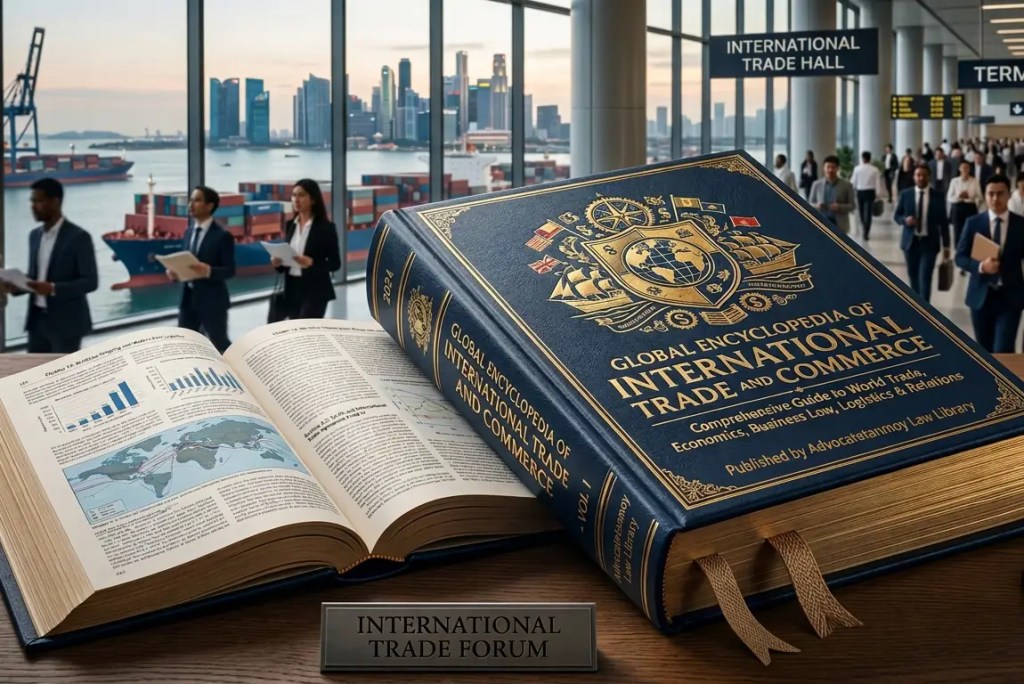
International trade is not merely the exchange of goods across national borders; it is a principal mechanism through which civilizations organize economic interdependence, transmit knowledge, distribute power, and transform the material conditions of human existence.
This Global Encyclopedia of International Trade and Commerce (GEITAC) integrates economic theory, commercial history, international law, finance, technology, geopolitics, institutions, and civilizational analysis without allowing any single discipline to dominate the whole.
Global Encyclopedia of International Trade and Commerce (GEITAC)
Sarvarthapedia Civilizational Knowledge System: Proposed 15-Volume Architecture
The fifteen-volume architecture: Encyclopedia of International Trade and Commerce
Volume 1 — Foundations of Trade and Commerce
Conceptual and theoretical foundations
Synopsis of Volume 1 of GEITAC
Defines trade, commerce, exchange, markets, value, specialization, comparative advantage, division of labour, transaction costs, economic interdependence, and commercial institutions. Examines barter, money-mediated exchange, merchant networks, market formation, and the relationship between production and exchange.
Civilizational question: Why do human societies trade, and how does exchange change the structure of civilization?
Volume 2 — Historical Evolution of World Commerce
From ancient exchange to the modern trading system
Synopsis of Volume 2 of GEITAC
Investigates Mesopotamian, Egyptian, Indus, Chinese, Mediterranean, African, Persian, Indian Ocean, Central Asian, and European commercial networks. Covers the Silk Roads, maritime trade, medieval merchant communities, European expansion, colonial commercial systems, industrialization, the gold standard, the two world wars, Bretton Woods, GATT, the WTO, and contemporary globalization.
Civilizational question: How have commercial networks connected, enriched, transformed, and sometimes destabilized civilizations?
Volume 3 — International Trade Theory and Economic Structures
The analytical science of cross-border exchange
Synopsis of Volume 3 of GEITAC
Covers absolute and comparative advantage, Heckscher–Ohlin theory, economies of scale, imperfect competition, new trade theory, gravity models, intra-industry trade, trade creation and diversion, productivity, terms of trade, gains from trade, distributional effects, and the political economy of protectionism.
Civilizational question: Why do nations specialize differently, and who gains or loses when markets become interconnected?
Volume 4 — Global Production, Supply Chains and Industrial Networks
The architecture of worldwide production
Examines global value chains, multinational production, outsourcing, offshoring, contract manufacturing, industrial clusters, intermediate goods, supplier networks, just-in-time systems, inventory management, supply-chain resilience, critical materials, reshoring, friend-shoring, and industrial policy.
Civilizational question: How does production become distributed across countries, and what happens when interdependence becomes vulnerability?
Volume 5 — International Logistics, Shipping and Trade Infrastructure
The physical networks of world commerce
Covers maritime shipping, ports, canals, railways, aviation, roads, inland waterways, pipelines, warehousing, freight forwarding, containerization, customs logistics, multimodal transport, insurance, chokepoints, strategic straits, logistics costs, and infrastructure investment.
Civilizational question: Which physical networks make world commerce possible, and who controls the routes through which economic life flows?
Volume 6 — International Trade Finance, Banking and Payments
The financial machinery of cross-border commerce
Examines letters of credit, documentary collections, trade credit, export financing, factoring, forfaiting, correspondent banking, international payment systems, foreign-exchange markets, trade finance gaps, credit insurance, guarantees, settlement risk, sovereign risk, and the role of development finance institutions.
Civilizational question: How does trust become finance when buyers, sellers, banks, and governments operate under different jurisdictions?
Volume 7 — International Monetary Systems and Commercial Economics
Currencies, exchange rates and macroeconomic interdependence
Covers exchange-rate regimes, balance of payments, current and capital accounts, foreign-exchange reserves, currency convertibility, capital flows, sovereign debt, international liquidity, reserve currencies, monetary unions, currency crises, sanctions-related financial restrictions, and the interaction between trade, inflation, interest rates, and employment.
Civilizational question: How do monetary arrangements influence the distribution of wealth and power between nations?
Volume 8 — International Trade Law and Commercial Institutions
The legal order governing international exchange
Covers the WTO framework, GATT, GATS, TRIPS, regional trade agreements, free-trade agreements, customs unions, most-favoured-nation treatment, national treatment, tariff bindings, trade remedies, dispute settlement, international commercial contracts, Incoterms, arbitration, jurisdiction, enforcement, and recognition of foreign judgments and awards.
Civilizational question: How can commercial obligations be enforced across political boundaries without a single world government?
Volume 9 — Customs, Tariffs, Trade Regulation and Compliance
The administration and control of international commerce
Examines tariff classification, customs valuation, rules of origin, preferential trade arrangements, import and export licensing, customs procedures, trade facilitation, anti-dumping duties, countervailing measures, safeguards, export controls, product standards, technical barriers, sanitary and phytosanitary measures, and trade compliance systems.
Civilizational question: How do states balance the facilitation of commerce with the protection of revenue, industry, health, and security?
Volume 10 — Global Enterprises, Merchants and Commercial Strategy
The organization of international business
Studies multinational enterprises, trading houses, merchant communities, export management, foreign-market entry, international joint ventures, franchising, licensing, distribution agreements, global marketing, pricing, procurement, negotiation, commercial intelligence, country risk, corporate governance, and cross-border mergers and acquisitions.
Civilizational question: How do commercial organizations acquire the capacity to operate across multiple political, cultural, and legal systems?
Volume 11 — Digital Trade, E-Commerce and Emerging Technologies
The transformation of commerce through information systems
Covers cross-border e-commerce, digital services, cloud computing, artificial intelligence, data flows, digital identity, electronic signatures, paperless trade, blockchain applications, digital payments, platform economies, cybersecurity, data localization, digital taxation, intellectual property, and the emerging rules of the digital economy.
Civilizational question: What happens to international commerce when information itself becomes a principal traded resource and coordinating infrastructure?
Volume 12 — Geopolitics, Economic Statecraft and Trade Security
Commerce as an instrument of national power
Examines trade wars, sanctions, embargoes, export controls, investment screening, economic coercion, strategic dependencies, energy security, food security, critical minerals, industrial competition, economic blocs, de-risking, technological sovereignty, and the relationship between trade, diplomacy, and national security.
Civilizational question: When does economic interdependence promote peace, and when does it become an instrument of coercion?
Volume 13 — Development, Inequality, Labour and Sustainable Commerce
The human and ecological consequences of trade
Covers developing economies, least-developed countries, industrialization, commodity dependence, employment, wages, labour standards, migration, gender and trade, poverty, inequality, food systems, environmental externalities, carbon border measures, circular economy, responsible sourcing, sustainable supply chains, and the distribution of gains from globalization.
Civilizational question: Under what conditions can international commerce strengthen human capabilities without transferring its costs to vulnerable societies or future generations?
Volume 14 — Regional Trading Systems and Civilizational Commercial Networks
The geography and diversity of world commerce
Examines North America, Latin America, Europe, Africa, the Middle East, Central Asia, South Asia, East Asia, Southeast Asia, and the Pacific. Covers regional economic communities, trade corridors, commodity systems, port civilizations, historic merchant diasporas, regional integration, emerging economies, and the changing position of India within world commerce.
Civilizational question: How do geography, culture, institutions, political power, and historical inheritance produce distinct commercial systems?
Volume 15 — The Future of World Commerce and Meta-Civilizational Architecture
Systemic resilience and the next commercial order
Integrates the preceding volumes into a study of complex adaptive commercial systems, network centrality, systemic risk, resilience, technological transformation, autonomous logistics, AI-mediated markets, space commerce, ocean resources, planetary supply networks, demographic change, alternative globalization models, and the future of multilateral institutions.
Civilizational question: What architecture of world commerce can sustain prosperity, strategic autonomy, cooperation, and resilience in a deeply interdependent civilization?
II. The intellectual structure of the encyclopedia
This fifteen-volume encyclopedia should not be treated as independent books placed together under one title. They rather operate as a connected knowledge architecture.
Civilizational Foundations
Vol. 1–2 · Concepts, history and the evolution of exchange
Economic and Operational Systems
Vol. 3–7 · Theory, production, logistics, finance and money
Governance and Commercial Organization
Vol. 8–11 · Law, regulation, enterprises and digital commerce
Power, Society and Geography
Vol. 12–14 · Geopolitics, development and regional systems
Meta-Civilizational Synthesis
Vol. 15 · Resilience, systemic risk and future commercial order
The structure follows a deliberate progression: why commerce emerges → how it operates → how it is governed → how it distributes power and opportunity → how the entire system evolves.
Cross-referenced knowledge network
This encyclopedia uses a consistent network of related concepts across volumes.
- Comparative Advantage ↔ Specialization ↔ Productivity ↔ International Division of Labour
- Maritime Chokepoints ↔ Shipping Costs ↔ Energy Security ↔ Strategic Vulnerability
- Trade Finance ↔ Banking Trust ↔ Contract Enforcement ↔ Commercial Risk
- Tariffs ↔ Protectionism ↔ Industrial Policy ↔ Trade Diversion
- Digital Trade ↔ Data Governance ↔ Artificial Intelligence ↔ Technological Sovereignty
- Global Value Chains ↔ Critical Dependencies ↔ Economic Coercion ↔ Supply-Chain Resilience
- Trade Liberalization ↔ Employment ↔ Inequality ↔ Political Legitimacy
- Commercial Networks ↔ Network Centrality ↔ Systemic Risk ↔ Civilizational Resilience
Global Encyclopedia of International Trade and Commerce ensures that the following subjects receive explicit coverage somewhere in the fifteen volumes:
- Commodity exchanges, agricultural markets, energy trading, metals, and critical minerals.
- Maritime law, cargo insurance, bills of lading, trade documentation, and international commercial arbitration.
- Intellectual property, technology transfer, services trade, and international investment.
- Taxation, transfer pricing, illicit trade, customs fraud, money laundering risks, and commercial transparency.
- State-owned enterprises, sovereign wealth funds, development banks, and public procurement.
- Sanctions compliance, dual-use goods, strategic export controls, and economic security.
- Informal commerce, smuggling, counterfeit markets, and the relationship between formal and informal economies.
- Trade statistics, economic complexity, market intelligence, forecasting, and empirical research methods.
- Climate-related trade regulation, resource constraints, and the environmental consequences of production and transportation.
- Space-based services, satellite communications, and emerging commercial domains.