Israel-Syria Conflict
Date: Dec 9, 2024
In Syria, we are systematically blocking attempts by Iran, Hezbollah and the Syrian army to transfer weapons to Lebanon. Assad must understand that he is playing with fire. (PM Netanyahu 26.11.2024)
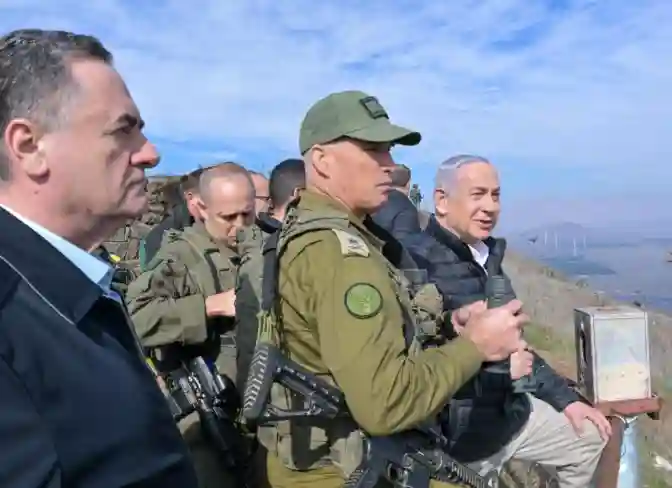
The Israel-Syria conflict is rooted in the broader Arab-Israeli dispute, marked by territorial, political, and military tensions. The Assad regime in Damascus, led by the Alawite family since Hafez al-Assad’s rise to power in 1971 and later his son Bashar al-Assad, has played a crucial role in distorting Syria’s relationship with Israel. Prime Minister Benjamin Netanyahu said on 8th December 2024, he ordered Israeli forces to grab a buffer zone in the Golan Heights established by a 1974 ceasefire agreement with Syria after Syrian opposition forces ended Bashar al-Assad’s rule. Netanyahu said on Sunday that the decades-old agreement had collapsed and that Syrian soldiers had abandoned their positions, necessitating the Israeli takeover. He hailed the removal of al-Assad as a “historic day” that followed the blows delivered by Israel against al-Assad’s supporters Iran and Hezbollah in its recent war on Lebanon.
PM Netanyahu’s Statement from the Golan Heights
“This is a historic day for the Middle East. The collapse of the Assad regime, the tyranny in Damascus, offers great opportunity but also is fraught with significant dangers. This collapse is the direct result of our forceful action against Hezbollah and Iran, Assad’s main supporters. It set off a chain reaction of all those who want to free themselves from this tyranny and its oppression.
But it also means that we have to take action against possible threats. One of them is the collapse of the Separation of Forces Agreement from 1974 between Israel and Syria. This agreement held for 50 years. Last night, it collapsed. The Syrian army abandoned its positions. We gave the Israeli army the order to take over these positions to ensure that no hostile force embeds itself right next to the border of Israel. This is a temporary defensive position until a suitable arrangement is found.
Equally, we send a hand of peace to all those beyond our border in Syria: to the Druze, to the Kurds, to the Christians, and to the Muslims who want to live in peace with Israel. We’re going to follow events very carefully. If we can establish neighborly relations and peaceful relations with the new forces emerging in Syria, that’s our desire. But if we do not, we will do whatever it takes to defend the State of Israel and the border of Israel”. (PM Netanyahu’ 08.12.2024)
Below we shall inquire about the root of the Israel-Syria Conflict and the role of the Assad family in continuing it with the help of Hezbollah and other terror groups.
Development of Conflict and Examples
The Golan Heights (1967 and beyond)
- Background: During the Six-Day War in 1967, Israel captured the Golan Heights, a strategically vital plateau previously under Syrian control. This region became a focal point of Israeli-Syrian tensions due to its military significance and fertile land.
- Assad’s Role: As Syria’s Defense Minister in 1967, Hafez al-Assad played a key role in the military decisions that led to the loss of the Golan Heights. Under his presidency, Syria refused to negotiate peace with Israel unless the Golan Heights were fully returned.
- Aftermath: In 1981, Israel unilaterally annexed the Golan Heights, a move never recognized internationally. The Assad regime continued to push for its return, integrating the Golan issue into its national identity.
The Yom Kippur War (1973)
- Conflict: Hafez al-Assad, as Syrian president, launched a surprise attack alongside Egypt on Israel during the Yom Kippur War. The goal was to reclaim the Golan Heights and reverse losses from 1967.
- Outcome: Although Syria achieved initial military gains, a strong Israeli counteroffensive forced Syrian troops to retreat. The war reaffirmed the stalemate over the Golan Heights but showcased Assad’s commitment to challenging Israel militarily.
Lebanon and Proxy Wars (1980s-2000s)
- Syria’s Role: The Assad regime supported various anti-Israel groups, including Hezbollah in Lebanon and Palestinian factions like Hamas and Islamic Jihad. These groups engaged in cross-border attacks on Israel, often drawing retaliation.
- Lebanon War (1982): During Israel’s invasion of Lebanon to expel the Palestine Liberation Organization (PLO), Syrian forces clashed with the Israeli Defense Forces (IDF). The war highlighted the regional dimensions of the Israeli-Syrian conflict, with Syria backing Lebanese and Palestinian resistance groups.
- Hezbollah Connection: Under Hafez and later Bashar al-Assad, Syria became a key conduit for Iranian support to Hezbollah, enabling its emergence as a powerful anti-Israel force.
The Assad Regime and Peace Negotiations
- Attempts at Peace: The Assad regime participated in U.S.-brokered peace talks in the 1990s, with Hafez al-Assad meeting U.S. President Bill Clinton in 2000. These talks failed over disagreements regarding the Golan Heights.
- Bashar’s Stance: After assuming power in 2000, Bashar al-Assad maintained his father’s hardline stance, insisting on the complete return of the Golan Heights before any normalization with Israel.
Syria’s Civil War and Israeli Involvement (2011–Present)
- Civil War: The Syrian Civil War created new dynamics in the Israeli-Syrian conflict. The Assad regime faced internal rebellion, supported by regional powers opposed to Assad and his Iranian allies.
- Israeli Strikes: Israel carried out numerous airstrikes targeting Iranian and Hezbollah forces operating in Syria. While Israel avoided direct involvement in the civil war, it acted to prevent arms transfers to Hezbollah and curtail Iranian entrenchment near its borders.
- Example: In January 2015, an Israeli airstrike near Quneitra killed senior Hezbollah and Iranian commanders. These strikes were justified by Israel as preemptive actions against threats emanating from the Syrian conflict.
Normalization Efforts and Current Tensions
- Normalization Setbacks: Despite broader Arab-Israeli normalization under the Abraham Accords, Syria remains excluded due to its alignment with Iran and the Assad regime’s contentious history with Israel.
- Ongoing Issues: Today, the Israeli-Syrian conflict persists as a low-intensity confrontation, with sporadic Israeli airstrikes in Syria targeting Iran-linked infrastructure and Syria’s responses often involving anti-aircraft fire or limited retaliation.
The Assad regime, across both Hafez and Bashar’s leadership, has remained a steadfast opponent of Israel, leveraging alliances with Iran and Hezbollah to counterbalance Israeli dominance. While the overt warfare of earlier decades has diminished, the conflict remains a volatile element in Middle Eastern geopolitics, underscored by unresolved territorial disputes and proxy engagements.
Bibliography on Israel-Syria Conflicts and the Assad Regime
1. “The Arab-Israeli Wars: War and Peace in the Middle East”
- Author: Chaim Herzog
- Publication Date: 1984 (Updated editions in 2005)
- Summary: This comprehensive history of the Arab-Israeli wars covers the conflicts from 1948 through the Yom Kippur War of 1973. It offers detailed insights into the military strategies and political decisions that defined the wars, including Syria’s role under Hafez al-Assad and its attempts to recover the Golan Heights. The book examines the broader implications of the wars on regional geopolitics.
2. “Asad: The Struggle for the Middle East”
- Author: Patrick Seale
- Publication Date: 1988
- Summary: This biography of Hafez al-Assad provides a deep dive into his leadership, detailing his rise to power and his strategic approach to the Israel-Syria conflict. The book highlights Assad’s handling of the Golan Heights issue, Syria’s alliances with Iran and Hezbollah, and his pursuit of regional dominance despite repeated setbacks in wars with Israel.
3. “The Golan Heights: Political History, Settlement, and Geography since 1949”
- Author: Yigal Kipnis
- Publication Date: 2012
- Summary: Kipnis provides a detailed analysis of the political and geographical significance of the Golan Heights, focusing on its role in Israeli-Syrian relations. The book traces the strategic and ideological importance of the region, with a focus on how its annexation shaped Syrian policies under the Assad regime.
4. “Syria: A History of the Last Hundred Years”
- Author: John McHugo
- Publication Date: 2015
- Summary: McHugo’s book contextualizes modern Syria within its broader historical framework, including its conflicts with Israel. The text explores how the Assad family entrenched its rule and positioned Syria as a central player in the Arab-Israeli conflict, particularly through its alliances with anti-Israel groups.
5. “The Israel-Hezbollah War of 2006: Strategic and Tactical Lessons”
- Authors: Anthony Cordesman and William Sullivan
- Publication Date: 2007
- Summary: While focused on the 2006 Lebanon War, this book provides insights into Syria’s role in supporting Hezbollah as part of its proxy war strategy against Israel. It discusses how the Assad regime’s backing of Hezbollah influenced Israel’s security policies and regional alliances.
6. “Syria’s Peasantry, the Descendants of Its Lesser Rural Notables, and Their Politics”
- Author: Hanna Batatu
- Publication Date: 1999
- Summary: This sociopolitical analysis of Syria delves into the dynamics of Syrian society under Hafez al-Assad and his policies towards Israel. It examines the internal factors influencing Assad’s hardline stance on the Golan Heights and his approach to regional conflicts.
7. “War and Peace in the Middle East: A Concise History”
- Author: Avi Shlaim
- Publication Date: 1995
- Summary: Shlaim offers a concise overview of the Arab-Israeli conflict, with chapters dedicated to Syria’s wars with Israel and the Assad regime’s attempts to leverage peace negotiations while maintaining its territorial claims and regional influence.
8. “The Syrian Civil War and Its Implications for Israeli-Syrian Relations”
- Author: Elizabeth Tsurkov (Journal Articles and Reports)
- Publication Date: 2018
- Summary: This analysis explores how the Syrian Civil War reshaped Israeli-Syrian dynamics, focusing on Israel’s military interventions against Iranian entrenchment in Syria. The report highlights Bashar al-Assad’s reliance on Iran and Hezbollah and how this perpetuates the conflict with Israel.
9. “Israel’s Wars: A History Since 1947”
- Author: Ahron Bregman
- Publication Date: 2010
- Summary: This book chronicles Israel’s wars, including its confrontations with Syria, and discusses the Assad regime’s military and political strategies during these conflicts. It evaluates the enduring impact of unresolved issues like the Golan Heights on Israeli-Syrian relations.
10. “The Longest War: Israel and Hezbollah in Lebanon”
- Author: David Hirst
- Publication Date: 2010
- Summary: Hirst examines the prolonged conflict in Lebanon, emphasizing Syria’s role in supporting Hezbollah. It discusses how the Assad regime used Hezbollah as a proxy against Israel and the broader implications for Israeli-Syrian relations.