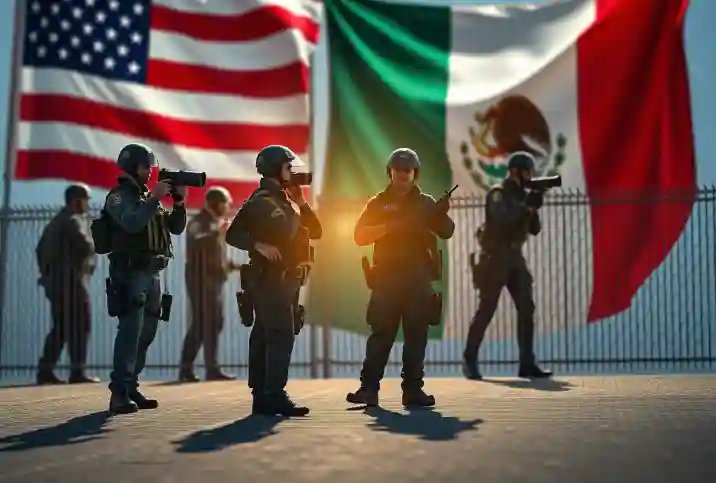
U.S.-Mexico Security Cooperation: A Comprehensive Overview
Reference Date: 9 Dec 2024
The security cooperation (as the Pentagon loves to use the terminology) between the United States and Mexico is a pivotal component of their bilateral relationship. The two nations share a 1,954-mile border and face interconnected challenges, including drug trafficking, human smuggling, organized crime, and border security. Over the decades, they have worked to develop policies, frameworks, and initiatives to address these complex issues. Below, we explore key examples, policy decisions, and programs that define U.S.-Mexico security cooperation.
Historical Foundations of U.S.-Mexico Security Cooperation
- Merida Initiative (2007)
One of the cornerstone agreements in U.S.-Mexico security cooperation, the Merida Initiative was launched in 2007 under Presidents George W. Bush and Felipe Calderón. This multi-billion-dollar program was designed to combat transnational crime, strengthen judicial systems, and enhance law enforcement capabilities. Key elements include:- Equipment and Training: Provision of aircraft, surveillance technology, and training for Mexican law enforcement.
- Judicial Reform: Supporting Mexico’s transition to an adversarial legal system.
- Community Engagement: Programs to address root causes of violence and crime.
- North American Free Trade Agreement (NAFTA) and Security Linkages
Though primarily an economic agreement, NAFTA (1994) increased cross-border cooperation, indirectly influencing security coordination. Trade volume surged, necessitating improved customs and border security systems to manage legal trade while addressing smuggling concerns.
Key Challenges Addressed in Bilateral Cooperation
- Drug Trafficking and Organized Crime
Mexico serves as a major transit country for illegal drugs destined for the U.S., including cocaine, heroin, methamphetamines, and fentanyl. Cartels such as Sinaloa, Jalisco New Generation, and others operate transnationally, posing significant threats. Joint efforts include:- Targeting cartel leaders through intelligence sharing.
- Combating precursor chemical smuggling for synthetic drug production.
- Enhancing border interdiction capabilities.
- Human Trafficking and Migrant Smuggling
The U.S. and Mexico have cooperated to combat human trafficking and migrant smuggling networks, especially as migration flows from Central America increased. The Southern Border Plan in Mexico, supported by U.S. funding, strengthened Mexico’s border controls with Guatemala and Belize. - Weapons Trafficking
A significant issue for Mexico is the illicit flow of firearms from the U.S., often linked to violence by drug cartels. Initiatives like Operation Frozen Timber focus on intercepting weapons trafficking across borders.
Recent Policy Developments
- Bicentennial Framework for Security (2021)
In October 2021, the U.S. and Mexico announced the Bicentennial Framework, replacing the Merida Initiative. This updated framework emphasizes:- Public health approaches to addressing drug addiction and overdose.
- Joint efforts to disrupt criminal networks.
- Human rights and community development.
- Combatting Synthetic Drugs
Under President Joe Biden, the U.S. prioritized combatting synthetic opioids like fentanyl. Enhanced cooperation with Mexico includes monitoring precursor chemicals and targeting trafficking networks. - Border Security Enhancements
Investments in technology, such as automated license plate readers and advanced x-ray systems, have streamlined inspections at ports of entry, balancing trade facilitation with security enforcement.
Impactful Initiatives
- Plan Frontera Sur
Initiated in 2014 by Mexico, this plan aimed to regulate migration and enhance border security. It received U.S. financial and technical support, showcasing collaboration in addressing migration surges. - Transnational Anti-Gang Unit (TAG)
A U.S.-funded program that collaborates with Mexican law enforcement to target gang activity, including MS-13 and Barrio 18, which have connections to broader transnational crime.
Critiques and Challenges
- Human Rights Concerns
Critics argue that militarized security approaches, such as deploying the Mexican military for law enforcement, have sometimes led to human rights abuses. This has strained public trust in bilateral efforts. - Cartel Resilience
Despite high-profile arrests and financial disruptions, cartels continue to adapt, using advanced technology and corruption to evade enforcement. - Political Shifts
Changes in leadership in both nations often bring shifts in priorities. For instance, Mexican President Andrés Manuel López Obrador’s “hugs, not bullets” policy emphasizes social programs over militarized enforcement.
Future Prospects
Looking ahead, U.S.-Mexico security cooperation will likely prioritize:
- Combating Synthetic Opioids: Expanding cooperation on fentanyl and precursor chemicals.
- Addressing Root Causes of Crime: Greater focus on socioeconomic development programs.
- Technology Integration: Advancing the use of artificial intelligence and surveillance tools for security operations.
Recent Development
Statement from President Joe Biden on U.S.-Mexico Security Cooperation (December 06, 2024)
As Commander in Chief, I have one solemn responsibility: protect the American people from harm. That’s why, over the last four years, I made beating the opioid epidemic a central focus of my Unity Agenda at home—and my cooperation with world leaders abroad.
Earlier this week, we saw the impact: Mexican security forces seized more than twenty million doses of illicit fentanyl—enough to kill 15 percent of all Americans. I want to thank President Claudia Sheinbaum for her leadership and partnership that made this possible, and the many military and law enforcement officials on both sides of the border who have dedicated their lives to countering fentanyl, disrupting traffickers, and saving their fellow citizens. It matters.
And we won’t let up. Under my Administration, we have seized more fentanyl at our border in the last two years, than the previous five years combined. We’ve put dozens of major cartel leaders and money launderers behind bars. And latest data shows over a 14 percent drop in overdose deaths across the nation—that’s the largest decrease on record.
These aren’t just facts and figures. They are families. Families who don’t have to bear the loss of a child, or parent, or spouse. So today, with partners around the world—including Mexico—we vow to double down on our work to size more drugs. To stop more traffickers. To save more lives. And to we make it clear: enough is enough.
Bibliography (U.S.-Mexico Security Cooperation)
U.S.-Mexico Security Cooperation is a complex issue to be understood singularly, therefore we are providing a list of key resources, books, articles, and reports that provide insights into the history, policies, and outcomes of U.S.-Mexico security cooperation and for further reading:
Books
- Title: El Narco: Inside Mexico’s Criminal Insurgency
Author: Ioan Grillo
Year: 2011
Summary: Grillo provides a comprehensive account of Mexico’s drug cartels, their history, and their impact on Mexican society. The book explores the challenges faced by U.S. and Mexican authorities in dismantling these networks and the broader implications for bilateral security cooperation. - Title: The Politics of Drug Violence: Criminals, Cops, and Politicians in Colombia and Mexico
Author: Angélica Durán-Martínez
Year: 2018
Summary: This comparative study examines the political dynamics of drug-related violence in Mexico and Colombia. Durán-Martínez highlights the complexities of state responses and the role of U.S. foreign aid in shaping Mexico’s security strategies. - Title: Border Games: Policing the U.S.-Mexico Divide
Author: Peter Andreas
Year: 2009
Summary: Andreas delves into the evolution of border security policies, emphasizing the impact of U.S. initiatives on the U.S.-Mexico border. The book critiques the militarization of border security and its effectiveness in addressing crime and immigration. - Title: The Dead March: A History of the Mexican-American War
Author: Peter Guardino
Year: 2017
Summary: While focused on historical conflicts, this book provides context for modern U.S.-Mexico relations, including the roots of cross-border challenges such as crime, migration, and security cooperation.
Academic Articles
- Title: “The Merida Initiative and the Limits of U.S.-Mexico Security Cooperation”
Author: Shannon O’Neil
Year: 2013
Journal: Foreign Affairs
Summary: This article critically assesses the Merida Initiative, emphasizing its successes and limitations. O’Neil discusses how the initiative shifted from direct combat to institution-building efforts. - Title: “Fentanyl Flow and U.S.-Mexico Counterdrug Collaboration”
Authors: Vanda Felbab-Brown
Year: 2020
Journal: Brookings Institution Report
Summary: Felbab-Brown explores the rise of fentanyl trafficking, its impact on U.S.-Mexico relations, and policy recommendations to enhance bilateral counterdrug efforts. - Title: “The Evolution of U.S.-Mexico Security Cooperation: From the Merida Initiative to the Bicentennial Framework”
Author: Cecilia Farfán-Méndez
Year: 2022
Journal: Mexican Studies/Estudios Mexicanos
Summary: The article traces the evolution of U.S.-Mexico security policies, highlighting the transition from militarized approaches to holistic frameworks under the Bicentennial Framework.
Reports and Government Documents
- Title: The Merida Initiative: The United States and Mexico Take on the Drug Cartels
Publisher: Congressional Research Service (CRS)
Year: 2019
Summary: This report provides an overview of the Merida Initiative, detailing U.S. funding allocations, program outcomes, and challenges in combating organized crime. - Title: Beyond Merida: The Evolving Approach to Security Cooperation
Publisher: Woodrow Wilson Center’s Mexico Institute
Year: 2021
Summary: This policy brief examines the transition from the Merida Initiative to the Bicentennial Framework, emphasizing new priorities such as public health and socioeconomic development. - Title: National Drug Threat Assessment 2022
Publisher: U.S. Drug Enforcement Administration (DEA)
Year: 2022
Summary: The report outlines drug trafficking trends, with a focus on the role of Mexican cartels in the production and trafficking of synthetic drugs like fentanyl. - Title: U.S.-Mexico Security Cooperation: Challenges and Opportunities
Publisher: RAND Corporation
Year: 2020
Summary: This study analyzes the effectiveness of joint security programs and offers policy recommendations to enhance cross-border collaboration.
Policy Briefs and Analysis
- Title: “The Bicentennial Framework: A New Era in U.S.-Mexico Security Cooperation?”
Publisher: Center for Strategic and International Studies (CSIS)
Year: 2022
Summary: This analysis highlights the goals and potential of the Bicentennial Framework, focusing on addressing root causes of violence and improving public health responses to drug abuse. - Title: “Weapons of Mass Migration: Forced Displacement and Security on the U.S.-Mexico Border”
Author: Kelly Greenhill
Year: 2018
Publisher: Harvard University Press
Summary: Greenhill examines the intersections of migration and security, providing insights into how forced displacement shapes bilateral security policies. - Title: “Combatting Organized Crime: Lessons from U.S.-Mexico Collaboration”
Publisher: Americas Society/Council of the Americas (AS/COA)
Year: 2019
Summary: This brief discusses the successes and limitations of organized crime initiatives, emphasizing the need for innovation in enforcement and prevention strategies.