Meta-Civilizational Architecture
Domain Name Registration Statistics and Internet Governance History
The history of domain name registrations forms a central chapter in the development of the modern internet, linking the technical evolution of computer networking with commerce, governance, communication, and global digital identity. The system emerged from research environments created during the Cold War period in the United States, when packet-switching experiments funded by the United States Department of Defense led to the construction of ARPANET in 1969. Early networked computers relied on manually maintained host files, distributed through the Stanford Research Institute in Menlo Park, California, where a centralized HOSTS.TXT directory identified machines connected to the network. By the late 1970s and early 1980s, the rapid expansion of networked institutions, universities, government laboratories, and military contractors exposed the limitations of this centralized method. Network administrators faced increasing delays, duplication conflicts, and scaling problems as the number of connected systems expanded across North America and Europe.
In 1983, computer scientists Paul Mockapetris and Jon Postel introduced the Domain Name System, commonly known as DNS, while working through the Internet Engineering Task Force and the Information Sciences Institute at the University of Southern California in Los Angeles. The DNS architecture replaced the single HOSTS.TXT file with a distributed and hierarchical naming system capable of translating human-readable names into numerical Internet Protocol addresses. The design was formally documented in RFC 882 and RFC 883 during November 1983, establishing a structure that remains foundational to internet operations decades later. The DNS hierarchy separated administrative authority into top-level domains, second-level domains, and subordinate naming layers, enabling decentralized registration and management.
The first top-level domains were introduced during January 1985. These included the generic top-level domains, or gTLDs, .com, .org, .net, .edu, .gov, .mil, and .int. The first registered domain name, Symbolics.com, was created on March 15, 1985, for Symbolics Inc., a computer manufacturer headquartered in Cambridge, Massachusetts. Shortly afterward, additional registrations appeared, including BBN.com for Bolt Beranek and Newman in Cambridge, Think.com for Thinking Machines Corporation in Cambridge, MCC.com for the Microelectronics and Computer Technology Corporation in Austin, and DEC.com for Digital Equipment Corporation in Maynard, Massachusetts. During the mid-1980s, domain name registrations remained highly restricted and largely academic or governmental in character. The internet itself was still inaccessible to most households, while commercial traffic on federally funded backbone networks remained limited.
By 1987, fewer than 30,000 domain names existed worldwide. Registration procedures during this period were administered through the Defense Data Network Network Information Center, operated by SRI International in Menlo Park. Registrants frequently communicated through email correspondence, and approval processes could require several days or weeks. Domain names initially carried minimal commercial value because businesses had not yet recognized the importance of digital branding or online identity. Nevertheless, technological developments in California’s Silicon Valley, Massachusetts’ Route 128 corridor, and research institutions across Europe and Japan gradually increased dependence on interconnected computing systems.
A major transformation occurred during the early 1990s with the commercialization of the internet. In 1991, the United States Congress passed the High Performance Computing and Communication Act (See American Law), promoted by Senator Al Gore, expanding federal networking infrastructure. In 1993, the release of the Mosaic web browser by the National Center for Supercomputing Applications at the University of Illinois in Urbana-Champaign accelerated public internet adoption. The following year saw the emergence of Netscape Communications in Mountain View, California, whose Navigator browser popularized graphical web access. Businesses rapidly sought domain name registrations as electronic commerce, digital publishing, and online advertising gained momentum.
Network Solutions Inc., headquartered in Herndon, Virginia, became the dominant registration authority after receiving a cooperative agreement from the National Science Foundation in 1993 to administer .com, .net, and .org registrations. Initially, domain names were available without charge. However, on September 14, 1995, Network Solutions introduced annual registration fees, charging 50 United States dollars per year for domain maintenance. This commercialization triggered intense debates regarding internet governance, monopolistic control, and intellectual property rights. During the mid-1990s, domain names increasingly acquired speculative value, particularly short, memorable, and commercially attractive names.
The rise of domain speculation emerged prominently between 1995 and 2000. Entrepreneurs, investors, and opportunistic registrants began purchasing generic words, geographic identifiers, product categories, and common phrases in anticipation of future resale value. Terms such as Hotels.com, Business.com, and Loans.com became symbols of the rapidly expanding digital economy. In 1999, Business.com reportedly sold for 7.5 million United States dollars, representing one of the earliest high-profile domain transactions. The phenomenon of cybersquatting also intensified during this period, with individuals registering brand-related names corresponding to trademarks owned by corporations, celebrities, and public institutions.
Legal disputes surrounding domain ownership expanded rapidly across the United States, Europe, and Asia. In response, the Internet Corporation for Assigned Names and Numbers, commonly known as ICANN, was established on September 18, 1998, in Marina del Rey, California. ICANN assumed responsibility for coordinating domain name systems, accrediting registrars, and overseeing root zone management. The organization introduced the Uniform Domain-Name Dispute-Resolution Policy in 1999, providing arbitration mechanisms through bodies such as the World Intellectual Property Organization in Geneva, Switzerland. Trademark conflicts involving brands like Panasonic, Nike, Microsoft, and Coca-Cola highlighted the growing economic significance of digital naming rights.
The late 1990s also witnessed explosive growth in the .com top-level domain. During the dot-com boom between 1997 and 2000, startups across Silicon Valley, New York, London, Berlin, Stockholm, Bangalore, and Tel Aviv sought internet visibility through domain registrations. Venture capital firms regarded ownership of concise .com domains as strategically important for attracting investment and consumer recognition. By the end of 1999, the number of registered domain names exceeded 20 million globally, with .com accounting for a substantial majority.
Country-code top-level domains, or ccTLDs, also expanded significantly during the 1990s. Introduced under ISO 3166 country codes, ccTLDs such as .uk for the United Kingdom, .de for Germany, .fr for France, .jp for Japan, and .au for Australia developed independent regulatory structures. Nominet UK was established in Oxford during 1996 to administer .uk registrations, while DENIC in Frankfurt managed Germany’s .de domain space. Many ccTLD registries initially restricted registrations to domestic organizations or residents, although policies gradually liberalized as electronic commerce became international.
Germany’s .de domain emerged as one of the world’s largest ccTLDs by the early 2000s due to widespread internet adoption, strong industrial digitization, and relatively liberal registration rules. Similarly, the United Kingdom’s .uk namespace gained substantial prominence through commercial use and media adoption. France’s .fr registry, administered by AFNIC in Paris, maintained stricter eligibility standards until later liberalization measures during the 2000s. Russia’s .ru namespace expanded rapidly after the dissolution of the Soviet Union, reflecting increasing digital infrastructure investment across Moscow, Saint Petersburg, and regional centers.
The collapse of many internet startups during the dot-com crash of 2000–2001 temporarily slowed domain registration growth. Nevertheless, domain ownership continued expanding because businesses increasingly regarded websites as essential commercial infrastructure rather than speculative experiments. Search engines such as Yahoo!, founded in Sunnyvale, California, and Google, established in Menlo Park during 1998, intensified demand for memorable web addresses capable of improving search visibility and brand recall.
By 2003, the global domain registration industry had become highly competitive. ICANN accredited numerous registrars, including GoDaddy in Scottsdale, Arizona, Tucows in Toronto, eNom in Bellevue, Washington, and Melbourne IT in Australia. Price competition reduced registration costs dramatically compared with the mid-1990s. Consumers gained the ability to register domain names instantly through automated web-based interfaces rather than manual email requests. This technological simplification democratized participation in online publishing, blogging, independent commerce, and nonprofit communication.
New generic top-level domains were gradually introduced to diversify internet naming structures. In 2001, ICANN approved .biz, .info, .name, and .pro. The .info extension, operated by Afilias, became one of the fastest-growing domains in history because of widespread promotional campaigns and free registration offers. The .biz extension targeted commercial enterprises, while .name focused on individuals seeking personal online identities. Adoption varied considerably, however, because .com retained overwhelming dominance in public recognition and market trust.
The rise of social networking and user-generated content during the mid-2000s altered domain registration patterns. Companies such as Facebook in Menlo Park, YouTube in San Bruno, and Twitter in San Francisco relied on short and recognizable domain names to support rapidly expanding global audiences. Simultaneously, independent bloggers, journalists, musicians, and small enterprises increasingly acquired personalized domains to establish autonomous online identities beyond centralized platforms.
China became a major force in the domain registration landscape during the late 2000s and early 2010s. The .cn ccTLD, administered by the China Internet Network Information Center in Beijing, experienced dramatic growth due to expanding internet penetration, e-commerce activity, and state-supported digital infrastructure development. By the early 2010s, .cn frequently ranked among the world’s largest TLDs by registration volume. Chinese registrants also became significant participants in speculative domain markets, especially involving numeric domains and short-letter combinations considered culturally or commercially valuable.
Internationalized domain names, commonly abbreviated as IDNs, represented another important milestone. Traditional DNS architecture originally relied on Latin alphabet characters, limiting accessibility for billions of users employing scripts such as Arabic, Cyrillic, Chinese, Hindi, Japanese, Korean, and Thai. ICANN and technical standards organizations introduced IDN protocols during the 2000s, enabling domain registrations in non-Latin scripts through encoding systems such as Punycode. In 2010, ICANN approved the first internationalized country-code domains, allowing representations of countries and territories in native scripts.
The introduction of new gTLDs after 2012 constituted one of the most significant structural transformations in domain registration history. ICANN launched an expansive application program permitting organizations to operate custom top-level domains. Technology firms, cities, brands, and registry operators submitted applications costing approximately 185,000 United States dollars each. Extensions such as .xyz, .online, .shop, .site, .store, .tech, .app, .blog, and .guru emerged alongside brand-specific domains including .google, .apple, and .bmw.
The expansion of the root zone generated both optimism and skepticism. Supporters argued that new gTLDs increased competition, innovation, linguistic diversity, and branding flexibility. Critics warned of consumer confusion, defensive registration costs, cybersecurity concerns, and dilution of trust associated with established extensions. Despite these debates, several new gTLDs achieved substantial adoption. The .xyz extension, launched in 2014, gained international attention when Alphabet Inc., Google’s parent company, adopted ABC.xyz as its corporate website in August 2015.
Cybersecurity concerns became increasingly intertwined with domain registration policy during the 2010s and 2020s. Phishing campaigns, malware distribution, counterfeit retail operations, and fraudulent financial schemes frequently relied on newly registered domains. Governments, registries, registrars, and cybersecurity firms collaborated to improve verification systems, WHOIS data accuracy, DNSSEC deployment, and abuse mitigation mechanisms. The European Union’s General Data Protection Regulation, implemented on May 25, 2018, significantly altered public access to WHOIS registrant information, generating ongoing tensions between privacy protections and investigative transparency.
The COVID-19 pandemic beginning in early 2020 accelerated digital transformation worldwide and substantially increased domain registration activity. Lockdowns imposed across Europe, Asia, Africa, North America, South America, and Oceania forced businesses, educational institutions, medical providers, and cultural organizations to expand online operations rapidly. E-commerce platforms, remote work systems, streaming services, and telemedicine providers registered large numbers of new domains. Small enterprises that had previously relied on physical storefronts increasingly adopted digital branding strategies involving dedicated websites and localized domains.
By the early 2020s, domain names had evolved into strategic digital assets comparable to trademarks, real estate, and communication infrastructure. Major corporations maintained extensive defensive registration portfolios across numerous TLDs to protect intellectual property and consumer trust. Domain brokerage markets expanded globally, with premium domains frequently selling for six- or seven-figure sums. Cryptocurrency-related naming systems and blockchain-based alternatives also emerged, although conventional DNS infrastructure remained dominant because of universal browser compatibility and institutional support.
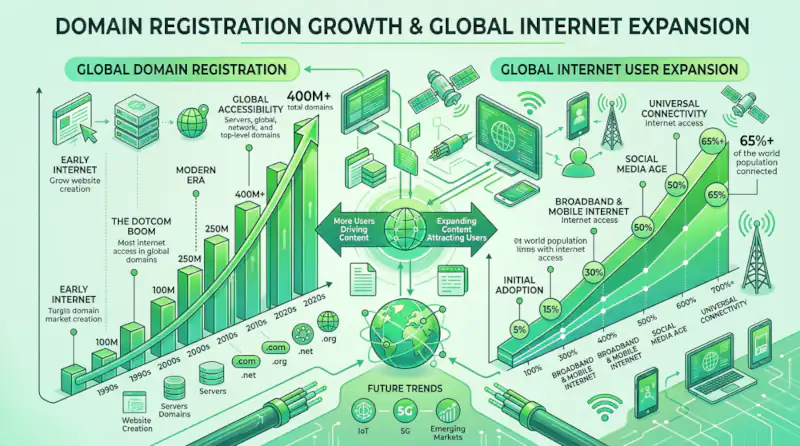
The first quarter of 2026 closed with 392.5 million domain name registrations across all top-level domains, an increase of 5.6 million domain name registrations, or 1.4% compared to the fourth quarter of 2025. Domain name registrations increased by 24.1 million, or 6.5%, year over year. These figures reflected the continued integration of digital identity into commerce, government administration, media distribution, cloud computing, education, and artificial intelligence services across nearly every region of the world.
The .com and .net TLDs had a combined total of 176.1 million domain name registrations in the domain name base at the end of the first quarter of 2026, an increase of 2.5 million domain name registrations, or 1.5% compared to the fourth quarter of 2025. The .com and .net TLDs had a combined increase of 6.2 million domain name registrations, or 3.7%, year over year. As of March 31, 2026, the .com domain name base totaled 163.6 million domain name registrations and the .net domain name base totaled 12.4 million domain name registrations. These statistics demonstrated the enduring dominance of .com, more than four decades after its introduction during January 1985.
New .com and .net domain name registrations totaled 11.5 million at the end of the first quarter of 2026, compared to 10.1 million domain name registrations at the end of the first quarter of 2025. The preliminary combined renewal percentage for the .com and .net TLDs was 76.3% for the first quarter of 2026. Renewal rates remained a crucial indicator of registry stability and commercial confidence because they reflected the willingness of registrants to maintain long-term digital identities rather than engage solely in speculative or temporary acquisition strategies.
Total country-code TLD domain name registrations were 146.3 million at the end of the first quarter of 2026, an increase of 0.7 million domain name registrations, or 0.5% compared to the fourth quarter of 2025. ccTLDs increased by 3.4 million domain name registrations, or 2.4%, year over year. Available data remained insufficient to estimate a combined quarterly renewal percentage across ccTLDs because registry reporting structures and measurement methodologies varied considerably among jurisdictions.
The historical importance of ccTLDs reflected broader geopolitical and linguistic developments. National internet identities frequently became associated with digital sovereignty policies, local commerce regulation, and cultural branding. The .cn domain represented China’s expanding technological infrastructure and state-supported internet economy. Germany’s .de namespace symbolized one of Europe’s earliest and most stable digital ecosystems. The .uk namespace maintained strong adoption among British enterprises, government agencies, and media organizations, while India’s .in extension expanded rapidly alongside growth in Bengaluru, Hyderabad, Pune, Mumbai, Delhi, and Chennai as global technology centers.
Total new generic TLD domain name registrations were 49.6 million at the end of the first quarter of 2026, an increase of 1.8 million domain name registrations, or 3.7%, compared to the fourth quarter of 2025. New gTLDs increased by 11.8 million domain name registrations, or 31.3%, year over year. The most recent combined renewal percentage estimate for new gTLDs was 30.9%. These comparatively lower renewal rates illustrated the continued volatility and speculative characteristics of many newer extensions, particularly those promoted through discounted introductory pricing campaigns.
Total other legacy generic TLD domain name registrations, excluding .com and .net, were 20.5 million at the end of the first quarter of 2026, an increase of 0.6 million domain name registrations, or 2.9%, compared to the fourth quarter of 2025. Other legacy gTLDs increased by 2.6 million domain name registrations, or 14.6%, year over year. The most recent combined renewal percentage estimate for legacy gTLDs was 67.6%. Established extensions such as .org and .info continued attracting nonprofit organizations, advocacy networks, educational initiatives, open-source communities, and independent publishers.
As of March 31, 2026, the 10 largest TLDs by number of reported domain names were .com, .cn, .de, .net, .org, .uk, .xyz, .ru, .top, and .nl. This ranking demonstrated the continuing coexistence of long-established legacy domains, national digital ecosystems, and rapidly expanding new gTLDs. The rise of .xyz and .top highlighted the growing influence of Asian registrants and domain investment markets, particularly in mainland China and Hong Kong.
For the top 10 TLDs with available data, recent quarterly renewal percentage estimates ranged from 80.0% for .net to 19.6% for .top. Such disparities revealed significant differences in user behavior, registration incentives, commercial trust, and long-term adoption patterns. High renewal percentages generally indicated stable business use, institutional reliance, and enduring brand value, whereas lower renewal percentages often reflected speculative bulk registrations, promotional campaigns, or short-term marketing experiments.
The top 10 ccTLDs, as of March 31, 2026, were .cn, .de, .uk, .ru, .nl, .br, .fr, .au, .in, and .eu. The inclusion of .eu reflected the European Union’s efforts to establish a supranational digital identity following its launch in 2005 under EURid administration in Brussels. Brazil’s .br namespace represented one of Latin America’s most developed internet ecosystems, centered in São Paulo and Rio de Janeiro, while Australia’s .au domain maintained strong commercial credibility across Oceania.
As of March 31, 2026, there were 316 global ccTLD extensions delegated in the root zone, including internationalized domain names, with the top 10 ccTLDs comprising 57.6% of all ccTLD domain name registrations. For the top 10 ccTLDs with available data, recent quarterly renewal percentage estimates ranged from 82.1% for .fr to 72.0% for .ru. France’s comparatively high renewal percentage reflected strong institutional continuity and stable registrant behavior, while lower figures in some regions were influenced by market volatility, geopolitical conditions, and changing registry policies.
The top 10 gTLDs, as of March 31, 2026, were .com, .net, .org, .xyz, .top, .info, .shop, .online, .store, and .site. As of March 31, 2026, there were 1,265 extensions delegated in the root zone, including internationalized domain names, with the top 10 gTLDs comprising 88.6% of all gTLD domain name registrations and 55.6% of all TLD registrations. New gTLDs collectively accounted for 12.6% of all TLD registrations as of March 31, 2026. For the top 10 gTLDs, recent quarterly renewal percentage estimates ranged from 80.0% for .net to 14.3% for .shop.
The concentration of registrations within a relatively small number of extensions demonstrated the persistence of network effects in digital naming systems. Registrants frequently preferred extensions with established consumer familiarity, search engine credibility, and global recognition. Consequently, .com retained extraordinary market dominance despite decades of expansion in the root zone. At the same time, specialized gTLDs enabled niche branding opportunities for e-commerce, technology startups, retail operations, and geographically targeted services.
The domain registration industry by 2026 represented a complex global infrastructure involving registry operators, registrars, hosting providers, cybersecurity firms, governments, standards organizations, intellectual property institutions, and financial intermediaries. Registry operators maintained authoritative databases for specific top-level domains, while accredited registrars provided retail access to consumers and organizations. Cloud infrastructure providers integrated domain management into broader service ecosystems including hosting, email delivery, content distribution, analytics, and cybersecurity protection.
The economics of domain registration evolved substantially from the manual systems of the 1980s. Registry agreements generated recurring revenue streams based on annual renewals, premium domain auctions, aftermarket brokerage services, and ancillary digital products. Some registries implemented variable pricing structures for highly desirable keywords, while others emphasized mass registration growth through low-cost promotions. Domain investors, often called domainers, developed sophisticated portfolio strategies involving geographic terms, emerging technologies, cryptocurrency terminology, artificial intelligence concepts, and multilingual brand opportunities.
Artificial intelligence and machine learning technologies increasingly influenced domain valuation and registration patterns during the 2020s. Automated systems analyzed linguistic trends, search engine behavior, advertising data, trademark filings, and startup funding activity to identify commercially promising domain names. Simultaneously, cybersecurity systems employed machine learning algorithms to detect malicious registration activity, phishing infrastructure, and fraudulent domain generation patterns.
The legal environment surrounding domain registrations continued evolving through international treaties, national legislation, arbitration systems, and judicial decisions. Trademark disputes remained among the most prominent issues, especially regarding typosquatting, counterfeit retail operations, and deceptive impersonation schemes. Courts in the United States, European Union member states, China, India, Brazil, and other jurisdictions increasingly treated domain names as significant commercial property capable of generating measurable economic value.
The social significance of domain names also expanded beyond commerce. Political movements, nonprofit organizations, religious institutions, universities, indigenous communities, and cultural preservation initiatives used domain registrations to establish visibility, preserve linguistic heritage, and coordinate international communication. During periods of political unrest or military conflict, domain infrastructure occasionally became associated with censorship disputes, sanctions enforcement, or digital sovereignty controversies.
Environmental considerations emerged as another area of discussion during the 2020s. Although domain registration itself required relatively limited computational resources compared with cryptocurrency mining or large-scale artificial intelligence training, the broader internet infrastructure supporting websites, cloud hosting, and data centers contributed significantly to global electricity consumption. Major technology firms operating DNS infrastructure increasingly invested in renewable energy procurement, efficient cooling systems, and carbon reduction initiatives.
The historical development of domain name registrations reflected the broader transition from a research-oriented network connecting a handful of academic institutions into a globally integrated digital environment supporting billions of users. What began with a limited collection of government-funded computers in California, Massachusetts, and Virginia evolved into a worldwide naming architecture linking financial markets in New York and London, manufacturing systems in Shenzhen and Stuttgart, educational platforms in Delhi and São Paulo, and media networks in Seoul and Tokyo.
From the registration of Symbolics.com in Cambridge on March 15, 1985, to the existence of hundreds of millions of domain names across thousands of top-level domains by March 31, 2026, the evolution of domain registration systems illustrated the extraordinary expansion of digital communication infrastructure. The DNS became one of the foundational organizational systems of the internet era, enabling navigation, branding, authentication, and global connectivity. Its history combined technical innovation, commercial speculation, legal transformation, geopolitical negotiation, and cultural adaptation across more than four decades of continuous global development.
The continuing growth of domain registrations into 2026 demonstrated that despite the rise of mobile applications, social media platforms, and artificial intelligence interfaces, independently controlled digital identities retained strategic importance. Governments required stable digital portals for public administration, corporations depended on globally recognized brands, educational institutions maintained online research archives, and individuals continued using personal domains for communication and creative expression. Domain names therefore remained both technical identifiers and symbolic markers of participation within the global digital order.
Throughout the historical trajectory of the internet, domain registrations functioned as records of technological adoption, economic expansion, and geopolitical change. Patterns of growth frequently mirrored industrial development, infrastructure investment, educational modernization, and regulatory transformation. The emergence of large-scale registration activity in China reflected the country’s industrial and technological rise after economic reforms initiated in 1978. The steady growth of India’s .in domain paralleled the expansion of software services and digital entrepreneurship after economic liberalization during the 1990s. The strength of European ccTLDs reflected early broadband deployment, regulatory coordination, and mature digital commerce systems.
The future trends of domain name registrations remained connected to developments in cybersecurity, artificial intelligence, digital governance, quantum-resistant cryptography, multilingual computing, and decentralized technologies. Discussions continued regarding abuse prevention, privacy regulation, DNS encryption standards, and the long-term balance between centralized coordination and distributed internet governance. Nevertheless, the historical continuity of the DNS since the early 1980s suggested remarkable institutional resilience despite repeated technological transformations.
By the conclusion of the first quarter of 2026, domain registrations represented not merely technical database entries but components of a vast global communications framework shaping commerce, culture, governance, and identity. The statistics recorded during March 2026 reflected decades of cumulative expansion beginning with experimental networking research in the United States during the Cold War era and extending into a digitally interconnected global civilization dependent on stable naming systems for daily economic and social activity.
See also
Sarvarthapedia Conceptual Nod: Domain Name Registrations
See also
Domain Name System (DNS)
Top-Level Domains (TLDs)
Generic Top-Level Domains (gTLDs)
Country-Code Top-Level Domains (ccTLDs)
Internet Corporation for Assigned Names and Numbers (ICANN)
Internet Governance
WHOIS Databases
Domain Name Registrars
Domain Name Registries
DNS Security Extensions (DNSSEC)
Cybersquatting
Internet Infrastructure
Web Hosting
Internet Protocol (IP) Address
ARPANET
Internet Commercialization
Digital Identity
E-Commerce
Search Engine Optimization (SEO)
Internationalized Domain Names (IDNs)
Root Zone
Internet Engineering Task Force (IETF)
RFC Standards
Dot-Com Bubble
Domain Speculation
Cloud Computing
Cybersecurity
Trademark Law
Uniform Domain-Name Dispute-Resolution Policy (UDRP)
Domain Name System (DNS)
Core concepts
Hierarchical Naming Structure
Recursive Resolution
Authoritative Name Servers
Root Servers
DNS Queries
Zone Files
Connected subjects
Domain Name Registrations
Internet Infrastructure
Internet Protocol (IP) Address
Root Zone
DNSSEC
ICANN
IETF
Web Browsers
Internet Backbone Networks
Top-Level Domains (TLDs)
Categories
Generic Top-Level Domains (gTLDs)
Country-Code Top-Level Domains (ccTLDs)
Sponsored Top-Level Domains (sTLDs)
Infrastructure TLDs
Internationalized Domain Names (IDNs)
Connected subjects
Domain Name Registrations
ICANN
Root Zone
Internet Governance
Digital Branding
Global Internet Expansion
Generic Top-Level Domains (gTLDs)
Major examples
.com
.net
.org
.info
.biz
.xyz
.shop
.online
Historical links
Dot-Com Bubble
Commercial Internet
E-Commerce Expansion
Startup Culture
Digital Marketing
Related concepts
New gTLD Program
Domain Speculation
Brand Protection
SEO
Corporate Identity
Country-Code Top-Level Domains (ccTLDs)
Major examples
.cn
.de
.uk
.ru
.nl
.fr
.in
.br
Historical links
National Internet Policies
Digital Sovereignty
Telecommunications Expansion
Broadband Development
Related concepts
Localized Search
National Registries
Regional Internet Governance
Multilingual Internet
Internet Corporation for Assigned Names and Numbers (ICANN)
Established
Marina del Rey, California, 1998
Responsibilities
Root Zone Coordination
Registrar Accreditation
DNS Policy Management
TLD Delegation
UDRP Administration
Connected subjects
DNS
Internet Governance
Domain Registrars
Domain Registries
New gTLD Program
WHOIS Policy
Cybersecurity
Internet Governance
Institutional structures
ICANN
IETF
World Wide Web Consortium (W3C)
International Telecommunication Union (ITU)
Related debates
Digital Sovereignty
Internet Decentralization
Data Privacy
Domain Regulation
Online Censorship
Connected subjects
DNS
ccTLDs
Cybersecurity
GDPR
Digital Rights
WHOIS Databases
Functions
Registrant Identification
Ownership Verification
Technical Contact Management
Abuse Investigation
Historical developments
Public WHOIS Era
GDPR Privacy Restrictions
Redacted Registration Data
Connected subjects
Cybersecurity
Trademark Disputes
ICANN Policy
Domain Registrars
DNS Abuse
Domain Name Registrars
Major functions
Domain Registration Services
Renewal Processing
DNS Management
WHOIS Administration
Domain Transfers
Historical companies
Network Solutions
GoDaddy
Tucows
eNom
Namecheap
Connected subjects
ICANN
Registries
Web Hosting
SSL Certificates
Domain Auctions
Domain Name Registries
Core functions
TLD Database Management
Root Zone Updates
Registry Policies
Domain Availability Control
Major registries
Verisign
DENIC
Nominet
AFNIC
CNNIC
Connected subjects
TLDs
ICANN
DNS Infrastructure
ccTLD Administration
DNS Security Extensions (DNSSEC)
Purpose
DNS Authentication
Data Integrity
Spoofing Prevention
Connected subjects
Cybersecurity
DNS
Encryption Standards
Internet Security
Trust Infrastructure
Cybersquatting
Characteristics
Trademark-Based Registrations
Domain Resale Speculation
Typosquatting
Brand Impersonation
Legal frameworks
UDRP
Trademark Law
Anti-Cybersquatting Consumer Protection Act
Connected subjects
Domain Speculation
Intellectual Property
ICANN
WHOIS Databases
ARPANET
Historical importance
First Packet-Switched Network
Cold War Research Infrastructure
Foundation of the Internet
Key locations
Stanford Research Institute
UCLA
University of Utah
Bolt Beranek and Newman
Connected subjects
DNS
Internet History
TCP/IP
Academic Networking
Dot-Com Bubble
Time period
1995–2001
Characteristics
Startup Speculation
Venture Capital Expansion
Rapid .com Growth
Internet IPO Boom
Connected subjects
Domain Registrations
Silicon Valley
E-Commerce
Online Advertising
Search Engines
Internationalized Domain Names (IDNs)
Purpose
Non-Latin Script Domains
Linguistic Accessibility
Global Internet Inclusion
Supported scripts
Arabic
Cyrillic
Chinese
Hindi
Japanese
Korean
Connected subjects
Unicode
DNS
ccTLDs
Global Internet Expansion
Search Engine Optimization (SEO)
Domain-related factors
Keyword Domains
Brand Authority
Geographic Domains
Domain Age
Link Reputation
Connected subjects
Digital Marketing
E-Commerce
Search Engines
Website Traffic
Online Branding
Cybersecurity
Domain-related threats
Phishing
Malware Domains
DNS Hijacking
Fake E-Commerce Sites
Credential Theft
Defensive technologies
DNSSEC
SSL/TLS Certificates
Threat Intelligence
Domain Monitoring
Connected subjects
WHOIS
ICANN
Internet Governance
Cloud Security
Root Zone
Functions
Global DNS Coordination
TLD Delegation
Internet Stability
Connected subjects
ICANN
DNS
Root Servers
TLD Registries
Internet Commercialization
Historical developments
NSFNET Privatization
Rise of Web Browsers
Online Retail Expansion
Digital Advertising Markets
Important companies
Netscape
Yahoo!
Amazon
Connected subjects
Dot-Com Bubble
Domain Registrations
E-Commerce
Search Engines
Digital Identity
Components
Domain Names
Email Infrastructure
Brand Recognition
Authentication Systems
Connected subjects
SEO
Cybersecurity
E-Commerce
Social Media Platforms
Personal Branding
E-Commerce
Infrastructure elements
Domain Names
Payment Gateways
SSL Certificates
Web Hosting
Content Delivery Networks
Historical developments
Online Retail Expansion
Marketplace Platforms
Mobile Commerce
Connected subjects
.com Domains
SEO
Cloud Computing
Digital Advertising
Cloud Computing
Domain-related functions
DNS Hosting
Distributed Infrastructure
Traffic Routing
Content Delivery
Major providers
Amazon Web Services
Microsoft Azure
Google Cloud
Connected subjects
Web Hosting
DNS
Internet Infrastructure
Artificial Intelligence
Artificial Intelligence and Domains
Emerging developments
AI-Based Domain Valuation
Automated Brand Detection
Predictive Registration Analytics
Abuse Detection Systems
Connected subjects
Machine Learning
Cybersecurity
Digital Marketing
Domain Speculation
Trademark Law
Domain-related disputes
Brand Infringement
Cybersquatting
Fraudulent Impersonation
International institutions
World Intellectual Property Organization
ICANN Arbitration Panels
Connected subjects
UDRP
WHOIS
Intellectual Property
E-Commerce
Uniform Domain-Name Dispute-Resolution Policy (UDRP)
Arbitration Procedures
Trademark Protection
Domain Transfer Orders
Connected subjects
ICANN
Cybersquatting
Trademark Law
WHOIS Databases
Internet Infrastructure
Components
DNS
Fiber-Optic Networks
Data Centers
Internet Exchange Points
Satellite Connectivity
Connected subjects
Cloud Computing
ARPANET
Web Hosting
Cybersecurity
Global Internet Expansion
Domain Name Registrations,Digital Identity, Global Internet Expansion
- Domain Name Registrations → Website Ownership → Digital Presence → Online Commerce
- Domain Name Registrations → Brand Recognition → Consumer Trust → E-Commerce Growth
- Domain Name Registrations → DNS Infrastructure → Internet Navigation → Global Connectivity
- Domain Name Registrations → SEO Visibility → Search Traffic → Advertising Revenue
- Domain Name Registrations → Trademark Conflicts → Cybersquatting → Legal Arbitration
ARPANET → TCP/IP → DNS → Modern Internet
ARPANET → Packet Switching → Distributed Networking → Internet Architecture
TCP/IP Adoption (1983) → Interconnected Networks → Internet Standardization
DNS Creation (1983) → Human-Readable Naming → Mass Internet Accessibility
DNS Expansion → Commercial Internet → Domain Registration Industry
DNS ↔ Internet Infrastructure ↔ Cybersecurity
DNS → Name Resolution → Web Accessibility
DNS Failure → Connectivity Disruption → Economic Impact
DNSSEC → Authentication Integrity → Anti-Spoofing Protection
DNS Abuse → Phishing Campaigns → Cybercrime Expansion
Cybersecurity → DNS Monitoring → Threat Intelligence → Abuse Mitigation
.com Dominance → Corporate Branding → Consumer Memory
.com Popularity → Market Trust → Higher Renewal Rates
Short Domains → Memorability → Commercial Value
Premium Domains → Brand Authority → Investor Speculation
Startup Culture → .com Preference → Venture Capital Visibility
Country-Code Domains ↔ Digital Sovereignty ↔ National Identity
ccTLDs → National Regulation → Local Internet Governance
.cn Growth → Chinese Digital Expansion → Domestic Technology Ecosystem
.de Stability → Industrial Digitization → European Internet Maturity
.in Expansion → IT Sector Growth → Startup Economy Development
National Domains → Linguistic Identity → Regional Trust
ICANN ↔ Internet Governance ↔ Root Zone Stability
ICANN → TLD Delegation → DNS Coordination
Root Zone Management → Internet Stability → Global Interoperability
Registrar Accreditation → Registration Competition → Lower Domain Costs
Governance Disputes → Sovereignty Debates → Regulatory Fragmentation Risks
WHOIS ↔ Transparency ↔ Privacy Regulation
WHOIS Visibility → Ownership Verification → Fraud Investigation
GDPR → Data Redaction → Reduced Public Transparency
Privacy Protection → Limited Investigative Access → Enforcement Challenges
Anonymous Registrations → Abuse Potential → Cybersecurity Concerns
Cybersquatting → Trademark Disputes → UDRP Arbitration
Famous Brands → Unauthorized Registrations → Legal Complaints
Typosquatting → Consumer Confusion → Fraudulent Traffic
UDRP → Faster Dispute Resolution → Domain Transfers
Trademark Protection → Defensive Registrations → Portfolio Expansion
Domain Speculation → Scarcity Perception → Digital Asset Markets
Short Domains → Scarcity → Rising Market Prices
Keyword Domains → SEO Advantage → Commercial Demand
Domain Investors → Portfolio Accumulation → Aftermarket Trading
Artificial Scarcity → Auction Inflation → Speculative Bubbles
Dot-Com Boom → Startup Expansion → Domain Demand Explosion
Web Browsers → Public Internet Adoption → Commercial Websites
Venture Capital → Startup Creation → Massive .com Registrations
Digital Advertising → Traffic Competition → Premium Domain Valuation
Dot-Com Crash → Market Correction → Long-Term Internet Consolidation
Search Engines ↔ SEO ↔ Domain Economics
Search Engines → Website Discovery → Traffic Allocation
SEO Optimization → Keyword Domains → Higher Visibility
Domain Authority → Search Ranking → Revenue Potential
Search Dependence → Branding Pressure → Competitive Registrations
Internationalized Domains ↔ Linguistic Accessibility ↔ Internet Inclusion
IDNs → Native Language Domains → Wider Accessibility
Multilingual DNS → Cultural Inclusion → Regional Internet Growth
Unicode Adoption → Script Diversity → Global Participation
Local Language Domains → Community Trust → Domestic Commerce
Cloud Computing ↔ DNS Hosting ↔ Platform Centralization
Cloud Infrastructure → Managed DNS → Scalable Internet Services
Centralized Hosting → Operational Efficiency → Dependency Risks
DNS Routing → Global Load Distribution → Faster Connectivity
Cloud Failures → DNS Interruptions → Large-Scale Downtime
Artificial Intelligence → Domain Analytics → Predictive Valuation
AI Systems → Trend Detection → Automated Registrations
Machine Learning → Fraud Detection → Cybersecurity Automation
Predictive Models → Brand Forecasting → Speculative Investments
AI-Generated Brands → Increased Domain Demand → Naming Scarcity
E-Commerce ↔ Trust Infrastructure ↔ Domain Stability
- Domain Ownership → Business Credibility → Consumer Confidence
- SSL Certificates → Secure Transactions → Online Retail Expansion
- Stable Domains → Repeat Customers → Long-Term Revenue
- Fake Domains → Consumer Fraud → Reputation Damage
Social Media Platforms ↔ Independent Domains ↔ Digital Autonomy
Platform Dependence → Algorithmic Visibility Risks
Independent Domains → Ownership Control → Brand Independence
Personal Websites → Long-Term Stability → Archival Permanence
Social Media Decline → Domain Persistence → Digital Continuity
Cybersecurity ↔ Trust ↔ Economic Stability
Malware Domains → Financial Fraud → Institutional Losses
DNS Hijacking → Infrastructure Vulnerability → Service Disruption
Anti-Abuse Policies → Safer Registrations → User Confidence
Trust Erosion → Reduced Online Commerce → Economic Consequences
Domain Renewal Rates ↔ Stability ↔ Commercial Confidence
High Renewal Rates → Established Usage → Strong Market Trust
Low Renewal Rates → Speculation → Market Volatility
Renewal Dependence → Registry Revenue Stability → Infrastructure Investment
Expiring Domains → Secondary Market Growth → Investor Opportunities
New gTLDs ↔ Branding Innovation ↔ Market Fragmentation
New Extensions → Niche Branding → Industry Specialization
Excessive Extensions → Consumer Confusion → Recognition Challenges
Promotional Pricing → Temporary Registrations → Low Renewals
.xyz Growth → Startup Adoption → Alternative Branding Trends
Internet Governance ↔ Decentralization ↔ Political Power
Global DNS Coordination → Unified Internet → Cross-Border Connectivity
National Regulation → Sovereignty Assertion → Fragmentation Risks
Censorship Policies → Restricted Access → Information Control
Decentralized Governance → Open Standards → Interoperability
Domain Registrars ↔ Competition ↔ Mass Accessibility
Registrar Competition → Lower Prices → Wider Participation
Automated Registration → Instant Ownership → Democratized Access
Bulk Registrations → Speculative Behavior → Artificial Inflation
Retail Domain Services → Hosting Bundles → Platform Ecosystems
Historical Internet Expansion,Domain Growth,Digital Civilization
- Academic Networks → Commercial Networks → Consumer Internet
- Broadband Expansion → Website Proliferation → Global Registrations
- Mobile Internet → Localized Domains → Emerging Market Growth
- AI Economy → Digital Infrastructure Demand → Continued DNS Expansion