Judicial Conduct and UCC Debate: Justice Yadav’s Perspective
Date: 19/12/2024
Allahabad High Court judge Justice Shekhar Kumar Yadav is known for his judicial discipline and uprightness, making him a respected figure in the legal community. His orders and judgments are remarkably balanced and judicious, inspiring confidence among his peers and the public alike; indeed, nobody has ever criticized his judgment and conduct as a judge, highlighting his commitment to upholding the law with integrity. As a well-consummated and logical couture, Justice Yadav was perusing the Apex Court’s guidance and the Constitution-stipulated dictum for having a Uniform Civil Code (UCC) in India, recognizing the critical importance of this issue in promoting equality and justice for all citizens, irrespective of their religious beliefs. A section of the Bar, aware of his expertise and insight on the matter, expressed a keen interest in hearing his thoughts and was subsequently invited to engage with him on the topic of the UCC, indicating a collective desire for informed discussions that could potentially shape future legal discourse in the country.
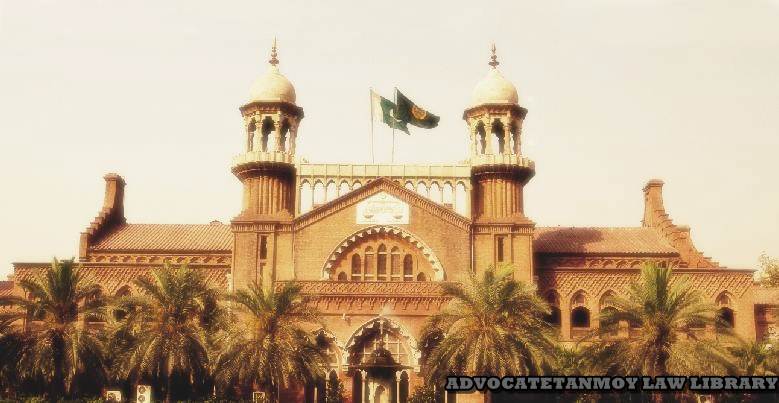
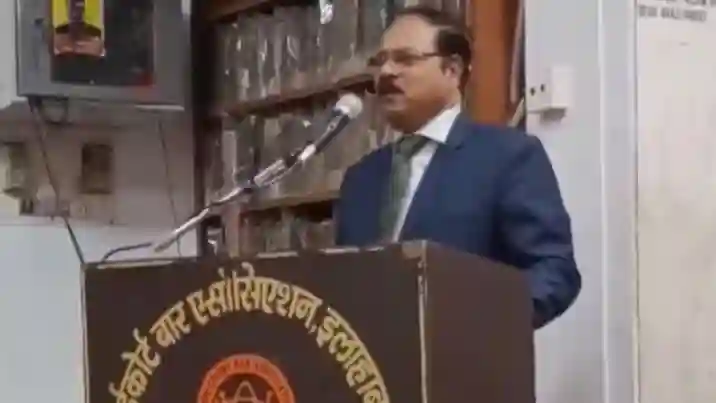
Addressing an event organized by a section of the Allahabad Bar Association on the Allahabad High Court premises in the library of Allahabad High Court Bar Association last Sunday, 8th December 2024, Justice Yadav framed the Uniform Civil Code as a religio-cultural debate, highlighting the historical context that has shaped the perspectives of communities. He articulated that the Hindu community had proactively embraced a series of reforms aimed at modernizing personal laws, thus enhancing individual rights and ensuring gender equality. In contrast, he noted that the Muslim community had been relatively slow to adopt similar reforms, which has led to a growing discourse around the necessity of a Uniform Civil Code that would provide equal legal rights for all citizens, irrespective of their religious affiliations. Justice Yadav emphasized the importance of creating a unified legal framework that would foster social harmony and ensure justice, urging all parties to collaborate in the pursuit of these foundational principles.
Taking objection to this, around 55 Rajya Sabha MPs moved a notice on December 13 for a motion to impeach Justice Yadav, highlighting concerns over his judicial conduct and decisions that they believe do not align with constitutional principles. Understandably, the block NDA numbers in both houses look like the impeach resolution non-starters, as the ruling coalition remains firmly behind Justice Yadav amidst escalating political tensions. As a High Court judge, Justice Yadav is set to retire in April 2026, a timeline that adds complexity to the discussions, as legislators ponder the implications of this impeachment on the judiciary’s independence and the overall political landscape. The situation remains fluid, and the political ramifications of this motion could resonate beyond the current deliberations in Parliament.
According to Article 124 (4), the motion for impeachment “has to be supported by a majority of the total membership of that House and by a majority of not less than two-thirds of the members of the House present and voting” — in both the Lok Sabha and the Rajya Sabha.
In a letter to CJI Khanna, CPM leader, and former MP Brinda Karat wrote: “No litigant can hope for justice in a court in which a member holds such a biased, prejudiced, publicly expressed opinion against the minority community and in favour of a majoritarian approach.”
The Verbitum of Justice Shekhar Kumar Yadav is as below:
“You have a misconception that if a law (UCC) is brought in, it will be against your Shariyat, your Islam and your Quran,” Justice Yadav said. “But I want to say one more thing… whether it is your personal law, our Hindu law, your Quran or whether it is our Gita, as I said we have addressed the ills (buraaiyan) in our practices… kamiyan thi, durust kar liye hain (the shortcomings have been addressed) …untouchability… sati, jauhar… female foeticide…we have addressed all those issues… Then why are you not doing away with this law… that while your first wife is there…you can have three wives… without her consent… that is not acceptable.”
Justice Yadav further said that Hinduism had the seeds of tolerance which Islam didn’t. He also said, “I have no hesitation in saying that this is Hindustan… and the country will run according to the majority who live in Hindustan.”
“It is taught to us that…even an ant should not be killed. That is perhaps why we are tolerant and generous. Hame kisi ka kasht dekh karke kasht hota hai… kisike peeda ko dekhke peeda hota hai… par aapke andar nahin hoti hai… Why? Because when a child is born in our community, they are taught about God, the Vedas, and Mantras right from the childhood… they are told about non-violence… lekin aap ke yahan to bachhpan se bachhe saamne rakh kar ke vadh kiya jaat hai pashuon ka (in your community, animals are slaughtered in the presence of children)… toh aap kaise apeksha karte hain ki sahishnu hoga woh… udaar hoga woh (how do you expect the person to become tolerant, kind?).”
Justice Yadav spoke nothing from his own opinion during his speech and largely quoted in Hindi from the judgment of the Apex Court pertaining to the matter of the Uniform Civil Code (UCC). This approach underscores a significant adherence to precedent rather than a personal prejudical opinion. It is said that the Supreme Court Collegium, which is not inherently a body for discipline, consciously avoided taking any stand on this issue.