Date:19th January 2025
Islamic Perspectives on Buddha: A Historical Analysis
The portrayal of Buddha by Islamic (Arabic) scholars offers a fascinating glimpse into the intersection of Buddhist thought and Islamic intellectualism in the medieval era. These scholars approached Buddhism through a prism of their own cultural, religious, and philosophical frameworks, resulting in nuanced interpretations of Buddha’s identity and teachings.
Below is a critical analysis of how classical Islamic scholars conceptualized Buddha and Buddhism:
1. Tabari’s Historical Observations
Tabari (839–923 CE), a foundational Sunni historian and exegete, provides a historical account of Buddhist idols being transported from Afghanistan to Baghdad in the 9th century. This anecdote signifies the exchange of cultural and religious artifacts during the Islamic expansion into Buddhist territories. While Tabari does not delve into the theological or philosophical role of Buddha, his reference to Buddhist idols highlights the interaction between Islamic and Buddhist civilizations. The fact that Buddhist idols were sold near mosques, such as in Bukhara, underscores the coexistence, albeit sometimes fraught, of these two traditions in Central Asia. This interaction raises questions about the extent to which Buddhism influenced early Islamic societies in areas like art, metaphysics, and cosmology.
2. Al-Biruni’s Analytical Approach
Al-Biruni (973–after 1050 CE), one of the most prominent Islamic polymaths, provides an essential window into medieval Islamic interpretations of Buddhism. In his works, he presents diverse views regarding Buddha’s identity:
- Divine Incarnate: Some considered Buddha an incarnation of the divine, akin to Hindu conceptions of avatars, which aligns with some Mahayana Buddhist and Hindu Sanatan syncretic traditions.
- Apostle of the Angels or Ifrits: The classification of Buddha as an apostle of angels or Ifrits (jinn-like beings) reflects an attempt to contextualize him within the Islamic cosmology, where intermediaries like angels or spiritual beings play a crucial role in guiding humanity.
- Apostle of God: Al-Biruni also records the interpretation of Buddha as an apostle sent by God (Allah), akin to a prophet, which resonates with Islamic theology’s emphasis on God’s messengers to various nations.
Al-Biruni’s treatment of Buddhism as a legitimate religious system, complete with a moral and philosophical framework, marks an open-minded and scholarly approach. His perspective exemplifies how Islamic scholars sought to understand foreign traditions without dismissing them outright, even while interpreting them through an Islamic lens.
3. Al-Shahrastani’s Philosophical Insight
Al-Shahrastani (1086–1153 CE), in his seminal work Kitab al-Milal wa al-Nihal (The Book of Sects and Creeds), compares Buddha to Khidr, a figure in Islamic tradition associated with hidden knowledge, spiritual guidance, and immortality. This comparison reflects an elevation of Buddha to the status of an “ideal human,” a concept rooted in Islamic mysticism and philosophy. Khidr, like Buddha, is often portrayed as a wanderer and teacher, transcending conventional religious boundaries. Al-Shahrastani’s analogy points to the recognition of Buddha as a symbol of universal wisdom and virtue, transcending his original cultural and religious milieu.
4. Ibn Nadim’s Identification of Buddha as a Prophet
Ibn Nadim (d. 995 CE), in his Fihrist, identifies Buddha as a prophet who introduced a religion to combat Satan. This interpretation aligns with the Islamic belief in the universality of prophethood, where prophets are sent to guide different nations. By positioning Buddha as a prophet, Ibn Nadim acknowledges the moral and spiritual dimensions of Buddhism while integrating it into the Islamic framework of monotheism. His familiarity with Manichaean teachings, which also synthesized elements of Zoroastrianism, Christianity, and Buddhism, may have influenced his portrayal of Buddha as a figure combating cosmic evil.
5. Buddha in Islamic Context: A Critical Synthesis
The Islamic scholars’ diverse views on Buddha demonstrate a sophisticated engagement with Buddhism, characterized by:
- Adaptation to Islamic Categories: Scholars framed Buddha’s teachings within Islamic paradigms, often portraying him as a prophet, a sage, or a divine messenger. This reflects an inclusive approach to understanding religious plurality.
- Recognition of Spiritual Depth: Comparisons to Khidr and interpretations of Buddha as an ideal human signify an acknowledgment of the profound ethical and philosophical insights in Buddhist teachings.
- Cosmopolitan Engagement: The works of these scholars highlight the cosmopolitan nature of the Islamic Golden Age, where intellectuals engaged with a wide range of religious and cultural traditions, from Zoroastrianism to Hinduism and Buddhism.
However, these interpretations also reveal limitations. Islamic scholars often viewed Buddha through a theological lens that sometimes misrepresented or oversimplified his teachings, particularly the absence of a creator deity in traditional Buddhism. Nevertheless, their efforts to comprehend Buddhism demonstrate a remarkable willingness to engage with non-Islamic traditions on intellectual and spiritual grounds.
Buddhism and its influence extended into pre-Islamic Arabia, and that the Arabic word “But” (idol) may have been derived from “Buddha” (Budh). The Arabian traders had learnt Buddhist meditation and prayers. The prostration prayer (sijdah) was simply a buddhist pranama.
1. Historical Presence of Buddhism in Arabia
Evidence suggests that Buddhism, along with other religious traditions, may have reached Arabia through trade, migration, and cultural exchange.
A. Arabia’s Trade Routes
Arabia served as a critical crossroads of trade between the Indian subcontinent, the Persian Empire, and the Mediterranean. The incense trade routes, which passed through regions like Yemen and Hejaz (modern-day Saudi Arabia), brought Arabian merchants into contact with Indian merchants and their religious beliefs, including Buddhism. For example:
- Maritime Trade: Trade links between South India (a region with thriving Buddhist communities in ancient times) and Arabia are well-documented. Ports such as Muziris (India) and Al-Ubulla (near Basra, Iraq) facilitated the exchange of goods and ideas.
- Caravans to Syria and Mesopotamia: Land caravans from Arabia to Mesopotamia would have passed through regions influenced by Greco-Buddhist art and culture, such as Gandhara and Bactria.
B. Potential Buddhist Communities in Arabia
While direct evidence of Buddhist communities in Arabia is sparse, the presence of Buddhist populations in neighboring regions, such as the Sassanian Empire (Persia) and Yemen (Himyarite Kingdom), suggests the possibility of Buddhist influences in Arabian religious practices. For instance:
- Sassanian Influence: The Sassanian Empire encompassed regions like Balkh (modern Afghanistan), a center of Buddhist scholarship. As the Sasanians had interactions with Arabia, it is plausible that Buddhist ideas permeated Arabian society.
- Himyarite Kingdom: The Himyarite rulers in southern Arabia were known for their religious pluralism, with Judaism, Christianity, and possibly Buddhism coexisting in their territory.
C. Buddhist Statues in Baghdad and Mecca
Islamic historian Al-Tabari mentions Buddhist statues being transported to Baghdad from Afghanistan and sold in marketplaces like those in Bukhara. The presence of Buddhist statues in Baghdad, a major intellectual hub of the Islamic world, demonstrates the continuity of Buddhist cultural artifacts within Islamic territories. Although no direct evidence exists of Buddhist statues in Mecca, pre-Islamic Mecca housed a diverse array of religious idols in the Kaaba, representing various regional and foreign deities. It is not inconceivable that some of these idols might have been inspired by Buddhist representations or were even direct imports.
2. Linguistic Argument: ‘But’ Derived from ‘Buddha’
The Arabic word “But” (plural Asnam, idols) is commonly used in Islamic texts to refer to idols or false gods. The hypothesis that “But” derives from “Buddha” (or “Budh”) is linguistically plausible but requires critical scrutiny.
A. Semantic Evolution
- Buddha as a Proper Name: The term “Buddha” originates from the Sanskrit root “Budh,” meaning “to awaken” or “to know.” Over time, “Buddha” became synonymous with the enlightened teacher Siddhartha Gautama.
- Adoption into Arabic: It is conceivable that Arab traders and scholars, encountering Buddhist cultures in India or Central Asia, adapted the term “Buddha” into “But” to describe statues or religious icons. In Buddhist tradition, statues of Buddha were common objects of reverence, making the term “Buddha” closely associated with religious idols.
- Shift in Meaning: As Buddhism waned in regions like Arabia and Central Asia, the term may have undergone a semantic shift in Arabic, coming to denote “idol” more broadly, detached from its original connection to the Buddha.
B. Historical Usage in Pre-Islamic Arabia
- Pre-Islamic poetry and oral traditions reveal the use of the term “But” to refer to idols, though the exact etymology remains unclear.
- Case of Hubal: The idol of Hubal, housed in the Kaaba, has been argued by some scholars to have been influenced by foreign (possibly Nabataean or even Indian) traditions. While speculative, it highlights the eclectic nature of Arabian idol worship and the potential for Buddhist influences.
C. Linguistic Counterarguments
- The word “But” might have independent Semitic origins unrelated to “Buddha.” For example, in Hebrew and Aramaic, words like “Bethel” (House of God) and “Beth” (house) show a similar phonetic structure, potentially indicating a native linguistic origin for “But.”
- While plausible, the derivation from “Buddha” remains unproven without corroborating historical or linguistic evidence.
3. Syncretism and Shared Religious Symbolism
The potential influence of Buddhism on Arabian religious practices and terminology can be further explored through syncretism and shared iconographic motifs.
A. Anthropomorphic Representations
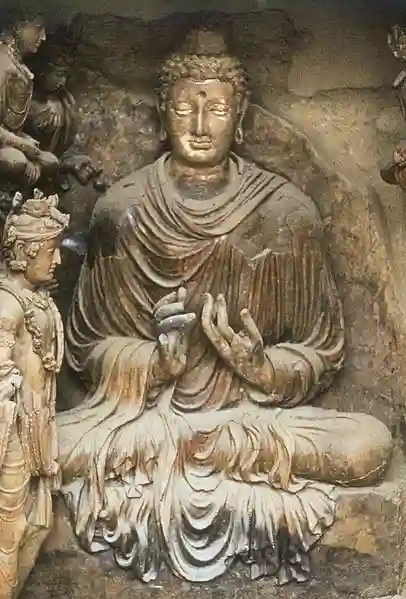
- Buddhist statues, particularly from the Greco-Buddhist Gandhara tradition, depicted Buddha in a Hellenistic style, often with a serene expression and meditative posture. Such representations may have inspired idol-making practices in regions like Mesopotamia and Arabia, where anthropomorphic idols were common.
- The emphasis on meditation and spiritual awakening in Buddhism may have resonated with pre-Islamic Arabian mysticism.
B. Ethical and Philosophical Parallels
- Some early Islamic traditions reflect parallels with Buddhist teachings, such as asceticism, emphasis on charity, and moral conduct. For example, the Quranic critique of materialism and idolatry echoes similar themes in Buddhist philosophy.
4. Critical Reflections and Conclusion
The hypothesis that the Arabic word “But” derives from “Buddha” is intriguing but remains speculative due to limited linguistic and historical evidence. However, the broader argument that Buddhism and its cultural symbols influenced pre-Islamic Arabia and early Islamic societies is well-supported by the following:
- Trade and Cultural Exchange: Arabia’s position as a hub of commerce made it a meeting ground for diverse religious traditions, including Buddhism.
- Archaeological Evidence: The transport of Buddhist statues to Baghdad and the presence of Greco-Buddhist art in Central Asia indicate a sustained Buddhist influence on the Islamic world.
- Syncretic Religious Practices: The diverse idols worshipped in pre-Islamic Mecca suggest the assimilation of foreign religious symbols, potentially including Buddhist elements.
Buddhism was an ‘Evangelical’ or missionary religion that spread beyond Afghanistan and Iran, with this, the worshiping pattern and religious vocabulary also penetrated the regional culture and social life. The cultural and linguistic interactions between Buddhism and Arabia underscore the ancient world’s complex tapestry of spiritual exchange. Further research may provide additional insights into this intriguing possibility, particularly in archaeology and philology.
Bibliography for the Discussion of Buddha’s Influence in Pre-Islamic Arabia and Linguistic Derivations
1. Historical Evidence of Buddhism in Arabia and Beyond
- Tabari, Abu Ja’far Muhammad ibn Jarir. History of al-Tabari (Tarikh al-Rusul wa al-Muluk).
- Publication: Various editions and translations (original written c. 915 CE).
- Reason for Reading: This text provides an account of Buddhist idols being transported to Baghdad and mentions the trade in Buddhist artifacts, illustrating the interaction between Buddhist and Islamic cultures. Essential for understanding the historical context.
- Al-Biruni, Abu Rayhan. India (Kitab al-Hind).
- Publication: Translated by Edward C. Sachau, 1888; original written c. 1030 CE.
- Reason for Reading: Al-Biruni’s detailed observations of Indian religions, including Buddhism, offer insights into how Islamic scholars viewed Buddhist teachings. Relevant for understanding Islamic interpretations of Buddha.
- Al-Shahrastani, Muhammad ibn Abd al-Karim. Kitab al-Milal wa al-Nihal (The Book of Sects and Creeds).
- Publication: Written c. 1127 CE; translated into English by Alfred Guillaume (1984).
- Reason for Reading: Al-Shahrastani compares Buddha to Khidr, exploring the philosophical connections and interpreting Buddha as a universal symbol of wisdom. Essential for analyzing Buddhist influence in Islamic thought.
- **Wink, André. Al-Hind: The Making of the Indo-Islamic World, Vol. 1: Early Medieval India and the Expansion of Islam, 7th-11th Centuries.
- Publication: Oxford University Press, 1990.
- Reason for Reading: This work examines the influence of Indian religions on early Islamic territories, including trade and cultural exchanges. Critical for understanding the flow of Buddhism into the Islamic world.
- **Rappoport, S. The History of Egypt: From 330 B.C. to the Present Time.
- Publication: Grolier Society, 1904.
- Reason for Reading: Provides context on the Greco-Buddhist cultural exchange and its influence on neighboring regions, including Arabia.
2. Linguistic Analysis and Etymology of “But”
- **Jeffery, Arthur. The Foreign Vocabulary of the Qur’an.
- Publication: Oriental Institute, 1938.
- Reason for Reading: Jeffery’s work investigates the etymology of words in Arabic with foreign origins, including terms like “But.” Essential for linguistic analysis of potential derivations from “Buddha.”
- **Turner, Ralph Lilley. A Comparative Dictionary of Indo-Aryan Languages.
- Publication: Oxford University Press, 1966.
- Reason for Reading: Provides linguistic insights into the Sanskrit root “Budh” and its derivatives, which may have influenced Arabic terminology.
- **Lane, Edward William. Arabic-English Lexicon.
- Publication: 1863-1893.
- Reason for Reading: A foundational resource for exploring the historical meanings of Arabic terms like “But” and tracing their usage in pre-Islamic and Islamic contexts.
- **Emmerick, Ronald E. The Languages of Central Asia: Indo-Iranian Influence.
- Publication: Routledge, 1997.
- Reason for Reading: Examines the linguistic interactions between Indo-Iranian languages and neighboring cultures, relevant to tracing the transmission of terms like “Buddha.”
3. Archaeological and Cultural Interactions
- **Huntington, Susan L. The Art of Ancient India: Buddhist, Hindu, Jain.
- Publication: Weatherhill, 1985.
- Reason for Reading: Provides a comprehensive overview of Buddhist art, including Greco-Buddhist influences, which could have impacted Arabian iconography. Important for analyzing the role of Buddhist statues.
- **Ball, Warwick. The Monuments of Afghanistan: History, Archaeology, and Architecture.
- Publication: I.B. Tauris, 2008.
- Reason for Reading: Discusses the cultural and artistic connections between Afghanistan (a Buddhist center) and the Islamic world, including the transportation of Buddhist statues to places like Baghdad.
- **Flood, Finbarr Barry. Objects of Translation: Material Culture and Medieval “Hindu-Muslim” Encounter.
- Publication: Princeton University Press, 2009.
- Reason for Reading: Explores how Buddhist and Hindu artifacts were incorporated into Islamic societies, offering parallels for the presence of Buddhist statues in Arabia.
- **Seyyed Hossein Nasr. Science and Civilization in Islam.
- Publication: Harvard University Press, 1968.
- Reason for Reading: Highlights the intellectual curiosity of Islamic scholars about foreign traditions, including Buddhism. Relevant for understanding the cultural exchange.
4. Comparative Religious Studies
- **Chapple, Christopher Key. Nonviolence to Animals, Earth, and Self in Asian Traditions.
- Publication: State University of New York Press, 1993.
- Reason for Reading: Discusses ethical overlaps between Buddhism and other traditions, including Islam, particularly in asceticism and anti-materialism.
- **Asad, Muhammad. The Road to Mecca.
- Publication: Simon and Schuster, 1954.
- Reason for Reading: A modern Muslim scholar’s reflections on the pre-Islamic Kaaba and idolatry, offering insights into how Buddhist idols might have been perceived in the Arabian religious landscape.
- **Foltz, Richard. Religions of the Silk Road: Premodern Patterns of Globalization.
- Publication: Palgrave Macmillan, 1999.
- Reason for Reading: Explores the spread of Buddhism along the Silk Road and its influence on regions bordering Arabia. Crucial for understanding cultural transmission.
5. Pre-Islamic Arabian Religions and Idolatry
- **Hawting, Gerald R. The Idea of Idolatry and the Emergence of Islam: From Polemic to History.
- Publication: Cambridge University Press, 1999.
- Reason for Reading: Examines pre-Islamic Arabian idolatry and its transformation in Islamic polemics, providing a framework to explore Buddhist influences.
- **Peters, Francis E. The Hajj: The Muslim Pilgrimage to Mecca and the Holy Places.
- Publication: Princeton University Press, 1994.
- Reason for Reading: Discusses the Kaaba and the diversity of idols worshipped in pre-Islamic Mecca, offering context for the potential presence of Buddhist statues.
- **Crone, Patricia, and Cook, Michael. Hagarism: The Making of the Islamic World.
- Publication: Cambridge University Press, 1977.
- Reason for Reading: Argues for the multicultural and religiously diverse origins of Islam, suggesting influences from Buddhism and other traditions.