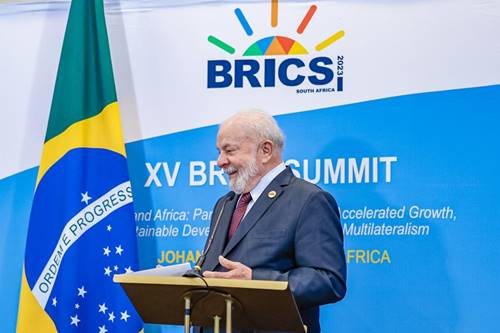
Full text of the speech read by the President of the Republic, Luiz Inácio Lula da Silva, on the occasion of the XIV CPLP Summit, with the theme “Youth and Sustainability in the CPLP”, in São Tomé and Príncipe, on August 27, 2023
DATE: Aug 29, 2023
I want to thank President Carlos Manuel Vila Nova and Prime Minister Patrice Trovoada for organizing this meeting – and the São Tome people for their warm hospitality.
I chose São Tomé and Príncipe as the end of my first African tour.
In Johannesburg I participated in the BRICS summit – which was focused on Africa.
In Luanda, I visited President João Manuel Lourenço – on my first state visit to a country in this continent during this third term as president.
It is very timely to come back to this beautiful country to address an issue that unites us.
Talking about youth and sustainability, the topic of this 14th CPLP Summit, is talking about the future.
When I was young, my generation’s dilemmas seemed simpler.
My goal was to have a technical education that would open doors to a profession and a stable job; have a family; and finance my own home.
Within union policy, we sought to organize workers to improve their living conditions.
Within the political sphere, we fought for the end of Brazil’s dictatorship.
When I talk to today’s young people, however, I realize that things are much more complex.
New generations are living with the uncertainties of a changing job market.
New technologies are an extraordinary achievement by human intelligence, but along with them unemployment and precariousness are reaching new heights.
The irresponsible use of social media, with the spread of fake news and hate speech, threatens democracy.
The worship of individualism makes many young people disbelieve in collective action.
These trends were aggravated by the pandemic – which pushed children and adolescents away from school and social life, heightening inequalities.
This is why it’s so important to turn to youngsters themselves to understand this new reality.
Ten years ago, the CPLP’s young people acted in a premonitory way when they adopted the Youth Charter.
This Charter is a visionary instrument in proposing the concept of Intergenerational Justice.
Today’s decisions directly affect the rights and opportunities of future generations.
We cannot sacrifice the well-being of those to come.
They had already warned us that climate change would threaten the future of the planet.
Most of the CPLP countries harbor a young population.
So that they may hope for a better future, from now on sustainability must be promoted in its three dimensions: social, economic and environmental.
Without adequate food, there is no prospect of a dignified life.
At the CPLP, we can be proud of our joint work in promoting food and nutritional security.
Our cooperation in favor of family farming as well as the strengthening of school feeding programs are examples to be multiplied.
I salute the recent Food Security Council meeting – held with the presence of the Brazilian Council, CONSEA, which was reestablished by my government.
Africa has what it takes to become an agricultural powerhouse – the capacity to feed its people and the world.
Brazil will continue to be a partner in this endeavor.
The Mais Alimentos Program which I relaunched in June allows small producers to access financing to buy tractors and other agricultural instruments.
As in the past, a version of More Food for Africa is to be resumed as another element of Brazil’s South-South cooperation.
Education is another core cooperation field.
Technical and academic training are a passport towards young people’s autonomy to create their own life projects.
I am very proud to say that over 1700 students from Portuguese-speaking countries have completed undergraduate studies in Brazil over the last 20 years.
I here mention our companion President José Maria Pereira Neves, from Cape Verde, who graduated in Business Administration in Brazil.
Yesterday, in Luanda, I met several former Angolan students who graduated from Brazilian universities.
Many of them are senior government officials and key civil society and private sector leaders.
As well as sending and receiving students, we must encourage research and collaboration – both in person and remotely.
For the effective implementation of the CPLP Mobility Agreement, we are regulating visas for the academic, scientific, cultural and business communities.
But training our youngsters is not enough.
Following the changes in the world of work, we are facing the challenge of boosting our economies by ensuring decent work, fair wages and protection for male and female workers.
This is the spirit of the Decent Work initiative that I will launch alongside President Biden on the sidelines of the next UN General Assembly.
The digital and ecological transitions need to be taken advantage of to generate opportunities and avoid income concentration and inequality.
The promotion of trade and investment must ensure dignified and green jobs, and aim to diversify our export basket beyond commodities.
Angola’s initiative to incorporate economic cooperation as a new pillar of our community will help connect our markets.
We are almost 300 million consumers spread across four continents, with a 2.3 trillion dollar GDP.
My dear friends,
Combating climate change is one of the focal points of my foreign policy.
At the beginning of the month, we gathered the presidents of Amazon countries in Belém.
We also carried out dialogues with civil society. Almost 30,000 people participated.
Many were young people who are engaged in fighting climate change in different ways.
We must place people at the center of public policies, creating solutions that equitably reward the preservation of forests and biodiversity.
We must avoid the neocolonialism that leads to a new cycle of predatory exploitation of critical minerals and other natural resources.
Nor should the ecological transition serve as a pretext for new green protectionism.
With their energy and creativity, young people are the driving force in our quest for innovative solutions to sustainable development challenges.
They will also keep the Portuguese language – the great common heritage that unites us – alive and constantly renewed.
As the São Tomé poet Marcelo da Veiga teaches:
“Language is the unit
She is the consciousness
That from an early age
Speaks of the right to independence.”
Or as Brazilian composer Caetano Veloso says:
“Language is my homeland
I have no fatherland, I have a motherland
And I want a brotherland.”
May the CPLP be our brotherland.
A great fraternity united by language and by the quest for sustainable and peaceful solutions in a time of great uncertainty.
Thank you very much.
Read also
- Brazil and Germany Relationship-Joint Statement on Visit to Brazil by Chancellor Olaf Scholz and Prez Lula (30/01/2023) – President Lula and Chancellor Scholz reviewed the major global issues. They reaffirmed Brazil and Germany’s unwavering commitment to democracy, human rights and social inclusion. They also emphasized their commitment to international law, the United Nations Charter, and peaceful conflict resolution. They deplored, in the strongest terms, the violation of the territorial integrity of Ukraine by Russia and the annexation of parts of its territory as flagrant violations of international law.
- Constitution of the Federative Republic of Brazil 1988 – We the representatives of the Brazilian People, convened in the National Constituent Assembly to institute a democratic state for the purpose of ensuring the exercise of social and individual rights, liberty, security, well-being, development, equality and justice as supreme values of a fraternal, pluralist and unprejudiced society, founded on social harmony and committed, in the internal and international orders, to the peaceful settlement of disputes, promulgate, under the protection of God, this CONSTITUTION OF THE FEDERATIVE REPUBLIC OF BRAZIL.
- Decree to Declare Slavery Extinct in Brazil-1888 – Slavery Extinct -Decree of the General Assembly- Slavery in Brazil has been declared extinct since the date of this law
- India-Brazil Joint Statement (10/09/2023) – Highlighting their roles as major global food producers, the leaders reaffirmed their resolve to increase cooperation in sustainable agriculture and rural development, including at the multilateral level, with the aim of safeguarding food and nutritional security of both countries and of the world.
- Judiciary under Constitution Brazil of 1988 – Judiciary in Brazil-The Federal Supreme Federal Court, the National Council of Justice, and the Superior Courts have their seat in the Federal Capital.
- PM Modi’s remarks at the closing ceremony of G20 summit (10/09/2023) – I congratulate President of Brazil and my friend, Lula da Silva. We pledge our unwavering support to Brazil and firmly believe that, during their leadership, the G-20 will further advance our common objectives.
- Prez Lula talks at XIV Portuguese Speaking Countries Summit – We are almost 300 million consumers spread across four continents, with a 2.3 trillion dollar GDP. We must avoid the neocolonialism that leads to a new cycle of predatory exploitation of critical minerals and other natural resources.
- U.S.-Brazil diplomatic relationship-Joint Statement Following the Meeting Between Biden and Lula (10/02/2023) – The two leaders discussed a wide range of global and regional issues of mutual concern. They deplored the violation of the territorial integrity of Ukraine by Russia and the annexation of parts of its territory as flagrant violations of international law and called for a just and durable peace. They expressed concern about the global effects of the conflict on food and energy security, especially on the poorest regions of the planet and voiced support for the full functioning of the Black Sea Grain Initiative.