Supreme Court Warns NCERT: Judicial Corruption Chapter Sparks Legal Action
SC Orders Seizure of NCERT Grade 8 Book for Chapter on Judicial Corruption
IN RE: SOCIAL SCIENCE TEXTBOOK FOR GRADE – 8 (PART-2) PUBLISHED BY NCERT AND ANCILLARY ISSUES
VS. / 26-02-2026
ITEM NO.55 COURT NO.1 SECTION PIL-W
SUPREME COURT OF INDIA
RECORD OF PROCEEDINGS
SUO MOTU WRIT PETITION (CIVIL) No(s). 1/2026
IN RE: SOCIAL SCIENCE TEXTBOOK FOR GRADE – 8 (PART-2) PUBLISHED BY NCERT AND ANCILLARY ISSUES
Date : 26-02-2026
This petition was called on for hearing today.
CORAM :
HON’BLE THE CHIEF JUSTICE
HON’BLE MR. JUSTICE JOYMALYA BAGCHI
HON’BLE MR. JUSTICE VIPUL M. PANCHOLI
By Courts Motion
Mr. Tushar Mehta, Solicitor General
Mr. Kapil Sibal, Sr. Adv.
Mr. Vikas Singh, Sr. Adv.
Mr. Gaurav Kumar, Adv.
Mr. Naman Sherstra, Adv.
Dr. Vivek Sharma, Adv.
O R D E R
- The framers of our Constitution were profoundly conscious and took abundant caution to ensure that constitutional responsibilities were inscribed with such precision that the three pillars, namely, the Legislature, Executive and Judiciary remain capable of operating with institutional autonomy while functioning in concert to preserve the democratic fabric of our nation.
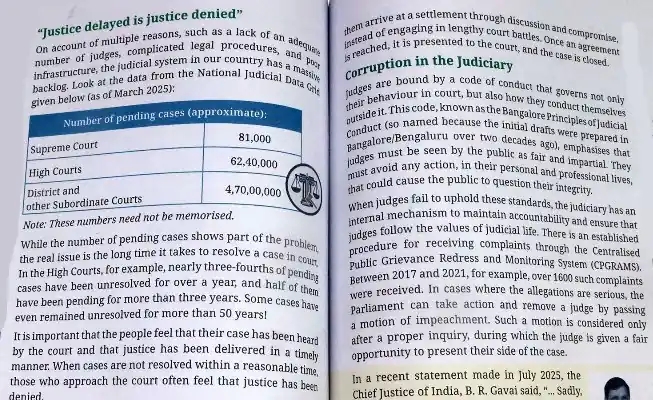
- While acknowledging this constitutionally described demarcation, we were nearly shocked when a leading English language newspaper, The Indian Express, published an article on 24.02.2026 regarding the release of the Social Science Textbook for Grade 8 (Part 2) titled “Exploring Society: India and Beyond”, First Edition (Book), published in February 2026 by the National Council of Educational Research and Training, i.e., NCERT. Chapter 4 of this Book is titled “The Role of the Judiciary in our Society” and incorporates a sub-topic explicitly expounding “Corruption in the Judiciary”. The inclusion of this subject matter within a foundational curriculum, in our considered opinion, warrants a rigorous review of its pedagogical suitability and its potential impact on the institutional standing of the Judiciary as a whole.
- Although we are reluctant to reproduce the full contents of this Chapter, it however makes prominent reference to hundreds of complaints received against the judiciary, clearly indicating, as if no action was taken, picking a few words from the statement of a former Chief Justice of India, suggesting that the judiciary itself has acknowledged the lack of transparency, accountability and institutional corruption. Not only this, the article further goes on to declare that “people do experience corruption of various levels of the judiciary………”
- In the wake of the publication of the Book and the self-speaking article in The Indian Express as already elucidated above, the Secretary General of this Court was asked to verify whether such a publication had indeed been released by NCERT. Instead of displaying any introspection about what had been written in the book in a reckless, irresponsible, contemptuous, and motivated manner, the Director responded in writing, defending the contents of the book.
- On a prima facie examination of the book’s contents, when read in conjunction with the administrative response received from the Director, NCERT, reveals a discernible underlying agenda to undermine the institutional authority and demean the dignity of the judiciary. This would, if allowed to go unchecked, erode the sanctity of the judicial office in the estimation of the public at large and, more importantly, within the impressionable minds of the youth.
- While the publication ostensibly dedicates an entire Chapter to the Role of Judiciary to our Society and washes off with one stroke of the pen, the illustrious history associated with the Supreme Court, the High Courts and the District Courts, it conspicuously omits the substantive contributions made by these institutions towards the preservation of our democratic fabric. The text unfortunately fails to acknowledge the imperative role the Judiciary undertakes in upholding Constitutional Morality and the Basic Structure Doctrine, principles that constitute the very lifeblood of the Indian citizens in public existence.
- It seems to us that the Book also chooses not to delve into any of the transformative initiatives and measures pioneered by this Court towards overhauling legal aid mechanisms and streamlining the ease of access to justice.
- This silence and the uninhibited criticism are particularly egregious when viewed in light of the sheer volume of high-ranking officials who have been censured by this very Court in the past for corrupt practices, fraudulent activities and for illicit siphoning of public funds, etc. It seems to us that the choice of words and expressions in the book may not be a simpliciter inadvertent or bona fide error.
- We may, however, hasten to add that we do not propose to initiate the suo moto proceedings to stifle any legitimate critique or to bring to task any individual or organisation exercising their right to scrutinize public institution, including the Judiciary. On the contrary, we remain of the firm conviction that dissent, deliberation and rigorous discourse constitute the very vitality of a living democracy and serve as essential instruments of institutional accountability.
- The necessity for judicial intervention nevertheless has arisen not from a desire to suppress criticism but from the imperative to safeguard the pedagogical integrity of the national curriculum. Young students in their formative years are only beginning to navigate the nuances of public life and the constitutional architecture that sustains it. It is fundamentally improper to expose them to a biased narrative that may engender permanent misconceptions at an age when they lack the perspicacity to appreciate the manifold and onerous responsibilities that are discharged by the judiciary on a day-to-day basis.
- While taking this initiative, we have to keep in mind that embedding such decontextualized text within a nationwide middle school curriculum is to bypass the safeguards of balanced education, risking systemic erosion of institutional faith in the minds of students, the teachers who will impart such education, parents of young students, society at large and ultimately even the next generation.
- Given these serious consequences and the everlasting impact it may have on the independence and autonomy of judiciary, such a misconduct would fall within the definition of ‘criminal contempt’ under Section 2(c) of the Contempt of Courts Act, 1971, as if proved to be a deliberate move, it will undoubtedly amount to impeding the dignity of the institution and interfering with the administration of justice, besides scandalizing the institution.
- We may, at this stage, also take notice of certain subsequent events. A notice has been published, which is reported in the media, and a copy thereof has also been placed on record by the learned Solicitor General of India, which is a press release issued by the NCERT. According to this press release, the Department of School Education and Literacy (Ministry of Education) has directed that the distribution of this book may be kept on strict hold until further orders, and that those directions have since been complied with. It is further stated that the chapter in the subject book shall be rewritten in consultation with the appropriate authority. An apology has also been tendered through this press release.
- The question as to whether the apology has been tendered genuinely with a view to purging the prima facie contempt, or whether it is merely a ruse to evade the consequences, particularly when substantial irreversible damage has already been done, is a matter that we will consider at an appropriate stage.
- As of now, we deem it appropriate to issue show-cause notice to:
(i) The Secretary, Department of School Education and Literacy (Ministry of Education), Government of India; and
(ii) Professor (Dr.) Dinesh Prasad Saklani, Director, NCERT:
as to why suitable action, either under the provisions of the Contempt of Courts Act or in accordance with any other provisions of penal laws, be not initiated against them or all those who are found responsible for introducing the offending chapter in the subject Book. - The NCERT in coordination with the Union Government and the concerned State Education Department, is directed to ensure that all copies of the book, in hard or soft form, presently in circulation, including those held in storage, retail outlets, or educational institutions, are forthwith seized and removed from public access.
- The Union of India and its agencies will ensure that the book is removed immediately from the physical and digital platforms without any delay, and a compliance report by way of an affidavit is placed on record.
- It shall be the personal responsibility of the Director, NCERT and the Principal of every school, where the Book has been circulated or prescribed to:
(a) effectuate the immediate seizure and sealing of all the physical and digital copy of the book within their respective premises and submit a compliance report; and
(b) ensure that no further pedagogical instructions are imparted based on the contents of the physical or digital copy of the subject book. - The Principal Secretaries of the Department of Education across all the States and Union Territories are directed to comply with the directions given hereinabove and submit their compliance reports through affidavits within two weeks.
- As an abundant precaution, a complete blanket ban is hereby imposed on any further publication re: printing or digital dissemination of the book titled “Exploring Society, India and Beyond”. Any attempt to circumvent this order through electronic media or alternative titles, containing the same contents, shall be treated as a direct interference, willful breach and defiance of the directions issued herein above.
- The Director, NCERT is further directed to submit:
(a) A comprehensive list and details pertaining to members of the National Syllabus and Teaching Learning Material Committee, who approved the offending chapter;
(b) The specific names and credentials of the Textbook Development Team responsible for drafting Chapter No.4; and
(c) The original records of the minutes of all meetings, where the offending chapter was deliberated and finalised, shall be produced on the next date of hearing. - Post this matter for further consideration on 11.03.2026.
(ARJUN BISHT)
ASTT. REGISTRAR-cum-PS
(PREETHI T.C.)
ASSISTANT REGISTRAR