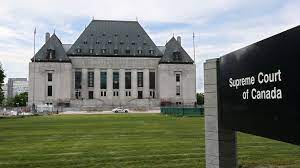
SUPREME COURT OF CANADA
R. v. Lindsay
December 14, 2023
The Supreme Court upholds a constable’s conviction for aggravated assault.
This case is about whether a constable who used force during an altercation with a person under arrest can rely on a defense under the Criminal Code.
The appellant, Trevor Ian James Lindsay, is a constable with the Calgary Police Service. In May 2015, he arrested Mr. Daniel Haworth for theft. Together with another constable, he handcuffed and transported Mr. Haworth to the Calgary Court Services building in a police vehicle for processing and an appearance before a Justice of the Peace.
Upon arrival, Constable Lindsay removed Mr. Haworth from the vehicle. They briefly interacted, then became physically engaged. Video surveillance showed Constable Lindsay punching Mr. Haworth in the face and head three times, throwing him to the pavement, then both constables holding him to the ground. Mr. Haworth suffered a skull fracture and a brain injury as a result of his head striking the pavement. He died a few months later from an unrelated drug overdose.
Constable Lindsay was charged with aggravated assault. At trial, he relied on section 25 of the Criminal Code in his defence, which protects peace officers from liability related to their lawful use of force. He testified that his use of force was to try to control Mr. Haworth. He said he was terrified that Mr. Haworth would spit blood or saliva toward him or the other constable, and that either or both officers could contract a serious infectious disease. With respect to putting Mr. Haworth on the ground, Constable Lindsay explained that, by mistake, he grabbed the hood instead of the collar from the hoodie Mr. Haworth was wearing. The slack between the hood and the collar prevented him from controlling the descent, resulting in Mr. Haworth contacting the pavement harder than he had intended.
The trial judge concluded that Constable Lindsay’s use of force was excessive. As such, section 25 of the Code did not protect him from criminal liability. With respect to the actual offence, the judge did not specifically address whether the Crown had proven the constable’s aggravated assault beyond a reasonable doubt because, in his view, the defence had conceded earlier in the trial that the elements of the offence were present.
A majority of the Court of Appeal agreed with the trial judge and dismissed the appeal. However, one dissenting judge would have allowed the appeal and ordered a new trial. First, he thought the trial judge did not decisively determine whether the Crown had proven the assault beyond a reasonable doubt. Second, he also believed there was an objective basis to Constable Lindsay’s fear of being spat on, and that his use of force may have been reasonable. As such, because the trial judge failed to properly evaluate the reasonableness of the force used, no conclusion could be made as to whether section 25 applied to the constable’s actions.
Constable Lindsay appealed to the Supreme Court of Canada. He asked the Court to determine two issues:
(1) whether the Crown had proven beyond a reasonable doubt that he had committed the crime of aggravated assault; and (2) whether his use of force on Mr. Haworth was justified under section 25 of the Code.
The Supreme Court has dismissed the appeal.
As a result, Constable Lindsay’s conviction is upheld.
Justice Jamal read the judgment of the Court.
A print version of the judgment that was read out will be available here once finalized.
Trevor Ian James Lindsay
and
His Majesty The King
R. v. Lindsay (40569) 2023 SCC 33
JUDGMENT
The appeal from the judgment of the Court of Appeal of Alberta (Calgary), Number 2101-0292A, 2022 ABCA 424, dated December 23, 2022, was heard on December 14, 2023, and the Court on that day delivered the following judgment orally:
Jamal J. — We are all of the view that the appeal should be dismissed.
We do not accept the appellant’s submission that the trial judge misinterpreted the concession of defence counsel that if an assault occurred, it was an aggravated assault. The appellant did not raise this as a ground of appeal before the Court of Appeal. The appellant now claims that the trial judge interpreted this concession as meaning that he did not need to decide whether the Crown had proved the elements of aggravated assault. We disagree. Reading the judgment as a whole, the trial judge concluded that the appellant committed aggravated assault when he intentionally struck and threw the person in his custody to the ground. As the majority of the Court of Appeal correctly noted, based on the trial judge’s reasons, “the pathway to conviction is clear and based on the correct application of relevant legal principles” (para. 6). A trial judge is presumed to know the law and is entitled to focus on the live issues at trial. In our view, the trial judge’s reasons are sufficient in law (see R. v. G.F., 2021 SCC 20, at para. 74).
Nor do we accept the appellant’s argument that the trial judge erred in concluding that s. 25(1) of the Criminal Code, R.S.C. 1985, c. C-46, did not provide a defence for the appellant’s use of force against the individual. Section 25(1) “essentially provides that a police officer is justified in using force to effect a lawful arrest, provided that he or she acted on reasonable and probable grounds and used only as much force as was necessary in the circumstances” (R. v. Nasogaluak, 2010 SCC 6, [2010] 1 S.C.R. 206, at para. 34). The matters raised by the dissenting judge in the Court of Appeal in essence impugn the trial judge’s findings of fact. In our view, the trial judge was entitled to find on the evidence before him that the appellant had no reasonable grounds to strike the person initially, and that his use of force in striking him three more times in the head and then throwing him to the ground was unnecessary and excessive on a proper standard. The trial judge’s findings of fact were amply supported by the record. We see no basis for this Court to intervene.
The appeal is dismissed.
