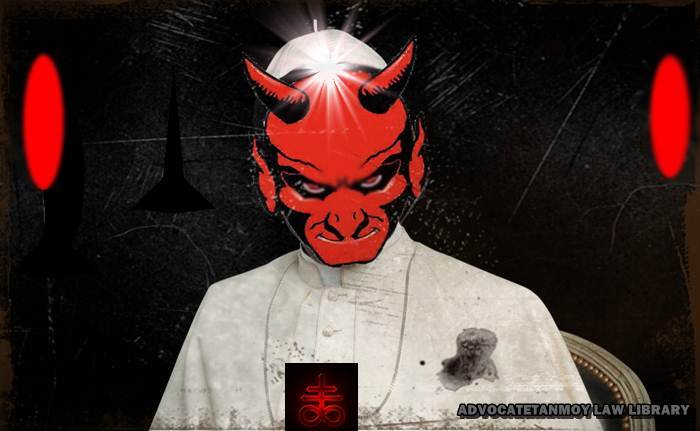
The Christian tradition of attribution reaches is apogee in the early modern witch scare, during which rumors of a devilworshipping “sectam modernam” were molded upon older fears of rural withcraft. While these allegation were devoid of a factual basis, there are some indication for actually practised Satanism in the premodern and early modern era, beginning with the possibly fictious “Satanians” of Epiphanius of Salamis and culminating in the more trustworthy instance of a Satanist “black magic” ’ brought into the open during the late-seventeenth century Affaire of the Poisons and in the decades after this. However, the peculiar character of these “Satanisms” is emphasized, as well as its numerical and cultural marginality with respect to the overwhelming tide of attribution.
By Publisher
Children of Lucifer: The Origins of Modern Religious Satanism
Ruben van Luijk
Published: June 2016
Contents
Front Matter
Introduction: (Mostly for academic readers)
Defining Satanism
Available Literature
Hypothesis, Framework, and Methodology of This Study
The Christian Invention of Satanism
Intermezzo 1 The Eighteenth Century: Death of Satan?
Intermezzo 2 Charles Baudelaire: Litanies to Satan
Intermezzo 3 Nineteenth-Century Religious Satanism: Fact or Fiction?
Intermezzo 4 Adolescent Satanism, Metal Satanism, Cyber-Satanism
End Matter
Abstract
Satanism adopts Satan, the Judeo-Christian representative of evil, as an object of veneration. This book explores the historical origins of this extraordinary “antireligion.” While the concept of people worshipping Satan was actually an invention of Christianity to demonize its internal and external competitors, this dark stereotype created by the Church eventually came to be embraced as a positive (anti)religious identity by some in the modern West. Children of Lucifer traces the long and tortuous trajectory to this unique occurrence, a story that involves Romantic poets, radical anarchists, eccentric esotericists, Decadent writers, and schismatic exorcists, among others, culminating in the establishment of the Church of Satan by the carnival entertainer Anton Szandor LaVey. Yet it is more than just a collection of colorful characters and unlikely historical episodes. The emergence of new attitudes to Satan proves to be intimately linked to the Western Revolution, the ideological struggle for emancipation that transformed the West and is epitomized by the American and French Revolutions. It is also closely connected to secularization, that other exceptional historical process during which Western culture spontaneously renounced its traditional gods in order to enter into a self-chosen state of religious indecision. As this study seeks to show, the emergence of Satanism thus presents a shadow history of the evolution of modern civilization as we know it.
In a historical sense, Western Satanism can primarily be understood as a reaction to Christianity, its genesis is more complicated than this bare fact suggests. The Christian tradition had solidly established an interpretation of the devil as the prime mythological representation of evil, and from this interpretation had emerged a predefined set of ideas that had evolved about what it meant to be a Satanist. A choice to adopt Satanism thus meant identification or at least coming to terms with this preceding image of the Satanist. In addition, this study has proposed a intermediate step in this process from attribution to appropriation: the rehabilitation of Satan undertaken by Romantic authors and artists. Springing from major historical developments as the Western Revolution and modern secularization, their redefinition of Satan and religion reflects a shift in attitude that would eventually enable a modern religious Satanism to emerge in the shape it has now, as a post-secular and post-Enlightment religious construct that is aware of its own rooting in fiction. Far from a mere change in the nomenclature of divine hierarchy, it presents a profound shift away from a lofty transcendent deity to a more earthly godhead anchored in man’s own humanity.