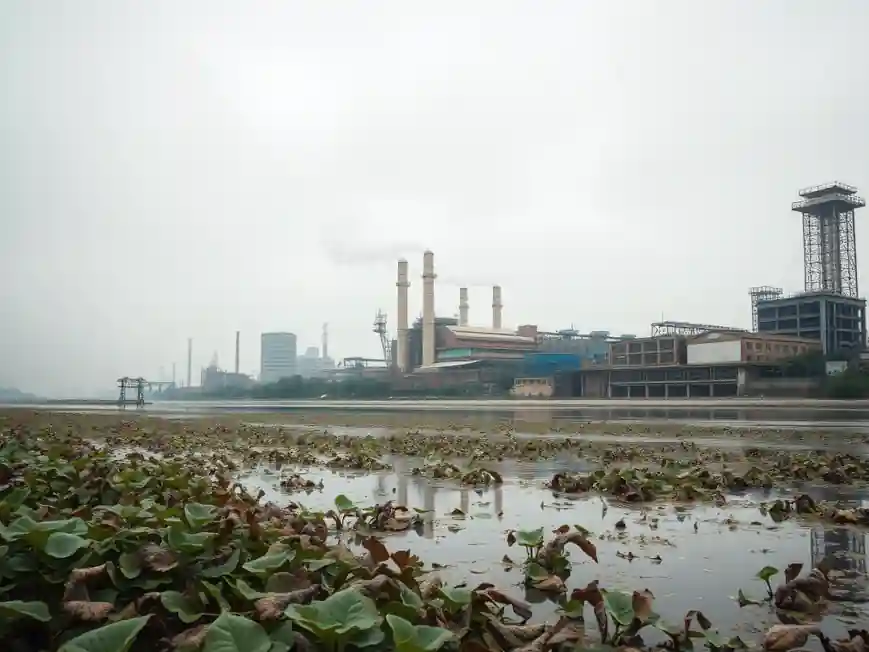
Exploring China’s river pollution, its causes, impacts, and the evolving legal measures for control
River pollution in China represents one of the most pressing environmental challenges confronting the nation in the wake of its extraordinary economic development. It is both a product of the country’s rapid industrialization and a matter of grave ecological and legal concern.
The causes of pollution are multifaceted, encompassing industrial, agricultural, municipal, and accidental sources. Factories engaged in heavy industry, such as chemicals, textiles, paper milling, and mining, historically discharged untreated or insufficiently treated wastewater into rivers, introducing heavy metals, toxic chemicals, and persistent pollutants into the aquatic system. At the same time, agricultural runoff has compounded the problem, as chemical fertilizers and pesticides, washed into rivers by rainfall, have triggered widespread eutrophication and the creation of hypoxic “dead zones.”
Urbanization, moving at a pace far exceeding infrastructure development, has produced a chronic overflow of untreated sewage and domestic waste into waterways. To these structural causes must be added episodic industrial accidents and dam breaches that release massive quantities of hazardous substances, generating ecological disasters of a sudden and catastrophic scale.
The severity of this contamination is most visible in key river systems that serve as lifelines to millions. The Hai River Basin in the north, passing through Beijing and Tianjin, is one of the most notoriously polluted due to both water scarcity and concentrated industrial and agricultural discharge. The Yellow River, hailed as the “Mother River” of China, has suffered from industrial effluent and siltation, its lower reaches unfit for many forms of use. The Huai River has stood as a symbol of the national pollution crisis since the 1990s, its repeated pollution incidents prompting large-scale intervention yet failing to eliminate persistent contamination. Even the Yangtze River, with its enormous volume and importance to the nation’s economy, has absorbed billions of tons of industrial and municipal waste, turning pollution there into a matter of national security.
The consequences of this environmental crisis are grave and extend beyond ecological degradation. Public health has suffered significantly, with communities along polluted rivers reporting elevated incidences of cancers, heavy metal poisoning, and chronic illnesses. Contaminated water has exacerbated China’s already acute water scarcity, rendering large portions of available water resources unusable even for agriculture. Ecological damage has reached the point of species extinction, with the Yangtze River Dolphin declared functionally extinct in 2006. Pollution has entered the food chain through irrigated crops and aquatic life, raising food safety risks. Economically, the burden of cleanup and the damage to fisheries, agriculture, and tourism has been immense.
Confronted with these realities, the Chinese state has launched an unprecedented legal and administrative response, particularly since the mid-2000s, signifying a shift from tolerance of environmental degradation in favor of growth to a command-and-control framework with strict accountability.
The 2014 Environmental Protection Law of the People’s Republic of China functions as the umbrella legislation, establishing the principles of the polluter pays, strict liability, and prioritization of protection. It authorizes consecutive daily penalties without limit, thus removing any economic incentive to delay compliance, and enshrines public participation through disclosure and litigation rights. This foundational law is complemented by the Water Pollution Prevention and Control Law, most recently revised in 2017, which functions as the specific cornerstone of the legal framework.
The law imposes direct responsibility on local governments for water quality within their jurisdiction, establishes the pollutant discharge permit system as the primary mechanism of compliance, and mandates national standards for both water quality and pollutant discharge. It also introduces total emission controls for key pollutants, stricter protections for drinking water sources, and heightened penalties for violations, including the possibility of criminal liability.
The Water Law of 2016 operates in tandem with these statutes, addressing water resource allocation, conservation, and development. Together with supporting instruments such as the Water Ten Plan of 2015 (Action Plan for Water Pollution Prevention and Control), the Environmental Protection Tax Law of 2018, and the widely implemented “River Chief” system, these measures constitute a comprehensive legal regime. The River Chief mechanism, which assigns personal accountability for river quality to senior local officials, represents a particularly notable innovation, aligning political incentives with environmental goals. The Environmental Protection Tax Law institutionalizes the cost of pollution by taxing discharges of pollutants regardless of whether they remain within permitted limits, while violations beyond the limits trigger separate enforcement actions.
Enforcement has become a defining feature of the modern Chinese environmental regime. The Ministry of Ecology and Environment, supported by local ecology and environment bureaus, oversees the issuance of permits, the monitoring of compliance, and the imposition of penalties. Sanctions include unlimited daily fines, forced production suspensions, shutdowns, and criminal prosecution of corporate managers. These legal and institutional innovations collectively represent a decisive shift from the pre-2010 era of weak guidelines and sporadic enforcement to a rigid and punitive system grounded in political accountability, economic disincentives, and legal coercion.
While official data demonstrates measurable improvements in water quality, particularly a decline in the percentage of surface water deemed unfit for human contact, challenges remain entrenched. Groundwater contamination persists as a long-term threat, legacy pollution continues to leach from sediments, agricultural runoff resists conventional regulatory mechanisms, and enforcement remains uneven across regions. Furthermore, the long-term health effects of chronic exposure to complex chemical mixtures are still poorly understood.
Thus, river pollution in China constitutes both an ecological crisis and a legal case study in the transformation of state capacity. It illustrates the trajectory of environmental governance from permissiveness and neglect to rigorous statutory control and political accountability. The task before China’s legal and administrative institutions is to advance beyond immediate crisis control toward the management of entrenched, diffuse, and often invisible forms of pollution that resist simple solutions. The success or failure of this endeavor will shape not only China’s environment and public health but also the legitimacy of its evolving environmental rule of law.
Tanmoy: 22/09/2025