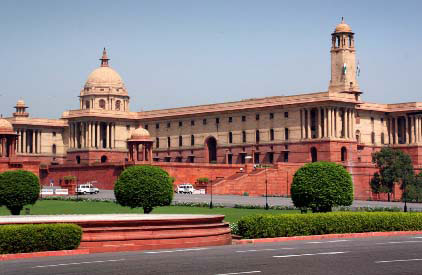
There exist difficulties to frame an exhaustive definition or listing of what executive function means and implies. Ordinarily, the executive power connotes the residue of governmental functions that remain after legislative and judicial functions are taken away subject, of course, to the provisions of the Constitution or of any law.
The executive function comprises both the determination of the policy as well as carrying it into execution, the initiation of legislation, the maintenance of order, the promotion of social and economic welfare, the direction of foreign policy; in fact, the carrying on or supervision of the general administration of the State. It includes political and diplomatic activities.
By reason of article 298 of the Indian Constitution, it also includes (a) the carrying on of trading operations;
(b) the acquisition, holding and disposing of property; and (c) the making of contracts for any purpose.
Once a law is passed, the executive power can be exercised only in accordance with such law so far as it goes, but the Government is not debarred from exercising its executive power merely because a Bill relating to the subject is pending before the Legislature.
EXTENT OF EXECUTIVE POWER OF THE UNION
Attention is invited to article 73 of the Constitution. which read as under:—
“73. (1) Subject to the provisions of this Constitution, the executive power of the Union
shall extend-
(a) to the matters with respect to which Parliament has power to make laws; and (b) to the exercise of such rights, authority and jurisdiction as are exercisable by the Government of India by virtue of any treaty or agreement:
Provided that the executive power referred to in sub-clause (a) shall not, save as expressly provided in this Constitution or in any law made by Parliament, extend in any State to matters with respect to which the Legislature of the State has also power to make laws.
(2) Until otherwise provided by Parliament, a State and any officer or authority of a State may, notwithstanding anything in this article, continue to exercise in matters with respect to which Parliament has power to make laws for that State such executive power
or functions as the State or Officer or authority thereof could exercise immediately before the commencement of this Constitution.”.
In view of the provisions of the Constitution, the Union shall have exclusive executive power for (a) the administration of laws made by Parliament under its exclusive powers; (b) the exercise of its treaty powers.
By virtue of clause (1) (a) of article 73 of the Constitution, the executive power of the Union shall be co-extensive with the legislative power of the Union Parliament.
In other words, it will extend over the whole of the Territory of India, with respect to the matters enumerated in Lists I and III of the 7th Schedule to the Constitution. But this power is subject to the two exceptions engrafted in the proviso to clause (1) and clause (2) of article 73 of the Constitution.
The proviso to clause (1) says that executive authority in regard to matters in the Concurrent List shall be ordinarily left to the States, for Parliament shall be entitled to provide that in exceptional cases the executive power of the Union shall also extend to these subjects. If the Ministers are constantly under the fear or threat of being proceeded against in a court of law for even the slightest of lapse or under the constant fear of exemplary damages being awarded against them, they will develop a defensive attitude which would not be in the interest of administration.
Apart from the provisions of articles 73 and 162 of the Constitution, Executive Power is conferred upon the Union as well as a State Government as regards three specified matters.
(i) carrying on of any trade or business under article 298;
(ii) acquisition, holding and disposal of property under article 298;
(iii) making of contracts for any purposes under article 299.
Extract from Constituent Assembly Debate
Hon’ble Shri (Dr.) B.R. Ambedkar during the Constituent Assembly Debates when the aforesaid article (corresponding article 60) before was taken for adoption, inter alia, observed as under:-
“Now, Sir, my second submission is that there is ample justification for a proviso of this
sort, which permits the Centre in any particular case to take upon itself the administration of certain laws in the Concurrent list.
Let me give one or two illustrations. The Constituent Assembly has passed article 11, which abolishes untouchability. It also permits Parliament to pass appropriate legislation to make the abolition of untouchability a reality. Supposing the Centre makes a law prescribing a certain penalty, certain prosecution for obstruction caused to the untouchables in the exercising of their civic rights. Supposing a law like that was made, and supposing that in any particular province the sentiment in favour of the abolition of untouchability is not as genuine and as intense nor is the Government interested in seeing that the untouchables have all the civic rights which the Constitution guarantees, is it logical, is it fair that the Centre on which so much responsibility has been cast by the Constitution in the matter of untouchability, should merely pass a law and sit with folded hands, waiting and watching as to what the Provincial Governments are doing in the matter of executing all those particular laws?
As everyone will remember, the execution of such a law might require the establishing of additional police, special machinery for taking down, if the offence was made cognizable, for prosecution and for all costs of administrative matters without which the law could not be made good. Should not the Centre which enacts a law of this character have the authority to execute it?
I would like to know if there is anybody who can say that on a matter of such vital importance, the Centre should do nothing more than enact a law. Let me give you another illustration. We have got in this country the practice of child marriage against which there has been so much sentiment and so much outcry. Laws have been passed by the Centre. They are left to be executed by the provinces.
We all know what the effect has been as a result of this dichotomy between legislative authority resting in one Government and executive authority resting in the other. I understand (and I think my friend Pandit Bharagava who has been such a staunch supporter of this matter has been stating always in this House) that notwithstanding the legislation, child marriages are as rampant as they were. Is it not desirable that the Centre which is so much interested in putting down these evils should have some authority for executing laws of this character? Should it merely allow the provinces the liberty to do what they liked with the legislation made by Parliament with such intensity of feeling and such keen desire of putting it into effect?
Take, for instance, another case–Factory Legislation. I can remember very well when I was the Labour Member of the Government of India cases after cases in which it was reported that no Provincial Government or at least a good many of them were not prepared to establish Factory Inspectors and to appoint them in order to see that the Factory Laws were properly executed. Is it desirable that the labour legislations of the Central Government should be mere paper legislations with no effect given to them? How can effect be given to them unless the Centre has got some authority to make good the administration of laws which it makes?
I therefore submit that having regard to the cases which I have cited–and I have no doubt honourable Members will remember many more cases after their own experience–that a large part of legislation which the Centre makes in the concurrent filed remains merely a paper legislation, for the simple reason that the Centre cannot execute its own laws. I think it is a crying situation which ought to be rectified which the proviso seeks to do.
There is one other point which I would like to mention and it is this. Really speaking, the
Provincial Government sought to welcome this proviso because, there is a certain sort of financial anomaly in the existing position.
For the Centre to make laws and leave to provinces the administrations means imposing certain financial burdens on the provinces which is involved in the employment of the machinery for the carrying out of those laws. When the Centre takes upon itself the responsibility of the executing of those laws, to that extent the provinces are relieved of any financial burden and I should have thought from that point of view this proviso should be a welcome additional relief which the provinces seek so badly.
I, therefore, submit, Sir, that for the reasons I have given, the proviso contains a principle which this House would do well to endorse.
(Cheers).