How the dramatic seizure of Nicolás Maduro ignited a storm over sovereignty, international law, and control of the world’s largest oil reserves
The seizure of Venezuela’s president, carried out in the predawn hours of January 3, 2025, reverberated through global politics like a shockwave, and at its center was a powerful and unmistakable idea: the pursuit of power and oil. The United States, acting on a mission that stretched the limits of international law and norms, captured President Nicolás Maduro from his own residence, transporting him thousands of miles away. The operation harshly illuminated the belief, loudly echoed by critics, that greed for petroleum remains a driving force in geopolitical decisions. In the aftermath, Washington signaled that it now stood ready to engage Venezuela’s surviving political leadership — but only if they made what American officials repeatedly described as “the right decision,” a phrase that itself underscored the leverage and pressure the United States intended to exert.
Secretary of State Marco Rubio, speaking with deliberate restraint on CBS’s “Face the Nation,” stressed that Washington would judge Venezuela’s leaders not by their rhetoric, not by prior alliances or public pronouncements, but by measurable deeds. This focus on actions over promises signaled another core idea: the United States wanted to keep maximum flexibility, reserving every possible tool of pressure. Rubio emphasized that if Venezuela’s authorities failed to align with U.S. expectations, Washington retained “multiple levers of leverage,” hinting at sanctions, economic strangulation, military presence, and diplomatic isolation — all instruments that have shaped U.S. relations with Latin America before.
At the center of this unfolding drama sat Maduro himself, now imprisoned in a New York detention facility. His capture followed a raid personally authorized by then–President Donald Trump, an operation crafted to seize control not merely of a man, but, symbolically and strategically, of a nation whose oil reserves are among the largest on Earth. In the early hours of Saturday morning, electricity in portions of Caracas flickered out, explosions rippled across the capital, and Venezuelan military installations came under attack. U.S. Special Forces descended with precision, detained Maduro and his wife, Cilia Flores, transported them first to a Navy vessel offshore, and finally ferried them to American soil — a chain of events that conveyed calculated dominance, while triggering accusations of kidnapping and international violations.
Trump himself had initially spoken in language that sounded almost imperial. He declared that the United States would “run” Venezuela if necessary and voiced no hesitation about placing military “boots on the ground.” Yet Rubio, appearing to soften and reframe the message, suggested that instead of ruling directly, Washington would explore cooperation with Delcy Rodríguez — Maduro’s vice president and, by Venezuelan court decree, the acting president — along with the ousted leader’s cabinet. The United States, he said, would watch closely, not dictating outcomes openly, yet making it unmistakably clear that compliance with U.S. expectations would determine future relations.
This shift highlighted another major theme: Washington wanted influence without the burden of overt nation-building. Rubio warned against repeating mistakes associated with Libya, Iraq, and Afghanistan, insisting that Venezuela represented a different situation entirely. The United States, he argued, did not intend to engineer a society from the ground up. Instead, it intended to apply pressure, create incentives, and force decisions that aligned with its own strategic and economic priorities.
Even so, Rubio’s reassurances did little to erase the tension between his stance and Trump’s sweeping declarations. Trump insisted the United States would remain in Venezuela “until such time as the proper transition can take place,” hinting that American officials — not Venezuelan institutions — would hold ultimate authority during an undefined interim period. He underscored that naval forces would maintain a formidable presence in the Caribbean and pointed to an oil embargo as another tool of control, underscoring the central motif again: leverage through energy resources.
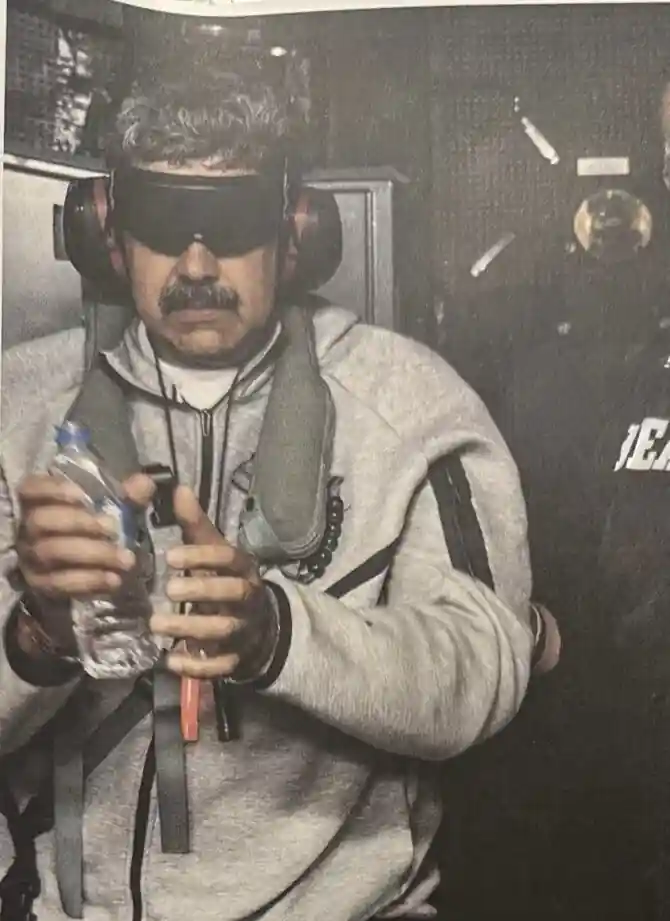
Maduro’s transfer to New York unfolded like a cinematic sequence. His aircraft landed outside the city on Saturday night, followed by a helicopter ride and then a heavily guarded convoy to the Metropolitan Detention Centre in Brooklyn. Photographs showed him handcuffed and blindfolded aboard the flight, later escorted through federal hallways at the offices of the U.S. Drug Enforcement Administration. Reports captured his muted attempt at normalcy as he wished his captors a “happy New Year,” even while indicted on charges ranging from narcotics trafficking conspiracy to broader allegations of criminal networks.
He was scheduled to appear before a Manhattan federal court on Monday, yet another symbol that the dispute had shifted away from diplomacy into the domain of prosecution and punishment. What remained profoundly unclear, however, was how the United States expected to govern or influence events in Venezuela from afar. American forces did not physically control Venezuelan territory, and key elements of Maduro’s government remained intact, defiant, and deeply suspicious of Washington’s intentions.
Delcy Rodríguez appeared on Venezuelan television alongside senior officials, rejecting U.S. explanations outright and framing Maduro’s capture as a brazen kidnapping. She demanded the immediate release of both Maduro and Flores, asserting repeatedly that Maduro remained the only legitimate president. A Venezuelan court backed her by instructing her to assume the role of interim leader — a legal act that only intensified the dispute over sovereignty. Her stance exposed another key idea: legitimacy, contested and fragile, becomes a battleground when foreign powers intervene.
Trump, meanwhile, made little secret of his fixation on Venezuela’s oil wealth. He spoke enthusiastically of allowing large U.S. oil corporations to reenter the country, invest billions, rebuild crippled infrastructure, and ultimately extract and sell substantial quantities of crude. The language revealed both ambition and opportunism. He promised that the United States would “run the country” temporarily, managing a transition with supposed prudence and safety rhetoric reminiscent of earlier interventions framed as temporary but extended indefinitely.
For months preceding the raid, Trump’s administration had escalated its allegations against Maduro, accusing him of facilitating drug shipments and presiding over corruption. U.S. naval forces massed near Venezuelan waters, and missile strikes targeted vessels alleged to be part of narcotics networks. Yet, in the middle of this dramatic environment, Trump brushed aside hopes that opposition figure María Corina Machado — Nobel Peace Prize laureate and former darling of Western capitals — might assume leadership. He suggested she lacked domestic backing, a surprising dismissal that contradicted prior American messaging.
Instead, Trump turned attention again to Rodríguez, saying she was “willing to do what we think is necessary” to restore Venezuela’s prosperity — although Rodríguez herself condemned the U.S. operation, demanded Maduro’s release, and pledged to defend Venezuelan sovereignty. Her resistance underscored that while Washington believed leverage could compel compliance, Caracas viewed the situation as an assault on national dignity.
The reaction from abroad unfolded quickly. China strongly condemned the U.S. operation, warning that external powers cannot dictate political outcomes. Later statements demanded Maduro’s immediate release and emphasized that his deportation violated the most basic standards of international law. The United Nations’ Secretary-General, António Guterres, voiced deep concern that legal norms appeared disregarded, and the Security Council convened at Venezuela’s request to confront the crisis — yet another reminder that the incident had spiraled from a regional confrontation into a global debate about sovereignty, legality, and raw geopolitical force.
For many nations — even those opposed to Maduro’s rule — Trump’s declarations about running Venezuela and exploiting its resources revived bitter historical memories. Latin America has endured repeated episodes in which foreign powers interfered, toppled leaders, and prioritized resources over people. Legal scholars questioned whether any justification existed for seizing a sitting head of state. Some U.S. lawmakers claimed they were misled during security briefings and demanded clarity about the long-term strategy. The specter of previous wars and occupations hovered over the conversation, shaping perceptions and fears alike.
Trump nevertheless touted plans to reinstall U.S. oil companies, arguing they could modernize infrastructure that had deteriorated over years. Experts countered that such rehabilitation would take years, perhaps decades, illustrating again the gap between rhetoric and logistical reality. Meanwhile, North Korea condemned the strikes, framing them as a grave encroachment on sovereignty and branding the United States as rogue and brutal. Pyongyang issued its warning even as it tested ballistic missiles, and its foreign ministry suggested that the Venezuelan situation destabilized the global order itself.
In the United Kingdom, Prime Minister Keir Starmer struck a carefully balanced tone. He reiterated Britain’s longstanding view that Maduro was illegitimate, acknowledged relief at the collapse of his regime, yet simultaneously insisted that change must honor international law. He pledged coordination with Washington while emphasizing the goal of a peaceful transition that genuinely reflected Venezuelan citizens’ will. Multiple European governments echoed concerns about legality despite their distaste for Maduro’s leadership, again reinforcing that legitimacy remained contested on multiple fronts.
For more than a decade, Maduro had defended himself against claims that the United States sought regime change purely to seize control of Venezuela’s petroleum. The dramatic events now unfolded in a way that seemed to validate his narrative, at least in the eyes of many supporters. Trump cited migration, narcotics, and oil as reasons for action, yet had previously avoided directly calling for regime removal. With planes, bombs, sanctions, and public statements converging, that restraint vanished.
In Congress, critics and allies clashed. Some lawmakers warned about the absence of a coherent plan. Others, including Trump’s ally Mike Johnson, endorsed the operation as justified and necessary. Meanwhile, ordinary Venezuelans had anticipated something ominous for months because of the visible military buildup offshore. They awoke to explosions at two in the morning, hearing helicopters slicing the air as airstrikes hammered bases and strategic installations.
U.S. General Dan Caine later revealed that 150 aircraft participated, supporting troops delivered with precision. He described how intelligence teams had studied Maduro’s daily routines in astonishing detail — what he ate, how he moved, even what pets he kept — using information that underscored another underlying idea: surveillance and preparation are central to modern intervention. According to American accounts, Maduro and his wife surrendered without resistance, and no U.S. soldiers died. Venezuelan authorities declined to reveal their casualty figures, while Trump asserted that numerous Cuban members of Maduro’s security unit had been killed.
When dawn finally broke, Caracas lay unsettled and strangely subdued. Smoke drifted through streets emptied by fear. Police guarded government facilities. Citizens whispered, unsure of what would come next, aware that their fate now seemed to rest in the hands of distant capitals and opaque negotiations. The quiet eeriness of the city captured the final crucial idea: when external power intervenes to reshape a nation, uncertainty fills every space, leaving people suspended between past and future, sovereignty and control, promise and peril.
In every dimension — from the raid itself to the diplomatic condemnation, from the hunger for oil to the talk of transitions — the episode revealed a world still wrestling with the tension between national autonomy and global power. The United States claimed it sought stability, justice, and reform. Venezuela’s remaining leaders insisted they were defending legitimacy and independence. Other nations worried aloud about the dangerous precedent of capturing a head of state by force. And above all, hovering through the narrative, repeated in statements, strategies, and expectations, was that one persistent, uncomfortable idea: the immeasurable value of oil and the lengths great powers will go to control it.
4th January 2026
Read More
EME Press Release on Venezuela Crisis (4th Jan 2026)