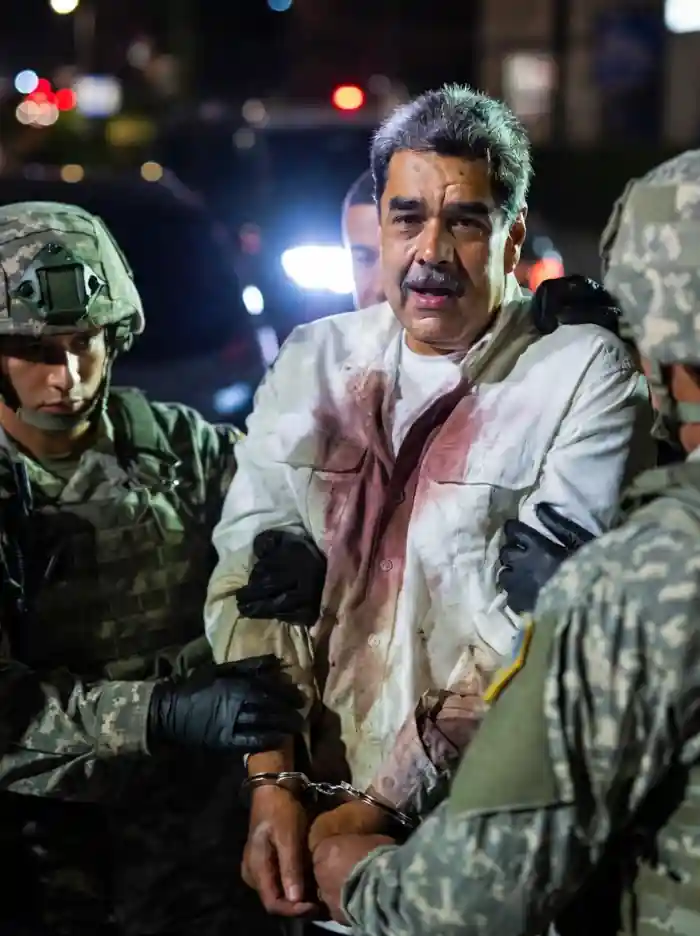
U.S. forces airstriked Venezuelan targets and captured Nicolás Maduro in a raid on Caracas 4th January 2026
By
Tanmoy BHattacharyya
We find ourselves, at the threshold of 2026, caught between worlds both ancient and unprecedented. The year 2025, which prompted speculation that Christian theology might find its terminus in algorithmic intelligences and transhuman capacities, instead brought into sharp relief the stubborn endurance of human conflict, empire building, nationalism, and violence. The most dramatic illustration of this enduring reality is the recent U.S. military strike in Venezuela — an action that resulted in civilian casualties in Caracas, the forcible capture of President Nicolás Maduro and First Lady Cilia Flores, and their subsequent removal to New York for prosecution on narco-terrorism charges. The operation has been likened by international jurists and historians to the 1989 invasion of Panama, drawing widespread condemnation as a violation of national sovereignty and international law, particularly the U.N. Charter’s prohibition on the use of force (Article 2.4). In this event — where geo-politics, natural resources, empire, and military might intersect — we glimpse the enduring urgency of theological reflection: theology has not passed away. On the contrary, it presses deeply on the moral questions of violence, power, dignity, and peace.
As Christians — Catholics, Protestants, Reformed, Orthodox, Pentecostals — we must ask not only what happened but what it means. What does this event disclose about human nature, the structures of political power, and the vocation of the church? How do doctrines developed over centuries — on justice, human dignity, sovereignty, sin, redemption, and peace — illuminate our moment? In what ways does theology remain indispensable amid geopolitical violence, and in what ways must theology itself be stretched, reformulated, or reclaimed?
This reflection unfolds not as a polemic nor as partisan advocacy for any political ideology, but as a theological interrogation of empire, law, human dignity, violence, and hope. It situates the event within the broader tradition of Christian moral reflection, contrasting divine command with secular might, and encapsulating both the critique and the hope substantive enough to withstand the allure of brute power.
Violence and Empire: Christian Theology’s Critique
The prophetic tradition of Scripture rings with denunciations of imperial violence and calls for justice. Amos proclaims: “Let justice roll down like waters, and righteousness like an ever-flowing stream” (Amos 5:24). Micah insists, “What does the Lord require of you but to do justice, and to love kindness, and to walk humbly with your God?” (Micah 6:8). These prophetic indictments are not peripheral to Christian ethics; they are its beating heart. They place justice before violence, calling people of faith to align with God’s desire for flourishing and integrity for all people — not simply for the powerful, the wealthy, or the strategically advantageous.
In the case of Venezuela, the U.S. government presented its military action as a kind of enforced remedy — a decisive strike against narco-terrorism, corruption, and authoritarianism. It is worth acknowledging that Maduro’s regime has been widely criticized for human rights abuses, economic mismanagement, and repression of political opposition. These realities, documented by Venezuelan civil society and international organizations, are serious and deserve ethical engagement, accountability, and solidarity with victims. Yet **theological reflection must ask not only whether a regime is unjust but whether the means chosen to hold it accountable conform to the just structures of political authority that Scripture and tradition uphold.
The Book of Revelation portrays empires as “beasts” that devour the vulnerable (Rev. 13). John’s apocalyptic visions do not offer a simplistic moral equivalence between all powers, but they underscore that imperial forces, when oriented toward domination and greed, stand in antagonism to God’s justice. Liberation theologians — particularly those shaped by the tumultuous history of Latin America — have read Scripture from the underside of empire, diagnosing the ways in which foreign intervention often masks economic hunger (especially for resources like oil) behind high-sounding vocabulary like “freedom,” “security,” or “rule of law.” In the Venezuelan case, where oil riches have historically been pivotal to the nation’s economy, American interest in petroleum cannot be disentangled from its geo-political justification. Christian theology, especially from the perspective of liberation and prophetic witness, therefore compels a critique of imperial violence that unites concern for victims of internal oppression with condemnation of external domination.
It is precisely here that Catholic social teaching — especially in works like Fratelli Tutti — speaks with clarion clarity. Pope Francis condemns “forms of nationalism that hinder international fraternity” and calls for a culture of encounter that resists violence and prioritizes human dignity. War, he insists, cannot be a first resort; love of neighbor demands negotiation, diplomacy, and structures that safeguard both life and cooperation. Aquinas’ just-war tradition — developed through centuries of theological reflection — insists that legitimate military action must be waged by authority, for just cause, with right intention, with probability of success, as a last resort, and with proportionality of means. The U.S. action in Venezuela lacks multilateral authorization (UN Security Council sanction) and fails to pass the most basic criteria of jus ad bellum. Absent imminent threat or interdiction approved by international consensus, it veers toward unilateralism — a posture that theologians across traditions have long criticized as inherently unjust.
The Catholic tradition grounds moral reflection not in power but in the inherent dignity of every human person. The bombing of Caracas, resulting in civilian deaths, is not a collateral damage to be minimized, it is a moral devastation to be mourned. Thousands of Venezuelans identify as Roman Catholic, and their theology of suffering locates pain not in isolation but within the communal body of Christ — where no suffering is private and no violence can be separated from its ethical weight.
Reformed and Protestant traditions provide additional lenses through which to critique imperial action. Karl Barth’s Church Dogmatics (1932–1967) articulates a theology that refuses to worship the state or enshrine any political power as normative. In Barth’s epistemology, the church’s allegiance belongs to the Word of God, not to the nation, not to the empire. When states exalt themselves against God’s covenantal claim on the world, they become “principalities and powers” opposed to the liberating God revealed in Christ. John Calvin’s strong affirmation of natural law and justice does not sanction vigilantism or extrajudicial seizure of leaders; rather, it calls Christians to critique all powers that disregard human rights and dignity. Reinhold Niebuhr’s The Irony of American History highlights the recurring contradiction in U.S. foreign policy — the rhetoric of freedom wielded on behalf of domination. In Venezuela, the announcement that the United States will now “run” the oil fields for stability echoes the very pride and exceptionalism that Niebuhr decried: a moral language of liberation that too easily hides economic self-interest.
Eastern Orthodox theology adds another dimension. The Orthodox concern for sobornost — communal harmony informed by a spirituality of conciliarity — views violent interventions not only as political rupture but as fractures in the cosmic order. Vladimir Lossky’s apophatic mystical theology reminds us that true peace — eirene — flows not from strategic victory over enemies, but from participation in divine energies: love, humility, mercy. For Orthodox Christians, peace is not merely an absence of conflict, but the wholeness of human life in community. When military action undermines the dignity of the person — the imago Dei — it offends the image of God in every brother and sister. Even those who wield power are not to be treated as conveniences in a geopolitical game; they are persons whose salvation remains mysterious and whose redemption, always the hope of the church, cannot be settled through force alone.
Pentecostal communities — charismatic, Spirit-conscious, often among the most marginalized — view such upheavals as arenas of deep spiritual contestation. Drawing on Amos Yong’s theological anthropology, Pentecostals interpret the world as riddled with spiritual forces that shape human action, and they respond with prophetic intercession, lament, and pursuit of justice that refuses to be co-opted by politicking or power plays. Acts 4:32–35 portrays the early church as a community whose goods were shared, not hoarded, and whose solidarity with one another transcended political computation. Pentecostal ethics challenges any narrative that justifies violence on behalf of economic or national gain. Instead, it calls for repentance, reconciliation, and sacrificial solidarity with the suffering.
Across all these traditions, a profound consensus emerges: violence justified by expediency or interest is a distortion of moral life. The U.S. operation — regardless of its aims — carries the specter of original sin writ large. It reveals the systemic powers of pride and domination that theology has long named: the human tendency not merely to fall short of justice, but to assert self-importance as if it were divine right. In this, the theological critique of imperial violence does not concede that all states are identical in moral weight; rather, it refuses to allow any actor to escape scrutiny when actions undermine human dignity and international order.
Imago Dei and the Kidnapping of a Head of State
The forcible apprehension of President Nicolás Maduro — the designation of “kidnapping” employed by international critics is not mere rhetoric — demands a theological reckoning rooted in the doctrine of the imago Dei. Genesis 1:27 affirms that every human being is made in the image and likeness of God. This affirmation transcends political affiliation, legal standing, moral reputation, and even personal culpability. It locates the foundation of human worth not in achievement or virtue, but in existence itself. To treat a person as a means to an end — be it geopolitical leverage or economic control — is to violate this foundational Christian conviction.
This conviction reverberates across traditions. Jesus’ teaching in the Sermon on the Mount (Matt. 5–7) radicalizes moral life away from injury toward love of enemies and non-retaliation. In Matthew 5:44, Christ says, “Love your enemies and pray for those who persecute you.” Paul reiterates in Romans 12:19–21 that vengeance belongs to God: “Beloved, never avenge yourselves, but leave it to the wrath of God … Do not be overcome by evil, but overcome evil with good.” These texts do not naively ignore injustice; rather, they place moral action within a horizon where justice and love persist without recourse to violence.
Catholic social teaching — from Rerum Novarum through Fratelli Tutti — upholds state sovereignty as a protection against anarchy and a safeguard for human dignity. It does not deny that states may face sanctions, international prosecution, or diplomatic pressure, but it insists these must proceed through legitimate multilateral institutions. Extrajudicial capture violates not just international law but also the moral fabric that sustains the community. Solomon’s wisdom pronounces: “Righteousness exalts a nation, but sin is a disgrace to any people” (Prov. 14:34). Employing kidnapping as a strategy — even in the name of justice — subverts that wisdom.
Pentecostal ethics adds a holistic layer here. The Spirit-baptized community understands that punitive justice without the possibility of transformation tends toward death rather than life. The narrative of redemption in Scripture is not merely punishment and reward; it is liberation, reconciliation, restoration. Pentecostal tradition emphasizes that even those most deeply complicit in injustice remain subjects of divine mercy and call for repentance. The forceful extraction of a head of state — powdered with charges, stands of evidence, and robust media narratives — cannot substitute for the deeply tragic work of reconciliation that attends every human community. Pentecostals, attuned to spiritual warfare, see this not as celebration but as summons to prayer for all involved: victims, perpetrators, and bystanders caught in the spiral of violence.
The capture also raises questions of extradition versus sovereignty, of national self-determination versus international justice. Theology does not sanction tyranny. Leaders who perpetrate harm deserve accountability. But accountability must be grounded in procedures that respect human dignity, not merely in the rhetoric of criminality attached to convenient geopolitical narratives. The refusal to engage with tribunals like the International Criminal Court — citing instead unilateral military action — reveals the inequities embedded in global governance structures. Theology champions a higher justice, one that demands fairness, due process, and respect for all persons — even those we find morally repugnant.
Theological Anthropology, Empire, and Human Worth
This episode also confronts a theological anthropology rooted in the imago Dei. Human beings are not merely biological units, econometric data points, or political variables. They are beings of intrinsic worth, relational beings summoned to communion. This anthropology resists any calculus that treats life as raw material for geopolitical ends. It stands against functional reductionism — the idea that value derives from utility, cooperation, or compliance — and insists that every life bears divine inscription.
In the wake of violence, theology calls for lament, a practice embedded deeply in Scripture and tradition. Habakkuk’s protest to God — “How long, O Lord?” — models a theology of mourning that refuses to sanitize suffering for theological convenience. Catholic liturgical practice, especially in funeral rites and memorials, trains communities to name loss without evasion. Protestant lamentation psalms voice the anguish of a people bereft of justice. Orthodox iconography of Christ’s descent into Hades imagines divine presence in the depths of suffering. Pentecostal lament becomes intercessory prayer for liberation. These practices testify that theology is not indifferent to suffering; it enters deeply into it.
In this moment, Venezuelan civilians — disproportionately affected by war planes and political instability — embody the face of God as much as any emperor or dictator. Theology demands that their suffering not be subsumed under strategic pro/con analyses. It calls communities of faith worldwide to embody solidarity — not merely through commentary but through prayerful accompaniment, advocacy for humanitarian aid, and critique of policies that perpetuate suffering.
International Law and Divine Justice
International law — while secular — historically reflects moral intuitions about community conduct. The U.N. Charter’s prohibition of force without Security Council authorization is not a bureaucratic quirk; it is an attempt to institutionalize peace after centuries of inter-state bloodshed. Christian theology does not abdicate moral responsibility to secular institutions, yet it can affirm structures that protect peace and restrict violence. Theologians across traditions have historically supported international norms that limit war precisely because they accord with the biblical thirst for justice and shalom (peace as wholeness).
In this light, the Venezuelan invasion becomes not merely a political scandal but a moral rupture that prompts urgent theological reflection. Theology, far from irrelevant, has tools for moral critique that secular frameworks cannot provide on their own. It invokes sin where secularism sees mere strategy. It names domination where realism sees national interest. It calls for reparations where legality seeks punishment.
The Future of Theology in Geopolitics and Technological Disruption
A striking question follows from our broader lecture series: Does theology retain relevance in an era of geopolitical upheaval and emergent technologies? The answer, grounded in this unfolding reality, is unequivocal: yes. Theology retains its relevance precisely because it addresses the perennial human questions that neither geopolitics nor technology can fully answer — questions about dignity, suffering, the common good, vocation, forgiveness, reconciliation, and hope.
The recent Vatican document Antiqua et Nova (2025), while focusing on AI and human intelligence, also declares what is intuitively evident in the events in Venezuela: technology and data are tools; they do not replace moral agency, conscience, or relational intelligence. Geopolitical reasoning might rely on cost benefit analysis, predictive models, or strategic dominance, but theology asks: Whose life is this? Whom does violence serve? What kind of future are we making together?
In Venezuela’s Catholic context, theology provides moral vocabulary absent in realpolitik—e.g., sin, redemption, shalom. Liberation theology equips resistance to imperialism, while ecumenical dialogues (e.g., World Council of Churches) foster peacebuilding.
AI’s rise has accelerated narratives about efficiency, optimization, and control — paradigms that can dangerously permeate political life. When states start thinking of citizens as data points or national interests as equations, theology must intervene with anthropology rooted in the imago Dei. What does it mean to treat a person as more than an economic variable? What does it mean to measure success by the flourishing of all, not merely the security of some?
In an age where algorithmic governance, surveillance tech, and automated decision-making shape social life, theology humanizes morality. It refuses to let virtue be reduced to utility. It insists that love — not optimization — remains the highest good. It reminds that justice without mercy injures, and mercy without justice fails neighbors in need.
Theology’s “end,” if ever it comes, is not the subsidence of human conflict into algorithmic bliss. Theology’s end is eschatological — a future consummated not by human engineering but by divine fulfillment. Until that horizon, theology remains indispensable. It provides vocabulary for lament absent from realpolitik. It offers frameworks of reconciliation unavailable to purely secular discourse. It calls rulers and nations to account not just before international law but before God.
Toward True Peace: Theological Vision and Practical Paths
Does theology retain relevance amid such events, especially in an AI-driven age of “rational” geopolitics? Unequivocally yes. As our series “The Beginning and End of Christian Theology 2025” explored, theology endures not despite crises but through them, offering a transcendent critique where secular frameworks falter.
So what is the theological response — not simply polemical critique, but constructive wisdom for action?
First, lament and solidarity with victims. Theology trains us not to rush to judgment or to toe lines of power, but to enter into the grief of those who suffer most deeply. Venezuelan civilians are not collateral casualties; they are crying stones whose laments rise with sacramental intensity before the God who hears the oppressed.
Second, prophetic witness against unjust use of force. Prophets do not shy away from calling power to account. Theology reinforces that national greatness that depends on domination is a parody of greatness. True greatness belongs to those who turn swords into plowshares.
Third, advocacy for reparative justice. International tribunals, diplomatic forums, humanitarian deployments, and reparations for victims are not optional niceties; they are moral necessities. Theology demands that justice be restorative, not retributive.
Fourth, ecumenical cooperation for peacebuilding. Catholic, Orthodox, Protestant, Reformed, Pentecostal communities can form alliances committed to peace and human dignity. Global ecumenical bodies like the World Council of Churches have a role not merely of witnessing but of mobilizing for reconciliation.
Fifth, ethical formation amid technological disruption. Theology must contribute to shaping the moral frameworks that will govern AI, warfare tech, economic systems, and civic life. Theology’s voice in bioethics, digital ethics, and human rights discourse remains vital.
Sixth, resilience of hope. Christian faith is not blind optimism. It refuses despair because it anchors itself in the God who raised Christ from the dead — a power stronger than empire, violence, and death. Hope sustains activism without cynicism, love without surrender to despair.
A Final Prayerful Exhortation
If theology ends, it does not end in the closing bracket of history but in the consummation of all things in God’s justice and mercy. Empire will not vanish because laws are passed nor because technology advances. Empire dissolves when hearts turn from domination toward neighbor-love. That remains theology’s task.
In this unfolding drama — of geopolitics, technology, and mortal dignity — we hold fast to the courage to lament, the discipline to discern, the compassion to act, and the hope to endure. We do not shy away from complexity. We do not reduce moral life to algorithms. We do not surrender human worth to the exigencies of power. Instead, we stand with the oppressed, challenge the unjust, and proclaim a vision of peace that no cannonade nor conquest can destroy.
Theology’s “end” is eschatological, not technological or geopolitical. It adapts, as in digital evangelism or AI-augmented scriptural study, while prophetically challenging abuses like this invasion. In a world of eroding international norms, theology’s call to justice (Isa. 1:17) ensures its perpetuity, guiding humanity toward God’s kingdom amid empire’s shadows.
May God grant us wisdom that judges rightly, courage that refuses violence, mercy that heals wounds, and hope that insists upon life for all.