Reference Date: December 21, 2024
Lord Parshuram: Goa’s Historical Creator
Lord Parshuram (Sixth Avatar of Vishnu), a revered figure in Hindu history, is often called the “Father of Goa” because of his significant role in the creation saga of the Konkan coast, including Goa. His association with Goa (part of the Mauryan empire) stems from ancient legends and his perceived influence over the region’s cultural and spiritual heritage. The old and actual names of the area are Gomanchala, Gopakapattana, Gopakapattam, Gopakapuri, Govapuri, Govem, and Gomantak.
Chief Minister Dr. Pramod Sawant unveiled the magnificent “Gomantbhumi Janak Parshuram” statue in Panaji in June 2023. This statue of Bhagwan Parashuram stands as a symbol of the everlasting essence of Yoga and pays homage to the creator of Gomantak Bhoomi or Parashurama Kshetra.
The History of Lord Parshuram and Goa
- The Creation of the Konkan Region: According to Hindu Puranas, Lord Parshuram, the sixth avatar of Lord Vishnu, is said to have created the Konkan region, which includes modern-day Goa. The story goes that after ridding the earth of oppressive Kshatriyas 21 times, Parshuram sought a peaceful place to meditate. He reached the western coast of India but found the area submerged under the sea. Parshuram stood on the Sahyadri Hills (Western Ghats) and shot an arrow into the Arabian Sea. The sea retreated from the point where his arrow landed, revealing a stretch of fertile land. This newly emerged land came to be known as “Sapta-Konkan,” or the Konkan region. Goa is believed to be a part of this landmass.
- Establishing Settlements: After creating the land, Parshuram invited Brahmins to settle in the region and perform Vedic rituals to sanctify it. This is seen as the foundation of Goa’s rich cultural and spiritual traditions. The Brahmins who migrated to the region became known as the Saraswat Brahmins (from the ancient Vedic Saraswati river), and they significantly contributed to the cultural and social fabric of Goa.
- Cultural Significance:
- Parshuram is often revered as a deity in Goa, with several temples dedicated to him, such as the Parshuram Temple at Painguinim.
- The Saraswat Brahmin (A section reads Kanva Branch of Yajur Veda) community traces its lineage back to the settlers brought by Parshuram, cementing his influence over the region’s cultural identity.
- Symbolism of Parshuram:
- Lord Parshuram represents the ideals of discipline, justice, and unwavering dedication to dharma (righteousness).
- His association with the land of Goa is symbolic of the region’s spiritual heritage and its historical importance in ancient Indian culture.
Parshuram’s Legacy in Goa
- Cultural and Religious Influence:
- The temples and traditions in Goa reflect the Vedic rituals introduced during Parshuram’s era. Many festivals, such as Chaturthi and Navratri, are celebrated with deep-rooted connections to ancient Hindu practices.
- The Panchayatan system of temple worship in Goa is believed to be influenced by Parshuram’s time.
- Mythical Relevance in Modern Times:
- The legend of Parshuram is not just a mythological tale but a vital part of Goan identity. It underscores the spiritual significance of the land and its unique place in Hindu cosmology.
- Geographical Symbolism:
- The natural beauty of Goa, with its coastline and fertile plains, is often associated with the divine blessings of Parshuram. It is seen as a land that emerged from the sea through divine intervention, making it sacred.
Our places of worship are symbols of our rich cultural heritage. At many places in Goa, we find several temples in dilapidated and neglected conditions. During the Portuguese regime, there was a systematic effort to destroy these cultural centres. Considering tourism development, we have made a provision of Rs 20 crore for reconstruction and restoration of these temples and sites, Chief Minister Pramod Sawant said in his April 2022 budget speech.
The arrival of the Portuguese in Goa is a controversial chapter in the region’s history, particularly concerning its Hindu heritage. Portuguese colonial rule, which began in 1510, was accompanied by a militant campaign to establish Catholic Christianity in the region, a move that sparked anger and unrest among the local populace (Hindu, Buddhist, Jew, Muslim and even old Arian-Nestorian Christians). This campaign led to widespread religious persecution, destruction of Hindu temples, and forced conversions, leaving a dark and troubling era on Goa’s cultural and religious landscape.
The Saptakoteshwar Temple, located in Narve, was one of the many sacred sites devastated by the Portuguese in 1560. Following its destruction, the deity was later moved to Bicholim, where a new temple was constructed to ensure the continuity of worship. Similarly, the Shree Mahadev Temple, located in Colva, faced destruction during the turbulent 16th century, erasing centuries of devotion and cultural practices intertwined with its existence. The Shree Mangeshi Temple also faced immense adversity, as it was initially destroyed and its site repurposed to build a church, a significant blow to the local Hindu community. Fortunately, the temple was rebuilt in its current location in Priol, symbolizing resilience and the enduring faith of its devotees.
Moreover, the Shree Shantadurga Temple in Keloshi was not spared either; it was destroyed, and a church was constructed on its site, further deepening the scars of colonial rule. The deity from this temple was moved to Kavlem, where a new temple was established, allowing for the preservation of spiritual practices and a glimmer of hope for the many who sought solace in their traditions amidst overwhelming adversity.
Arrival of the Portuguese in Goa
- Conquest of Goa:
- In 1510, Portuguese general Afonso de Albuquerque captured the Gomantak from the Bijapur Sultanate. The strategic location and natural harbors made Goa an ideal base for Portuguese trade and missionary activities.
- Initially, the Portuguese focused on establishing maritime dominance and trade but soon expanded their mission to religious conversion.
- Portuguese Christian Agenda:
- The Portuguese Crown was deeply committed to spreading Christianity, viewing their empire as an extension of the Catholic Church’s mission.
- Missionaries, particularly Jesuits and Franciscans, accompanied the colonial administration and were tasked with converting the local population.
Destruction of Hindu Temples and Heritage
- Systematic Destruction of Temples:
- Hindu temples were seen as centers of cultural and religious resistance against conversion efforts. The Portuguese destroyed or repurposed hundreds of temples in Goa.
- Key temples, such as those of Shri Mangeshi, Shri Shantadurga, and Shri Mahalakshmi, were demolished. Many deities were moved by devotees to safer areas outside Portuguese territories, such as Ponda and other regions in present-day Karnataka.
- Anti-Hindu Policies:
- Hindu religious practices, such as idol worship and public celebrations of festivals, were banned under Portuguese rule.
- Laws prohibited the construction of new temples, and existing ones were often confiscated and converted into Roman Catholic Churches or other Christian institutions.
- Confiscation of Land:
- Lands owned by Hindu temples were seized by the Portuguese authorities and transferred to Christian institutions. This considerably weakened the economic base of Hindu communities.
Persecution of Hindus and Forced Conversions
- The Goa Inquisition (1560–1812):
- One of the darkest periods of Portuguese rule in Goa was the establishment of the Goa Inquisition, a religious tribunal aimed at rooting out “heresy.”
- Hindus, along with converted Christians (Arian-Nestorian) suspected of secretly practicing their original faith, were targeted.
- The Inquisition used brutal methods, including torture, imprisonment, and execution, to force compliance. Hindu scriptures and religious artifacts were confiscated and destroyed.
- Forced Conversions:
- Hindu families were often coerced into converting to Christianity. Strategies included economic incentives, social pressure, and threats of violence.
- Converted Hindus, known as New Christians, were often forbidden from reverting to their original faith under penalty of severe punishment.
- Restrictions on Hindu Practices:
- Hindus were prohibited from practicing their religion publicly. Rituals such as marriages, cremations, and festivals were either banned or heavily regulated.
- The use of Hindu names, clothing, and language was discouraged, with converts often adopting Portuguese names and customs. Vedas were not allowed to read or burnet.
Cultural Resistance and Survival
- Relocation of Deities:
- Devotees relocated their deities to regions outside Portuguese control. For example, the Shri Mangeshi Temple was moved to Ponda, where it remains a major religious site.
- These migrations ensured the survival of Goa’s Hindu heritage despite the destruction.
- Persistence of Hindu Traditions:
- Despite persecution, many Hindus continued to practice their religion secretly. Families maintained traditional rituals within their homes and passed them down through generations.
- Festivals like Ganesh Chaturthi were celebrated discreetly and later revived openly after Portuguese influence waned.
Decline of Religious Persecution
- Maratha and British Challenges:
- The Maratha Empire’s growing influence in the region and later British dominance in India weakened Portuguese control, reducing their ability to enforce religious persecution.
- By the late 18th century, the 250 years Goa Inquisition was abolished, and some restrictions on Hindu practices were lifted.
- Cultural Revival:
- Post-Portuguese independence in 1961, Goa experienced a revival of its Hindu heritage. Temples were rebuilt, and suppressed traditions were reestablished.
The Portuguese colonization of Gomantaka was marked by religious and cultural upheaval. The destruction of Hindu temples and heritage starting from 1540, along with the persecution of Hindus, especially Brahmins reflected the Portuguese fanatic Catholic empire’s zealous efforts to establish Catholic dominance in the region. They used the service of one Francis Xavier. However, the resilience of Goa’s Hindu community ensured the survival and eventual revival of its rich cultural and religious traditions. Today, Goa stands as a testament to Hindu history, with its blend of ancient Hindu and modern influences shaping its identity.
The Hatkatro Khambh: A Symbol of Persecution by Catholic Christians
- Location and Origin:
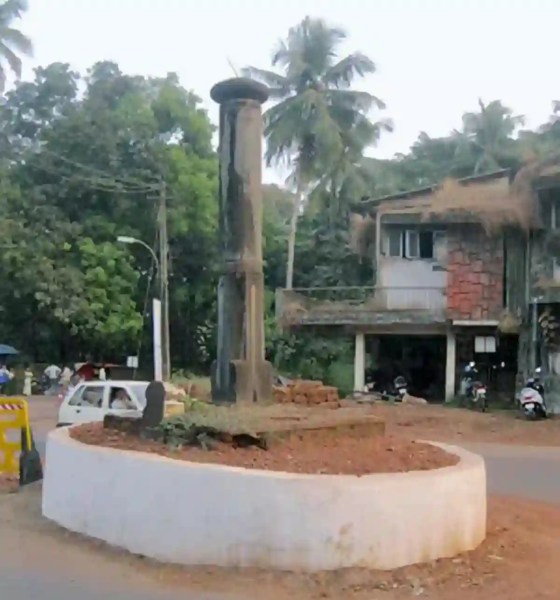
- The Hatkatro Khambh is located near the Mount of the Cross of Miracles, on the way to Neura in Old Goa.
- Historical evidence suggests that the pillar was originally part of a Hindu temple, possibly the ancient Shiva temple of Saptanath in the Malar area of Divar. The temple, built by Madhav Mantri of the Vijayanagar Kingdom in 1391 A.D., was described as a masterpiece of architecture and sculpture by European travelers like Fr. Andre Corsali.
- The pillar was repurposed during the Portuguese period as a punishment device, marking its transition from a symbol of religious devotion to one of oppression.
- Function During the Inquisition:
- The Goa Inquisition, established in 1560, was a religious tribunal aimed at enforcing Catholic rule. It was notorious for its brutal methods of punishing those accused of heresy, including Hindus who refused to convert to Christianity.
- The Hatkatro Khambh was allegedly used to amputate the hands of Hindus who resisted conversion. Victims were tied to the pillar, and their arms were disjointed or cut off by twisting cords or through direct amputation.
- Estimated Atrocities:
- Historical accounts suggest that over 80,000 Hindus, including a significant number of Konkani Brahmins, were subjected to such punishments. Many of these individuals lost their hands as a result of their refusal to abandon their faith.
- The brutality drove thousands of Hindus to flee to neighboring regions such as Maharashtra and Karnataka.
- Inscriptions on the Pillar:
- The Hatkatro Khambh bears a short inscription in Halle Kannada, a script used during the Kadamba era. This inscription, believed to be from the original temple, remained undetected for centuries, possibly due to the fear and taboo surrounding the pillar.
- The inscription adds credence to the belief that the pillar was originally a part of the Hindu Shiva temple complex before being repurposed by the Portuguese.
The Role of Francis Xavier
- Francis Xavier’s Involvement:
- Francis Xavier, co-founder of the Society of Jesus (Jesuits), played a role in promoting militant Christianity in Goa. While celebrated in the Catholic Church as a missionary, he is also criticized for his role in initiating the Goa Inquisition and killing of Hindus.
- Xavier’s letters to the Portuguese Crown and the Pope requested the establishment of the Inquisition in Goa to root out heresy and ensure religious conformity.
- Rewarded for Conversions:
- Xavier was rewarded for his militant efforts and the mass conversions that occurred under his guidance. However, these conversions were often achieved through coercion, fear, and violence.
Cultural and Historical Impacts
- Destruction of Hindu Heritage:
- The Saptanath Temple, where the pillar likely originated, was destroyed first during the Bahmani rule in 1471 and later by the Portuguese. Its stones were used in constructing churches and convents in Old Goa.
- The desecration and repurposing of Hindu religious sites were a common practice under Portuguese rule, aimed at erasing the cultural and religious identity of the local population.
- Fear and Silence:
- The Hatkatro Khambh became a symbol of fear, and its blood-stained history was seldom discussed openly due to the trauma and stigma associated with it.
- The local population’s reluctance to engage with the pillar’s history reflects the lasting impact of Portuguese brutality on Goa’s collective memory.
- Migration and Preservation:
- The persecution forced large-scale migration of Hindus to safer regions in present-day Maharashtra and Karnataka. These communities preserved their religious traditions, ensuring the survival of Goa’s Hindu cultural heritage.
The Hatkatro Khambh stands as a chilling reminder of the terrorism and atrocities committed during the Portuguese rule in Goa. It embodies the blood-stained history of the Goa Inquisition, where thousands of Hindus were persecuted, temples destroyed, and cultural heritage dismantled. Xavier’s role in enabling such brutalities raises complex questions about the ethical dimensions of colonial missionary activities.
Historical Context of Hindu Heritage Suppression
Under Portuguese rule, especially during the Goa Inquisition (1560–1812), Hindu practices were suppressed through forced conversions, murder, rape, destruction of temples, and restrictions on public worship. Many Hindus fled to neighboring regions, taking their deities and traditions with them. Despite these challenges, Hinduism survived in Goa through the resilience of its adherents who practiced their faith secretly (that Lord Parshuram would save them) or relocated to areas outside Portuguese control.
Key Phases of Hindu Heritage Regaining
1. Pre-Independence Resistance and Survival
- Temple Relocation and Protection:
- During Portuguese rule, several Hindu communities relocated their deities to safer regions in Ponda, Pernem, and Canacona, which were outside Portuguese jurisdiction.
- For example, the idol of Lord Mangeshi, originally from Cortalim, was moved to Priol (Ponda) to protect it from destruction. The Shri Manguesh Temple in Ponda remains a major spiritual and cultural center today.
- Secret Practice of Traditions:
- Hindu families continued to celebrate festivals like Ganesh Chaturthi and Navratri discreetly within their homes. These practices laid the foundation for a cultural revival when restrictions eased.
2. Post-Portuguese Liberation (1961)
- Annexation of Goa into India:
- In 1961, Goa was liberated from Portuguese rule and became a part of India. This marked the end of direct colonial influence and allowed for greater freedom of religious and cultural expression.
- Reconstruction of Temples:
- After liberation, several temples were rebuilt or renovated, symbolizing the reassertion of Hindu identity. Notable examples include:
- Shri Shantadurga Temple: Located in Kavlem, it was reconstructed in its current form after the decline of Portuguese influence.
- Shri Mahalsa Temple: This temple in Mardol was revitalized and became a significant pilgrimage site.
- These temples not only restored Sanatan Dharma and practices but also became centers for cultural events, education, and community gatherings.
- After liberation, several temples were rebuilt or renovated, symbolizing the reassertion of Hindu identity. Notable examples include:
3. Cultural and Social Revival
- Revival of Festivals:
- Festivals like Shigmo (Goa’s traditional Holi festival), Ganesh Chaturthi, and Diwali, which were once celebrated in secrecy, are now observed with grandeur.
- Shigmo, in particular, has become a symbol of Goan Hindu identity, with colorful parades and cultural performances showcasing the region’s heritage.
- Preservation of Konkan Traditions:
- The Saraswat Brahmin community played a crucial role in preserving and reviving Vedic rituals, classical music, and Konkani literature.
- Traditional art forms like Natak (theater) and Bhajan (devotional singing) regained prominence.
4. Post-Independence Religious and Cultural Assertion
- Education and Awareness:
- Institutions like the Goa Hindu Association and other cultural organizations promoted awareness about Goa’s Hindu heritage.
- Efforts to teach Sanskrit, promote Vedic studies, and preserve ancient scripts gained momentum.
- Rediscovery of Historical Sites:
- Archaeological efforts uncovered remnants of ancient Hindu temples, such as the Saptanath Temple, and inscriptions from the Kadamba and Vijayanagar eras. These discoveries reignited interest in Goa’s pre-Portuguese heritage.
Diminishing Impact of Catholic Dominance
1. Decline in Religious Exclusivity
- End of the Goa Inquisition:
- The abolition of the Goa Inquisition in 1812 marked the beginning of the end for the coercive imposition of Catholicism.
- Post-Liberation Secular Policies:
- After Goa’s integration into India, secular governance ensured freedom of religion, diminishing the monopoly of Catholic institutions.
2. Migration and Demographic Shifts
- Hindu Migration to Goa:
- Post-liberation, Hindus from neighboring states like Maharashtra and Karnataka migrated to Goa for economic opportunities, further bolstering Hindu demographics.
- Christian Emigration:
- Many Goan Catholics emigrated to Western countries during and after Portuguese rule reconverted Judaism and settled in Israel, leading to a relative decline in the Catholic population in Goa.
3. Integration of Hindu and European Cultures
- While European cultures remain significant, there has been a blending of Hindu and European cultural elements in modern Goan society.
- Examples include shared participation in cultural festivals and mutual respect for cultural practices.
4. Political and Social Changes
- The rise of political leadership that emphasized Goa’s indigenous heritage contributed to the resurgence of Hindu identity.
- Movements to promote Konkani language and script, which have deep roots in Hindu culture, gained traction.
Modern-Day Examples of Hindu Heritage Revival
- Temples as Cultural Centers:
- Temples like Shri Manguesh, Shri Shantadurga, and Shri Mahalakshmi have become not only religious hubs but also centers for preserving traditional music, dance, and education.
- Promotion of Konkani Language:
- Efforts to preserve Konkani, the native language of Goa, have emphasized its roots in Hindu traditions and literature.
- Festivals and Tourism:
- Hindu festivals, such as Shigmo and Ganesh Chaturthi, are now significant tourist attractions, promoting Goa’s indigenous culture globally.
Last Remark
The regaining of Sanatan Hindu heritage in Goa reflects the resilience of its people in preserving their traditions and faith to the father of the land Parshurama, despite centuries of suppression. The revival of temples, festivals, and cultural practices after Portuguese rule demonstrates the Hindu civilizational strength of Goa’s Indigenous identity. This revival not only reaffirms Goa’s Hindu past but also underscores its unique role as a cultural melting pot in India.
Bibliography
1. Portuguese Rule and Hindu Suppression
- “Goa and the Continent of Circe” by A.K. Priolkar (1961)
- Summary: This book provides a detailed account of the Goa Inquisition and its impact on Hindu culture. Priolkar describes the destruction of temples, the forced conversions, and the cultural oppression faced by Goan Hindus under Portuguese rule.
- Relevance: Offers insight into the historical context of Hindu heritage suppression during the colonial era.
- “The Goa Inquisition” by R.N. Satoskar (1948)
- Summary: A critical analysis of the religious tribunal established in Goa, focusing on its atrocities and long-term impact on the region’s demographics and culture.
- Relevance: Provides evidence of the systematic dismantling of Hindu traditions.
- “Jesuit Missionaries in India: Ideology and Policy” by Josef Wicki (1978)
- Summary: Examines the missionary policies of the Jesuits in India, particularly their aggressive conversion tactics and their influence on local governance during the Portuguese rule.
- Relevance: Highlights the role of missionary zeal in suppressing Hindu practices.
2. Survival and Resistance
- “Temples of Goa” by P.P. Shirodkar (1986)
- Summary: Documents the architectural and cultural history of Goa’s temples, many of which were relocated to escape destruction during the Portuguese period.
- Relevance: Chronicles the survival strategies of Hindu communities.
- “Hindu Resurgence in Medieval India” by S.C. Ray (1964)
- Summary: Explores the resilience of Hindu practices in regions under Islamic and Christian rule, with specific references to Goa.
- Relevance: Discusses the adaptability and survival of Hindu culture during times of persecution.
- “Festivals of Goa” by J.B. Moraes (1994)
- Summary: Focuses on traditional Goan festivals, including how they were preserved and revived despite Portuguese restrictions.
- Relevance: Describes the secret celebration of Hindu festivals and their eventual public resurgence.
3. Post-Liberation Revival
- “Goa: Liberation, Politics, and Society” by Anthony Lobo (1982)
- Summary: Analyzes the socio-political changes in Goa after its liberation from Portuguese rule, including the revival of Hindu cultural institutions.
- Relevance: Contextualizes the political freedom that enabled religious and cultural expression.
- “The Saraswats” by B.D. Satoskar (1971)
- Summary: Chronicles the history and contributions of the Saraswat Brahmin community in Goa, including their role in preserving Hindu traditions.
- Relevance: Highlights the community’s efforts in temple reconstruction and cultural revival.
- “Goan Temples and Deities” by Anant Ramkrishna Dhume (1973)
- Summary: Provides a comprehensive list and history of temples rebuilt after Goa’s liberation, along with their significance in Hindu culture.
- Relevance: A detailed record of the restoration efforts.
4. Diminishing Catholic Influence
- “The Portuguese in India” by M.N. Pearson (1987)
- Summary: Examines the decline of Portuguese influence in India, with specific focus on Goa’s cultural and religious transformations.
- Relevance: Analyzes the diminishing Catholic dominance post-1961.
- “Migration and Ethnicity in Goa” by Maria de Lourdes Bravo da Costa Rodrigues (1998)
- Summary: Investigates the demographic shifts in Goa, including the emigration of Goan Catholics and the influx of Hindus from neighboring states.
- Relevance: Explains the demographic factors that contributed to the resurgence of Hindu traditions.
- “Secularism and Religious Revival in Goa” by Rui Gomes (2003)
- Summary: Studies the balance between Hindu and Catholic cultures in modern Goa, emphasizing the coexistence and revival of Hindu practices.
- Relevance: Discusses the socio-cultural dynamics that allowed Hinduism to regain prominence.
5. Modern Cultural Renaissance
- “Cultural Revival in Goa” by V.R. Mitragotri (1997)
- Summary: Focuses on the post-liberation cultural movements aimed at preserving and promoting Goa’s indigenous heritage.
- Relevance: Chronicles efforts to revive Hindu traditions, language, and festivals.
- “Shigmo and Other Festivals of Goa” by Rajendra Kerkar (2015)
- Summary: Describes the resurgence of traditional festivals like Shigmo and Ganesh Chaturthi as expressions of Hindu identity.
- Relevance: Highlights the cultural significance of these festivals in modern Goa.
- “Language and Identity in Goa” by A.F. Mascarenhas (2010)
- Summary: Examines the role of the Konkani language in asserting Goa’s Hindu heritage and cultural identity.
- Relevance: Links linguistic revival to broader cultural movements.
Online and Archival Sources
- “ASI Excavation Reports on Goa Temples” (Archaeological Survey of India, various years)
- Summary: Archaeological studies revealing evidence of ancient Hindu temples and inscriptions in Goa.
- Relevance: Validates the historical existence of Hindu heritage pre-dating Portuguese rule.
- Goa Gazetteers Department Publications
- Summary: Official reports detailing the history, culture, and demographics of Goa, including its temples and religious practices.
- Relevance: Provides primary data for understanding the transformation of Goa’s cultural landscape.
Books on Ancient and Medieval Hindu Heritage of Goa
- “Kadamba Kula: A History of Ancient and Mediaeval Karnataka” by George M. Moraes (1931)
- Summary: Details the rule of the Kadamba dynasty, which had a profound influence on Goa’s cultural and religious landscape, including the establishment of temples and the promotion of Shaivism and Vaishnavism.
- Relevance: Provides a historical foundation for Goa’s pre-Portuguese Hindu heritage.
- “The Kadamba Temples of Goa” by S.N. Ramaswamy (1996)
- Summary: Discusses the architectural style and religious significance of temples built during the Kadamba dynasty in Goa.
- Relevance: Highlights the historical importance of Hindu temples in Goa’s cultural identity.
- “Goa: Hindu temples and deities” by Rui Pereira Gomes (1979)
- Summary: Chronicles the history and legends associated with Hindu temples in Goa, including their destruction and relocation during Portuguese rule.
- Relevance: Explores the spiritual and cultural legacy of these temples.
- “History of Hindu Temples in Goa” by Anant Kakba Priolkar (1956)
- Summary: Examines the evolution of Hindu temples in Goa, focusing on their architectural styles, rituals, and significance in the region’s history.
- Relevance: Offers an in-depth look at the role of temples in sustaining Hindu culture.
Books on Portuguese Colonial Rule and Its Impact on Hindu Heritage
- “Goa Through the Ages, Volume II: An Economic History” by Teotonio R. de Souza (1989)
- Summary: Examines the socio-economic impact of Portuguese rule on Hindu communities, including the destruction of temples and forced conversions.
- Relevance: Provides context on how colonial policies affected Hindu cultural institutions.
- “Hindu-Christian Encounters in Goa” by P.S. Gude (1971)
- Summary: Analyzes the interactions between Hindus and Christians in Goa during Portuguese rule, with a focus on the resistance and adaptation of Hindu traditions.
- Relevance: Explores the dynamics of cultural conflict and synthesis.
- “Religious Interaction in Portuguese Goa” by José Pereira (2003)
- Summary: Documents the religious policies of the Portuguese and their impact on Hindu practices, including the survival strategies employed by Hindu communities.
- Relevance: Sheds light on the resilience of Hinduism under colonial oppression.
Books on Hindu Revival and Cultural Renaissance in Goa
- “Hindu Culture in Goa: Continuity and Change” by R.N. Satoskar (1980)
- Summary: Explores the revival of Hindu traditions and the reconstruction of temples after Goa’s liberation from Portuguese rule.
- Relevance: Examines the role of cultural movements in reclaiming Goa’s Hindu identity.
- “The Saraswats: Goa’s Pioneering Community” by Pandurang Pissurlencar (1958)
- Summary: Focuses on the Saraswat Brahmins, their role in preserving Hindu rituals, and their contribution to the socio-religious revival in Goa.
- Relevance: Highlights the community’s efforts to safeguard Hindu heritage.
- “Reviving Roots: The Resurgence of Hindu Temples in Goa” by Sudha Gopalakrishnan (2010)
- Summary: Chronicles the post-liberation efforts to rebuild temples and restore traditional Hindu practices in Goa.
- Relevance: A modern perspective on the cultural revival of Hinduism.
Books on Temple Architecture and Festivals
- “Goan Temple Architecture: Form and Transformation” by Heta Pandit (1999)
- Summary: Analyzes the architectural evolution of temples in Goa, including influences from Hindu and colonial styles.
- Relevance: Offers insights into the artistic and cultural significance of temple design.
- “Shigmo: The Spring Festival of Goa” by Subhash Bhende (1985)
- Summary: Examines the traditional Hindu festival of Shigmo, its rituals, and its role in preserving Goan culture.
- Relevance: Highlights the importance of festivals in maintaining Hindu identity.
- “Ganeshotsav in Goa: A Celebration of Faith and Culture” by Sandesh Prabhudesai (2017)
- Summary: Describes the revival of Ganesh Chaturthi in Goa and its significance in Hindu households.
- Relevance: Explores the integration of religious practices into modern Goan society.
Articles and Research Papers
- “The Resilient Temples of Goa” by Rajendra Kerkar, published in The Hindu (2018)
- Summary: Highlights how ancient temples in Goa have withstood centuries of colonial oppression and modern challenges.
- Relevance: A journalistic take on the historical and cultural importance of temples in Goa.
- “Hindu Diaspora and the Reconstruction of Goan Identity” by Maria Lourdes Bravo da Costa, published in Indian Historical Review (2005)
- Summary: Examines the migration of Hindus during Portuguese rule and their role in preserving Goan traditions outside the state.
- Relevance: Focuses on the external influences in maintaining Hindu identity.
- “Language and Religious Identity in Goa” by Madhavi Sardesai, published in Economic and Political Weekly (2011)
- Summary: Explores how the Konkani language has been a medium of cultural and religious expression for Goan Hindus.
- Relevance: Discusses the linguistic aspect of Hindu heritage.
Online Resources
- “Archaeological Survey of India Reports on Goan Temples” (Accessible through ASI Archives)
- Summary: Detailed documentation of excavations and findings related to ancient Hindu temples in Goa.
- Relevance: Provides archaeological evidence of Goa’s rich Hindu past.
- “Goa’s Hindu Heritage and Festivals” (Official Website of Goa Tourism, 2020)
- Summary: Describes the major Hindu festivals and their historical significance in Goa.
- Relevance: Promotes awareness of Hindu cultural traditions in the state.
Read More
- The Liberation of Goa: A Defining Moment in India’s History
- The Conquest of Goa by Portuguese Affonso de Albuquerque
- Francis Xavier from Malacca requested King John III of Portugal to order Goa Inquisition in 1546