Skip to content

ADVOCATETANMOY LAW LIBRARY

Research & Library Database

Primary Menu
  • News
  • Opinion
  • Countries198
    • National Constitutions: History, Purpose, and Key Aspects
  • Judgment
  • Book
  • Legal Brief
    • Legal Eagal
  • LearnToday
  • HLJ
    • Supreme Court Case Notes
    • Daily Digest
  • Sarvarthapedia
    • Sarvarthapedia (Core Areas)
    • Systemic-and-systematic
    • Volume One
07/04/2026
  • Law Library

Principles of Relevance and Materiality

The law of evidence is grounded in the principle of relevance, which establishes a fact's admissibility based on its rational connection to consequential matters. All relevant evidence is admissible unless excluded by legal mandates. Relevance filters out immaterialities, ensuring rational adjudication while empowering the tribunal to assess evidential weight.
advtanmoy 18/11/2025 2 minutes read

ยฉ Advocatetanmoy Law Library

  • Share on WhatsApp (Opens in new window) WhatsApp
  • Share on X (Opens in new window) X
  • Share on Facebook (Opens in new window) Facebook
  • Share on Telegram (Opens in new window) Telegram
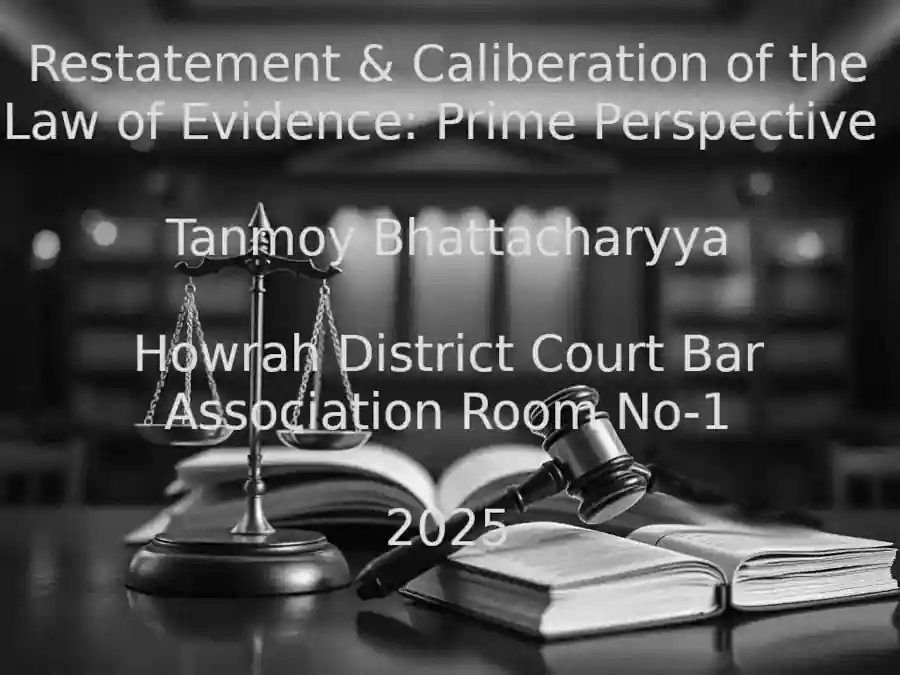
Restatement & Caliberation of the Law of Evidence: Prime Perspective

Restatement & Caliberation of the Law of Evidence: Prime Perspective by Tanmoy Bhattacharyya Howrah District Court Bar Association Room No-1

Home ยป Law Library Updates ยป Law Library ยป Principles of Relevance and Materiality

Restatement of the Law of Evidence (Prime Perspective)

Tanmoy Bhattacharyya

Howrah District Court

Bar Association Room No-1

Read Next

  • THE NATIONAL SPORTS GOVERNANCE ACT, 2025
  • 2016 Report of Ministry of Home Affairs, Govt of India
  • The Number ฯ€ (Pi): History, Properties, and Importance in Mathematics

18th Novemeber 2025

Part I: The Principle of Relevance

The law of evidence rests upon a single, unyielding cornerstone โ€” relevance. A fact is relevant when it bears any rational connection, however slight, to a fact of consequence in the adjudication of rights. It need not conclusively prove or disprove the matter asserted; it suffices that it renders that matter more probable or less probable than it would appear without the evidence. The law admits of no degrees of relevance: a fact is either within the compass of relevance, or it is not.

From this foundation flows the general rule of admissibility: all relevant evidence is admissible, save where its reception is forbidden by constitutional command, statutory exclusion, or a recognized doctrine of public policy. The sources of exclusion are limited and specific; they do not extend to matters of professional etiquette or judicial convenience.

Relevance thus performs a dual function. It filters out the immaterial, ensuring that adjudication proceeds on rational grounds; and it dignifies the fact-finding process by confining it to that which assists reason, rather than passion or conjecture. The law presumes the tribunal competent to assess weight once relevance is established; the task of admissibility is to determine entry, not persuasion.

Read Next

  • THE NATIONAL SPORTS GOVERNANCE ACT, 2025
  • 2016 Report of Ministry of Home Affairs, Govt of India
  • The Number ฯ€ (Pi): History, Properties, and Importance in Mathematics

Read the complete Book

Restatement & Caliberation of the Law of Evidence: Prime Perspective

Tags: Law of Evidence

Post navigation

Previous: Epilogue: The Prime Perspective of the Law of Evidence
Next: The Judicial Balancing Function
Communism
Sarvarthapedia

Manifesto of the Communist Party 1848: History, Context, and Core Concepts

Arrest
Sarvarthapedia

Latin Maxims in Criminal Law: Meaning, Usage, and Courtroom Application

Abolition of Slave Trade Act 1807: Facts, Enforcement, and Historical Context

British Slavery and the Church of England: History, Theology, and the Codrington Estates

United States of America: History, Government, Economy, and Global Power

Biblical Basis for Slavery: Old and New Testament Laws, Narratives, and Interpretations

Rule of Law vs Rule by Law and Rule for Law: History, Meaning, and Global Evolution

IPS Cadre Strength 2025: State-wise Authorised Strength

Uric Acid: From 18th Century Discovery to Modern Medical Science

Christian Approaches to Interfaith Dialogue: Orthodox, Catholic, Protestant, and Pentecostal Views

Origin of Central Banking in India: From Hastings to RBI and the History of Preparatory Years (1773โ€“1934)

Howrah District Environment Plan: Waste Management, Water Quality & Wetland Conservation

Bharatiya Nyaya Sanhita 2023: Sections (1-358), Punishments, and Legal Framework

Bengali Food Culture: History, Traditions, and Class Influences

  • Sarvarthapedia

  • Delhi Law Digest

  • Howrah Law Journal

  • Amit Aryaย vs Kamlesh Kumari:ย Doctrine of merger
  • David Vs. Kuruppampady: SLP against rejecting review by HC (2020)
  • Nazim & Ors. v. State of Uttarakhand (2025 INSC 1184)
  • Geeta v. Ajay: Expense for daughter`s marriage allowed in favour of the wife
  • Ram v. Sukhram: Tribal women’s right in ancestral property [2025] 8 SCR 272
  • Naresh vs Aarti: Cheque Bouncing Complaint Filed by POA (02/01/2025)
  • Bharatiya Nagarik Suraksha Sanhita 2023 (BNSS)
  • Bharatiya Sakshya Adhiniyam 2023 (BSA): Indian Rules for Evidence
  • Bharatiya Nyaya Sanhita (BNS) 2023
  • The Code of Civil Procedure (CPC)
  • Supreme Court Daily Digest
  • U.S. Supreme Court Orders
  • U.k. Supreme Court Orders
United Kingdom, UK

Abolition of Slave Trade Act 1807: Facts, Enforcement, and Historical Context

British Slavery and the Church of England: History, Theology, and the Codrington Estates

British Slavery and the Church of England: History, Theology, and the Codrington Estates

USA, America

United States of America: History, Government, Economy, and Global Power

Biblical Basis for Slavery, english slave trade

Biblical Basis for Slavery: Old and New Testament Laws, Narratives, and Interpretations

2026 ยฉ Advocatetanmoy Law Library

  • About
  • Global Index
  • Judicial Examinations
  • Indian Statutes
  • Glossary
  • Legal Eagle
  • Subject Guide
  • Journal
  • SCCN
  • Constitutions
  • Legal Brief (SC)
  • MCQs (Indian Laws)
  • Sarvarthapedia (Articles)
  • Contact Us
  • Privacy Policy
  • FAQs
  • Library Updates