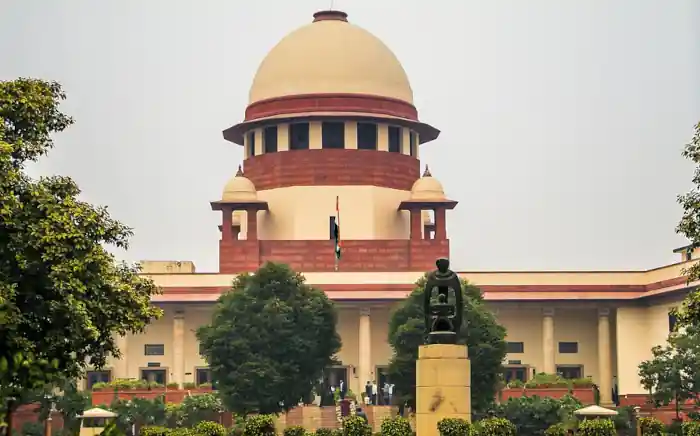
Supreme Court of India
High Court recorded a perverse finding that oral partition had taken place. It also did not deal with the other findings recorded by the Courts below.
Supreme Court of India
2024 INSC 12
Rajendhiran v. Muthaiammal @ Muthayee & Ors.
(Civil Appeal No. 37 of 2024)
03 January 2024
[Vikram Nath and Rajesh Bindal, JJ.]
The judgment pertains to the scope and limitations of the High Court’s jurisdiction under Section 100 of the Code of Civil Procedure, 1908 (CPC), which governs second appeals. Here’s an analysis based on the case details provided:
Key Points of the Judgment:
- Trial Court and First Appellate Court Findings:
- The trial court and the subordinate appellate court dismissed the plaintiff’s suit for declaration and injunction.
- These courts considered both oral and documentary evidence, finding the plaintiff’s claims regarding oral partition and ownership unsubstantiated.
- It was established that the survey number in question was jointly held by the plaintiff and eight others, with no evidence of partition.
- The plaintiffs themselves admitted this joint holding in their deposition.
- High Court’s Findings in Second Appeal:
- The High Court reversed the concurrent findings of the trial court and the first appellate court.
- It relied on two sale deeds and one mortgage deed to conclude that an oral partition had taken place.
- However, these documents pertained to different parcels of land and were insufficient to establish the oral partition claimed by the plaintiffs.
- The High Court’s judgment ignored critical oral and documentary evidence and failed to address the findings of the lower courts.
- Scope of Section 100 CPC:
- Section 100 CPC limits the High Court’s jurisdiction in second appeals to questions of law only.
- The High Court cannot reappreciate evidence or overturn findings of fact unless they are perverse or based on no evidence.
- In this case, the High Court’s decision was deemed perverse as it relied on irrelevant documents and ignored material evidence.
- Conclusion and Supreme Court’s Observations:
- The Supreme Court held that the High Court’s judgment was unsustainable as it failed to conform to the scope of Section 100 CPC.
- The High Court’s findings were based on an incorrect appreciation of evidence and disregarded critical findings by the trial court and the appellate court.
- The Supreme Court reinstated the judgments of the trial court and the first appellate court, confirming the dismissal of the plaintiff’s suit.
Held:
- The High Court’s judgment and order are set aside.
- The trial court’s and first appellate court’s judgments are confirmed.
- The respondent-plaintiff’s suit is dismissed.
Legal Principles Highlighted:
- The High Court, in a second appeal, cannot reassess or reappreciate evidence unless the findings of fact are demonstrably perverse or based on no evidence.
- The judgment under Section 100 CPC must strictly adhere to addressing substantial questions of law and not venture into questions of fact unless exceptional circumstances exist.
This decision reiterates the principle that concurrent findings of fact by the trial court and the first appellate court are binding unless a clear error of law or perversity in the findings is demonstrated.