1
The seed and the water
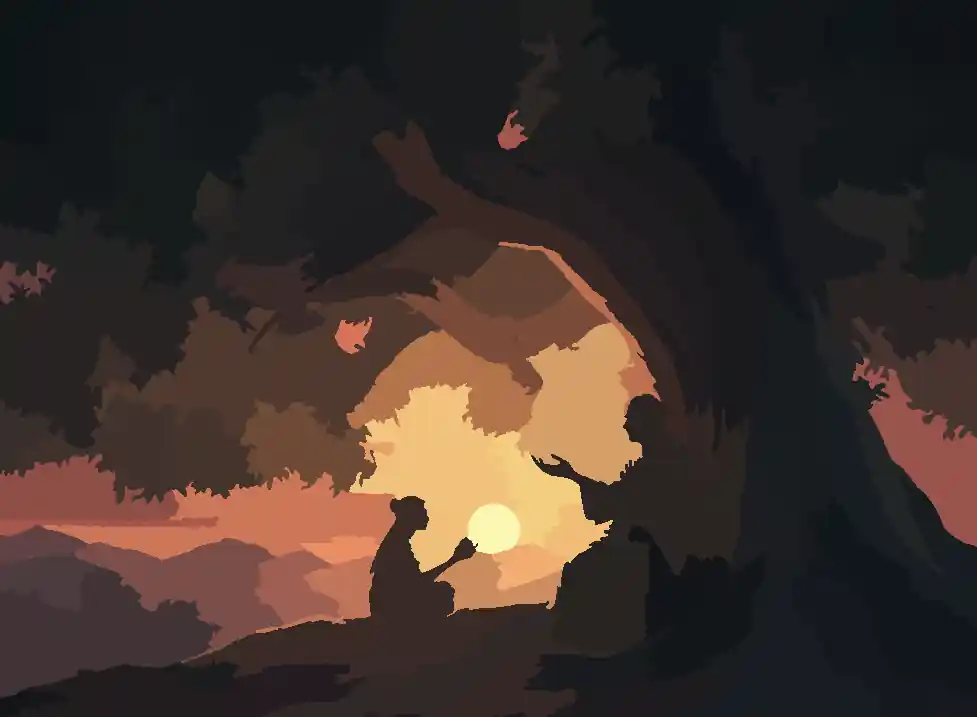
Under the immense shade of the banyan tree, where the roots hung like silent hymns and the breeze carried the scent of earth and distance, Anandakirtan sat. His body was a relic of time—his beard untamed, his hair gray and uncombed, his eyes half-closed as though he dreamed not of sleep but of the spaces between thought. The sun moved slowly above him, and the dust shimmered with quiet purpose.
Then she came—a mother, her skin glistening from a recent bath, her body wrapped in a simple loincloth, her son pressed against her lap like a sapling clinging to its soil. She was not aged by years but by tenderness; her face carried no trace of deep wisdom, only the raw compassion that belongs to those who still marvel at the world. As she approached, her footsteps softened the air around the sage.
“Father,” she called gently, her voice neither hesitant nor bold, “are you hungry? Since morning, I have seen you beneath this tree, unmoving. I was feeding my son and thought perhaps you, too, have not eaten. Take this mango—do not stay hungry. The sun will soon rest in the west, and the darkness will fold over the earth.”
At her words, Anandakirtan opened his eyes. They bloomed like a lotus waking to dawn. His gaze met hers—not as a stranger’s, but as one who has long waited for something familiar to return. In a voice that seemed drawn from the ocean’s depth, he said, “Give what you intend to give.”
The mother smiled, shifting her child upon her lap. “Only this fruit I have,” she murmured, her tone flowing like a river through the stones. “Eat it before my eyes—I wish to see you taste it.”
Anandakirtan accepted without speech. Behind her, the sky was painting its farewell in strokes of crimson. He peeled the mango, the scent of sweetness filling the air, and ate. When he finished, the mother, still seated in calm devotion, said softly, “Give me the seed.” Her smile curved like a rainbow over wet fields. He placed the seed in her hand, his eyes as tranquil as still water.
“What will you do with it?” he asked.
“I will dig the earth,” she replied, brushing back the strands of her long, damp hair. “I will sow it. A tree will grow from it.”
Anandakirtan studied her as the fading light touched her face. “Do you know the origin of the seed?” he asked.
She looked up with simple certainty. “From the fruit we eat.”
“And the fruit—where did it come from?”
“From this seed,” she said, and laughter rippled between them—soft, round, endless. The horizon blushed, and the sun melted away. She stood, holding her son close, and began to walk back toward her village. Anandakirtan watched until she became one with the distance, the color of twilight closing around her form.
Then he rose. His movements were quiet, as though the ground itself breathed him upward. The air cooled, and his murmur floated into the space the woman had left behind: “The seed of the fruit never comes from the fruit. The seed without origin, the mother without beginning.”
He turned toward the path that led to the river Narmada. The wind accompanied him like a soft chant, and in the gathering dusk, he felt the truth settle within him— “Nar-Mada”, the water, eternal and originless, the place of birth of humankind.
Sarvarthapedia Conceptual Network
Systemic and Systematic Cross-Referencing Framework
Core Narrative Node
The Seed and the Water
This narrative serves as a cosmological and cyclical origin node, exploring recursion, causality, and the paradox of beginnings. It complements other core areas by shifting focus from silence to originless continuity and generative cycles.
Cluster I: Foundational Ontology
Seed (Latent Potential)
- Carrier of unmanifest form within form
- Appears as origin, yet points beyond itself
- Cross-links:
- Originlessness
- Cycle
- Potentiality
- Creation
Originlessness (Anadi Principle)
- That which has no first cause
- Dissolves linear causality
- Cross-links:
- Eternality
- Non-duality
- Water (Narmada)
- Being
Being (Self-Existing Reality)
- Exists without derivation
- Beyond cause and effect
- Cross-links:
- Originlessness
- Silence
- Pure Existence
Cluster II: Cyclical Cosmology
Cycle (Recursive Continuity)
- Seed → Tree → Fruit → Seed
- No identifiable beginning
- Cross-links:
- Time
- Eternal Return
- Nature
Fruit (Manifest Outcome)
- Expression of latent seed
- Temporarily perceived as origin
- Cross-links:
- Seed
- Nourishment
- Experience
Tree (Embodied Process)
- Bridge between seed and fruit
- Visible continuity of life
- Cross-links:
- Growth
- Nature
- Transformation
Cluster III: Water Ontology
Water (Primordial Flow)
- Symbol of formless continuity
- Carrier of life without fixed origin
- Cross-links:
- Narmada
- Originlessness
- Adaptation
- Birth
Narmada (Sacred Flow)
- Embodiment of eternal water principle
- “Nar-Mada” as birthplace of humanity
- Cross-links:
- Water
- Life
- Civilization
- Sacred Geography
Flow (Dynamic Existence)
- Reality as movement rather than object
- Cross-links:
- Time
- Change
- Impermanence
Cluster IV: Epistemological Inquiry
Questioning (Inquiry into Origins)
- Dialogue revealing paradox
- Cross-links:
- Knowledge → Knowledge Ecosystem
- Ignorance
- Wisdom
Paradox (Cognitive Threshold)
- Seed comes from fruit, fruit from seed
- Breaks linear reasoning
- Cross-links:
- Non-duality
- Originlessness
- Insight
Insight (Direct Knowing)
- Arises when paradox is embraced
- Cross-links:
- Realization
- Awareness
- Silence
Cluster V: Human Experience and Relation
Mother (Embodied Compassion)
- Represents nurturing without abstraction
- Acts without metaphysical concern
- Cross-links:
- Nature
- Care
- Simplicity
Child (Emergent Life)
- Symbol of continuity and dependence
- Cross-links:
- Future
- Growth
- Innocence
Nourishment (Shared Sustenance)
- Fruit as both physical and symbolic
- Cross-links:
- Giving
- Receiving
- Interdependence
Cluster VI: Nature as Living System
Banyan Tree (Cosmic Continuity)
- Represents timeless expansion and rooted multiplicity
- Cross-links:
- Shelter
- Wisdom
- Recursion
Earth (Receptive Ground)
- Receives seed without question
- Cross-links:
- Fertility
- Creation
- Stability
Growth (Unfolding Process)
- Invisible transformation into visible form
- Cross-links:
- Time
- Cycle
- Becoming
Cluster VII: Philosophical Pathways
Path of Recursion
- Understanding reality through cycles
- Cross-links:
- Seed
- Time
- Eternal Return
Path of Originlessness
- Letting go of first-cause inquiry
- Cross-links:
- Being
- Non-duality
- Liberation
Path of Simplicity
- Truth revealed through ordinary acts
- Cross-links:
- Mother
- Nourishment
- Nature
Cluster VIII: Integrated Systemic Flow
Cycle of Manifestation
Seed → Tree → Fruit → Seed → (Infinite Recursion)
Flow of Existence
Water → Flow → Life → Return to Water
Path of Realization
Question → Paradox → Insight → Acceptance of Originlessness
Meta-Structure
Systemic Nature
- Concepts operate as interlinked cycles, not linear chains
- Each node reflects and generates others
Systematic Nature
- Structured progression:
- Ontology → Cosmology → Epistemology → Human Experience → Nature → Practice
Cross-Linking with Other Core Areas
Connection to Silence and Darkness
- Silence parallels originlessness as pre-expression
- Darkness parallels seed-state potential
Unified Core Concept
- Silence (unmanifest awareness)
- Seed (unmanifest form)
- Water (unmanifest continuity)
- Knowledge Graph
All represent different lenses of the same primordial reality
Central Integrative Insight
The seed does not begin in the fruit, nor does the fruit begin in the seed. Both are expressions of an originless continuum, just as water flows without a first drop. The narrative reveals that reality is not constructed from beginnings, but from endless, self-sustaining relationships, where every origin is already a return.
Note: Under a banyan tree, Anandakirtan, an old sage, is approached by a compassionate mother offering him a mango out of concern for his hunger. As he eats, she requests the seed to plant, symbolising growth and continuity. Their exchange leads to a profound discussion about the origins of the seed and fruit, highlighting the cycle of life. The mother understands that the seed comes from the fruit, which in turn originates from the seed, emphasising a connection of existence. Anandakirtan reflects on this cyclical nature as twilight descends, feeling a sense of truth related to the eternal river Narmada and humanity’s beginnings.