ADDRESS TO PROVISIONAL PARLIAMENT—31 JANUARY 1950
Session — First Session
President of India — Dr. Rajendra Prasad
Prime Minister of India — Pt. Jawaharlal Nehru
Speaker, Provisional Parliament — Shri G.V. Mavalankar
MEMBERS OF PARLIAMENT,
As I stand here today to greet you, representatives of the people of
India, my mind is filled with emotion, and the recent past of India, with
its travail and struggle, passes before my eyes. We meet in this sovereign
Parliament of the Republic of India, and the high enterprise of serving our
motherland and the millions of our countrymen has been entrusted to us,
That is an immense and sacred trust and, as your President, I approach it
with humility and prayer.
On this historic occasion our thoughts naturally turn to Mahatma Gandhi
and our hearts pay homage to him. Let us accept our great task in the spirit
of the Father of the Nation, who brought us our freedom, and let us
remember always the message that he gave us, the message of unity and
goodwill between all the people of India, of communal harmony, of the
abolition of class distinctions and of those based on birth, caste or religion,
and the evolution of a peaceful, cooperative India, which gives opportunities
of progress to all her citizens.
It is the firm policy of my Government to maintain peace and friendship
with all the nations of the world and to help in every way possible in the
maintenance of world peace. The Republic of India inherits no enmities or
traditional rivalries with other nations and my Government intend continuing
a policy directed towards securing peace in the world and avoiding any
alignment which leads to hostilities with any nation.
India is a sovereign democratic Republic, but she has decided to continue
her association with the Commonwealth of Nations. That is a unique
development, new to constitutional law and history. Thereby we do not
limit our freedom in any way, but we indicate our desire for continued
friendship and co-operation with the group of nations represented in the
Commonwealth.
My Prime Minister recently attended the Conference of Commonwealth Foreign Ministers held in Colombo. That conference was an example of how independent nations can meet together and discuss, in a friendly way, the great problems that face the world and endeavour to find common ways of action, without in any way infringing the independence and sovereignty of one another.
Our relations with foreign powers are friendly and my Government have
exchanged diplomatic representation with a very large number of countries.
Treaties of friendship have been concluded with Switzerland, a country
with a great tradition of democratic freedom, and with Afghanistan with
whom we have been bound by cultural and historical ties since the dawn
of history. Negotiations have been proceeding for treaties of friendship and
commerce with Iran, Nepal and the United States of America. As you are
aware, my Prime Minister visited this great country recently and his visit
led to a greater understanding and respect and closer ties between India
and the United States.
My Government have recently accorded de Jure recognition to the new
Government of China and it is hoped that an exchange of diplomatic
representatives will take place soon. With this great country we have had
friendship and cultural contacts for more than two thousand years. I trust
that those friendly contacts will be maintained and will help in preserving
the peace of Asia and the world.
With the nations of Europe, America and Australasia, India is developing
friendly contacts. It is natural that India should be even more interested
in the mother-continent of Asia, of which she is a part, as well as in Africa.
Her primary interest is in the freedom of peoples still subject and in the
removal of all barriers that come in the way of the full development of
nations and peoples. She is entirely opposed to the continuation of colonial
rule, in any shape or form, as well as to any kind of racial discrimination.
In Asia freedom is on the march; at the same time there is trouble and
turmoil in some parts of it. I earnestly trust that out of this turmoil will
emerge peace and freedom and co-operative relations between all the
countries of Asia.
An historic event took place recently in the establishment of the free
and independent United States of Indonesia. We have welcomed this more
particularly because of the very close relations, both in the past and in the
present, between the people of India and the people of Indonesia. It has
been an honour and privilege for us to welcome the President of the United
States of Indonesia in our midst and to convey to him and to his people our
greetings and good wishes.
India has large numbers of her children living in countries abroad,
notably in Africa, in Fiji, in the West Indies, in the island of Mauritius and
elsewhere. Our advice to them has always been that they should identify
themselves with the indigenous people and look upon the country of adoption
as their real home.
I regret to say that our relations with our neighbour country, Pakistan,
are not as good as they should be and there are several matters in dispute
between us. Our history and culture; as well as the unalterable facts of
geography, compel both India and Pakistan to live in friendly co-operation
with each other. But the grievous wound caused by recent events will take
some time to heal. It is my Government’s policy to endeavour to help in
every way this process of healing. In pursuance of this policy, my Government
have proposed to the Government of Pakistan that both the Governments
should make a solemn declaration for the avoidance of war as a method
for the settlement of any disputes between them, and to resort to
negotiation, mediation, arbitration or reference to some international
tribunal, in order to settle such disputes. I trust that the Pakistan Government
will accept this offer in the spirit in which it has been made and thus help
to reduce the unfortunate tension that has existed between these two countries.
One of the principal causes of tension between India and Pakistan is the
dispute over the future of Jammu and Kashmir. The matter is before the
Security Council and I wish to say nothing at this stage that may prejudice
the prospect of a just and peaceful settlement by the efforts of that body.
My Government have repeatedly declared their intention that the people
of the State should themselves decide freely whether they will remain
acceded to India. That policy remains unaltered. But the conditions which
will make a free declaration of the will of the people possible have not yet
been established. Until that happens and a satisfactory solution to the
difficult problem has been found, India will continue to discharge her
obligations to protect The State and its people against aggression.
During the last two and a half years the map of India has changed
greatly. Hundreds of States have disappeared or have been formed in larger
units. This remarkable change has been brought about in a peaceful manner
and the process of integration of over 500 States is now practically complete.
Their number has been reduced to 16 units. The federal functions of the
Unions and States will be taken over by the Central Government with effect
from the 1st April. My Government propose to bring forward a Bill during
the current session which will bring about legislative uniformity, in so far
as the Central laws are concerned, between the States and the rest of
India.
The economic situation in the country has been a matter of grave
concern to my Government. Suffering from many generations of colonial
rule, India had to face the heavy burdens of the world war. Her economy
was badly shaken; there was shortage of essential materials, and inflation.
It is the primary objective of my Government to raise the standard of living
of the people. Owing to the great difficulties which have followed from
partition and which have cast a heavy burden on our finances, the progress
we had hoped for has not been made.
The burden of defence expenditure has been great, as also expenditure on the relief and rehabilitation of
millions of displaced persons. The deficit in food has compelled Government
to import large quantities of foodstuffs at a heavy cost to the country. My
Government have aimed at stopping inflation and bringing about gradually
a lowering of prices. All these additional burdens and certain upsets which
have taken place from time to time in our economy, have delayed our
progress in many important aspects of nation-building, among them being
education and health, to which my Government attach great importance.
My Government regret this delay greatly. It was essential, however, that in
the difficult circumstances which the country had to face, every kind of
economy should be practised, so that a sound foundation might be laid for
future progress. There has been some definite progress in economy of expenditure.
Our railways, which had suffered grievously during the war and
immediately after the Partition, have registered a welcome improvement
in many directions. With the integration of the railways of Indian States
and Unions of States with the Indian Government Railways from the first
of April next, there will be practically one entirely nationalised railway system operating throughout the land.
It is my Government’s intention to establish a Planning Commission so
that the best use can be made of such resources as we possess for the
development of the nation. Such planning will need the fullest help from
statistical information. It is proposed therefore to establish a Central
Statistical Organisation. It must be remembered that planning must have
clear objectives and that any widespread effort can only succeed with the
full co-operation of the people. It is only when governmental agencies and
popular enthusiasm and co-operation are yoked together that large-scale
economic and social development can take place.
My Government have also been considering for sometime past the
reorganisation of the machinery of Government in order to make it more
efficient and to avoid waste.
I have referred to the large expenditure on our defence forces. My
Government, wedded as they are to the promotion of peace in India and
outside, have had to face painful dilemmas during the past two and a half
critical years. With all the desire to reduce defence expenditure, they
could not take the risk of putting the country in jeopardy at a time when
evil forces were endangering its security both within and from outside. The
first essential of freedom is the strength to preserve it and no country can
take any risk in such a vital matter. Hence the process of demobilisation,
which should have taken place after the World War, Was delayed and
slowed down. I am glad to say that our defence services have acquitted
themselves admirably and have gained the praise and approbation of
competent experts. While the security of the country must remain the
paramount obligation of any Government, they are anxious to reduce
expenditure on defence, in so far as this is possible, and they propose to
do so as a measure of economy as well as a gesture of peace.
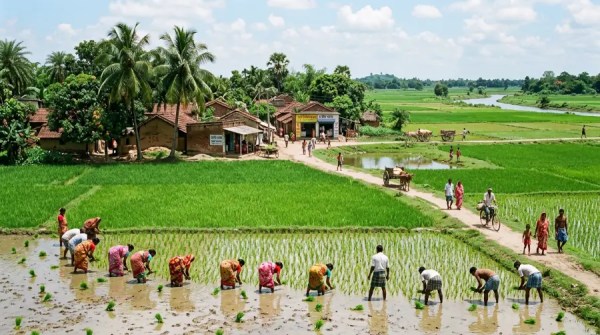
Food has been a heavy item in our national expenditure and a great
deal of thought and effort has been devoted to solving this problem. My
Government have declared that we must make good the deficiency in food
by the end of 1951. At the same time it is necessary to ensure adequate
production of cotton and jute, which are essential industrial raw materials
in short supply. I am glad to say that definite progress is being made in
regard to food production and we are proceeding with both short-term and
long-term schemes for adding to it. Food procurement is an essential part
of our short-term scheme. Fortunately the harvest generally has been good
though there has been lack of winter rainfall in certain areas and, in
Madras, almost complete failure. The campaign for growing more food
requires the full co-operation of the people and more especially the
peasantry. Among the major schemes before the country are certain river
valley projects. Three of these, viz. the Damodar Valley, the Bhakra Dam
and Hirakud are under construction at present. Government attach great
importance to these, from the point of view of irrigation and food and
hydro-electric power.
I am glad that scientific research is making considerable progress in the
country. It is ultimately on science and the applications of science that all
progress depends. Recently two great national research laboratories have
been started. One of these is the National Chemical Laboratory at Poona
and the other, the National Physical Laboratory in Delhi, Both are magnificent
reseach institutions, it is proposed to have nine more national research
laboratories, of which five will be working this year, in addition to the two
mentioned above. These laboratories will not only carry out research work
of all kinds but will also be feeders to industry and will thus help in
industrialisation.
The Well being of the country depends very largely on the welfare of
labour, both urban and agricultural. In the course of the last two years the
Factories Act and the Minimum Wages Act have been enacted and begining
has been made with schemes of social security by enacting the Employees’
State Insurance Act of 1948 and the Coal Mines Provident Fund and Bonus
Schemes Act, 1948. My Government will shortly bring before you two
comprehensive Bills dealing with labour relations and trade union. An
all-India agricultural labour enquiry is at present in progress and, when it
is completed, it will assist Government in devising measures for improving
the lot of those who are engaged in agricultural production.
The problem of rehabilitation of the large number of evacuees from
Pakistan is of great importance not only for them but also for the country.
My Government have devoted their earnest attention to it and achieved a
measure of success, and a large number of people have been settled and
rehabilitated. But it is also true that a large number still remain to be
settled and have suffered great hardships. My Government are determined
to proceed with the rehabilitation of these displaced persons as quickly as
possible.
A statement of the estimated receipts and expenditure of the
Government of India will be laid before you in due course during this
session and you will be asked to approve the financial proposals of my
Government.
There are twenty Bills pending before you. Some of them have passed
the Committee stage and some others have already been discussed in
principle. A few of them, which are still under consideration by the
Committees, will be brought before you with their recommendations during
the course of this session.
A few ordinances have been issued before the commencement of the
present session. Such of them as require permanent legislation will be
brought before you in the shape of new Bills.
Among the other legislative measures that it is intended to bring before
you during this session, the following may be specially mentioned:
A Bill to amend the Indian Income Tax Act in the light of the
recommendations made by the Income Tax Investigation Committee, a Bill
to extend the duration of the Import and Export Control Act, a Bill to give
protection to certain industries, a Bill to provide for the conservation of
India’s coal resources and the regulation of the coal mining industry, and
a Bill to provide for the proper regulation and development of inter-State
rivers and river valleys—these are the more important measures which my
Government propose to place before you. They also propose, if the
preliminary work could be got through in time, to introduce a comprehensive
Representation of the People Bill providing for various election matters under the new Constitution.
I have given you a broad survey of the work in the legislative field. My
Government will announce to you from time to time the precise form in
which these and other legislative measures and important motions relating
to matters of general public interest will be brought before you and will
explain to you the degree of urgency in respect of them.
I shall now leave you to your labours. We live in a troubled world
scarcely recovered from the consequences of the war, facing crisis after
crisis and enveloped by suspicion, bitterness and fear. Nothing good can
come out of these. We have heavy and difficult tasks before us and the
only way to face them is with courage, co-operation and hard work. Above
all I trust we shall always remember that the foundations of our nation’s
progress can be well and truly laid only if they are based on right objectives
and right action and on integrity of mind and purpose. Great tasks cannot
be accomplished by petty means, nor can good results flow from evil
methods. We have to face the great challenge of our generation. I am
convinced that we can face it, if we prove true to the great ideals that the Father of the Nation placed before us.
I pray that wisdom and tolerance and the spirit of concerted effort may guide you in your deliberations.