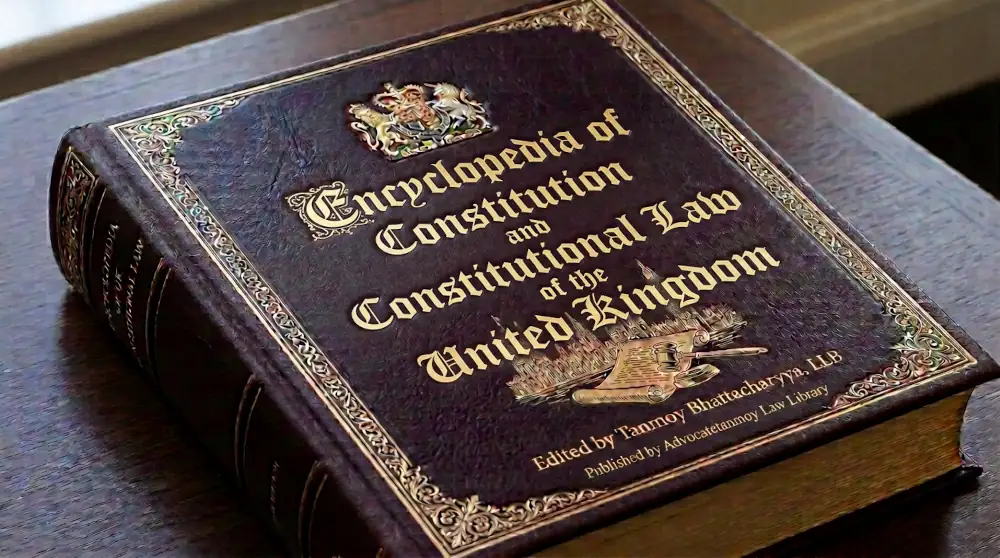
Encyclopedia of Contemporary World History
Encyclopedia of the British Parliamentary System
Introduction to the Constitutional Law of the United Kingdom
The constitutional law of the United Kingdom is the product of nearly a thousand years of political conflict, judicial interpretation, statutory reform, institutional compromise, and gradual adaptation. Unlike the constitutions of the United States, France, or India, the British constitution was never codified into a single foundational document. Instead, it emerged historically from charters, statutes, conventions, judicial decisions, royal practices, parliamentary struggles, and political understandings accumulated over centuries. The constitution of the United Kingdom therefore exists not in one text but in an interconnected body of legal and political principles. It has often been described as an “unwritten constitution,” although this expression is partly misleading because much of it is in fact written in statutes, judicial decisions, and constitutional authorities such as Erskine May and A. V. Dicey’s Introduction to the Study of the Law of the Constitution. What distinguishes the British constitution is not the absence of written material, but the absence of a single supreme constitutional code.
The origins of the British constitutional order may be traced to the Anglo-Saxon kingdoms before the Norman Conquest of 1066. Even before the arrival of William I at Hastings in Sussex, kingship in England was constrained by customary obligations and consultation with councils of nobles and clergy known as the Witenagemot. Following the Norman Conquest, royal power expanded dramatically. William the Conqueror centralized administration, reorganized landholding through the feudal system, and asserted direct royal supremacy. Yet medieval monarchy was never entirely absolute. The Crown depended upon taxation, military loyalty, and ecclesiastical legitimacy. The tensions between monarchic authority and aristocratic resistance became central to the constitutional development of England.
One of the earliest constitutional landmarks occurred at Runnymede near Windsor on 15 June 1215, when King John affixed his seal to the Magna Carta after rebellion by English barons. Although originally intended as a practical settlement between the king and rebellious nobles, Magna Carta gradually acquired symbolic constitutional significance. Clauses concerning lawful judgment, due process, and limitations upon arbitrary royal action later became foundational principles of constitutional liberty. The famous declaration that no free man could be imprisoned except by the lawful judgment of his equals or by the law of the land became central to later understandings of the rule of law. Medieval England did not immediately become constitutional in the modern sense after Magna Carta, yet the document established the enduring idea that sovereign authority itself could be legally constrained.
During the thirteenth and fourteenth centuries the institution that later became Parliament evolved from royal councils summoned for taxation and consultation. Under Edward I, particularly through the Model Parliament of 1295 at Westminster, representatives of counties and boroughs increasingly participated alongside nobles and clergy. Parliament gradually acquired a legislative and fiscal role. By the late Middle Ages, statutes enacted by the Crown in Parliament became recognized as authoritative law. The constitutional balance, however, remained unstable. Monarchs frequently attempted to govern independently, while Parliament sought greater authority over taxation and legislation.
The sixteenth century under the Tudor monarchy witnessed further constitutional transformation. Henry VIII, especially after the Act of Supremacy 1534, severed papal authority over England and established royal supremacy over the Church of England. Parliament played a crucial role in legitimizing these changes. The Tudor period therefore strengthened the legislative significance of Parliament even while enhancing royal power. Historians have often noted the paradox that the monarchy increased its authority through parliamentary statutes. The constitutional implication was profound: the legitimacy of major constitutional change increasingly depended upon legislation rather than purely personal royal command.
The constitutional crises of the seventeenth century fundamentally shaped modern British constitutional law. Under the Stuart kings, particularly James I and Charles I, disputes intensified concerning taxation, religion, military power, and the extent of royal prerogative. James I defended the doctrine of the divine right of kings, asserting that monarchs derived authority directly from God. Parliament increasingly resisted such claims. In the famous Case of Proclamations (1611) decided in London before the Court of King’s Bench, Sir Edward Coke, CJ, declared that the King could not change the law through proclamation alone. Coke stated that “the King hath no prerogative but that which the law of the land allows him.” This principle became one of the cornerstones of constitutional law because it established judicial authority to determine the limits of prerogative power.
Conflict deepened under Charles I. In 1628, Parliament presented the Petition of Right, protesting against arbitrary taxation, imprisonment without cause, and martial law. Charles accepted the Petition but soon attempted to govern without Parliament during the period known as the Personal Rule (1629–1640). Financial pressures eventually compelled him to recall Parliament, leading to escalating disputes that culminated in the English Civil War beginning in 1642. The war between Royalists and Parliamentarians transformed the constitutional order. Parliamentary forces under Oliver Cromwell defeated the Crown. Charles I was tried and executed outside the Banqueting House in Whitehall on 30 January 1649, an unprecedented assertion that even a monarch could be subject to law.
The subsequent Commonwealth and Protectorate period demonstrated the difficulties of constitutional experimentation without monarchy. Cromwell governed through military and parliamentary mechanisms, but political instability persisted. The monarchy was restored in 1660 under Charles II, yet the constitutional balance had changed permanently. Parliament increasingly asserted that royal power existed within legal limits.
The decisive constitutional settlement occurred during the Glorious Revolution of 1688–1689. Following widespread opposition to the policies of James II, Parliament invited William of Orange and Mary to assume the throne. The revolution established parliamentary supremacy over monarchical absolutism. The resulting Bill of Rights 1689, enacted in Westminster, declared that suspending or dispensing with laws without parliamentary consent was illegal. It prohibited excessive bail, cruel punishments, and taxation without parliamentary authority. Alongside the Claim of Right Act 1689 in Scotland and the later Act of Settlement 1701, these measures entrenched constitutional monarchy and judicial independence.
The constitutional settlements between 1688 and 1707 were particularly significant because they transformed sovereignty itself. Sovereignty no longer rested solely in the monarch but in the constitutional institution known as the Crown in Parliament. This concept meant that legislation enacted jointly by monarch, the Lords, and Commons possessed supreme legal authority. Constitutional scholar A. V. Dicey, writing in the nineteenth century, famously defined Parliamentary sovereignty as the right of Parliament to “make or unmake any law whatever.” No court or body could invalidate an Act of Parliament.
The Acts of Union of 1706 and 1707, creating the Kingdom of Great Britain, further altered the constitutional structure. The separate Scottish and English Parliaments were united at Westminster, though Scotland retained distinct legal and ecclesiastical institutions. Later, the Acts of Union 1800 incorporated Ireland into the United Kingdom. Constitutional tensions nevertheless persisted, especially in Ireland, where demands for autonomy eventually contributed to partition and the creation of Northern Ireland in 1921.
Throughout the eighteenth century, the office of the Prime Minister gradually emerged, although it had no formal constitutional basis. Sir Robert Walpole, serving from 1721, is generally regarded as the first Prime Minister. Cabinet government evolved through convention rather than statute. The monarch increasingly acted through ministers who depended upon parliamentary confidence. This gradual transition from royal governance to responsible parliamentary government was one of the defining constitutional developments of modern Britain.
The nineteenth century witnessed major constitutional democratization. The Reform Act 1832, passed after intense political agitation, redistributed parliamentary seats and extended the franchise. Further reforms in 1867 and 1884 broadened electoral participation. The constitutional system increasingly reflected representative democracy rather than aristocratic privilege. Simultaneously, courts developed administrative and constitutional principles through common law.
One defining feature of British constitutionalism is the interaction between statute law and common law. Constitutional principles are not confined to legislation alone. Judges have long recognized broader constitutional doctrines developed through judicial reasoning. Principles such as access to justice, procedural fairness, open justice, and the separation of powers evolved incrementally through case law. In Scott v Scott [1913] AC 417, the House of Lords affirmed the principle that justice should generally be administered in public. Such principles became constitutional in character because they protected democratic accountability and the integrity of legal institutions.
The constitutional role of the judiciary expanded significantly during the twentieth century. Although Parliament remained legally sovereign, courts increasingly scrutinized executive action. Judicial review developed as a mechanism through which courts could determine whether public authorities acted lawfully. This development reflected the growing importance of the rule of law, a principle associated particularly with Dicey. The rule of law requires that governmental power be exercised according to law rather than arbitrary discretion.
The royal prerogative remained a crucial constitutional concept. Historically, prerogative powers referred to residual powers originally exercised personally by the monarch but later exercised by ministers on behalf of the Crown. These included powers relating to foreign affairs, war, passports, treaties, and prorogation of Parliament. Unlike statutory powers defined in legislation, prerogative powers were historically identified through common law and constitutional practice.
In principle, if not always in practice, it is relatively straightforward to determine the limits of a statutory power because the authority is defined by the text of the statute itself. Since prerogative powers are not ordinarily constituted by a single document, determining their precise limits is less straightforward. Nevertheless, every prerogative power possesses constitutional boundaries, and it is the role of the courts to determine, when necessary, where those boundaries lie. Since prerogative authority is recognized by the common law and must remain compatible with common law principles, constitutional principles illuminate the scope and limitation of such powers.
This constitutional reasoning was illustrated in several landmark cases. In Attorney General v De Keyser’s Royal Hotel Ltd [1920] AC 508, arising from wartime requisitioning during the First World War, the House of Lords held that where Parliament had legislated upon a subject, ministers could not bypass statutory limits by relying upon prerogative powers. Statute displaced prerogative. The case demonstrated that executive authority derived legitimacy from parliamentary authorization.
Another constitutional confrontation emerged in Burmah Oil Co Ltd v Lord Advocate [1965] AC 75, concerning wartime destruction of property in Burma during the Second World War. The House of Lords held that prerogative powers could not be exercised to deprive individuals of property without compensation unless Parliament expressly authorized such deprivation. This case reflected the principle that executive action must conform to constitutional legality.
The constitutional conflicts of the late twentieth century further clarified judicial supervision of executive power. In Council of Civil Service Unions v Minister for the Civil Service [1985] AC 374, often called the GCHQ case, the House of Lords confirmed that exercises of prerogative power could be subject to judicial review depending upon subject matter. Lord Diplock recognized that prerogative powers were not immune from legal scrutiny merely because of their historical origin.
The constitutional principle of the separation of powers also became increasingly important. Although the United Kingdom does not maintain a rigid separation comparable to the United States, distinctions between legislature, executive, and judiciary remain constitutionally significant. Courts repeatedly emphasized that each institution possesses distinct constitutional responsibilities. In R v Secretary of State for the Home Department, ex parte Fire Brigades Union [1995] 2 AC 513, the House of Lords held that ministers could not frustrate the will of Parliament by using prerogative powers to avoid implementing statutory schemes enacted by Parliament.
Lord Browne-Wilkinson famously observed in that case that “the constitutional history of this country is the history of the prerogative powers of the Crown being made subject to the overriding powers of the democratically elected legislature.” This statement encapsulated centuries of constitutional evolution. Royal prerogative survived, but only within constitutional limits defined by Parliament, common law, and judicial interpretation.
The twentieth century also transformed constitutional rights protection. Historically, British constitutional liberty depended less upon written guarantees and more upon common law traditions and parliamentary accountability. However, following the devastation of the Second World War and the emergence of international human rights law, constitutional rights increasingly acquired statutory expression. The United Kingdom became a founding signatory of the European Convention on Human Rights in 1950.
The constitutional significance of rights protection increased substantially with the enactment of the Human Rights Act 1998, passed by the Parliament at Westminster under the government of Tony Blair. The Act incorporated Convention rights into domestic law, enabling British courts to review legislation and executive action for compatibility with human rights principles. Although courts could not invalidate Acts of Parliament, they could issue declarations of incompatibility. The Act therefore modified the constitutional balance between Parliament, courts, and executive government.
Another transformative constitutional reform occurred through devolution. The Scotland Act 1998, the Government of Wales Act 1998, and the Northern Ireland Act 1998 created devolved institutions with varying legislative competencies. The Scottish Parliament, established in Edinburgh in 1999, represented one of the most significant constitutional changes since the Union of 1707. Yet Parliament at Westminster remained legally sovereign.
Judicial interpretation of devolution legislation produced important constitutional jurisprudence. Courts frequently examined whether devolved legislation related to “reserved matters.” Constitutional adjudication therefore increasingly resembled federal constitutional reasoning, even though the United Kingdom formally remained a unitary state.
The constitutional principle of judicial independence also received enhanced institutional protection through the Constitutional Reform Act 2005. This legislation altered the role of the Lord Chancellor, created an independent Supreme Court of the United Kingdom, and strengthened the formal separation between judiciary and legislature. On 1 October 2009, the Supreme Court of the United Kingdom replaced the Appellate Committee of the House of Lords as the highest appellate court.
The constitutional consequences of European integration profoundly affected British constitutional law. The European Communities Act 1972 incorporated European Community law into domestic law. In Factortame Ltd v Secretary of State for Transport [1990] 2 AC 85, courts disapplied inconsistent domestic legislation because Parliament had voluntarily accepted the supremacy of European law within the scope of the 1972 Act. This generated extensive academic debate regarding whether parliamentary sovereignty had been limited or merely conditioned by statute.
The constitutional crisis surrounding withdrawal from the European Union produced some of the most significant constitutional litigation in modern British history. Following the Brexit referendum of 23 June 2016, legal disputes emerged concerning the constitutional powers of government. In R (Miller) v Secretary of State for Exiting the European Union [2017] UKSC 5, commonly known as the first Miller case, the Supreme Court held that ministers could not trigger Article 50 of the Treaty on European Union through prerogative powers alone because doing so would alter domestic legal rights established by Parliament. Parliamentary authorization was constitutionally required.
The Court emphasized that constitutional principles are not confined to statutory rules but include common law principles developed historically. These principles concern not only individual rights but also institutional relationships between Parliament, executive government, and courts. The judiciary therefore possessed constitutional responsibility to determine the legal limits of governmental power.
The constitutional controversies intensified in 2019 during the premiership of Boris Johnson. Amid political conflict concerning Brexit, the government advised Queen Elizabeth II to prorogue Parliament for an extended period between September and October 2019. Critics argued that the prorogation was designed to prevent parliamentary scrutiny during a constitutionally critical period.
The resulting litigation culminated in the Supreme Court decision R (Miller) v The Prime Minister and Cherry v Advocate General for Scotland [2019] UKSC 41, commonly called the second Miller case or the prorogation case. The judgment, delivered unanimously by an eleven-member court in London on 24 September 2019, became one of the most consequential constitutional decisions in British legal history.
The Court reaffirmed that the United Kingdom possesses a constitution established through common law, statutes, conventions, and historical practice. Although uncodified, this constitution contains enforceable legal principles. Courts possess responsibility for upholding those principles and determining the legal boundaries of governmental authority.
Central to the decision were two constitutional principles: Parliamentary sovereignty and Parliamentary accountability. Parliamentary sovereignty requires that laws enacted by Parliament remain supreme. Parliamentary accountability requires ministers to remain answerable to Parliament through debate, scrutiny, questioning, and legislation.
The Court reasoned that an unlimited power to prorogue Parliament would undermine these constitutional principles. If ministers could suspend Parliament indefinitely through prerogative powers, they could effectively prevent Parliament from legislating or scrutinizing executive action. Such authority would contradict centuries of constitutional development beginning with the struggles against monarchical absolutism in the seventeenth century.
The Court examined historical statutes including the Bill of Rights 1689, the Meeting of Parliament Act 1694, and earlier medieval enactments regulating parliamentary sittings. These measures illustrated the longstanding constitutional concern that government should not prevent Parliament from performing its constitutional functions.
The Supreme Court formulated an important constitutional test. A decision to prorogue Parliament would be unlawful if it had the effect of frustrating or preventing, without reasonable justification, Parliament’s ability to carry out its constitutional functions as legislature and supervisory body over the executive. Courts could intervene where the constitutional consequences were sufficiently serious.
The judgment emphasized that constitutional questions do not become non-justiciable merely because they possess political significance. Courts cannot avoid their constitutional responsibility simply because disputes arise within politically controversial contexts. Determining the legal limits of prerogative power remains a judicial function.
The Court concluded that the prorogation frustrated Parliament’s constitutional role during an exceptional political moment. Parliament was prevented from scrutinizing government actions for five weeks during the critical period preceding the anticipated Brexit date of 31 October 2019. The prorogation was therefore unlawful, null, and without legal effect.
The prorogation judgment reaffirmed several constitutional principles of immense significance. First, prerogative powers are limited by constitutional principles recognized through common law. Second, parliamentary sovereignty and accountability remain foundational elements of the constitution. Third, courts possess authority to determine the legal boundaries of executive power. Fourth, constitutional legality cannot be displaced by political convenience.
The constitutional role of conventions remains another defining feature of British constitutionalism. Conventions are non-legal rules governing constitutional behavior. Examples include the convention that the monarch grants Royal Assent to legislation, the convention that the Prime Minister must command confidence in the House of Commons, and the convention of collective cabinet responsibility. Conventions are politically binding though generally not legally enforceable.
The relationship between law and convention frequently creates constitutional ambiguity. Courts traditionally distinguish between enforceable legal rules and political conventions. Yet conventions often shape the practical operation of constitutional law. For example, the monarch theoretically retains prerogative powers such as appointing the Prime Minister or dissolving Parliament, but constitutional convention dictates that these powers are exercised according to democratic principles.
The monarchy itself occupies a unique constitutional position. The sovereign remains head of state, yet modern constitutional monarchy functions through ministerial advice and parliamentary government. Walter Bagehot, writing in the nineteenth century, distinguished between the “dignified” and “efficient” parts of the constitution. The monarchy symbolizes continuity, national identity, and constitutional legitimacy, while political authority is exercised primarily by ministers accountable to Parliament.
The constitutional doctrine of ministerial responsibility operates at both individual and collective levels. Collective responsibility requires ministers to publicly support cabinet decisions or resign. Individual responsibility requires ministers to answer to Parliament for departmental conduct. Although political realities sometimes weaken these doctrines, they remain central constitutional conventions.
The judiciary has increasingly developed constitutional doctrines protecting access to justice and legality. In R (UNISON) v Lord Chancellor [2017] UKSC 51, the Supreme Court invalidated employment tribunal fees because they effectively denied access to justice. The Court emphasized that constitutional rights and principles could limit executive powers even where statutes granted broad discretion.
The constitutional significance of judicial review expanded alongside the modern administrative state. Public authorities exercising statutory or prerogative powers became subject to principles of legality, rationality, procedural fairness, and proportionality. Courts therefore assumed a central constitutional role in supervising governance.
At the same time, debates continue regarding the democratic legitimacy of judicial power. Critics argue that unelected judges should not interfere excessively with decisions of elected governments. Supporters respond that judicial oversight protects constitutional principles, parliamentary democracy, and individual rights from executive overreach. British constitutional law therefore remains characterized by ongoing tension between democratic accountability and judicial supervision.
Another major constitutional issue concerns the territorial integrity of the United Kingdom. Scottish nationalism, Welsh devolution, and the constitutional status of Northern Ireland continue to shape constitutional debate. The Scottish independence referendum of 18 September 2014 raised fundamental questions regarding sovereignty and union. Similarly, the constitutional arrangements established by the Good Friday Agreement of 1998 remain crucial to peace and governance in Northern Ireland.
Brexit intensified these constitutional tensions. Scotland and Northern Ireland voted differently from England and Wales in the 2016 referendum, raising difficult constitutional questions regarding consent, devolution, and parliamentary authority. The constitutional implications of withdrawal from the European Union continue to evolve.
The constitutional law of the United Kingdom also includes significant principles concerning liberty and criminal justice. The Habeas Corpus Act 1679 strengthened protections against unlawful detention. Trial by jury, open justice, judicial independence, and procedural fairness became entrenched constitutional values. Although Parliament theoretically retains unlimited legislative authority, political and constitutional culture impose important practical constraints.
The relationship between constitutional law and political practice is particularly distinctive in the United Kingdom. Because the constitution is uncodified and flexible, constitutional change frequently occurs through ordinary legislation or political evolution rather than formal amendment procedures. This flexibility enables adaptation but also creates uncertainty. Constitutional scholars have debated whether the United Kingdom should adopt a codified constitution to clarify rights, institutional powers, and constitutional principles.
Supporters of codification argue that a written constitution would provide clarity, strengthen rights protection, and reduce executive dominance. Critics contend that constitutional flexibility has historically enabled pragmatic adaptation and political stability. The British constitution therefore continues to evolve incrementally rather than through revolutionary redesign.
The constitutional principle of the rule of law remains central throughout this historical development. The rule of law requires that all persons and institutions, including government itself, remain subject to law. Courts repeatedly affirmed that executive action must possess legal authority. Arbitrary power is constitutionally illegitimate.
The constitutional evolution of the United Kingdom demonstrates a gradual transfer of authority from monarchy toward representative democratic institutions governed by law. Beginning with medieval struggles over taxation and feudal obligation, continuing through civil war and revolution, and extending into modern disputes concerning Brexit and executive accountability, constitutional law developed through conflict as much as consensus.
The enduring significance of the British constitution lies not merely in institutional arrangements but in underlying constitutional principles. Parliamentary sovereignty, the rule of law, judicial independence, responsible government, parliamentary accountability, and constitutional monarchy together form the framework within which political authority operates.
Although the United Kingdom lacks a single constitutional document, it nevertheless possesses a sophisticated constitutional order shaped by centuries of legal development. Constitutional principles exist not as abstract theory alone but as enforceable legal standards recognized through statutes, judicial decisions, and constitutional practice.
The courts have repeatedly emphasized that constitutional principles constrain both statutory and prerogative powers. The executive cannot alter law without parliamentary authorization, cannot frustrate Parliament’s constitutional functions without justification, and cannot place itself beyond legal scrutiny. Judicial decisions from the Case of Proclamations in 1611 to the Miller prorogation case in 2019 reveal remarkable continuity in constitutional reasoning: governmental authority exists within legal limits.
In modern constitutional practice, Parliament remains legally sovereign, yet sovereignty operates within a broader constitutional culture shaped by democratic accountability, judicial review, devolution, human rights principles, and international obligations. Constitutional law therefore represents not merely a collection of legal rules but a historical process through which political power became increasingly accountable.
The constitutional history of the United Kingdom illustrates the gradual domestication of power through law. Medieval kings asserted divine authority; seventeenth-century judges insisted that prerogative powers derived from law; nineteenth-century reformers democratized representation; twentieth-century courts strengthened judicial review; and twenty-first-century judges reaffirmed that even the highest executive authorities remain constitutionally constrained.
This constitutional tradition remains fundamentally evolutionary rather than revolutionary. The constitution changes through statutes, judicial interpretation, conventions, and political practice rather than abrupt constitutional replacement. Its flexibility has enabled adaptation across monarchy, empire, industrialization, democratization, European integration, devolution, and withdrawal from the European Union.
Yet flexibility also creates vulnerability. Because constitutional principles are dispersed across institutions and traditions, their protection depends heavily upon constitutional culture, judicial independence, parliamentary vigilance, and public commitment to democratic governance. The constitutional law of the United Kingdom therefore remains simultaneously ancient and contemporary: rooted in medieval charters and seventeenth-century revolutions while continually responding to modern political realities.
Ultimately, the constitutional law of the United Kingdom is best understood not as a static legal code but as a historical constitutional conversation extending across centuries. From Runnymede in 1215, to Westminster in 1689, to the Supreme Court in 2019, constitutional development has reflected persistent efforts to reconcile authority with accountability, power with legality, and government with liberty. The enduring achievement of British constitutionalism has been the gradual establishment of a system in which political authority, however powerful, remains answerable to law, Parliament, courts, and ultimately the democratic principles upon which the constitutional order rests.
Read Also
Outline and Synopsis for a Ten-Volume Encyclopaedic Series on The Constitutional Law of the United Kingdom
General Aim of the Series
The Sarvarthapedia ten-volume series is designed as a comprehensive encyclopaedic and historical examination of the constitutional law of the United Kingdom. The series aims to combine constitutional history, judicial doctrine, parliamentary evolution, common law principles, statutory developments, constitutional conventions, and modern constitutional controversies into a unified scholarly work.
Since the United Kingdom possesses no single codified constitutional document, the constitutional order can only be fully understood through a broad historical and institutional study extending from Anglo-Saxon governance to contemporary constitutional adjudication after Brexit.
VOLUME I: Origins of the British Constitution: Anglo-Saxon England to Magna Carta (Before 1215–1307)
Proposed Scope
This volume examines the earliest constitutional foundations of England before the emergence of parliamentary sovereignty. It explores kingship, customary law, feudal structures, the Norman Conquest, and the emergence of legal limitations upon monarchical power.
Suggested Chapters
- Tribal Governance and Early Kingship
- The Anglo-Saxon Witenagemot
- Norman Conquest and Feudal Constitutionalism
- William the Conqueror and Administrative Centralization
- Royal Justice and the Curia Regis
- Henry II and the Common Law Revolution
- The Church, Canon Law, and Constitutional Authority
- Baronial Resistance and King John
- Magna Carta at Runnymede (1215)
- Constitutional Legacy of Magna Carta
- Early Parliamentary Assemblies
- Edward I and the Model Parliament (1295)
- Medieval Liberties and Due Process
Synopsis
The first volume establishes the medieval foundations of British constitutionalism. It demonstrates how constitutional limitation emerged gradually through feudal obligations, judicial development, and resistance to arbitrary monarchy. Magna Carta is analysed not merely as a symbolic charter of liberty but as the starting point of constitutional legality.
VOLUME II: Crown, Parliament, and Revolution: The Stuart Crisis and Constitutional Settlement (1307–1707)
Proposed Scope
This volume studies the constitutional transformation from medieval monarchy to parliamentary supremacy.
Suggested Chapters
- Growth of Parliament in the Late Middle Ages
- Tudor Monarchy and Parliamentary Legislation
- Henry VIII and Royal Supremacy
- Elizabeth I and Constitutional Monarchy
- Divine Right Theory under James I
- The Case of Proclamations (1611)
- Sir Edward Coke and Constitutional Common Law
- Petition of Right (1628)
- Charles I and the Personal Rule
- The English Civil War
- Trial and Execution of Charles I (1649)
- Cromwell and the Commonwealth
- Restoration of the Monarchy (1660)
- Habeas Corpus Act (1679)
- Glorious Revolution (1688)
- Bill of Rights (1689)
- Claim of Right Act (1689)
- Act of Settlement (1701)
- Constitutional Consequences of the Revolution Settlement
- Acts of Union (1706–1707)
Synopsis
This volume analyses the decisive constitutional struggles that transformed sovereignty from monarchical absolutism to parliamentary supremacy. It highlights the emergence of constitutional monarchy, judicial independence, and the foundational doctrine that prerogative powers are subordinate to law.
VOLUME III: Parliamentary Sovereignty and the Rise of Cabinet Government (1707–1832)
Proposed Scope
This volume focuses on the eighteenth-century constitutional order, cabinet evolution, political parties, and the emergence of the Prime Minister.
Suggested Chapters
- Constitutional Effects of the Union
- Hanoverian Succession and Political Stability
- Emergence of Cabinet Government
- Sir Robert Walpole and Prime Ministerial Leadership
- Crown Influence and Parliamentary Politics
- The Development of Political Parties
- Constitutional Conventions in the Eighteenth Century
- Blackstone and the English Constitution
- Edmund Burke and Representative Government
- American Revolution and Constitutional Debate
- Parliamentary Corruption and Electoral Inequality
- The French Revolution and British Constitutional Response
- Diceyan Foundations Before Dicey
- Constitutional Theory before Reform
- The Reform Crisis of 1832
Synopsis
This volume explains how executive power shifted from the monarch to ministers responsible to Parliament. It explores the evolution of conventions, cabinet solidarity, and parliamentary supremacy during the age of empire and political transformation.
VOLUME IV: Democracy, Reform, and Constitutional Modernization (1832–1914)
Proposed Scope
This volume examines democratization, electoral reform, constitutional liberalism, and the expansion of representative government.
Suggested Chapters
- Reform Act 1832
- Victorian Constitutionalism
- A. V. Dicey and Parliamentary Sovereignty
- Rule of Law Theory
- Growth of Responsible Government
- Civil Service Reform
- Local Government Development
- Trade Unionism and Constitutional Questions
- Irish Home Rule Debates
- Parliament Act Crisis
- Parliament Act 1911
- Constitutional Position of the House of Lords
- Growth of Administrative Governance
- Expansion of the Franchise
- Constitutional Effects of Industrialization
Synopsis
The fourth volume studies the democratization of British constitutional life and the transformation from aristocratic governance toward mass parliamentary democracy. Dicey’s constitutional theories are placed within their historical and political context.
VOLUME V: Empire, War, and Welfare Constitutionalism (1914–1979)
Proposed Scope
This volume explores constitutional developments during war, decolonization, administrative expansion, and the welfare state.
Suggested Chapters
- Constitutional Effects of the First World War
- Emergency Powers and Wartime Governance
- The Irish Settlement and Partition
- Statute of Westminster (1931)
- Abdication Crisis of Edward VIII
- Constitutional Impact of the Second World War
- The Zamora and Executive Power
- De Keyser’s Royal Hotel Case
- Rise of Administrative Law
- Nationalization and Parliamentary Sovereignty
- Welfare State Constitutionalism
- Human Rights Before the Human Rights Act
- Burmah Oil and Compensation Principles
- Entry into the European Communities
- European Communities Act 1972
- Parliamentary Sovereignty and European Law
- Constitutional Debates in the 1970s
Synopsis
This volume analyses how modern warfare, imperial decline, administrative expansion, and European integration transformed the constitutional structure of the United Kingdom.
VOLUME VI: Courts, Judicial Review, and the Rule of Law
Proposed Scope
This volume is devoted entirely to constitutional adjudication, judicial review, and constitutional common law.
Suggested Chapters
- Historical Development of Judicial Review
- The Rule of Law in British Constitutionalism
- Ultra Vires Doctrine
- Natural Justice and Procedural Fairness
- Legitimate Expectation
- Proportionality and Rationality
- Separation of Powers
- Open Justice and Scott v Scott
- Judicial Independence
- GCHQ Case and Prerogative Review
- Fire Brigades Union Case
- Constitutional Statutes Doctrine
- UNISON v Lord Chancellor
- Access to Justice
- Constitutional Principles in Common Law
- Relationship between Courts and Parliament
- Judicial Activism versus Judicial Restraint
Synopsis
This volume studies the judiciary as a constitutional institution and examines how courts developed doctrines limiting executive and administrative power while preserving parliamentary sovereignty.
VOLUME VII: Human Rights, Liberty, and Constitutional Protection
Proposed Scope
This volume analyses constitutional rights, liberties, and the incorporation of international human rights standards.
Suggested Chapters
- Historical Liberties in Common Law
- Habeas Corpus and Personal Liberty
- Freedom of Expression
- Parliamentary Privilege
- Religious Liberty and Constitutional Change
- Police Powers and Civil Liberties
- European Convention on Human Rights
- Human Rights Act 1998
- Declarations of Incompatibility
- Privacy and Surveillance Law
- National Security and Constitutional Rights
- Anti-Terror Legislation
- Equality Law and Constitutional Principles
- Constitutional Protection of Protest
- Judicial Interpretation of Rights
- Rights after Brexit
Synopsis
This volume explores how constitutional rights evolved from common law traditions into modern statutory and international human rights protections.
VOLUME VIII: Devolution, Union, and Territorial Constitutionalism
Proposed Scope
This volume examines the constitutional structure of the multinational United Kingdom.
Suggested Chapters
- Constitutional Nature of the Union
- Scottish Constitutional Traditions
- Wales and Administrative Devolution
- Northern Ireland Constitutional History
- Good Friday Agreement (1998)
- Scotland Act 1998
- Government of Wales Act
- Northern Ireland Act 1998
- Reserved and Devolved Powers
- Sewel Convention
- Supreme Court and Devolution Cases
- Scottish Independence Referendum (2014)
- Brexit and Territorial Tensions
- Constitutional Futures of the Union
- Federalism and the British Constitution
Synopsis
This volume studies the constitutional tensions between parliamentary sovereignty and territorial autonomy within the United Kingdom.
VOLUME IX: Brexit, Prerogative Powers, and Contemporary Constitutional Crisis
Proposed Scope
This volume analyses the constitutional implications of Brexit and the modern revival of constitutional litigation.
Suggested Chapters
- Constitutional Significance of EU Membership
- Brexit Referendum (2016)
- Miller I and Article 50
- Parliamentary Sovereignty after Brexit
- Constitutional Statutes and EU Law
- Prerogative Powers in Foreign Affairs
- Parliamentary Accountability
- Miller II / Cherry Prorogation Case
- Judicial Review of Prorogation
- Constitutional Principles and Political Questions
- Parliament and Executive Conflict
- Constitutional Conventions after Brexit
- Judicial Independence and Political Criticism
- Post-Brexit Constitutional Settlement
- Future of the Unwritten Constitution
Synopsis
This volume presents Brexit as a constitutional turning point comparable to earlier constitutional crises such as the Civil War and the Glorious Revolution.
VOLUME X: Comparative Constitutionalism and the Future of the United Kingdom Constitution
Proposed Scope
The final volume evaluates the British constitutional model comparatively and explores future constitutional reform.
Suggested Chapters
- The Unwritten Constitution in Comparative Perspective
- Comparison with the United States Constitution
- Comparison with the Indian Constitution
- Constitutional Courts and Parliamentary Sovereignty
- Codification Debates
- Republicanism and Constitutional Monarchy
- Reform of the House of Lords
- Electoral Reform and Democratic Legitimacy
- Future of Human Rights Protection
- Constitutional Reform after Brexit
- Artificial Intelligence and Constitutional Governance
- Emergency Powers in the Twenty-First Century
- Digital Democracy and Constitutional Law
- The Future of the Union
- Constitutional Identity of the United Kingdom
- Conclusion: Evolutionary Constitutionalism
Synopsis
The final volume places British constitutionalism within the global constitutional tradition while evaluating future constitutional reforms and challenges.
Research Methodology
The ten-volume work integrated:
- Historical constitutional analysis
- Judicial interpretation
- Parliamentary history
- Comparative constitutional law
- Political constitutionalism
- Common law evolution
- Archival and statutory research
- Case-law analysis
- Constitutional conventions
- Institutional practice
Primary Sources
- Magna Carta (1215)
- Petition of Right (1628)
- Bill of Rights (1689)
- Act of Settlement (1701)
- Acts of Union (1707)
- Parliament Acts (1911 and 1949)
- European Communities Act (1972)
- Human Rights Act (1998)
- Constitutional Reform Act (2005)
- Scotland Act (1998)
Landmark Cases
- Case of Proclamations (1611)
- Entick v Carrington (1765)
- De Keyser’s Royal Hotel (1920)
- Burmah Oil (1965)
- GCHQ Case (1985)
- Fire Brigades Union (1995)
- Factortame (1990)
- Miller I (2017)
- Miller II / Cherry (2019)
- UNISON (2017)
Academic Authorities
- A. V. Dicey
- Walter Bagehot
- Sir William Blackstone
- Jennings
- Wade and Forsyth
- Vernon Bogdanor
- Jeffrey Goldsworthy
- Tom Bingham
- Mark Elliott
- TRS Allan