Pax Silica Is Reshaping the AI Supply Chain in United States
Pax Silica and the Future of Semiconductor Security
U.S. led initiative to build a secure, resilient, innovation-driven technology ecosystem
Pax Silica is a strategic initiative led by the U.S. Department of State to build a secure, resilient supply chain for artificial intelligence among a coalition of allied and trusted partner nations. Launched in late 2025, it aims to ensure that the essential components of the AI economy—from critical minerals to advanced semiconductors—are developed and controlled by like-minded countries. At its core, it is a U.S.-driven effort to strengthen global technology security and innovation across the entire “silicon supply chain,” including energy, manufacturing, logistics, and AI infrastructure, with an emphasis on reducing coercive dependencies and fostering trusted tech ecosystems.
The name Pax Silica reflects these ambitions. “Pax,” Latin for peace, evokes eras of stability such as the Pax Romana, while “silica” refers to the compound used to produce silicon, the foundation of modern computer chips. Together, the name signals a commitment to a new era of stability built on secure, trustworthy technology. The initiative is guided by the belief that economic security is national security, especially as global supply chains shift under new geopolitical pressures. Under the leadership of Jacob Helberg, Pax Silica has been framed as part of the most significant reorganization of the global economy since the transition from oil and steel to computers and minerals.
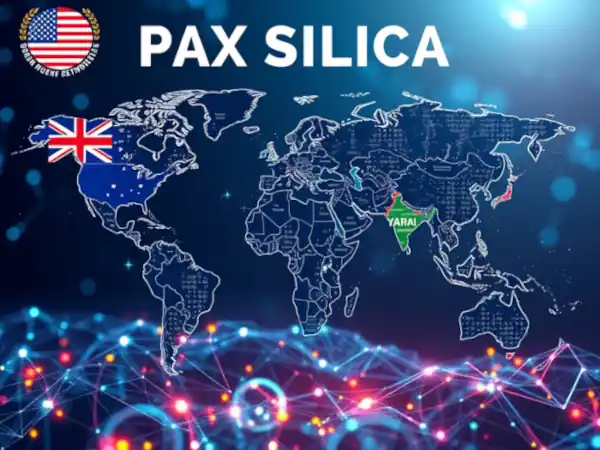
The coalition draws on a diverse group of partners that contribute capabilities across the AI supply chain. The signatories include Australia, Greece, India, Israel, Japan, Qatar, the Republic of Korea, Singapore, the United Arab Emirates, and the United Kingdom. Non-signatory participants include Canada, the European Union, the Netherlands, the Organization for Economic Cooperation and Development, and Taiwan.
Pax Silica’s objectives translate its vision into actionable cooperation: reducing reliance on unreliable or adversarial sources for critical materials and technologies, securing tech supply chains through joint work across the entire stack, and protecting sensitive technologies by building trusted digital infrastructure. To support these goals, the State Department launched a pilot “concierge” service that uses its roughly 270 diplomatic posts to help signatories navigate procurement and logistics. This service is designed to streamline access to U.S.-made AI products—power systems, cooling, software, and hardware—ensuring trusted partners can quickly adopt world-class technology.
The initiative has rapidly shifted from high-level principles to deliverables. The inaugural Pax Silica Summit, held in December 2025, brought together partner nations to coordinate on co-investment, joint industrial projects, and policy alignment with an emphasis on building physical capacity—“pouring concrete, smelting steel, and racking servers.” Momentum continued into 2026, when India formally joined as a signatory, coinciding with discussions at the Global AI Impact Summit in New Delhi and broader cooperation on critical minerals—an example of the initiative’s integrated approach to both upstream and downstream components of the AI ecosystem.
Overall, Pax Silica represents a major effort by the U.S. and its partners to shape the future global economy by securing the foundations of artificial intelligence. It is meant not as an exclusionary bloc but as a positive-sum partnership that strengthens competitiveness, resilience, and shared prosperity in an era defined by technological power.
Pax Silica Declaration
We affirm our shared commitment to advance mutual prosperity, technological progress, and economic security for our peoples.
We recognize that a reliable supply chain is indispensable to our mutual economic security. We also recognize that artificial intelligence (AI) represents a transformative force for our long-term prosperity and that trustworthy systems are essential to safeguarding our mutual security and prosperity.
We recognize that the technological revolution in AI is accelerating, increasingly reorganizing the world economy, and reshaping global supply chains. We believe that economic value and growth will flow through and across all levels of the global AI supply chain, driving historic opportunity and demand for energy, critical minerals, manufacturing, technological hardware, infrastructure, and new markets not yet invented.
In this spirit, we declare our shared vision to deepen our economic partnership through shared efforts on investment security practices, infrastructure, and incentives.
We encourage efforts to partner on strategic stacks of the global technology supply chain, including, but not limited to, software applications and platforms, frontier foundation models, information connectivity and network infrastructure, compute and semiconductors, advanced manufacturing, transportation logistics, minerals refining and processing, and energy.
We believe in mobilizing the immense creative and financial power of private industry and entrepreneurship to make our citizens more prosperous, our nations stronger, and our supply chains more secure. We seek scalable approaches and solutions to supply chain security by mobilizing the complementary industrial and technological strengths of strategic companies and firms from our respective economies.
We support the promotion of a shared and trusted ecosystem of AI developers and vendors to renew legacy industries and unlock new markets and services for the lasting prosperity of our peoples.
We believe that true economic security requires reducing excessive dependencies and forging new connections with reliable partners and suppliers committed to fair market practices. At the same time, we will endeavor to provide access to trusted partners to the full stack of technological advancements that are shaping the AI economy.
We understand the importance of addressing non-market practices that undermine innovation and fair competition. We believe that coordination is essential to protect private investment from the market distortions of overcapacity and unfair dumping practices, and to preserve a level playing field for innovation and growth. We understand the importance of cooperation on the enforcement of our respective policies to protect sensitive technologies and critical infrastructure from undue access, influence, or control.
In this spirit, we intend to further strengthen economic and national security cooperation, including taking complementary actions as appropriate to address non-market policies and practices and enhancing investment security.
We seek to build and deploy trusted information networks, including information and communication technology systems, fiberoptic cables, and data centers.
Through this cooperation, we pursue a comprehensive economic partnership to build an economic security order based on trust, technological complementarity, shared interests, and a shared commitment to a more prosperous future.
Signatories
- Australia
- Greece
- India
- Israel
- Japan
- Qatar
- Republic of Korea
- Singapore
- United Arab Emirates
- United Kingdom
Non-signatory Participants
- Canada
- European Union
- Netherlands
- Organization for Economic Cooperation and Development
- Taiwan
Note: The Pax Silica Summit was held in Washington, D.C. on 12 December 2025, where partner nations signed the Pax Silica Declaration.