Jawaharlal Nehru`s First TV Interview
Interview Transcript
3 June 1953
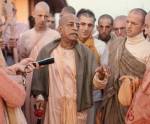
Host: Good evening. This week, more than perhaps ever before, our thoughts are on Asia, and we have the exceptional good fortune to have in the studio tonight one of Asia’s most prominent statesmen, the Prime Minister of India, Mr. Nehru. I am extremely grateful to you for coming here, and I speak on behalf of us here and the wider public who are watching us. I am particularly grateful, as I believe this is your very first appearance on television.
Nehru: Politicians are always compromising; they have to. By some circumstance, I became Prime Minister of India. I have to hold myself in check at all times regarding what I say; otherwise, I would shout from the housetops about what is happening all over the world.
Nehru: Yes, this is the first time I am facing this ordeal. In fact, I know very little about television except what I’ve heard about it.
Host: Well, I would like to introduce to you the people who are, I hope, going to make this not such a bad ordeal after all. Sitting on my left is Kingsley Martin, the editor of The New Statesman and Nation. Beyond him is H. B. Hudson, the editor of The Sunday Times, and at the end, to ask the first question, is Donald McLachlan, the foreign editor of The Economist.
McLachlan: Prime Minister, when you return to India, people will be asking what you thought of the Coronation. What are you going to tell them?
Nehru: I’ll have to tell them a great deal, but principally that it was very impressive in many ways. The most impressive thing to me—apart from it being a great spectacle—was the crowds here, the way they behaved, and how one begins to like more and more the London crowds and their fortitude in inclement weather, and their insistence on enjoying themselves whatever might happen.
Martin: Is there going to be no criticism in India of your having come to the Coronation?
Nehru: There was when I came, and there will be when I go back, no doubt. But I don’t think it will amount to much.
We all understand well why India decided to be a republic within the Commonwealth, but what seems remarkable to us is why there is so little resentment in India toward the British view of our past history. India seems wonderfully magnanimous. Can you explain this phenomenal forgiveness?
Nehru: Well, partly we don’t, I suppose, hate for long or intensively. But chiefly because of the background that Mr. Gandhi gave us during the past decades. After all, I’ve been in prison myself for sixteen years, and I don’t seem to have much resentment about it.
Hudson: You might almost say that being in prison is popular in India.
Nehru: Astonishing thing, really. I think it’s a good thing for a person to go to prison for a short while—and to be Prime Minister for seven years.
McLachlan: Looking back on those seven years, remembering all the hopes expressed at the time of independence, do you feel they have been years of satisfactory achievement, or have there been disappointments?
Nehru: Both. We’ve certainly achieved much, but there has also been a lack of achievement. We haven’t done all we hoped to do. So it has been both satisfactory and unsatisfying.
Hudson: What have you been most disappointed in? Perhaps I can give you a lead—the progress of political democracy?
Nehru: Politically, we have advanced. The unity of the country, integrating the old princely states, the general elections—all remarkable on a tremendous scale. We’ve built a good democratic structure. What troubles us chiefly is the economic side. I believe we’ve made progress, but I should like it to be much faster.
Martin: Has economic progress been fast enough to keep up with the very sharp increase in population? Is there any possibility India will be more or less self-sufficient in food?
Nehru: There’s not only a possibility—I imagine a certainty, and not in the distant future. In the course of a year or two.
Host: On the religious side, that’s a satisfactory and optimistic statement. But caste has long been a major trouble.
Nehru: We are on top of it, but I can’t say we’ve ended it. We still have to face it. The last elections showed the Indian people generally don’t like caste appeals, but caste still interferes with elections. Unfortunately, people may vote for their caste man.
Hudson: Given caste divisions, poverty, the contrast between riches and poverty—doesn’t communism have an opportunity in India?
Nehru: When you speak of communism, you may mean many things—a vague appeal, which has some effect, or the functioning Communist Party, which has a limited appeal.
Hudson: Communism produces economic results faster than democracy—some say that.
Nehru: It may, but it also produces disorder, disruption, chaos. In order to achieve results, it may create disruption first.
Martin: Have Indians not been impressed by what China has done?
Nehru: Yes, greatly impressed. Personally, although I admire much that has happened in China, I think we have done a good deal too, which might be admired.
McLachlan: Isn’t there rivalry between China and India for the leadership of Asia?
Nehru: No. No sense of rivalry.
Hudson: The land problem seems the great test. China solved it dramatically. India seems slow.
Nehru: True—we are slow, partly because democratic processes are slow, partly because our Constitution stresses individual rights, and the courts have interpreted it in ways that hold up legislative measures.
Hudson: Would you say Chinese methods are against the spirit of the Indian Constitution?
Nehru: Some coercive methods, yes. But I imagine much of their land reform was done with a large measure of consent.
Martin: Many worry that India lacks a strong opposition. What will happen if you retire?
Nehru: What do you mean? In our Parliament, there are 500 members; we have 350. The opposition is 150, but split among four or more parties. We can’t impose a two-party system. I would welcome it, but we don’t have it.
Hudson: Do you see any threat to India from communism—externally, through Afghanistan, Tibet, or Southeast Asia?
Nehru: Absolutely no external danger to India from communists or any other source.
Martin: What about relations with Pakistan?
Nehru: They have improved greatly. Our psychological approach to each other is better. We shall gradually solve most of our problems.
Hudson: Some fear China may expand south after a Korean truce.
Nehru: I think that is a completely wrong view. China has no desire to expand; it has enough problems. Our relations with them are friendly.
Martin: But Korea seemed expansionist.
Nehru: Until the 38th parallel was crossed, there was no Chinese activity. After that, China feared invasion of its mainland. They told us so.
Hudson: Isn’t there danger in Southeast Asia because China regards Chinese abroad as its own citizens?
Nehru: Perhaps, but that is an innate Chinese characteristic.
Martin: The big thing in Asia—and Africa—is the growth of national feeling.
Nehru: Yes. One of the biggest things happening is this awakening, this upsurge in Asia, and to some extent Africa. It has upset the old order. It’s a tremendous thing.
Hudson: Are Europeans understanding what is happening in Africa?
Nehru: I fear they are making the same mistakes. Africa is the most tragic continent; its people have suffered terribly for hundreds of years.
Martin: Problems differ across Africa.
Nehru: They differ, but the approach should be the same—friendly and sympathetic.
Hudson: Isn’t there a contrast between places like the Gold Coast and South Africa, where Europeans have permanent homes?
Nehru: The problems differ, but Europeans are vastly outnumbered. Either they cooperate or they suppress—and suppression will lead to Africans pushing them out.
Host: At the United Nations, Asian nations have expressed strong views on European policies in Africa. Does that help?
Nehru: We haven’t said much about British policies. We have said a great deal about South Africa and French North Africa. Should we remain silent when evil is happening? I have to restrain myself as Prime Minister.
Hudson: Is there a difference when Indians are living in those countries, such as Kenya?
Nehru: We have told Indians for years they must cooperate with Africans, not exploit them, and we will not support them in demands against Africans.
Host: What role do you see for the Commonwealth?
Nehru: Its development is of great significance. A free association of countries with different interests meeting in a friendly way is a great thing.
Hudson: Should members of government publicly express views about internal affairs of other members?
Nehru: Normally, no. But it is difficult to draw a clear line. On South Africa, we have raised questions at the United Nations. Are we to remain silent?
Host: Has Russian policy really changed?
Nehru: One cannot be definite, but my view is that there has been a marked change. Russia desires peace—for whatever period.
Hudson: Have they abandoned world revolution?
Nehru: I can’t say, but they may think revolution is furthered more by internal results than by adventures that may lead to war.
Host: Could a four-power conference produce results?
Nehru: Certainly the time is right.
Hudson: Could Asian questions be tackled without Asian governments?
Nehru: Asian countries must be represented.
Host: Should China be admitted to the United Nations?
Nehru: Yes. It is opposed to the very conception of the UN that some of the biggest countries are not allowed in.
Hudson: And after Korea?
Nehru: I hope it will be possible; the pressure of events will bring it about.
Host: In Bermuda, what should be pressed on Mr. Eisenhower?
Nehru: Surely you don’t expect me to say that. But the question of China’s admission must be raised.
Hudson: Anglo-American cooperation is vital to defending democracy.
Nehru: Yes, but leading statesmen in Europe and America tend to see the world from Europe and America. From Delhi or Karachi, it looks different.
Host: Has UN assistance helped with India–Pakistan issues?
Nehru: Not much. These problems are more easily dealt with directly.
Hudson: Kashmir began with both sides staking claims. Isn’t compromise inevitable?
Nehru: True, but the initial issue was Pakistan’s invasion. It is a complicated question, not easily disposed of by a simple formula.
Mr. Nehru, thank you for being with us tonight.
Nehru: I haven’t found this last half hour as bad as I expected. It has passed rapidly. Perhaps because your questions were interesting. It has been a pleasant time. I thank you for it, and I wish those who listen to this a good night.