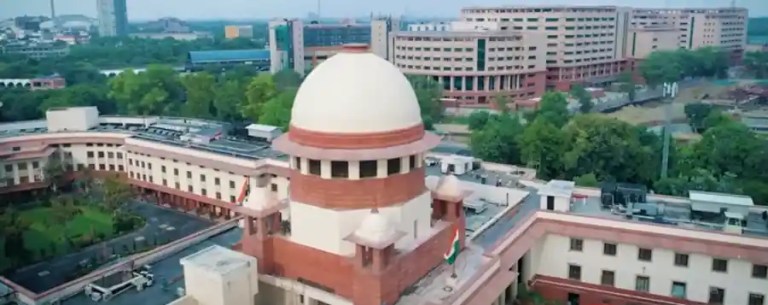
Supreme Court of India
SUPREME COURT OF INDIA
Are Indian courts jurisdictionally empowered to modify an arbitral award? If so, to what extent?
Date of Decision: 30 April 2025
If power is reserved for this Court to modify, at the fag end of the litigation, contracting parties will have grave uncertainties as they would not be sure of how the matter will
play out when it reaches the apex Court. It will be antithetical to arbitration as an alternative and efficacious mode of dispute resolution. this Court will refrain from exercising its power under Article 142 (Dissenting opinion by K.V. VISWANATHAN, J)
Court has a limited power under Sections 34 and 37 of the 1996 Act to modify the arbitral award. This limited power may be exercised under the following circumstances:
I. when the award is severable, by severing the “invalid” portion from the “valid” portion of the award, as held in Part II of our Analysis.
II. by correcting any clerical, computational or typographical errors which appear erroneous on the face of the record, as held in Part IV and V of our Analysis;
III. post award interest may be modified in some circumstances as held in Part IX of our Analysis; and/or
IV. Article 142 of the Constitution applies, albeit, the power must be exercised with great care and caution and within the limits of the constitutional power as outlined in Part XII of our Analysis.
Case Summary: Gayatri Balasamy v. M/s ISG Novasoft Technologies Ltd., 2025 INSC 605 (30 April 2025)
Bench: Constitution Bench (4:1 Majority)
Citation: 2025 INSC 605
Date of Decision: 30 April 2025
Key Issues:
- Whether Indian courts are jurisdictionally empowered to modify an arbitral award under Section 34 and 37 of the Arbitration and Conciliation Act, 1996.
- Whether the power to set aside an award includes the power to modify it.
- Whether such modification can be done by the Supreme Court under Article 142 of the Constitution.
Factual Background:
Gayatri Balasamy, an employee of ISG Novasoft Technologies, filed a criminal complaint of sexual harassment against company officials, which was met with counter-allegations. The matter was referred to arbitration by the Supreme Court, and the tribunal awarded her ₹2 crores. Dissatisfied, she approached the Madras High Court under Section 34 of the Arbitration and Conciliation Act, 1996. The High Court modified the award and granted an additional ₹1.6 crores. On appeal under Section 37, a Division Bench reduced this additional compensation to ₹50,000, terming the enhancement excessive. Gayatri appealed to the Supreme Court.
Due to conflicting precedents on the scope of judicial powers under Sections 34 and 37 of the 1996 Act, a Constitution Bench was formed to decide whether courts can modify arbitral awards.
Supreme Court’s Decision:
Majority (CJ Khanna + 3 Judges):
- Courts have a limited power to modify arbitral awards under Sections 34 and 37.
- Courts can modify post-award interest, and in certain circumstances, partially set aside or modify other aspects if clearly severable from the rest of the award.
- Such powers are inherent within the power to set aside, using the doctrine: omne majus continet in se minus (greater power includes lesser).
- Permitting modification avoids absurd outcomes, saves time and costs, and promotes effective dispute resolution.
- Article 142 allows the Supreme Court to do complete justice, including modifying awards in rare cases, without rewriting merits.
❌ Dissent (Justice Viswanathan):
- Courts cannot modify arbitral awards under Section 34; they may only set aside or remit for reconsideration.
- There is a clear distinction between “severing” an invalid part and “modifying” the award’s substance.
- The 1996 Act deliberately omits modification power, unlike the repealed 1940 Act.
- Article 142 cannot override statutory limitations or disrupt arbitration’s autonomy.
- Any modification by courts violates the minimal interference principle enshrined in the Act and compromises the finality of arbitral awards.
Key Doctrinal Findings:
🔹 Severability & Partial Set Aside:
- Section 34(2)(a)(iv) recognizes severability—courts can remove invalid parts of the award if clearly separable.
- Such partial setting aside implicitly includes a power to modify, where justified.
🔹 Difference Between Modification & Remand:
- Section 34(4) allows courts to remand the award for curable defects (e.g., inadequate reasoning), not to rewrite merits.
- Courts can directly correct minor computational or clerical errors under Section 34 without remanding.
🔹 Post-Award Interest:
- Courts may modify post-award interest, as it is discretionary and may not reflect future realities.
- Pendente lite interest, however, is part of the arbitrator’s adjudication and cannot be altered.
🔹 Article 142 of Constitution:
- Majority: Article 142 can be invoked to modify awards to avoid injustice or excessive litigation.
- Dissent: Article 142 cannot be used to rewrite arbitral awards, as it would supplant parliamentary intent and breach arbitral finality.
Impact & Significance:
- This judgment resolves conflicting precedent on whether Indian courts can modify arbitral awards.
- Courts now have a limited and structured power to correct awards without entirely setting them aside.
- It ensures judicial efficiency, but with safeguards to preserve arbitral autonomy.
- The dissent cautions against overreach, emphasizing the legislature’s role in expanding or limiting judicial power in arbitration.
In Gayatri Balasamy v. ISG Novasoft, the Supreme Court affirmed that Indian courts have a limited power to modify arbitral awards under Sections 34 and 37 of the 1996 Act, particularly where severable issues or interest components are involved. However, such power does not extend to substantive rewriting of the award, and must be exercised cautiously to uphold the foundational principles of arbitration. The Court also held that Article 142 may be used to deliver complete justice, but not to contravene statutory provisions.
Justices: Chief Justice Sanjiv Khanna, Justice Bhushan R. Gavai, Justice Sanjay Kumar, Justice Kalpathy V. Viswanathan, Justice Augustine G. Masih.
Date of Decision: 30 April 2025
Read also
Supreme Court’s Controversial Verdict in Tamil Nadu Case