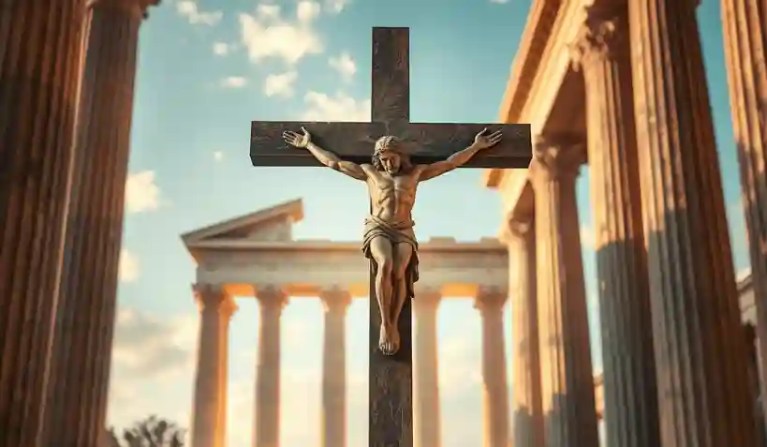
Pip: Welcome to the ADVOCATETANMOY LAW LIBRARY podcast — where the reading list starts in third-century Alexandria and somehow ends at Freud, Marx, and a colonial education debate, all before lunch.
Huma: Advocatetanmoy has put together a sweeping encyclopedic introduction to how Christianity and its doctrines have been examined, challenged, and reinterpreted across nearly two millennia of intellectual history. That’s the territory we’re covering today.
Pip: Let’s start with the critics themselves — who they were, what they objected to, and why the argument never really stopped.
Christian Doctrines: Two Thousand Years of Intellectual Challenge
Huma: The central claim here is that criticism of Christianity is almost as old as Christianity itself — and this piece maps that entire arc, from Roman-era philosophers to contemporary academic disciplines, asking how a religious tradition gets evaluated across radically different cultures and intellectual frameworks.
Pip: The post sets the scene early, and the framing is worth reading directly. It describes how “Christian beliefs have been examined through the lenses of philosophy, history, textual scholarship, comparative religion, political theory, psychology, and social criticism” — and that these critiques arose in different civilizations, languages, and intellectual traditions.
Huma: So the upshot is that this isn’t a story of one secular tradition pushing back against one church. It’s a genuinely global, multilingual argument running across centuries.
Pip: The earliest named critic is Celsus, a possibly imaginary Greek philosopher writing around 275 to 280 CE, whose work The True Doctrine survives only through quotations preserved by opponents. His objections — against the Virgin Birth, miracles, divine revelation — prompted Origen’s Contra Celsum, which the post describes as one of the earliest systematic debates between Christian theology and philosophical criticism.
Huma: Porphyry of Tyre follows, subjecting biblical texts to detailed historical and linguistic analysis, with his works later condemned by church authorities. Then Julian, Roman emperor from 361 to 363 CE, whose Against the Galileans reveals how thoroughly religious and political power had become entangled under Constantine’s successors.
Pip: The medieval section is where the argument genuinely goes global. Islamic theology, rooted in the principle of Tawhid — the absolute unity of God — rejected the Trinity and Incarnation on philosophical grounds. Jewish scholars engaged parallel debates over messianic prophecy and scriptural interpretation. Criticism was never exclusively a secular enterprise.
Huma: The Renaissance and Enlightenment sections bring in Erasmus, Voltaire, and Hume. Hume’s contribution gets a precise formulation in the post: “extraordinary claims require extraordinary evidence” — a framing that shaped every subsequent discussion of miracles and testimony.
Pip: The nineteenth century is where the institutional weight really shifts. Higher Criticism, the search for the Historical Jesus, the Nag Hammadi discovery, Marx’s reading of religion as ideology, Nietzsche’s assault on Christian morality as rooted in resentment — the post holds all of it together without collapsing the distinctions between them.
Huma: And the twentieth century adds Freud, Russell, Sartre, and postcolonial scholarship examining how Christian missions interacted with colonial expansion across Africa, Asia, and the Americas — including specific debates in India about missionary institutions and British rule.
Pip: Two thousand years of argument, and the post’s final word is that this tradition “reflects the continuing effort of diverse cultures and intellectual communities to understand, evaluate, and interpret one of the most influential religious traditions in human history.” That’s not a dismissal — it’s a genuinely open framing.
Huma: Which is probably the right note. The recurring themes the post identifies — authority versus inquiry, individual conscience versus institutional religion, scripture versus history — are still live questions in contemporary scholarship.
Pip: What stays with me is the sheer geographic spread of this argument — Alexandria, Baghdad, Edinburgh, Calcutta — the same doctrines, different courts of appeal.
Huma: And the post makes clear that the methods keep evolving too. Next time, we’ll see where else those methods are being applied.
Read More
- Christian Doctrines: Introduction to the Historical Critiques of Christianity
- Revelation 1 (Greek NT): Patmos, John, and the Vision of Christ
- Ancient and Modern India