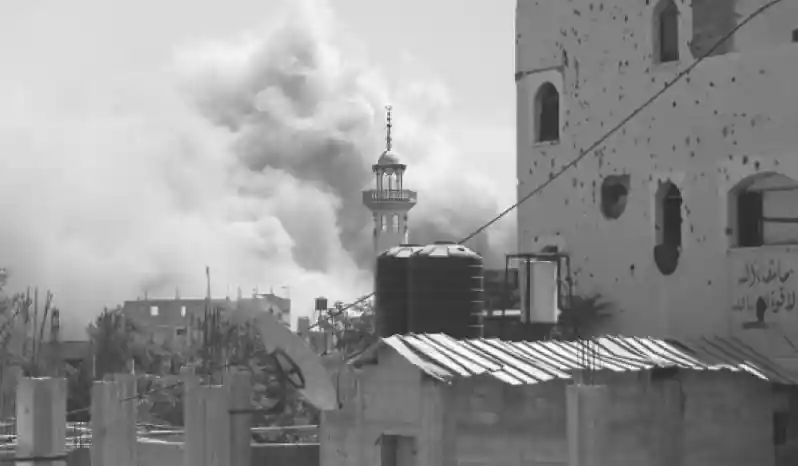
Gaza Strip on Sunday 25th August 2025
Gaza’s plight reveals the hypocrisy of international politics in its rawest, ugliest form
The world has chosen to look away from Gaza, not out of ignorance but out of cynical convenience. The two-state solution lies cold in its grave, and the dirge is not even sung anymore. The Muslim Ummah, once loud in its rhetoric, has lost its voice, while the OIC, that grand theatre of hollow resolutions, has long retreated into diplomatic slumber. America continues to fund Israel’s war machine, and Israel continues its ghastly ritual of bombing civilians as though it were a natural cycle of the seasons. Gaza’s man-made famine is no accident of weather; it is the product of design, obstruction, and deliberate cruelty. The UN has called it by its name, but Israel brands the finding a lie, and Washington, with its forked tongue, shrugs it off as “Hamas propaganda.”
What lies beneath is a grotesque parody of history. The descendants of a people once starved and incinerated by Hitler now use the tactics of their tormentors — the cordoning off of a population, the deliberate withholding of food, the machinery of extermination dressed in the language of security. Gaza has become a modern concentration camp. The skeletal children, the hollow-eyed mothers, the endless rows of shrouded corpses — all recall the same nightmarish imagery of Europe’s Holocaust. And yet the inheritors of that memory now rehearse the Nazi repertoire with a straight face, fortified by American money and American munitions. Denial of famine is itself a propaganda war crime, an insult to truth, and a brazen rehearsal of the same lies that once made Auschwitz possible.
The so-called international community, meanwhile, has perfected its art of impotent outrage. Statements of “deep concern,” resolutions without teeth, and the ever-reliable “thoughts and prayers” are the new currency of global diplomacy. What is famine to them, if the contracts for arms sales are secure and oil continues to flow? The silence of Arab capitals, too, is deafening. Their rulers dine on opulence while Palestinians starve on scraps, choosing commerce with Tel Aviv over conscience. In truth, Palestine has no champions left — only tired slogans, spent ideologies, and empty gestures.
Israel’s war cabinet now prepares to raze Gaza City itself, the very heart of a starving enclave. Its Defence Minister boasts of fire and ruin as bargaining tools, promising to flatten the city unless Hamas kneels. Negotiations for a ceasefire dangle like a cruel jest: Israel offers a pause of sixty days, a token prisoner exchange, only to resume its slaughter once the theatre of diplomacy has played out. The offer is not peace; it is extortion wrapped in humanitarian language.
And yet, behind this battlefield is the deeper, older script — the Biblical claim of entitlement. Nationalistic ideology of Jews, with its invocation of King David and Solomon, reads the map of the modern Middle East as if it were still a parchment from the Book of Kings. The land, they argue, was promised by Elohim, and Islam itself is but an error in the chronology of divine history. Such theology of possession, fused with modern militarism, is why negotiations remain theatre: because you cannot negotiate over land that one side deems a divine title deed.
India’s sympathy for Israel, meanwhile, is not mere geopolitics but historical memory. Like the Israelites, Hindus recall their long ordeal under Islamic and Christian dominations, their attempts to erase an ancient Vedic civilisation. They see in Israel’s war a mirror of their own civilisational struggle. Hindus once sheltered Jews on Indian soil from Christian pogroms, and today, both peoples drape their conflicts in the mantle of divine destiny — Dharma Yuddha for one, Talmudic restoration for the other. It is a dangerous romance, sanctified by myth and sharpened by modern politics.
Thus, the world ignores Gaza’s agony because it has been neatly filed under “collateral inevitability.” It is easier to watch people starve than to confront Israel, easier to weep over famine statistics than to impose real embargoes. Gaza’s tragedy is not only a humanitarian catastrophe; it is the triumph of political cowardice dressed as diplomacy, a stain on the conscience of an age that claims to uphold human rights while feasting on their corpse.
August 25, 2025
Read More
- Netanyahu Sets Five Conditions for Israel’s Victory in Gaza
- Gaza Humanitarian Crisis: U.S. Weapons Aid to Israel Continues
- Keir Starmer’s Talks with Saudi Prince on US-led Gaza Ceasefire
- Leaders of the UK, U.S., Germany and France on Gaza (06/06/2024)
- Global Leaders’ Support for Gaza Ceasefire and Hostage Release Deal