NCERT names them plainly: Jinnah, Congress, Mountbatten—the culprits of Partition
Editorial By Advocatetanmoy
Jinnah, Congress, and Mountbatten—Three Criminals in the Name of Freedom
Finally, India has begun to strip away the saccharine lies and identify the true culprits of her vivisection on communal lines. Bharatvarsha, for thousands of years, was a Hindu rashtra in its civilizational essence, shaped and sustained by Sanatan Dharma. Then came the Muslim invaders, spilling through Persia into Afghanistan and down into India, converting Hindus by the sword, desecrating temples, and ruling tyrannically until the mid-18th century. In 1754, the sun began to set on their dominion, only for Britain to arrive and tighten its imperial grip over a Hindu land until 1947. And in that year of supposed “freedom,” the departing British made their final, poisonous gift: partitioning India along communal lines, tearing Hindu-majority and Muslim-majority provinces apart. Pakistan—both East and West—was carved out of Hindu soil, a Frankenstein state born of fear and appeasement.
Independence on 15 August 1947 came not with jubilation, but with the screams of millions who were uprooted, butchered, and dishonoured. Pakistan’s creation unleashed unimaginable horrors. Hindus and Sikhs were forced to flee ancestral homes, either to convert or to die. Women, in countless numbers, were mutilated, dishonoured, or—choosing dignity over violation—flung themselves into wells. It was the largest human displacement in history, a bloody upheaval in which at least six lakh were slaughtered and crores rendered refugees in their own motherland. This was not an earthquake or flood—it was a human-engineered catastrophe, cold and deliberate.
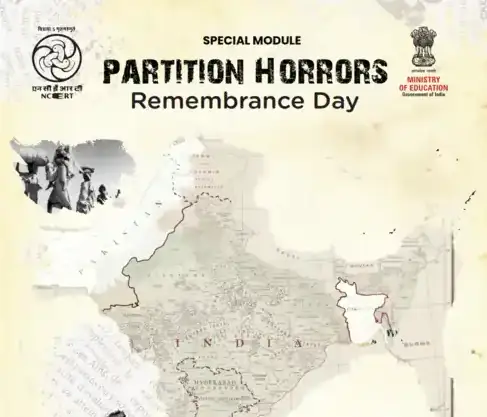
Prime Minister Narendra Modi was right when he declared on 14 August 2021: “Partition’s pains can never be forgotten. Millions of our sisters and brothers were displaced and many lost their lives due to mindless hate and violence. In memory of the struggles and sacrifices of our people, 14th August will be observed as Partition Horrors Remembrance Day.” At last, the nation pauses to remember not only the dead, but the betrayal that killed them.
The Partition left wounds that never healed. India, suddenly flanked by hostile neighbours, inherited Kashmir—an entirely new problem, nurtured by foreign powers eager to arm Pakistan as a permanent thorn. The communal bitterness Jinnah had manufactured was not exorcised; it was institutionalized. As Lord Wavell had forewarned in his diary (4 February 1946): “Partition would be a frightfully disruptive operation. It would not solve the communal problem, but would perpetuate it. It would leave Hindustan and Pakistan still face to face with all the same problems of defense, minorities, and so on, and probably increase bitterness.” The man was not wrong.
The Muslim League, intoxicated by Jinnah’s rhetoric, had laid the seeds in Lahore in 1940. Jinnah himself declaimed: “Hindus and Muslims belong to two different religious philosophies, social customs, and literatures. … They have different epics, different heroes… the hero of one is the villain of the other.” With this grotesque philosophy of division, he justified tearing apart millennia of shared land. The British obliged with their Cripps Mission in 1942 and Cabinet Mission in 1946, half-hearted charades that pretended to promise dominion status while dangling autonomy to Muslim provinces. When Congress balked, Jinnah bared his teeth with “Direct Action Day” (16 August 1946), unleashing pogroms in Calcutta where six thousand were butchered within days. Violence became his veto.
Patel, the iron realist, lamented but conceded: “I am not in favor of partition; I am against it. But we have to accept it as a bitter medicine. The country has been turned into a battlefield, and the two communities cannot live together in peace. It is better to have partition than to have a civil war.” (Bombay, July 1947). Nehru, ever the calculating statesman, agreed: “Partition is bad. But whatever the price of unity, the price of civil war would be infinitely greater.” Gandhi, cornered, sighed: “If the Congress wishes to accept partition, it will be against my advice… But I will not oppose it with violence or anger.” (9 June 1947). Even the Mahatma laid down his arms.
Mountbatten, the grinning undertaker, sped the process. Instead of June 1948, he advanced Independence to August 1947, leaving Radcliffe a mere five weeks to scrawl borders that would decide the fate of millions. Radcliffe later muttered: “I was given a job to do and I did my best, though it may not have been very good.” Very good? Millions bled because lines were drawn in haste. For two days after Independence, villages in Punjab did not know whether they belonged to India or Pakistan. Mountbatten would later wash his hands: “I did not partition India. The plan had been accepted by Indian leaders themselves. … I accept the blame for the haste… But I do not accept the blame for the violence that followed.” (c. 1970s).
Yet the responsibility cannot be diluted. As even official accounts now dare to admit: the unholy trinity of Partition’s culprits was Jinnah, who demanded it; the Congress, which conceded it; and Mountbatten, who bungled it.
The aftermath was devastation. Punjab and Bengal—India’s most prosperous provinces—were gutted. Homes were torched, temples razed, trains arrived filled with corpses. Aurobindo’s prophetic warning thundered true: “The Partition must go. Let it be only a temporary and not a permanent dismemberment… If it lasts, India may be seriously weakened, even crippled; civil strife may remain always possible, possibly leading to a new and more disastrous Partition.” (15 August 1947).
And yet, this was no inevitable destiny. Just six months before, no one seriously believed it possible. Even Jinnah confessed privately: “I never thought it would happen. I never expected to see Pakistan in my lifetime.” For many in the Muslim League, the Pakistan slogan was a bargaining chip, not a blueprint. For Congress, Partition was unthinkable—until Jinnah’s violence made it a bitter reality.
The lessons are brutal but clear. Appeasing communal politics is national suicide. Granting legitimacy to violence rewards the mob and cripples the state. Leaders must rise above vanity and short-sightedness, for their arrogance can devastate entire peoples. Above all, history must not be whitewashed. To airbrush Partition is to condemn future generations to repeat it.
As S. H. Vatsyayan ‘Ajneya’ wrote in November 1947: “… The body bears the weight of even its own disease. Shame! Again, shame! And this shame is neither Hindu nor Muslim— It is the outrage of my insulted humanity!”
The shame of Partition belongs to those who demanded it, those who permitted it, and those who botched its execution. NCERT, through its special module, now names Jinnah, Congress, and Mountbatten as the culprits. History, at last, begins to be corrected—not forgiven.
Sunday, August 17, 2025