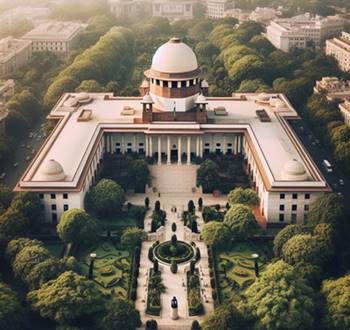
Supreme Court Of India
SUPREME COURT OF INDIA
IN RE: ARTICLE 370 OF THE CONSTITUTION
Date: December 11, 2023.
Legend has it that eons ago Kashmir valley was a vast mountain lake called ‘Satisar’ and that Rishi Kashyap created the valley of Kashmir by draining this lake.
An analysis of the Nilamat Purana, the oldest scripture of Aryan Saraswat Brahmins of Kashmir (can put Kas’mira) indicates that the first set of settlers in Kashmir were the Nagas – snake worshippers and animists. A batch of Aryans, originally settled on the banks of the mighty Vedic River Saraswati, moved to the Valley when the Saraswati river dried up. This was about 5,000 years ago. The origin of the people of the Valley has had varied versions, including that they were descendants of one of the lost tribes of Israel. The Valley has heritage and culture as a place of learning. One of the most respected places of learning is the Sharda Peeth, now in the Pakistan Occupied Kashmir area, where education was gender neutral and based on excellence.
Article 370 of the Constitution of India incorporated special arrangements for the governance of the State of Jammu and Kashmir. The President issued Constitutional Orders 272 and 273 during the subsistence of a Proclamation under Article 356(1)(b). These orders have the effect of applying the entire Constitution of India to the State of Jammu and Kashmir and abrogating Article 370. Contemporaneously, Parliament enacted the Jammu and Kashmir Reorganisation Act 20191 which bifurcated the State into two Union territories. The petitioners have challenged the constitutionality of these actions.
The State of Jammu and Kashmir does not retain any element of sovereignty after the execution of the IoA and the issuance of the Proclamation dated 25 November 1949 by which the Constitution of India was adopted. The State of Jammu and Kashmir does not have ‘internal sovereignty’ which is distinguishable from the powers and privileges enjoyed by other States in the country. Article 370 was a feature of asymmetric federalism and not sovereignty;
It can be garnered from the historical context for the inclusion of Article 370 and the placement of Article 370 in Part XXI of the Constitution that it is a temporary provision;
The power under Article 370(3) did not cease to exist upon the dissolution of the Constituent Assembly of Jammu and Kashmir. When the Constituent Assembly was dissolved, only the transitional power recognised in the proviso to Article 370(3) which empowered the Constituent Assembly to make its recommendations ceased to exist. It did not affect the power held by the President under Article 370(3);
The exercise of power by the President under Article 370(1)(d) to issue CO 272 is not mala fide. The President in exercise of power under Article 370(3) can unilaterally issue a notification that Article 370 ceases to exist. The President did not have to secure the concurrence of the Government of the State or Union Government acting on behalf of the State Government under the second proviso to Article 370(1)(d) while applying all the provisions of the Constitution to Jammu and Kashmir because such an exercise of power has the same effect as an exercise of power under Article 370(3) for which the concurrence or collaboration with the State Government was not required;
The President had the power to issue a notification declaring that Article 370(3) ceases to operate without the recommendation of the Constituent Assembly. The continuous exercise of power under Article 370(1) by the President indicates that the gradual process of constitutional integration was ongoing. The declaration issued by the President under Article 370(3) is a culmination of the process of integration and as such is a valid exercise of power. Thus, CO 273 is valid;
The Constitution of India is a complete code for constitutional governance. Following the application of the Constitution of India in its entirety to the State of Jammu and Kashmir by CO 273, the Constitution of the State of Jammu and Kashmir is inoperative and is declared to have become redundant;
The views of the Legislature of the State under the first proviso to Article 3 are recommendatory. Thus, Parliament’s exercise of power under the first proviso to Article 3 under the Proclamation was valid and not mala fide;
We direct that steps shall be taken by the Election Commission of India to conduct elections to the Legislative Assembly of Jammu and Kashmir constituted under Section 14 of the Reorganisation Act by 30 September 2024. Restoration of statehood shall take place at the earliest and as soon as possible.
Union Territories are normally geographically small territories, or may be created for aberrant reasons or causes. Conversion of a State into Union Territory has grave consequences, amongst others, it denies the citizens of the State an elected state government and impinges on federalism. Conversion/creation of a
Union Territory from a State has to be justified by giving very strong and cogent grounds. It must be in strict compliance with Article 3 of the Constitution of India.
Dr Dhananjaya Y Chandrachud….CJ
B R Gavai….J
Surya Kant….J
Sanjay Kishan Kaul…J
Sanjiv Khanna….J