Constitution of Islamic Republic of Afghanistan-2004
CHAPTER THREE: THE PRESIDENT
Article Sixty
The President shall be the head of state of the Islamic Republic of Afghanistan, executing his authorities in the executive, legislative and judiciary fields in accordance with the provisions of this Constitution. The President shall have two Vice-Presidents, first and second. The Presidential candidate shall declare to the nation names of both vice presidential running mates. In case of absence, resignation or death of the President, the first Vice-President shall act in accordance with the provisions of this Constitution. In the absence of the first Vice-President, the second Vice-President shall act in accordance with the provisions of this Constitution.
Article Sixty-One
The President shall be elected by receiving more than fifty percent of votes cast by voters through free, general, secret and direct voting. The presidential term shall expire on 1st of Jawza of the fifth year after elections. Elections for the new President shall be held within thirty to sixty days prior to the end of the presidential term. If in the first round none of the candidates gets more than fifty percent of the votes, elections for the second round shall be held within two weeks from the date election results are proclaimed, and, in this round, only two candidates who have received the highest number of votes in the first round shall participate. In case one of the presidential candidates dies during the first or second round of voting or after elections, but prior to the declaration of results, re-election shall be held according to provisions of the law.
Article Sixty-Two
The individual who becomes a presidential candidate shall have the following qualifications:
- Shall be a citizen of Afghanistan, Muslim, born of Afghan parents and shall not be a citizen of another country;
- Shall not be less than forty years old the day of candidacy;
- Shall not have been convicted of crimes against humanity, a criminal act or deprivation of civil rights by court.
No individual shall be elected for more than two terms as President. The provision of this article shall also apply to Vice-Presidents.
Article Sixty-Three
Before assuming office, the President shall take, in accordance with special procedures set by law, the following oath of allegiance:
“In the name of God, Most Gracious, Most Merciful, I swear by the name of God Almighty that I shall obey and protect the Holy religion of Islam, respect and supervise the implementation of the Constitution as well as other laws, safeguard the independence, national sovereignty and territorial integrity of Afghanistan, and, in seeking God Almighty’s help and support of the nation, shall exert my efforts toward the prosperity and progress of the people of Afghanistan.”
Article Sixty-Four
The President shall have the following authorities and duties:
- Supervise the implementation of the Constitution;
- Determine the fundamental lines of the policy of the country with the approval of the National Assembly;
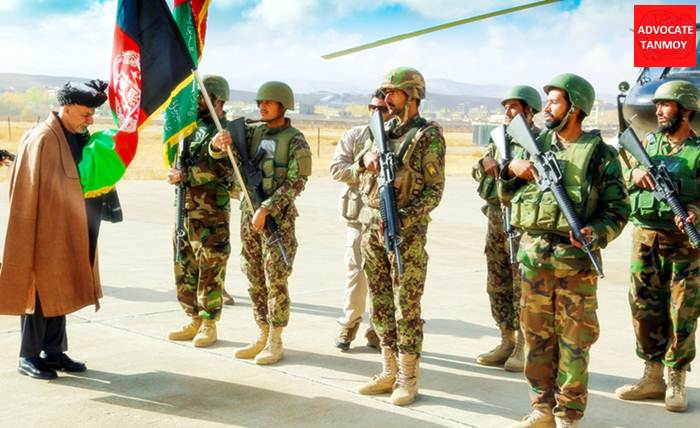
- Being the Commander in Chief of the armed forces of Afghanistan;
- Declare war and peace with the endorsement of the National Assembly;
- Take necessary decisions to defend territorial integrity and preserve independence;
- Dispatch armed forces units outside of Afghanistan with the endorsement of the National Assembly;
- Convene the Loya Jirga except in the situation prescribed in Article 69 of this Constitution;
- Proclaim as well as terminate the state of emergency with the endorsement of the National Assembly;
- Inaugurate the sessions of the National Assembly and Loya Jirga.
- Accept the resignations of vice-presidents of the Republic;
- Appoint the Ministers, the Attorney General, the Head of the Central Bank, the National Security Director as well as the Head of the Red Cross with the endorsement of the House of People, and their dismissal and acceptance of resignation;
- Appoint the Justice of the Supreme Court as well as justices of the Supreme Court with the endorsement of the House of People;
- Appointing, retiring and accepting the resignation and dismissal of judges, officers of the armed forces, police, national security as well as high-ranking officials according to the provisions of law;
- Appoint heads of political representatives of Afghanistan to foreign states as well as international organizations;
- Accept credentials of foreign political representatives in Afghanistan;
- Endorse laws as well as judicial decrees;
- Issue credential letter for conclusion of international treaties in accordance with the provisions of the law;
- Reduce and pardon penalties in accordance with the provisions of the law;
- Bestow medals, insignias as well as honorary titles in accordance with the provisions of the law;
- Establish commissions to improve the administration of the country in accordance with the provisions of the law;
- Perform other authorities and duties enshrined in this Constitution.
Article Sixty-Five
On important national, political, social as well as economic issues the President can call for a referendum of the people of Afghanistan. The referendum shall not be contrary to the provisions of this Constitution or require its amendment.
Article Sixty-Six
The President shall take into consideration the supreme interests of the people of Afghanistan to enforce the authorities enshrined in this Constitution. The President shall not sell or bestow state properties without the provision of the law. During the term of office, the Presidential position shall not be used for linguistic, sectarian, tribal, and religious as well as party considerations.
Article Sixty-Seven
In case of resignation, impeachment or death of the President, as well as an incurable illness impeding performance of duty, the First Vice-President shall assume authorities and duties of the President. The President shall personally tender resignation to the National Assembly. Affirmation of an incurable illness shall be verified by an authoritative medical team assigned by the Supreme Court. In such cases, elections for the new President shall be held within three months in accordance with Article Sixty-One of the Constitution. The First Vice-President, in acting as interim President, shall not perform the following duties:
- Amend the Constitution;
- Dismiss ministers;
- Call a referendum.
The Vice-Presidents can according to the provisions of this Constitution, nominate themselves as presidential candidates. In the absence of the President, the duties of the First Vice-President shall be determined by the President.
Article Sixty-Eight
In case any of the Vice-Presidents resign or die, another person shall be appointed by the President with the endorsement of the House of the People. In case of simultaneous death of the President and the First Vice-President, the Second Vice-President, the President of the House of Elders, the President of the House of Representatives and the Foreign Minister shall succeed respectively and, in that order, and, according to Article Sixty-Seven of this Constitution, shall assume the duties of the President.
Article Sixty-Nine
The President shall be responsible to the nation as well as the House of People in accordance with the provisions of this Article. Accusations of crimes against humanity, national treason as well as a crime against the President shall be demanded by one third of all members of the House of People. If this demand is approved by two thirds of the House of People, the House of People shall convene the Loya Jirga within one month.
If the Loya Jirga, by two-thirds majority, approves the accusation, the President shall be released from duty and the issue shall be referred to a special court, which shall be comprised of the President of the House of Elders, three members of the House of People, and three members of the Supreme Court appointed by the Loya Jirga. The case shall be presented by the individual appointed by the Loya Jirga. In such a situation the provisions of Article Sixty-Seven of this Constitution shall be applied.
Article Seventy
The salary and expenses of the President shall be regulated by law. The President, after completion of his term of service, except when dismissed, shall be entitled to financial benefits of the presidency for the rest of his life in accordance with the law.