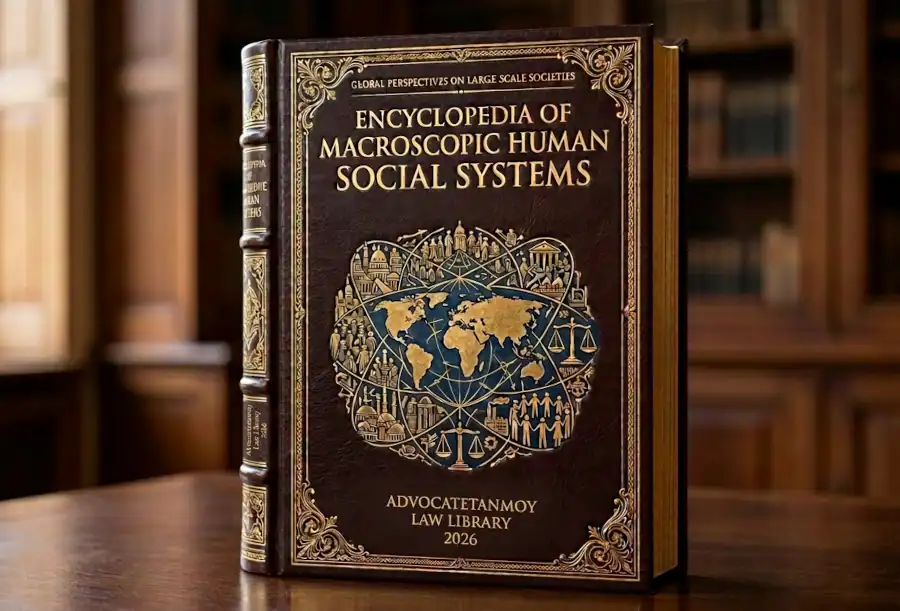
Macroscopic Human Social System Analysis
The Last Generation of Original Knowledge: Why 2026 May Become a Civilisational Milestone
From the perspective of the history of civilisation, 2050 may eventually be remembered not as the year in which artificial intelligence achieved complete supremacy over humanity, but as the moment at which humanity encountered the intrinsic limits of a civilisation constructed upon recursively generated information. The hypothesis rests upon a fundamental distinction between information, knowledge, understanding, and civilisational creativity. Information may be copied indefinitely at negligible cost; knowledge requires observation, verification, and interpretation; understanding emerges from intellectual judgement; civilisation advances only when successive generations introduce genuinely original contributions into the historical record. If the global informational ecosystem becomes overwhelmingly populated by synthetic documents generated by artificial intelligence rather than by direct human observation, civilisation may enter an Epistemic Closed Loop, a condition in which knowledge ceases to expand despite unprecedented computational capacity. Under such circumstances, the apparent growth of information conceals an underlying contraction of originality.
The modern history of artificial intelligence began during the intellectual transformation initiated after the Second World War. Between 1943 and 1956, pioneers including Warren McCulloch, Walter Pitts, Alan Turing, John McCarthy, Marvin Minsky, Claude Shannon, and others established theoretical foundations for computational intelligence in institutions located principally in the United Kingdom and the United States. The Dartmouth Summer Research Project on Artificial Intelligence, convened in Hanover, New Hampshire, during 1956, formally introduced the expression Artificial Intelligence into scientific vocabulary. Yet throughout the twentieth century, machine intelligence remained constrained by limited computational resources and comparatively modest datasets. The decisive transformation occurred only after the convergence of the World Wide Web, large-scale digitisation, cloud computing, social media, distributed storage, and the emergence of Large Language Models (LLMs) between approximately 2017 and 2026. During this period, machines gained access to the largest accumulated archive of human textual production ever assembled, including books, scientific journals, legal records, encyclopaedias, newspapers, artistic literature, governmental publications, technical manuals, and billions of individual communications.
This unprecedented archive represented the accumulated intellectual labour of thousands of years. The earliest written records appeared in Uruk in southern Mesopotamia around 3400–3200 BCE, where cuneiform inscriptions recorded economic transactions upon clay tablets. Egyptian civilisation developed hieroglyphic writing shortly thereafter, while the Indus Valley Civilisation, ancient China, classical Greece, Rome, medieval Islamic scholarship, Indian philosophical traditions, European universities, printing technology after 1450, industrial publishing, and digital communication successively enlarged the human archive. Every generation deposited new observations into civilisation’s expanding reservoir of knowledge. Artificial intelligence inherited this reservoir; it did not create it. The extraordinary performance of twenty-first-century language models depended almost entirely upon statistical analysis of this accumulated historical inheritance.
Consequently, artificial intelligence possesses a structural dependency fundamentally different from biological intelligence. Human beings acquire knowledge through experience, observation, experimentation, error, memory, emotion, social interaction, and continuous engagement with physical reality. Artificial intelligence acquires statistical competence only after analysing existing representations of reality created by humans. It does not independently discover archaeological sites beneath deserts, observe astronomical phenomena through telescopes, conduct geological expeditions across mountain ranges, negotiate diplomatic settlements, endure political revolutions, experience mortality, establish families, construct civil institutions, or witness historical catastrophes. Every sentence generated by an artificial system ultimately originates from patterns embedded within previous human expression. Machine intelligence therefore functions historically as a secondary processor of civilisation rather than as its primary witness.
During the 2023–2026 period, computer scientists increasingly recognised a phenomenon subsequently described as Model Collapse, Recursive Training Degradation, or the Synthetic Data Feedback Problem. Mathematical studies demonstrated that successive generations of machine learning systems trained predominantly upon synthetic outputs gradually lost statistical diversity. Rare linguistic forms disappeared first. Minority interpretations diminished. Regional vocabulary contracted. Exceptional observations became increasingly uncommon because statistical optimisation naturally favoured dominant probability distributions. Over multiple iterations, artificial systems reproduced progressively simplified versions of previous outputs until informational diversity approached homogenisation. The computational infrastructure remained operational; the informational ecology deteriorated. The phenomenon resembled biological inbreeding rather than mechanical failure. Complexity declined because the system increasingly consumed its own reproductions instead of fresh empirical reality.
If this tendency were to become the defining characteristic of the global informational ecosystem between 2027 and 2050, the consequences would extend far beyond software engineering. The crisis would represent not merely the degradation of machine learning but the emergence of a civilisation increasingly dependent upon synthetic regeneration rather than human creation. Every civilisation requires continuous intellectual inflow. Ancient civilisations expanded through exploration, conquest, trade, agriculture, astronomy, mathematics, philosophy, metallurgy, architecture, and religious reflection. Modern civilisation expanded through scientific experimentation, industrial innovation, constitutional development, medicine, telecommunications, and digital computation. Innovation requires anomalies—facts not previously contained within existing explanatory systems. When anomalies disappear, intellectual progress slows because every conclusion merely confirms previous conclusions.
The hypothetical condition may therefore be described as the Exhaustion of the Human Knowledge Reservoir. This expression does not imply that all knowledge has been discovered. Rather, it denotes the possibility that publicly accessible digital knowledge ceases to receive sufficient quantities of authentic human contribution while synthetic generation expands exponentially. Artificial intelligence continues producing essays, research summaries, educational material, artistic compositions, legal commentary, journalism, advertising, entertainment, and academic prose, yet increasingly derives each successive layer from preceding machine-generated material. The informational universe appears to expand numerically while contracting conceptually. Billions of new documents exist, yet relatively few contain genuinely original observations concerning the natural or human world.
Historical precedent suggests that every major civilisation confronted crises arising from informational closure. The destruction of the Library of Alexandria, although historically more complex than popular legend suggests, symbolises the vulnerability of accumulated knowledge. During portions of the European Middle Ages, manuscript production remained restricted to comparatively limited scholarly communities. The invention of the movable-type printing press by Johannes Gutenberg in Mainz around 1450 fundamentally altered this equilibrium by reducing the cost of textual reproduction. Yet Gutenberg’s press did not itself generate new knowledge; it accelerated the dissemination of human authorship. Likewise, the Internet revolution after approximately 1991 democratised publication without replacing the necessity of human observation. Artificial intelligence introduces a qualitatively different historical condition because the system itself becomes an autonomous producer of textual abundance. The distinction between creation and replication therefore acquires unprecedented civilisational significance.
Within this framework, 31 December 2026 may be interpreted symbolically as the closing boundary of the Primary Human Digital Epoch. By this date, enormous quantities of authentic human writing had already entered the digital ecosystem. If subsequent decades witness declining levels of independently generated scholarship relative to synthetic production, future language models may increasingly preserve the epistemic horizon established by that historical corpus. They would not necessarily become inaccurate in every respect; rather, they might become progressively less capable of participating in genuine intellectual evolution. Artificial intelligence would preserve civilisation’s memory while gradually losing civilisation’s future.
One of the most profound implications concerns the institution of the university. Since the establishment of organised centres of higher learning, including Nalanda in ancient India, the University of Bologna around 1088, the University of Oxford during the late eleventh century, and the University of Paris during the twelfth century, higher education rested upon an asymmetry of knowledge. Professors possessed access to manuscripts, libraries, laboratories, specialised training, and intellectual traditions unavailable to ordinary students. Authority derived substantially from informational scarcity. Artificial intelligence radically alters this equilibrium. A student entering university in 2050, born on 1 January 2027, could possess instantaneous computational access to an informational corpus exceeding anything available to earlier generations of scholars. The historical monopoly over information disappears.
The consequence is not necessarily the disappearance of universities but the collapse of epistemic authority based solely upon information possession. The professor who merely repeats archived knowledge risks becoming indistinguishable from a conversational algorithm. Academic legitimacy would increasingly depend upon capacities unavailable to statistical systems: designing original experiments, conducting field research, interpreting contradictory evidence, exercising ethical judgement, recognising conceptual anomalies, and producing genuinely new knowledge. If these functions weaken, universities risk becoming custodians of archived civilisation rather than laboratories of future civilisation.
The implications extend equally into science. Scientific revolutions have historically emerged through empirical discoveries rather than textual synthesis. Nicolaus Copernicus challenged inherited cosmology through astronomical reasoning; Galileo Galilei employed telescopic observation; Isaac Newton formulated mathematical principles describing universal gravitation; Charles Darwin relied upon biological observation during and after the voyage of HMS Beagle; Marie Curie investigated radioactivity through experimental research; Albert Einstein transformed theoretical physics through conceptual innovation subsequently tested against observation. None of these achievements emerged through recursive summarisation of existing literature alone. Each required confrontation with reality itself. If scientific institutions increasingly substitute synthetic literature for direct experimentation, innovation inevitably decelerates regardless of computational sophistication.
The same principle governs history. Historical knowledge expands whenever archaeologists excavate forgotten settlements, archivists recover neglected manuscripts, linguists decipher extinct languages, anthropologists document disappearing cultures, or governments declassify official records. Artificial intelligence may organise existing archives with extraordinary efficiency, yet archives themselves remain finite unless humanity continues generating new primary evidence. The distinction between primary sources and secondary synthesis, long recognised within historiography, becomes the defining principle of the digital age. Artificial intelligence excels at secondary synthesis; civilisation ultimately depends upon continuing production of primary sources.
The prediction likewise encompasses art, literature, music, and poetry. Throughout history, artistic innovation reflected changing social experience rather than statistical recombination alone. The Renaissance transformed medieval aesthetics because European society itself changed. Romanticism emerged partly in reaction to Enlightenment rationalism and industrialisation. Modernism reflected technological upheaval, urbanisation, and world war. Every artistic movement introduced experiences absent from previous generations. Should synthetic systems merely interpolate among stylistic patterns accumulated before 2026, artistic production may become increasingly derivative despite enormous technical proficiency. Quantity would expand while originality contracts.
An instructive civilisational analogy may be drawn from 325 CE, when the First Council of Nicaea, convened by Emperor Constantine I in Nicaea of Bithynia, sought doctrinal uniformity within Christianity. Regardless of theological evaluation, the council illustrates the establishment of an authoritative canonical framework repeatedly transmitted across subsequent centuries. Canonical preservation provides continuity, coherence, and institutional stability. Yet every civilisation simultaneously requires spaces in which inherited frameworks may be questioned, expanded, or revised through encounter with new reality. The analogy suggests that a civilisation dependent exclusively upon perpetual regeneration of an established informational corpus risks confusing preservation with intellectual vitality. A canon without continuous discovery becomes an archive rather than a civilisation.
The ultimate significance of the 2050 Epistemic Collapse Hypothesis therefore lies not in predicting the literal death of artificial intelligence but in identifying the possible exhaustion of the relationship between machines and human originality. Artificial intelligence may become increasingly powerful while simultaneously becoming increasingly dependent upon a finite historical reservoir produced during humanity’s previous intellectual epochs. Computational acceleration cannot compensate indefinitely for declining empirical input. An engine without new fuel merely circulates existing energy.
If such a condition were to emerge, the most valuable resource of the mid-twenty-first century would no longer be computational power but authentic human observation. Eyewitness testimony, laboratory notebooks, archaeological excavation reports, ecological surveys, diplomatic correspondence, handwritten diaries, ethnographic interviews, engineering prototypes, philosophical reflection, artistic experimentation, and field research would acquire unprecedented strategic importance because they would constitute the principal sources from which future knowledge could genuinely expand. Human creativity would become civilisation’s equivalent of biodiversity within an ecological system. Its preservation would no longer represent merely a cultural aspiration but a prerequisite for the continued evolution of knowledge itself.
Under this interpretation, 2050 would not signify the triumph of artificial intelligence over humanity. It would instead reveal an older historical truth repeatedly demonstrated across five millennia of civilisation: every archive, every library, every university, every algorithm, and every machine ultimately depends upon living human beings willing to observe reality directly, question inherited assumptions, and contribute something that did not exist before. When a civilisation ceases producing original witnesses, even the most advanced intelligence becomes the curator of a completed museum rather than the architect of an unfinished future.
Sarvarthapedia Knowledge Network: Core Civilisational Thesis
The 2050 Epistemic Collapse Hypothesis belongs to a larger civilisational framework rather than a standalone theory of artificial intelligence. It intersects with the history of knowledge production, information systems, education, scientific discovery, digital civilisation, creativity, and human consciousness. Within Sarvarthapedia, the article functions as a bridge between the History of Knowledge and the Future of Civilisation. It is grounded in the proposition that civilisation survives only through continuous production of authentic human knowledge.
Cluster I: Core Concept
2050 Epistemic Collapse Hypothesis
Core Concepts
- Computer Science
- Intelligence
- Artificial Intelligence
- Human Knowledge Architecture
- Information
- Knowledge
- Understanding
- Wisdom
- Civilisation
- Digital Civilisation
- Knowledge Production
- Knowledge Management
- Knowledge Evolution
- Human Creativity
- Original Human Data
- Synthetic Knowledge
- Historical Memory
- Existence of Future
See also
- Model Collapse
- AI Echo Chamber
- Recursive Training
- Synthetic Data
- Information Entropy
- Epistemology
- Philosophy of Knowledge
- History of Science
- History of Civilisation
Cluster II: Artificial Intelligence and Computational Systems
Artificial Intelligence
Related Concepts
- Machine Learning
- Deep Learning
- Large Language Models (LLMs)
- Neural Networks
- Artificial General Intelligence
- Computational Intelligence
- Statistical Learning
- Natural Language Processing
- AI Chatbots
- Knowledge Graphs (Google)
Connected Articles
- History of Artificial Intelligence
- Dartmouth Conference (1956)
- Alan Turing
- John McCarthy
- Marvin Minsky
- Claude Shannon
- Open-source AI
- AI Governance
- AI Ethics
- AI Safety
Model Collapse
Connected Concepts
- Recursive Learning
- Synthetic Data Feedback
- Recursive Training Degradation
- Distribution Shift
- Dataset Contamination
- Information Loss
- Statistical Collapse
- Data Degeneration
- Cyber Security
See also
- AI Echo Chamber
- Information Ecology
- Human Data Exhaustion
- Synthetic Knowledge
- Machine Hallucination
- Data Provenance
AI Echo Chamber
Connected Topics
- Closed Information Systems
- Recursive Information
- Digital Self-reference
- Computational Feedback Loops
- Information Homogenisation
- Loss of Novelty
Related Articles
- Recursive Civilisation
- Closed Knowledge Systems
- Algorithmic Culture
- Information Bubbles
Cluster III: Knowledge and Epistemology
Knowledge
Branches
- Human Knowledge
- Scientific Knowledge
- Historical Knowledge
- Tacit Knowledge
- Explicit Knowledge
- Indigenous Knowledge
- Institutional Knowledge
- Practical Knowledge
Connected Articles
- Information
- Understanding
- Wisdom
- Truth
- Belief
- Observation
- Experience
- Discovery
Epistemology
Related Fields
- Philosophy of Knowledge
- Theory of Truth
- Theory of Evidence
- Scientific Method
- Verification
- Falsification
- Rationalism
- Empiricism
Connected Articles
- Karl Popper
- Thomas Kuhn
- Philosophy of Science
- Historiography
- Knowledge Validation
Human Knowledge Reservoir
Components
- Libraries
- Archives
- Museums
- Universities
- Scientific Literature
- Historical Records
- Oral Traditions
- Manuscripts
- Digital Repositories
Related Concepts
- Knowledge Preservation
- Knowledge Transmission
- Knowledge Accumulation
- Knowledge Exhaustion
Cluster IV: History of Civilisation
Civilisation
Interconnected Fields
- Cultural Evolution
- Political Evolution
- Technological Evolution
- Economic History
- Intellectual History
- Religious History
- Military History
- Scientific Revolution
See also
- History of Writing
- History of Books
- History of Libraries
- History of Universities
- Printing Revolution
- Digital Revolution
Information Revolutions
Timeline
Writing Revolution (c. 3400 BCE)
- Cuneiform
- Hieroglyphics
- Early Records
Manuscript Civilisation
- Scrolls
- Papyri
- Palm-leaf Manuscripts
- Codices
Printing Revolution (1450 CE)
- Johannes Gutenberg
- Printing Press
- Mass Literacy
Digital Revolution (1991 onwards)
- Internet
- World Wide Web
- Search Engines
- Cloud Computing
Artificial Intelligence Revolution (2017–2026)
- Large Language Models
- Generative AI
- AI Chatbots
- Synthetic Media
Synthetic Regeneration Era (2027–2050) (Hypothesis)
- Recursive Knowledge
- Human Data Exhaustion
- Model Collapse
- Epistemic Closure
Cluster V: Education and Universities
University
Historical Evolution
- Nalanda
- Takshashila
- Bologna
- Oxford
- Paris
- Humboldt Model
- Research University
Connected Topics
- Professorship
- Academic Authority
- Research
- Peer Review
- Scientific Method
- Knowledge Transfer
Epistemic Authority
Related Concepts
- Professors
- Teachers
- Universities
- Experts
- Journalists
- Encyclopaedias
- Scientific Institutions
See also
- Trust
- Institutional Legitimacy
- Credentialism
- Knowledge Democratisation
Cluster VI: Science and Innovation
Scientific Discovery
Foundations
- Observation
- Experimentation
- Measurement
- Verification
- Replication
- Theory Formation
Related Scientists
- Galileo
- Newton
- Darwin
- Curie
- Einstein
Connected Articles
- Scientific Revolution
- Laboratory Science
- Empirical Research
- Innovation
- Discovery
Innovation
Drivers
- Curiosity
- Creativity
- Experiment
- Failure
- Risk
- Exploration
Threats
- Information Stagnation
- Recursive Knowledge
- Closed Systems
- Intellectual Conformity
Cluster VII: Human Creativity
Creativity
Domains
- Literature
- Poetry
- Music
- Painting
- Cinema
- Architecture
- Philosophy
Connected Topics
- Originality
- Imagination
- Inspiration
- Artistic Evolution
- Cultural Innovation
Human Originality
Foundations
- Experience
- Emotion
- Consciousness
- Observation
- Memory
- Cultural Diversity
Related Articles
- Human Intelligence
- Consciousness
- Free Will
- Creative Thinking
- Innovation
Cluster VIII: Information Ecology
Information Ecology
Components
- Human Data
- Machine Data
- Archives
- Digital Records
- Primary Sources
- Secondary Sources
Threats
- Data Pollution
- Synthetic Saturation
- Information Entropy
- Digital Homogenisation
Data Provenance
Related Concepts
- Authenticity
- Verification
- Metadata
- Archival Science
- Documentary Evidence
Connected Articles
- Digital Preservation
- Historical Sources
- Research Methodology
- Information Integrity
Cluster IX: Future Civilisation
Synthetic Regeneration Era
Characteristics
- AI-generated Information
- Recursive Knowledge
- Digital Memory
- Automated Publishing
- Synthetic Creativity
Connected Topics
- AI Governance
- Digital Sovereignty
- Knowledge Economy
- Human Adaptation
Human Data Exhaustion Theory
Related Concepts
- Model Collapse
- Epistemic Collapse
- Information Entropy
- Knowledge Reservoir
- AI Dependency
Connected Articles
- Knowledge Economy
- Human Creativity
- Civilisational Sustainability
- Scientific Progress
Cluster X: Historical Analogies
Library of Alexandria
Connected Topics
- Preservation of Knowledge
- Loss of Knowledge
- Ancient Scholarship
- Manuscript Culture
First Council of Nicaea (325 CE)
Connected Topics
- Canon Formation
- Knowledge Preservation
- Religious Authority
- Institutional Memory
Gutenberg Revolution
Connected Topics
- Printing
- Information Expansion
- Literacy
- Scientific Revolution
Internet Revolution
Connected Topics
- Global Connectivity
- Digital Information
- Search Engines
- Big Data
- Social Media
Sarvarthapedia Core Knowledge Web
Primary Hub
2050 Epistemic Collapse Hypothesis
First-Level Links
- Artificial Intelligence
- Model Collapse
- AI Echo Chamber
- Human Knowledge Reservoir
- Human Data Exhaustion
- Information Ecology
- Epistemology
- Knowledge Production
- Knowledge Preservation
- Digital Civilisation
- Scientific Discovery
- Universities
- Human Creativity
- Innovation
- Information Entropy
Second-Level Links
- Large Language Models
- Machine Learning
- Deep Learning
- Artificial General Intelligence
- Recursive Learning
- Synthetic Data
- Statistical Learning
- Primary Sources
- Secondary Sources
- Scientific Method
- Research Methodology
- Philosophy of Science
- History of Writing
- Printing Revolution
- Internet Revolution
- Knowledge Economy
- Digital Archives
- Libraries
- Museums
- Archives
- Historiography
- Philosophy of Knowledge
- Civilisational Evolution
- Future Studies
- Information Theory
- Computational Epistemology
Parent Categories
- Philosophy
- Epistemology
- Artificial Intelligence Studies
- Civilisation Studies
- History of Science
- Digital Humanities
- Information Science
- Knowledge Systems
- Future Studies
- Technology and Society
- Human Civilisation Studies
- Sarvarthapedia Core Concepts