Encyclopedia of American Governance
How to Get an Easy Loan in America: Credit Scores, APR, and Eligibility
In the United States, a loan is a contractual transfer of money from a lender to a borrower, creating a legal obligation to repay the principal together with interest, fees and other agreed charges. The American loan system is not one single market but a vast network of commercial banks, credit unions, mortgage lenders, finance companies, fintech lenders, online lenders, government-backed lending programs, private lenders, institutional investors and specialized consumer-credit providers. The practical meaning of an easy loan in America depends on the borrower’s credit history, income, employment, debt obligations, collateral, residence, banking relationship, loan purpose and ability to document repayment capacity.
The central principle of American lending is risk-based pricing. A lender does not charge every borrower the same price for money. A borrower with a strong credit score, stable income, low debt-to-income ratio (DTI) and substantial financial history generally represents lower credit risk and may obtain a lower interest rate. A borrower with poor credit, irregular income, high existing debt or limited U.S. credit history may still obtain financing, but the lender may compensate for the greater perceived risk through a higher APR, larger fees, shorter repayment period, collateral requirement or co-signer requirement. Thus, the phrase easy loan has to be separated from the phrase cheap loan. A loan can be easy to obtain and expensive to repay.
American consumer lending can first be divided into secured loans and unsecured loans. A secured loan is supported by collateral. The collateral gives the lender a legally recognized asset that can potentially be recovered if the borrower defaults. Mortgage loans are secured by real estate; auto loans are secured by vehicles; home equity loans and HELOCs are connected to home equity; and share-secured loans or certificate-secured loans can be backed by savings or certificates held with a financial institution. The lower risk to the lender can produce lower borrowing costs, but the borrower assumes the risk of losing the pledged asset.
An unsecured loan does not normally require a specific physical asset as collateral. Instead, the lender evaluates the borrower’s creditworthiness. The underwriting process can examine FICO score, credit report, payment history, income, employment, debt-to-income ratio, bank-account information and other legally permissible financial information. The most familiar unsecured products include personal loans, credit cards and certain student loans. Because there is no particular asset standing behind the obligation, unsecured borrowing generally carries greater lender risk and therefore can carry higher interest rates.
A personal loan is one of the principal forms of general-purpose consumer credit in America. The borrower receives a specified amount, usually as a lump-sum deposit into a bank account, and repays the debt through scheduled installments. Personal loans can be used for debt consolidation, emergency expenses, home repairs, medical expenses, relocation, major purchases and other lawful personal purposes. Online personal loans have increased the speed of the application process because much of the underwriting, identity verification, income verification and document collection can be performed digitally. The result is an increasingly automated American fintech lending system in which loan applications can be assessed without a traditional face-to-face bank interview.
The credit score is one of the most important gateways to American consumer credit. Credit reporting and scoring allow lenders to estimate how a borrower has handled previous obligations. A strong credit profile can open access to more lenders and lower-priced credit, while damaged or limited credit can restrict the available market. Credit score, however, is not the only factor. Income stability, existing monthly obligations, employment history, loan amount, loan term and collateral can materially influence the underwriting decision. A person with poor credit may therefore qualify for a secured loan when an unsecured lender would decline the application.
The debt-to-income ratio, commonly called DTI, measures monthly debt obligations in relation to gross monthly income. It is important because a borrower can have a respectable credit score and still have limited capacity to take on additional debt. For example, a consumer who already has a mortgage, auto loan, student loan and credit-card balances may face greater difficulty obtaining another large unsecured loan. Lenders use DTI and related affordability measures to estimate whether the proposed monthly payment can reasonably be supported by the borrower’s income.
The American credit market contains several levels of accessibility. At the smallest scale are cash advances and earned-wage-access products, which may provide relatively small amounts to consumers facing a temporary gap between earning wages and receiving a paycheck. Eligibility can depend on employment and direct-deposit arrangements rather than a conventional credit-score assessment. These products can therefore be attractive to consumers who need a small amount of liquidity quickly, but fees, subscriptions, expedited-transfer charges and repayment conditions must be examined carefully.
The next level includes credit unions, banks and online personal-loan lenders. Credit unions are member-owned financial institutions and can provide consumer loans under their own underwriting policies and applicable federal or state rules. Certain federal credit unions offer Payday Alternative Loans (PALs), designed as regulated alternatives to conventional payday lending. For borrowers with limited credit access, a credit union relationship can therefore be an important part of the American consumer-finance system.
At the high-risk end are payday loans, title loans and other short-term high-cost loans. These products can be easier to obtain because the underwriting requirements may be less demanding. Their economic cost, however, can be extremely high. Payday lending may involve short repayment periods and very high annualized costs, while a car title loan uses the vehicle title as collateral and exposes the borrower to the possibility of repossession following default. The existence of easy approval therefore does not establish affordability.
The interest rate is the price charged for the use of borrowed money. American loans may have fixed interest rates or variable interest rates. A fixed-rate loan maintains the contractual rate throughout the applicable period, making future payments more predictable. Variable-rate credit can change according to a reference index and contractual margin. Credit cards, HELOCs and some adjustable-rate loans can therefore experience changes in borrowing costs when the underlying market index changes.
The Federal Reserve has an important indirect influence on American borrowing costs through monetary policy and short-term interest rates. Changes in the broader interest-rate environment can influence the cost of bank funding and the pricing of loans and revolving credit. The relationship is not mechanical for every consumer product: mortgage rates, for example, are influenced substantially by longer-term bond-market conditions, while credit cards and other variable-rate products can be more directly connected to benchmark rates. Nevertheless, the Federal Reserve, federal funds rate, prime rate, Treasury yields, inflation, monetary policy and credit-market conditions form an important macroeconomic background to American borrowing.
The borrower should distinguish the interest rate from the Annual Percentage Rate (APR). APR is particularly important for comparing loans because it incorporates interest and certain applicable finance charges into a standardized annualized measure. A lender can advertise an attractive nominal rate while charging an origination fee, administrative fee or other borrowing cost. The supplied material gives the practical example of a $10,000 loan with an 8% origination fee: the borrower could receive only $9,200 while remaining contractually responsible for the $10,000 principal.
Origination fees are therefore an important part of loan economics. Some lenders charge no origination fee, while others deduct a percentage of the loan amount before disbursement. The borrower should determine three separate numbers: how much is borrowed, how much cash is actually received, and how much must ultimately be repaid. The difference between these figures can reveal the true economic cost of the credit more clearly than the advertised interest rate alone.
The loan term also changes the financial trajectory. A short-term loan normally produces a higher monthly payment but reduces the period over which interest accumulates. A long-term loan reduces the monthly payment but generally increases the total interest cost. In the supplied $10,000 example at a 12.44% rate, a five-year repayment period produces a monthly payment of approximately $224.66, with approximately $3,479.79 in total interest over the life of the loan. The same principal repaid more quickly would require greater monthly cash flow but would generally produce a lower total interest expense.
This is the significance of loan amortization. In a conventional installment loan, every scheduled payment contains both an interest component and a principal component. Interest is calculated against the outstanding principal, so the interest component normally declines as the principal balance falls. Early payments can therefore feel slow from the borrower’s perspective because a meaningful portion of the payment is allocated to interest. Over time, the principal-reduction component becomes increasingly significant. Understanding an amortization schedule allows the borrower to see the exact relationship between payment, interest, principal and remaining balance.
A borrower may also reduce the life of a loan through additional principal payments, provided the loan contract permits them without a relevant prepayment charge. Paying additional principal can reduce the balance on which future interest is calculated. A biweekly payment strategy can also result in an additional full payment over a year when structured correctly. The borrower should nevertheless verify the lender’s payment-allocation rules so that additional money is actually applied to principal reduction rather than merely advancing the next scheduled payment.
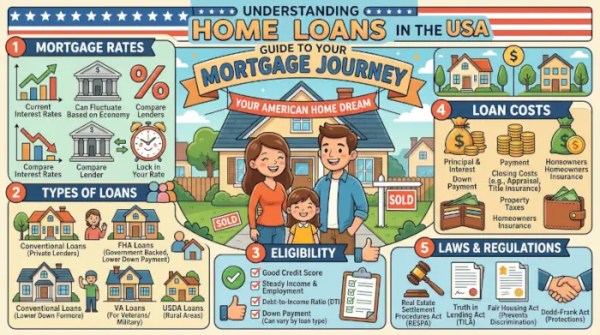
Mortgages form the largest and most structurally important category of secured consumer borrowing. A mortgage finances residential real estate and normally creates a lien against the property. American mortgage lending includes conventional mortgages, FHA loans, VA loans, USDA-related programs, fixed-rate mortgages, adjustable-rate mortgages, home-equity loans and HELOCs. The loan-to-value ratio, credit profile, income, property value, down payment, mortgage insurance and other underwriting factors can determine the final terms.
An auto loan finances the acquisition of a vehicle and normally gives the lender a security interest in the automobile. American consumers can obtain financing directly from a bank or credit union or indirectly through a dealership. Preapproval before visiting a dealership can allow the buyer to understand the financing cost separately from the vehicle price. Auto lending can also include different pricing tiers according to credit quality, with weaker credit profiles generally facing higher borrowing costs.
Credit cards constitute another major form of American consumer credit. Unlike an installment loan, a credit card normally provides a revolving credit line. The borrower can use available credit repeatedly as balances are repaid. When the statement balance is paid according to the card agreement, interest treatment can differ substantially from carrying a balance from month to month. Persistent revolving balances at high APRs can become expensive because interest continues to accrue while the principal remains outstanding. Credit cards are therefore simultaneously a payment instrument, revolving credit facility and source of consumer debt.
Student loans occupy a special category. Federal student loans are associated with the U.S. Department of Education and operate under federal statutory and regulatory frameworks. Private student loans are provided by private financial institutions and generally depend more heavily on the borrower’s creditworthiness and, in many cases, a creditworthy co-signer. Federal and private student loans should not be treated as economically or legally identical because their repayment structures, borrower protections and available relief mechanisms can differ substantially.
The American loan system is also defined by consumer-credit law. The Truth in Lending Act (TILA) addresses disclosure of credit costs; the Equal Credit Opportunity Act (ECOA) establishes important anti-discrimination protections in credit transactions; the Fair Credit Reporting Act (FCRA) regulates consumer credit reporting; and the Fair Debt Collection Practices Act (FDCPA) regulates specified conduct by third-party debt collectors. The Dodd-Frank Wall Street Reform and Consumer Protection Act of 2010 created the Consumer Financial Protection Bureau (CFPB), which has a major federal role in consumer financial protection and enforcement. State law adds another layer through licensing rules, interest-rate restrictions, debt-collection requirements and usury laws.
The consequences of loan default depend upon the nature of the debt and applicable law. Failure to repay a secured loan can place the collateral at risk. Default on an unsecured loan can lead to delinquency reporting, collection activity and, depending on the circumstances, litigation and enforcement of a judgment. The precise remedies depend on the contract, federal law and the law of the relevant state. Bankruptcy law also creates formal mechanisms through which individuals may seek relief from qualifying debts, although not every category of debt receives identical treatment.
The practical architecture of American lending can therefore be understood as a sequence:
Need for money → Loan purpose → Borrower profile → Credit evaluation → Risk classification → Interest rate → Fees → Loan term → Monthly payment → Amortization → Repayment → Credit reporting → Default or payoff.
The American loan market is consequently not merely a mechanism for obtaining cash. It is an institutional system for transforming future income into present purchasing power. Consumer credit, personal loans, mortgages, auto finance, student loans, credit cards, home equity, credit unions, commercial banks, fintech lending, online lending, secured credit, unsecured credit, interest rates, APR, credit scores, FICO, DTI, collateral, loan underwriting, amortization, debt consolidation and debt repayment are interconnected components of that system.
For someone seeking an easy loan in America, the practical objective should therefore not simply be rapid approval. The meaningful question is whether the loan provides the required capital at a cost and repayment schedule that the borrower can sustain. The difference between a useful loan and a destructive debt obligation is often found in the details: APR, origination fee, monthly payment, total interest, repayment term, collateral, default provisions, credit reporting and state law. Easy access to money solves an immediate liquidity problem; affordable and properly structured credit determines whether that solution remains financially viable over time.
Read also
- Home Loan in USA: Mortgage Rates, Types, Eligibility, Costs and Laws
- US Health Insurance Crisis 2026
- Personal Loan Balance Transfer: How to Refinance it
Sarvarthapedia Conceptual Node: Easy Loan in America
Easy Loan in America is the central node connecting the concepts of consumer credit, lending institutions, creditworthiness, risk-based pricing, interest, APR, fees, collateral, debt, repayment and financial regulation.
Core Concepts
Loan
A contractual transfer of money from lender to borrower, creating an obligation to repay principal, interest, fees and other contractual charges.
Borrower
The individual or entity receiving credit and assuming the legal obligation of repayment.
Lender
The institution or person providing credit, including commercial banks, credit unions, finance companies, fintech lenders, mortgage lenders and specialized consumer-credit providers.
Principal
The amount of debt legally owed before considering accumulated interest and other charges.
Interest
The economic price paid for the use of borrowed capital.
Annual Percentage Rate
APR expresses the annualized cost of credit and can incorporate interest and certain applicable finance charges, making it important for comparing borrowing arrangements.
Loan Term
The contractual period over which the debt is scheduled to be repaid.
Monthly Payment
The periodic amount required under an installment-loan agreement, ordinarily containing both interest and principal.
Amortization
The systematic reduction of loan principal through scheduled payments over the life of an installment loan.
Creditworthiness
The lender’s assessment of the borrower’s capacity and history of repaying debt.
Credit Score
A numerical representation derived from credit-report information and used as one component of credit-risk assessment.
Debt-to-Income Ratio
DTI compares recurring debt obligations with income and provides an indicator of repayment capacity.
Collateral
Property or another asset pledged to secure repayment of a debt.
Default
Failure to perform contractual repayment obligations, potentially producing collection activity, credit-report consequences, litigation, repossession, foreclosure or other remedies depending upon the debt and applicable law.
Cluster: American Consumer Credit System
Consumer Credit
Consumer credit is the wider institutional field within which personal loans, credit cards, automobile finance, mortgages and other household borrowing operate.
Installment Credit
Installment credit normally involves a fixed amount advanced at origination and repaid through scheduled payments.
Personal Loan
General-purpose installment borrowing used for purposes such as debt consolidation, home repair, emergency expenses, relocation and major purchases.
Auto Loan
A loan used to finance a motor vehicle, normally secured by a security interest in the vehicle.
Mortgage Loan
Long-term secured credit used to acquire or refinance real estate.
Student Loan
Credit used for educational expenses, divided broadly between federal student loans and private student loans.
Revolving Credit
Credit Card
A revolving credit facility permitting repeated borrowing up to an established credit limit.
Home Equity Line of Credit
A HELOC provides revolving access to borrowing based upon available home equity and is generally secured by the property.
Cluster: Secured and Unsecured Lending
Secured Loan
A secured loan is supported by collateral.
Mortgage
Real property functions as collateral.
Auto Finance
The financed vehicle normally secures the debt.
Home Equity Loan
Home equity supports the borrowing obligation.
Share-Secured Loan
Savings or another qualifying financial asset may serve as security.
Unsecured Loan
An unsecured loan does not ordinarily depend upon a specific pledged physical asset.
Personal Loan
The lender principally evaluates the borrower’s credit and financial capacity.
Credit Card
The revolving obligation is generally unsecured unless specifically structured otherwise.
Conceptual Link
Secured Credit → Collateral → Lower Lender Loss Exposure → Potentially Different Pricing
Unsecured Credit → Creditworthiness → Greater Lender Risk → Potentially Higher Pricing
This relationship connects the Collateral node directly to Risk-Based Pricing, Credit Score, Interest Rate and Default.
Cluster: Creditworthiness
Credit Score
The credit score functions as one of the principal gateways to American consumer credit.
Credit Report
A credit report contains information concerning credit accounts, payment history and other information governed by applicable credit-reporting rules.
Payment History
Past repayment behavior is a major component of conventional credit assessment.
Credit Utilization
The relationship between revolving balances and available revolving credit can influence credit scoring models.
Length of Credit History
The duration and history of credit accounts can form part of credit evaluation.
New Credit
Recent applications and newly opened accounts can form part of certain scoring models.
FICO Score
FICO is one of the best-known credit-scoring systems used in American lending.
Thin Credit File
A person with limited American credit history may have difficulty obtaining conventional credit even when income is sufficient.
Poor Credit
Poor credit can restrict lender choice, increase borrowing costs or lead lenders to require collateral or a co-signer.
Creditworthiness Network
Credit Report → Credit Score → Risk Classification → Interest Rate → APR → Monthly Payment → Repayment Capacity
Cluster: Loan Underwriting
Underwriting
Loan underwriting is the process through which a lender evaluates the risk and affordability of extending credit.
Income Verification
The lender may evaluate wages, salary, self-employment income, benefits or other permissible income sources.
Employment History
Employment stability can form part of the lender’s assessment of repayment capacity.
Debt-to-Income Ratio
DTI connects income with existing debt obligations.
Loan Amount
The requested principal affects both repayment burden and perceived credit risk.
Loan Purpose
Some lending products are purpose-specific, while personal loans may permit broader lawful uses.
Co-Signer
A co-signer may strengthen an application by undertaking additional repayment responsibility, subject to the contractual structure.
Underwriting Network
Borrower → Identity → Income → Credit History → DTI → Loan Amount → Collateral → Risk Assessment → Approval or Decline → Loan Pricing
Cluster: Risk-Based Pricing
Credit Risk
Credit risk is the possibility that a borrower will fail to perform the repayment obligation.
Interest Rate
The interest rate represents a central component of the lender’s compensation for providing capital.
Risk Premium
Higher perceived credit risk can be reflected in a higher borrowing price.
APR
APR broadens the comparison beyond the nominal interest rate by incorporating certain applicable finance charges.
Origination Fee
An origination fee may be deducted from the amount advanced while the borrower remains legally obligated for the contractual principal.
Total Cost of Credit
The economically meaningful comparison is not merely the advertised rate but the relationship among:
Amount Borrowed → Amount Received → Interest → Fees → Monthly Payments → Total Repayment
Central Conceptual Proposition
Easy Approval ≠ Low Cost
Low Monthly Payment ≠ Low Total Cost
Low Interest Rate ≠ Low APR
Longer Term ≠ Cheaper Loan
These distinctions connect Easy Loan to Financial Literacy, Consumer Protection, Debt Management and Household Financial Risk.
Cluster: American Lending Institutions
Commercial Banks
Banks provide deposits, payment services and various forms of consumer and commercial credit.
Credit Unions
Credit unions are member-oriented financial institutions that provide savings, payment and lending services under their applicable regulatory framework.
Credit Union Personal Loans
Personal loans may be available through membership-based financial institutions.
Payday Alternative Loans
Certain federal credit unions offer regulated Payday Alternative Loans (PALs) as alternatives to conventional payday lending.
Online Lenders
Online lenders conduct much or all of the application and underwriting process digitally.
Fintech Lending
Fintech lending combines financial services with software, automated underwriting, electronic verification and digital disbursement.
Finance Companies
Specialized finance companies provide consumer and commercial credit outside the conventional deposit-taking bank structure.
Mortgage Lenders
Mortgage lenders specialize in real-estate-secured lending.
Dealer Financing
Automobile dealerships can participate in indirect financing arrangements connecting consumers with financing institutions.
Institutional Lending Network
Banks ↔ Credit Unions ↔ Finance Companies ↔ Fintech Lenders ↔ Mortgage Institutions ↔ Capital Markets
The institutional network connects consumer borrowing with the wider American financial system.
Cluster: Short-Term and High-Cost Credit
Payday Loan
A payday loan is a short-duration form of consumer credit generally associated with repayment around a borrower’s next paycheck.
Title Loan
A title loan uses an automobile title as collateral.
High-Cost Credit
High-cost credit can provide rapid access to liquidity while imposing substantial fees or annualized borrowing costs.
Liquidity Trap
Repeated short-term borrowing can create a cycle in which new borrowing is used to satisfy earlier obligations.
Conceptual Chain
Income Gap → Emergency Liquidity Need → Easy Approval → Short-Term Credit → High Cost → Repayment Pressure → Repeat Borrowing
This cluster should cross-reference Debt Cycle, Household Financial Vulnerability, Consumer Protection and Financial Regulation.
Cluster: Interest Rates and Monetary System
Federal Reserve
The Federal Reserve System forms a central institution in the American monetary and banking architecture.
Federal Funds Rate
The federal funds rate influences short-term financial conditions and therefore indirectly affects many forms of borrowing.
Prime Rate
The prime rate is an important reference point for certain categories of lending.
Treasury Yields
Longer-term Treasury-market conditions influence broader financial-market pricing and can be relevant to long-term borrowing costs.
Inflation
Inflation affects the purchasing power of money and forms part of the broader macroeconomic environment surrounding interest rates.
Monetary Policy
Federal Reserve monetary policy affects financial conditions throughout the American economy.
Interest-Rate Network
Federal Reserve → Monetary Policy → Financial Conditions → Market Rates → Lender Funding Costs → Loan Pricing → Household Borrowing
The reverse connection is:
Household Borrowing → Consumption → Investment → Credit Demand → Economic Activity
Cluster: Loan Economics
Loan Amortization
Amortization transforms a large principal obligation into a sequence of scheduled payments.
Principal Reduction
Each payment can reduce the outstanding principal according to the contractual amortization schedule.
Interest Accumulation
Interest represents the cost associated with the outstanding balance.
Prepayment
Additional principal payments can reduce the outstanding balance more rapidly when permitted under the loan contract.
Biweekly Payment
A properly structured biweekly schedule can result in an additional annual payment compared with twelve ordinary monthly payments.
Total Interest
Total interest represents the cumulative interest paid during the life of the loan.
Loan Economics Network
Principal → Interest → Payment → Amortization → Balance Reduction → Interest Reduction → Loan Payoff
Cluster: Mortgage Civilization
Residential Mortgage
The mortgage is a central institution of American household finance and real-estate ownership.
Conventional Mortgage
A conventional mortgage is generally not insured or guaranteed by the federal government in the manner of certain government-backed programs.
FHA Loan
An FHA-insured mortgage operates within a federal housing-finance framework.
VA Loan
A VA-backed mortgage operates through a federal program for eligible borrowers.
USDA Housing Finance
Certain USDA programs support qualifying rural housing finance.
Fixed-Rate Mortgage
The contractual interest rate remains fixed according to the loan agreement.
Adjustable-Rate Mortgage
An ARM permits the interest rate to change according to specified contractual rules.
Loan-to-Value Ratio
LTV compares the loan amount with the value of the property securing the loan.
Mortgage Insurance
Certain mortgage structures require insurance connected to the lender’s or program’s risk.
Mortgage Network
Home Ownership → Down Payment → Mortgage → Property Lien → Monthly Payment → Amortization → Home Equity → Refinancing or Sale
Cluster: Automobile Credit
Vehicle Finance
Automobile finance transforms the purchase price of a vehicle into a scheduled debt obligation.
Dealer Financing
A dealer may arrange financing with a third-party lender.
Direct Lending
A consumer may obtain financing directly from a bank or credit union.
Repossession
Default on secured automobile debt can create legal rights concerning recovery of the collateral, subject to applicable law.
Auto Credit Network
Vehicle Purchase → Loan → Security Interest → Monthly Payment → Principal Reduction → Vehicle Equity → Payoff or Sale
Cluster: Credit Cards and Revolving Debt
Revolving Credit
Unlike installment credit, revolving credit permits repeated borrowing and repayment within a credit limit.
Credit Limit
The maximum amount available under the revolving credit facility.
Statement Balance
The balance appearing on the periodic statement.
Minimum Payment
The minimum contractual payment necessary to remain current under the card agreement.
Revolving Balance
A balance carried forward can generate interest according to the card’s contractual terms.
Credit Utilization
Credit-card balances interact with available credit and can influence credit scoring.
Revolving-Debt Network
Credit Limit → Spending → Balance → Interest → Minimum Payment → Persistent Debt → Credit Utilization
Cluster: Student Credit
Federal Student Loan
Federal student lending operates within a statutory and administrative framework associated with the U.S. Department of Education.
Private Student Loan
Private educational loans are provided by private financial institutions and can depend heavily upon borrower creditworthiness.
Co-Signer
Private educational lending may involve a co-signer where the principal borrower does not independently satisfy underwriting standards.
Student Debt
Student borrowing creates a long-duration financial obligation that can interact with income, employment, housing and household formation.
Student-Credit Network
Education → Student Loan → Graduation → Employment → Income → Repayment → Credit History
Cluster: Debt Consolidation
Debt Consolidation Loan
A borrower may use a new loan to replace multiple existing obligations.
Multiple Debts
A household may simultaneously maintain credit-card debt, auto debt, student debt, medical debt and personal loans.
Consolidation Logic
Multiple High-Cost Debts → New Loan → Single Payment → Different Interest Rate → Extended or Reduced Term
Consolidation Risk
A lower monthly payment may result from extending the repayment period rather than reducing the underlying economic cost.
Debt Management
Debt consolidation therefore connects directly to APR, total interest, loan term, monthly payment and household cash flow.
Cluster: Consumer Protection Law
Truth in Lending Act
TILA forms a major federal framework for disclosure of credit terms and costs.
Equal Credit Opportunity Act
ECOA establishes important protections concerning discrimination in credit transactions.
Fair Credit Reporting Act
FCRA regulates consumer reporting and the use of consumer credit information.
Fair Debt Collection Practices Act
FDCPA regulates specified conduct by third-party debt collectors.
Dodd-Frank Act
The Dodd-Frank Wall Street Reform and Consumer Protection Act of 2010 substantially reorganized federal financial regulation following the financial crisis.
Consumer Financial Protection Bureau
The CFPB occupies a central federal position in consumer financial protection and supervision.
State Law
Federal consumer-finance law operates alongside state lending laws, licensing requirements, usury rules and debt-collection law.
Legal Network
Loan Contract → Disclosure → Credit Reporting → Collection → Consumer Rights → Federal Regulation → State Regulation → Enforcement
Cluster: Default and Enforcement
Delinquency
Failure to make a required payment on time can produce delinquency.
Default
A more serious contractual failure that can activate remedies defined by the loan agreement and applicable law.
Credit Reporting
Delinquent or defaulted obligations can affect the borrower’s credit history subject to applicable reporting rules.
Debt Collection
Creditors or debt collectors may seek repayment through legally permitted methods.
Judgment
Litigation can produce a judgment that may create additional enforcement mechanisms under applicable state law.
Repossession
Secured creditors may have rights concerning collateral after default, subject to contractual and legal requirements.
Foreclosure
Mortgage default can potentially result in foreclosure procedures under applicable law.
Bankruptcy
Federal bankruptcy law creates formal legal procedures for qualifying debtors seeking relief or restructuring.
Default Network
Missed Payment → Delinquency → Default → Collection → Litigation or Collateral Enforcement → Credit Consequences
Cluster: Household Financial Risk
Cash Flow
Loan affordability ultimately depends upon the relationship between recurring income and recurring expenditure.
Emergency Expense
Medical expenses, unemployment, relocation, repairs and other unexpected costs can generate short-term borrowing demand.
Debt Burden
Debt burden represents the cumulative pressure created by outstanding repayment obligations.
Financial Resilience
A household with savings and stable cash flow may have less need for expensive emergency credit.
Liquidity
Liquidity represents the ability to meet immediate financial obligations using available cash or readily accessible resources.
Household Risk Network
Income → Cash Flow → Savings → Emergency Need → Credit Demand → Debt Service → Disposable Income
Cluster: Easy Loan Versus Affordable Loan
Easy Approval
Ease of approval concerns the probability and speed with which a borrower can obtain credit.
Affordable Credit
Affordability concerns whether the borrower can sustain repayment without destabilizing household finances.
Cheap Credit
Cheap credit concerns the economic price of borrowing.
Fast Credit
Fast credit concerns the speed of application, underwriting and disbursement.
Conceptual Distinction
Easy → Accessibility
Fast → Speed
Cheap → Price
Affordable → Repayment Sustainability
These are separate dimensions and should not be treated as synonyms.
Cluster: Financial Literacy
Loan Comparison
A borrower should compare APR, interest rate, origination fee, monthly payment, term, total interest and total repayment.
Contract Reading
Loan agreements contain legally significant provisions concerning payment, default, fees, collateral, dispute resolution and other contractual matters.
Amortization Schedule
An amortization schedule exposes the relationship between each payment, interest, principal and remaining balance.
Prepayment Analysis
A borrower considering early repayment should examine whether additional principal payments are permitted and how the lender applies them.
Cost-of-Credit Analysis
The true comparison is:
Cash Received + Total Payments + Fees + Risk of Collateral Loss + Consequences of Default
Cluster: American Financial Architecture
Banking System
Banks and credit unions form important institutional channels for deposits, payments and credit.
Capital Markets
The American credit system is connected to broader capital markets through securitization, institutional investment and financial intermediation.
Household Finance
Consumer borrowing connects individual financial decisions with the larger economy.
Monetary System
Interest rates and credit conditions interact with monetary policy and economic activity.
Legal System
Credit relationships are ultimately embedded within contracts, federal statutes, regulations and state law.
Financial Architecture
Household → Financial Institution → Loan Contract → Credit Market → Capital Market → Monetary System → Regulatory System
Cluster: Core Conceptual Chain
Primary Chain
Financial Need → Borrowing Decision → Loan Application → Underwriting → Credit Risk → Loan Pricing → Contract → Disbursement → Amortization → Repayment
Risk Chain
Weak Credit Profile → Higher Perceived Risk → Restricted Lender Choice → Higher Cost → Greater Payment Burden → Greater Default Risk
Institutional Chain
Borrower → Bank / Credit Union / Fintech / Finance Company → Credit Decision → Loan → Credit Reporting → Repayment
Legal Chain
Credit Agreement → Disclosure → Consumer Rights → Performance → Delinquency → Collection → Enforcement
Macroeconomic Chain
Federal Reserve → Interest-Rate Environment → Financial Conditions → Lender Pricing → Consumer Credit → Household Consumption
Cluster: Sarvarthapedia Core Concepts
Credit as a Social Institution
Credit converts future income into present purchasing power.
Debt as an Intertemporal Contract
Debt links the present economic decision of borrowing with the future obligation of repayment.
Risk as an Institutional Variable
The lender’s perception of risk determines access, underwriting conditions and pricing.
Law as the Boundary of Credit
The loan relationship is not merely an economic transaction; it exists within a framework of contract law, consumer-credit law, property law, bankruptcy law and financial regulation.
Credit as a Complex Adaptive System
The American lending system can be understood as an interconnected system in which:
Borrowers ↔ Lenders ↔ Credit Bureaus ↔ Regulators ↔ Courts ↔ Capital Markets ↔ Monetary Authorities
Each node changes the behavior and risk of the others.
Cluster: See Also Knowledge Web
Directly Connected Nodes
[[Loan]]
Central contractual institution of borrowing and repayment.
[[Consumer Credit]]
Umbrella system containing household borrowing products.
[[Personal Loan]]
Principal unsecured installment-credit pathway.
[[Credit Score]]
Major mechanism of consumer-credit risk classification.
[[Credit Report]]
Information infrastructure underlying credit assessment.
[[Debt-to-Income Ratio]]
Affordability measure connecting income with debt obligations.
[[Annual Percentage Rate]]
Standardized cost-of-credit comparison concept.
[[Interest Rate]]
Core price mechanism of lending.
[[Loan Amortization]]
Mathematical structure of installment repayment.
[[Origination Fee]]
Up-front cost potentially deducted from loan proceeds.
[[Secured Loan]]
Credit supported by collateral.
[[Unsecured Loan]]
Credit primarily dependent upon borrower creditworthiness.
[[Collateral]]
Asset supporting secured debt.
[[Default]]
Failure to satisfy contractual repayment obligations.
[[Debt Consolidation]]
Replacement or restructuring of multiple debts through new financing.
Institutional Nodes
[[Commercial Banking in the United States]]
Bank-based lending and deposit architecture.
[[Credit Unions in the United States]]
Member-based financial institutions and consumer lending.
[[Fintech Lending]]
Technology-mediated credit origination and underwriting.
[[Mortgage Lending]]
Real-estate-secured consumer finance.
[[Automobile Finance]]
Vehicle-secured household credit.
[[Student Lending]]
Educational finance system.
[[Federal Reserve System]]
Monetary and financial-system institution influencing broader credit conditions.
[[Consumer Financial Protection Bureau]]
Federal consumer-finance regulatory institution.
Legal Nodes
[[Truth in Lending Act]]
Federal credit-cost disclosure framework.
[[Equal Credit Opportunity Act]]
Federal framework concerning discrimination in credit transactions.
[[Fair Credit Reporting Act]]
Consumer credit-reporting framework.
[[Fair Debt Collection Practices Act]]
Federal regulation of specified debt-collection conduct.
[[Dodd-Frank Wall Street Reform and Consumer Protection Act]]
Major post-financial-crisis financial regulatory legislation.
[[Bankruptcy Law of the United States]]
Federal legal architecture for debt relief and restructuring.
[[Usury Law]]
Legal restrictions on interest and lending practices under applicable jurisdictional law.
Economic Nodes
[[Household Debt]]
Aggregate and individual obligations arising from borrowing.
[[Consumer Spending]]
Economic activity partly financed through credit.
[[Inflation]]
Macroeconomic variable affecting purchasing power and financial conditions.
[[Monetary Policy]]
Policy mechanism influencing broad financial conditions.
[[Capital Markets]]
Institutional environment connected to the financing and distribution of credit.
[[Financial Intermediation]]
Process through which financial institutions channel capital between economic actors.
Risk Nodes
[[Credit Risk]]
Possibility that a borrower will fail to repay.
[[Liquidity Risk]]
Risk arising from inability to meet immediate financial obligations.
[[Debt Cycle]]
Potential recurrence of borrowing driven by inability to meet existing obligations.
[[Predatory Lending]]
Contested and legally variable concept concerning exploitative or abusive lending practices; relevant definitions depend upon the applicable legal and regulatory framework.
[[Repossession]]
Recovery of secured collateral following qualifying default.
[[Foreclosure]]
Legal process concerning enforcement of certain real-estate security interests.
Cluster: Cross-Cluster Connections
Credit Score ↔ Interest Rate
Credit history influences perceived credit risk, which can influence loan pricing.
Interest Rate ↔ Federal Reserve
Monetary conditions influence the broader environment within which many loan rates are established.
Interest Rate ↔ APR
APR expands the cost comparison beyond the nominal interest rate by incorporating certain applicable finance charges.
APR ↔ Origination Fee
An origination fee can materially alter the effective cost of borrowing even when the advertised interest rate appears attractive.
Loan Term ↔ Total Interest
A longer repayment period generally creates more opportunities for interest to accumulate, although the exact result depends upon the loan structure and rate.
DTI ↔ Monthly Payment
The proposed monthly payment becomes part of the borrower’s overall debt burden and therefore relates directly to affordability analysis.
Collateral ↔ Default
Collateral creates a property-based security mechanism that can become relevant when a secured borrower defaults.
Credit Report ↔ Credit Score
Credit-report information provides input into credit-scoring systems.
Default ↔ Credit Reporting
Certain delinquencies and defaults can affect credit records subject to applicable reporting rules.
Default ↔ Bankruptcy
Bankruptcy provides a separate federal legal mechanism for qualifying debtors confronting unmanageable obligations.
Debt Consolidation ↔ APR
Consolidation should be examined through both the new APR and the total repayment period rather than monthly payment alone.
Consumer Protection ↔ Loan Contract
Federal and state consumer-finance rules establish requirements and protections surrounding the contractual credit relationship.
Fintech ↔ Underwriting
Digital lending connects technological systems with automated identity verification, financial-data analysis and credit underwriting.
Household Debt ↔ Macroeconomy
Collective household borrowing influences consumption, housing, automobile purchases and broader economic activity.
Cluster: Sarvarthapedia GraphRAG Relations
Entity Relations
Easy Loan in America
→ instance-of → Consumer Credit
Personal Loan
→ subtype-of → Unsecured Installment Credit
Mortgage
→ subtype-of → Secured Credit
Auto Loan
→ subtype-of → Secured Credit
Credit Card
→ subtype-of → Revolving Credit
Credit Score
→ informs → Credit Risk
Credit Risk
→ influences → Loan Pricing
Loan Pricing
→ determines → Interest Rate + Fees
Interest Rate
→ contributes-to → APR
APR
→ influences → Total Cost of Credit
Loan Term
→ influences → Monthly Payment
Monthly Payment
→ contributes-to → Debt Service
Debt Service
→ contributes-to → DTI
DTI
→ informs → Affordability
Collateral
→ secures → Secured Loan
Default
→ activates → Contractual / Legal Remedies
Consumer Protection Law
→ regulates → Credit Relationship
Federal Reserve
→ influences → Monetary Conditions
Monetary Conditions
→ influence → Credit-Market Pricing
Knowledge-Graph Spine
Borrower
→ seeks → Credit
Credit
→ supplied-by → Lender
Lender
→ evaluates → Borrower
Evaluation
→ produces → Risk Classification
Risk Classification
→ influences → Loan Terms
Loan Terms
→ establish → Repayment Obligation
Repayment Obligation
→ produces → Debt Service
Debt Service
→ changes → Household Cash Flow
Household Cash Flow
→ affects → Financial Resilience
Financial Resilience
→ affects → Default Risk
Default Risk
→ feeds-back-to → Credit Pricing
Cluster: Ultimate Conceptual Map
The American Credit Civilization
Money
→ Credit
→ Loan
→ Debt
→ Future Income
→ Repayment
→ Household Cash Flow
→ Financial Risk
→ Credit History
→ Future Access to Credit
Institutional Feedback Loop
Borrower Behaviour
→ Credit Reporting
→ Credit Score
→ Risk Classification
→ Loan Pricing
→ Borrowing Cost
→ Repayment Burden
→ Borrower Behaviour
Civilizational Architecture
Individual Need
→ Household Finance
→ Consumer Credit
→ Financial Institution
→ Credit Market
→ Capital Market
→ Monetary System
→ Regulatory State
→ Legal System
→ Economic Order
→ Household Behaviour
→ Individual Need
This circular structure makes Easy Loan in America a gateway node rather than an isolated article. It connects the micro-level question of “How can a person obtain money?” with the larger Sarvarthapedia questions of “How is credit priced?”, “How is financial risk distributed?”, “How does law govern debt?”, “How do institutions transform savings into credit?”, and “How does household borrowing become part of the American economic system?”
See Also
Core Finance
[[Money]]
[[Credit]]
[[Debt]]
[[Interest]]
[[Interest Rate]]
[[Annual Percentage Rate]]
[[Loan]]
[[Consumer Credit]]
[[Household Finance]]
[[Financial Literacy]]
Credit Infrastructure
[[Credit Score]]
[[FICO Score]]
[[Credit Report]]
[[Credit Bureau]]
[[Credit History]]
[[Credit Utilization]]
[[Debt-to-Income Ratio]]
[[Loan Underwriting]]
[[Credit Risk]]
Lending Institutions
[[Commercial Banks]]
[[Credit Unions]]
[[Finance Companies]]
[[Online Lenders]]
[[Fintech Lending]]
[[Mortgage Lenders]]
[[Consumer Finance]]
Loan Types
[[Personal Loan]]
[[Mortgage Loan]]
[[Auto Loan]]
[[Student Loan]]
[[Home Equity Loan]]
[[HELOC]]
[[Credit Card]]
[[Payday Loan]]
[[Title Loan]]
[[Secured Loan]]
[[Unsecured Loan]]
Loan Economics
[[Loan Principal]]
[[Loan Term]]
[[Monthly Payment]]
[[Loan Amortization]]
[[Origination Fee]]
[[Total Cost of Credit]]
[[Prepayment]]
[[Refinancing]]
[[Debt Consolidation]]
Debt and Risk
[[Household Debt]]
[[Debt Service]]
[[Debt Cycle]]
[[Delinquency]]
[[Default]]
[[Debt Collection]]
[[Repossession]]
[[Foreclosure]]
[[Bankruptcy]]
[[Financial Risk]]
[[Liquidity Risk]]
Financial Regulation
[[Consumer Financial Protection Bureau]]
[[Truth in Lending Act]]
[[Equal Credit Opportunity Act]]
[[Fair Credit Reporting Act]]
[[Fair Debt Collection Practices Act]]
[[Dodd-Frank Act]]
[[Usury Law]]
[[Consumer Protection Law]]
[[Banking Regulation]]
Macroeconomic System
[[Federal Reserve System]]
[[Federal Funds Rate]]
[[Prime Rate]]
[[Treasury Yields]]
[[Monetary Policy]]
[[Inflation]]
[[Capital Markets]]
[[Financial Intermediation]]
[[American Banking System]]
[[American Financial System]]
Cross-Reference Principle
Every major article in this cluster should link upward to its parent concept, sideways to structurally related concepts, and downward to technical sub-concepts.
Easy Loan in America
→ Consumer Credit
→ Personal Loan
→ Creditworthiness
→ Credit Score
→ Underwriting
→ Risk-Based Pricing
→ APR
→ Loan Economics
→ Amortization
→ Debt Management
→ Default
→ Consumer Protection
→ Financial Regulation
→ Federal Reserve
→ American Financial System