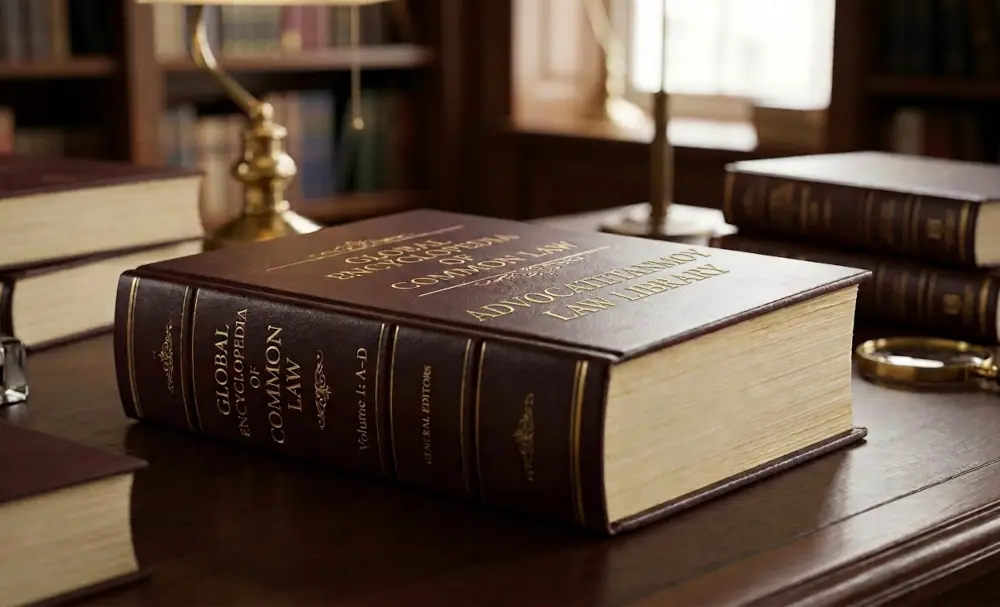
Global Common Law Encyclopedia: 10 Volumes on History, Doctrine, and Global Development
The Global Encyclopedia of Common Law promises a worldwide map of the Common Law legal civilization, from the medieval English court to the contemporary global judicial network, and ultimately to computational and AI-assisted law.
The Sarvarthapedia Thesis
Common Law is a continuously evolving legal civilization in which custom, judicial decisions, precedent, institutional memory, legal reasoning, legislation, equity, procedure and remedies interact across generations and jurisdictions.
The encyclopedia would ultimately investigate a larger question:
How can a legal tradition originating in particular historical institutions become a worldwide system of legal reasoning without becoming identical in every jurisdiction?
The answer lies in the structure of Common Law itself.
Common Law does not travel merely as rules.
It travels through:
Courts → Judges → Cases → Precedents → Legal Professionals → Institutions → Reception → Adaptation → New Precedents
Therefore:
English Common Law
↓
Colonial Reception
↓
Local Courts
↓
Local Legislation
↓
Local Judicial Interpretation
↓
National Common Law
↓
Comparative Judicial Dialogue
↓
Global Common-Law Network
This is why the word “Global” matters in the title.
The encyclopedia would not say that Indian, American, Australian, Canadian, African, or Asian Common Law is simply a copy of English law. Instead, it would document the historical relationship between inheritance and transformation.
Sarvarthapedia Civilizational Legal Knowledge System
10 Volumes · 1,200 Chapters
VOLUME I — ORIGINS AND HISTORICAL FORMATION OF COMMON LAW
The Birth of a Judicial Civilization
From Anglo-Saxon custom and Norman royal justice to the emergence of the King’s Courts, writ system, jury, forms of action, Year Books, Inns of Court, Magna Carta, Parliament, Chancery and the mature doctrine of precedent.
VOLUME II — SOURCES, PRECEDENT AND COMMON-LAW REASONING
The Architecture of Judicial Knowledge
The intellectual machinery of Common Law: precedent, ratio decidendi, obiter dicta, distinguishing, overruling, analogy, interpretation, legal principles, judicial discretion, legal fictions, stare decisis, judicial reasoning and the philosophy of adjudication.
VOLUME III — PERSONS, PROPERTY, POSSESSION AND OWNERSHIP
The Legal Architecture of Person and Property
Legal personality, capacity, possession, ownership, title, land, estates, lease, easement, mortgage, security, bailment, goods, intangible property, intellectual property and emerging digital property.
VOLUME IV — CONTRACT AND COMMERCIAL OBLIGATION
Promise, Exchange and Voluntary Obligation
Offer, acceptance, consideration, contractual intention, terms, interpretation, breach, frustration, damages, specific performance, restitution, agency, sale of goods, banking, insurance, commercial contracts, electronic contracts and transnational commerce.
VOLUME V — TORT AND CIVIL WRONGS
Injury, Responsibility and Compensation
Negligence, duty of care, causation, remoteness, trespass, nuisance, defamation, conversion, economic torts, professional liability, product liability, vicarious liability, privacy, environmental harm and emerging civil wrongs.
VOLUME VI — CRIMINAL LAW AND CRIMINAL RESPONSIBILITY
Crime, State Power and Individual Responsibility
Actus reus, mens rea, homicide, offences against persons and property, fraud, conspiracy, complicity, corporate crime, defences, criminal procedure, sentencing and the historical transition from common-law crimes to statutory criminal law.
VOLUME VII — EQUITY, TRUSTS AND FIDUCIARY LAW
The Law of Conscience
The history of Chancery, Equity, equitable maxims, injunctions, specific performance, rescission, trusts, trustees, beneficiaries, fiduciary duties, constructive trusts, proprietary estoppel, undue influence and equitable remedies.
VOLUME VIII — CONSTITUTIONAL AND ADMINISTRATIVE COMMON LAW
Law, State Power and Constitutional Order
Rule of law, parliamentary sovereignty, separation of powers, prerogative, executive authority, judicial review, natural justice, procedural fairness, legitimate expectation, proportionality, constitutional rights, habeas corpus and public-law remedies.
VOLUME IX — EVIDENCE, PROCEDURE, COURTS AND REMEDIES
The Machinery of Justice
Jurisdiction, pleadings, parties, limitation, discovery, disclosure, witnesses, evidence, hearsay, privilege, expert evidence, judgment, appeal, review, execution, enforcement, costs, contempt, arbitration, mediation and access to justice.
VOLUME X — GLOBAL COMMON LAW AND THE FUTURE OF LEGAL CIVILIZATION
From English Courts to a Global Legal System
The 10-Volume Knowledge Architecture
The complete Sarvarthapedia system therefore becomes:
| Volume | Core Domain | Central Question |
|---|---|---|
| I | Origins | Where did Common Law come from? |
| II | Reasoning | How does Common Law think? |
| III | Persons & Property | Who owns, possesses and controls what? |
| IV | Contract | How do promises become obligations? |
| V | Tort | Who bears responsibility for civil injury? |
| VI | Crime | When does the State punish conduct? |
| VII | Equity & Trust | How does law correct rigidity and protect conscience? |
| VIII | Constitution & Administration | How is State power legally controlled? |
| IX | Procedure & Evidence | How does a legal claim become an enforceable judgment? |
| X | Global Common Law | How did Common Law become a global legal civilization? |
Global Common Law Knowledge Graph
The entire 10-volume encyclopedia can ultimately be connected as:
HISTORY
↕
COURTS
↕
PRECEDENT
↕
REASONING
↕
DOCTRINE
↕
RIGHTS & DUTIES
↕
LIABILITY
↕
REMEDIES
↕
ENFORCEMENT
↕
NEW CASES
↕
NEW PRECEDENTS
Across jurisdictions:
England ↔ United States ↔ Canada ↔ Australia ↔ New Zealand ↔ India ↔ Pakistan ↔ Bangladesh ↔ Sri Lanka ↔ Singapore ↔ Malaysia ↔ Hong Kong ↔ Africa ↔ Caribbean ↔ Pacific
And across legal civilizations:
Common Law ↔ Civil Law ↔ Roman Law ↔ Hindu Law ↔ Islamic Law ↔ Customary Law ↔ Indigenous Law ↔ International Law