The discussion highlights the complexities and challenges faced by political alliances, particularly the tensions between the Congress...
Bharatiya Janata Part
The Bharatiya Janata Party (BJP) was formally established in 1980 following the collapse of the Janata Party, a coalition that had briefly united diverse political groups after the Emergency. When ideological disputes—particularly over the role of the former Bharatiya Jana Sangh members—intensified, leaders such as Atal Bihari Vajpayee and L. K. Advani regrouped to form a new party rooted in nationalist thought but committed to democratic pluralism. From the outset, the BJP positioned itself as a force advocating cultural nationalism, economic self-reliance, and governance free from corruption.The Bharatiya Janata Party (BJP) was founded on 6 April 1980, following the collapse of the Janata Party, whose internal disagreements—particularly regarding members of the former Bharatiya Jana Sangh—made continued unity impossible. The BJP’s early ideological framework was described as “Gandhian Socialism,” but by the late 1980s the party had repositioned itself around cultural nationalism, economic reform, and national security. A major political turning point came with the Ram Mandir movement, centered on the site later developed into the Ram Mandir, which significantly expanded the BJP’s mass support between 1989–1992. Parallel to this, the party adopted a strong position on Kashmir, advocating the integration of the region through the removal of Article 370—an objective eventually implemented by a BJP-led government in 2019. The BJP first formed a short-lived central government in May 1996, gained stability through coalition governments from 1998–2004, and achieved a decisive majority in 2014, followed by a larger mandate in 2019. Its politics has since combined organizational expansion, welfare and economic reforms, assertive security policy, and long-term ideological commitments—including its positions on Ayodhya and Kashmir—solidifying the party as a dominant force in contemporary Indian politics. The BJP occationally play with Hindutva idea.

In a 1977 speech, Atal Bihari Vajpayee clearly outlined India's Middle East policy, asserting support for Israel's...

The 1967 General Elections were pivotal in reshaping Indian politics, marking a decline in Congress's dominance, which...

The BJP on Monday appointed 45-year-old Bihar minister Nitin Nabin as its new national working president, making...

The 2024 General Elections in India saw the Bharatiya Janata Party (BJP) winning the majority in the...

I am very happy to share that Shri LK Advani Ji will be conferred the Bharat Ratna....
I am asked to present my thoughts on the subject of "Integral Humanism" in a series of...

A fresh constructive and creative impulse, therefore, needs to be imparted to Hinduism so that it can...
As a confident India rises on the strength of its own and with the resolve to realise...

Prof. Haripada Bharati, also known as "Master Mosai," was an influential figure in West Bengal politics. He...
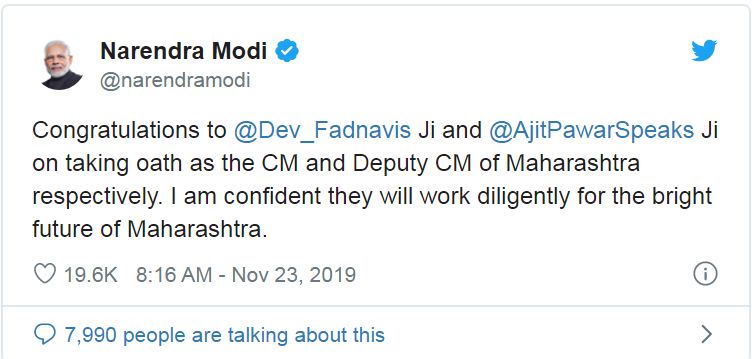
The BJP staked claim to form the government on Saturday morning after which the governor Bhagat Singh...

Maharashtra BJP Election manifesto 2019, released on October 15 said the party will ask the NDA government...